DRIFT AUDIO
Listen to this story
Choose a voice, then press play.
a chic
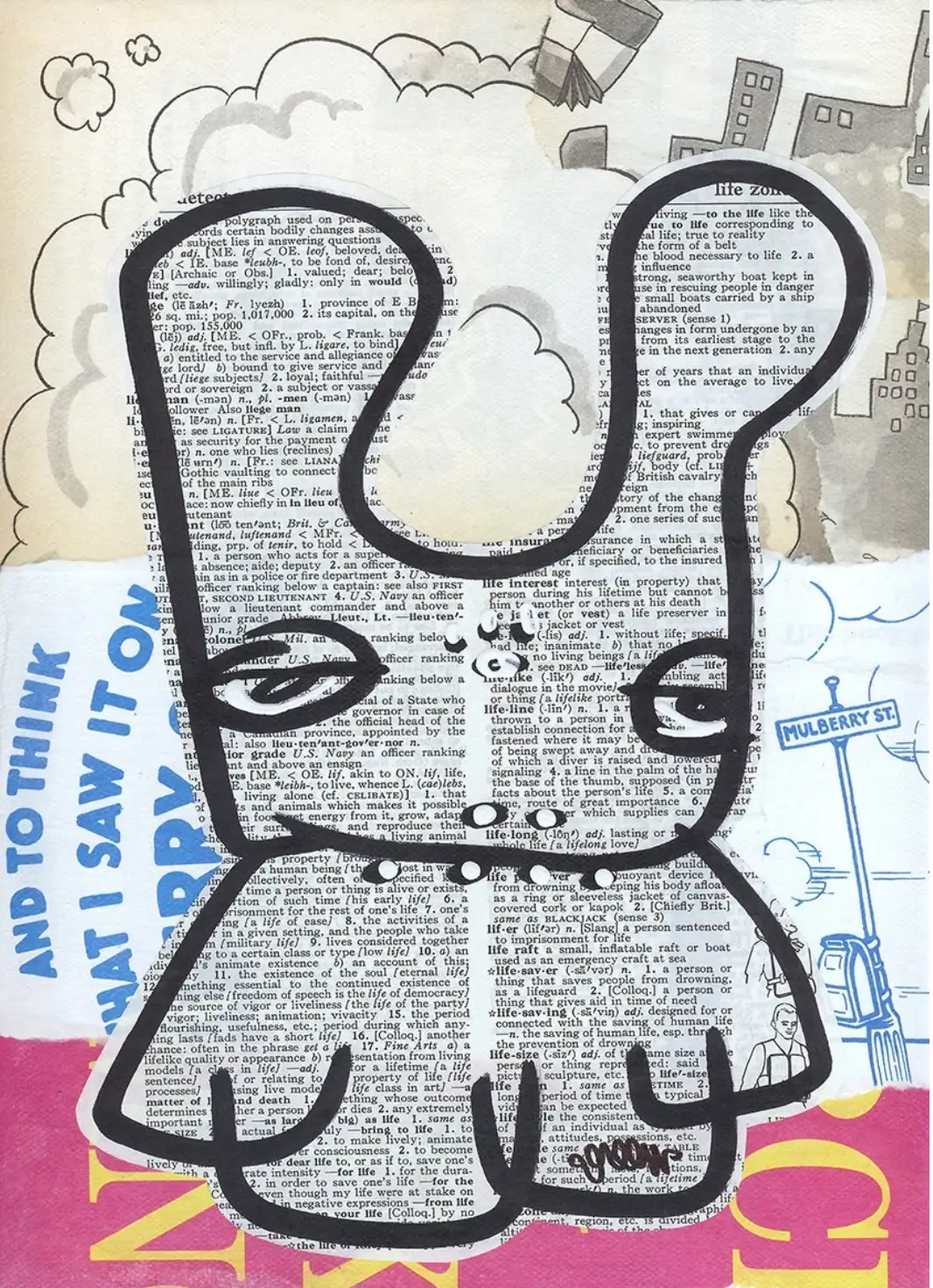
Charlie Green’s Crusty Mullberry Bunny (2015) does not introduce itself gently. Even before the surface is read, before the materials are traced, the title positions the work in a state of tension. It is not simply descriptive—it is atmospheric, almost resistant. The piece exists within an intimate scale, the kind that typically invites quiet observation. But what Green constructs within that space is anything but quiet. The work compresses gesture, material friction, and view instability into a compact field that refuses to settle.
idea
“Crusty Mullberry Bunny” reads less like a name and more like a diagnosis. Each word carries weight, and together they produce a friction that mirrors the view language of the piece. “Crusty” introduces texture immediately—something dried, hardened, perhaps neglected. It implies a temporal dimension, a before and after, even if that narrative is never explicitly shown. “Mullberry,” with its slightly unstable spelling, destabilizes the pastoral softness typically associated with “mulberry.” It introduces a subtle dissonance, a sense that something is not entirely aligned.
Then there is “Bunny.” The word arrives with a cultural density that is difficult to ignore. It carries associations of childhood, softness, comfort, repetition. It is one of those forms that exists almost pre-loaded in the viewer’s mind. Green’s decision to anchor the work in this figure is not incidental. It provides a point of entry—something recognizable—only to complicate it through material and gesture.
The title does not guide interpretation so much as it sets parameters. It suggests that what is being encountered is not a pristine or idealized form, but something that has undergone change. The bunny is not simply present; it is conditioned—altered by time, by handling, by process. The work operates within that space of alteration.
style
The choice of materials—acrylic, paper, ink, and canvas—is not neutral. Each carries its own history, its own set of expectations, and Green leverages these differences rather than smoothing them out. Acrylic, with its capacity for opacity and boldness, establishes fields that feel immediate, even assertive. It can flatten space, reduce depth, and create a kind of view certainty. Ink, by contrast, is inherently unstable. It bleeds, it hesitates, it records the movement of the hand in a way that resists control.
Paper introduces another layer of fragility. It absorbs, it warps, it exists in tension with the more durable canvas beneath it. The canvas itself, traditionally associated with permanence and structure, becomes less of a stable ground and more of a site where these materials interact—sometimes cooperatively, often not.
What emerges is not a seamless integration but a view layering. You can sense where one material interrupts another, where edges meet without fully merging. This is crucial. The work does not attempt to disguise its construction. Instead, it foregrounds it. The viewer is not presented with a finished image so much as a record of making—a surface that reveals its own process.
View this post on Instagram
show
At the center of the work—or perhaps more accurately, within its shifting field—is the suggestion of a bunny. It is important that the figure does not fully resolve. Recognition is partial, contingent. You might see the outline of ears, the curvature of a head, but these elements do not lock into a stable form. They hover, flicker, recede.
This instability is not a failure of representation; it is the point. By refusing to fully articulate the figure, Green disrupts the ease with which such imagery is typically consumed. The bunny cannot be immediately categorized or dismissed as familiar. It demands attention, not because it is complex in a traditional sense, but because it resists simplification.
There is also a psychological dimension to this partial visibility. The viewer becomes aware of their own impulse to complete the image, to stabilize it. In that moment, the work shifts from being an object to be viewed to a space of interaction. The act of looking becomes active, even slightly uncomfortable. You are not just observing; you are negotiating.
flow
The notion of “crustiness” embedded in the title finds its counterpart in the surface of the work. There is a sense that the materials have been applied, reworked, perhaps even distressed. The texture is not decorative; it feels consequential. It suggests handling, repetition, time.
This tactile quality is central to the work’s impression. In a cultural moment where images are often consumed digitally—flattened, smoothed, optimized—Green’s surface resists that mode of engagement. It insists on physicality. You can almost feel the unevenness, the raised areas of acrylic, the absorbed ink. The work does not translate easily into a purely saw experience; it retains a material presence that exceeds reproduction.
There is also an element of abrasion in the surface. It does not feel precious or protected. It feels exposed, as though it has been subjected to a process that leaves marks rather than erases them. This aligns with the broader conceptual framework of the piece. The bunny is not preserved in an ideal state; it is altered, perhaps even worn.
stir
It would be easy to position Crusty Mullberry Bunny within a narrative of nostalgia disrupted. The use of a childhood-associated figure, combined with a distressed aesthetic, lends itself to that reading. But such an interpretation risks flattening the work’s complexity. Green is not simply critiquing nostalgia or exposing its fragility. The approach is more nuanced.
The work does not present the bunny as something lost or corrupted. Instead, it presents it as something that continues to exist, but in a transformed state. The softness associated with the figure is not entirely erased; it is complicated. It coexists with hardness, with texture, with ambiguity. The work acknowledges the persistence of these forms in cultural memory while refusing to let them remain static.
This approach aligns with a broader shift in contemporary practice, where artists engage with familiar imagery not to reject it, but to reconfigure it. The goal is not to dismantle recognition entirely, but to destabilize it—to create a space where meaning is not fixed, but in flux.
compare
The scale of the work plays a crucial role in how it is experienced. At 9 x 12 inches, it requires proximity. You cannot engage with it from a distance and expect to grasp its nuances. This closeness changes the dynamic between viewer and work. It creates a more personal encounter, one that feels less mediated.
In this proximity, the details of the surface become more pronounced. The interplay between materials, the subtle shifts in color, the irregularities in texture—all of these elements reveal themselves gradually.
extent
There is a temporal dimension embedded not just in the title, but in the materials themselves. Acrylic, ink, paper, and canvas each age differently. They respond to environmental conditions, to light, to handling. Even if these changes are not immediately visible, they are implied. The work is not static; it exists within a continuum of change.
“Crusty” suggests a process that has already occurred—a transformation from something fluid to something fixed. But the materials resist complete fixity. They continue to shift, however subtly. This tension between stasis and change is part of the work’s conceptual framework. It exists in a moment, but it also points beyond that moment.\
fin
Ultimately, Crusty Mullberry Bunny resists closure. It does not offer a definitive interpretation or a singular reading. Instead, it leaves the viewer with a set of impressions—textural, visual, conceptual—that continue to shift after the encounter ends. This lingering quality is one of its most significant achievements.
Charlie Green’s Crusty Mullberry Bunny does not seek to impress in obvious ways. It does not declare itself loudly. Instead, it insists—through texture, through instability, through the quiet persistence of its materials. It is a work that rewards patience, that resists simplification, and that ultimately expands far beyond its modest dimensions.
Related Articles
Modigliani’s Limestone ‘Tête’
Carved from a single block of limestone in Montparnasse more than a century ago, one of Modigliani's rare stone heads goes to auction for the first time…