DRIFT AUDIO
Listen to this story
Choose a voice, then press play.
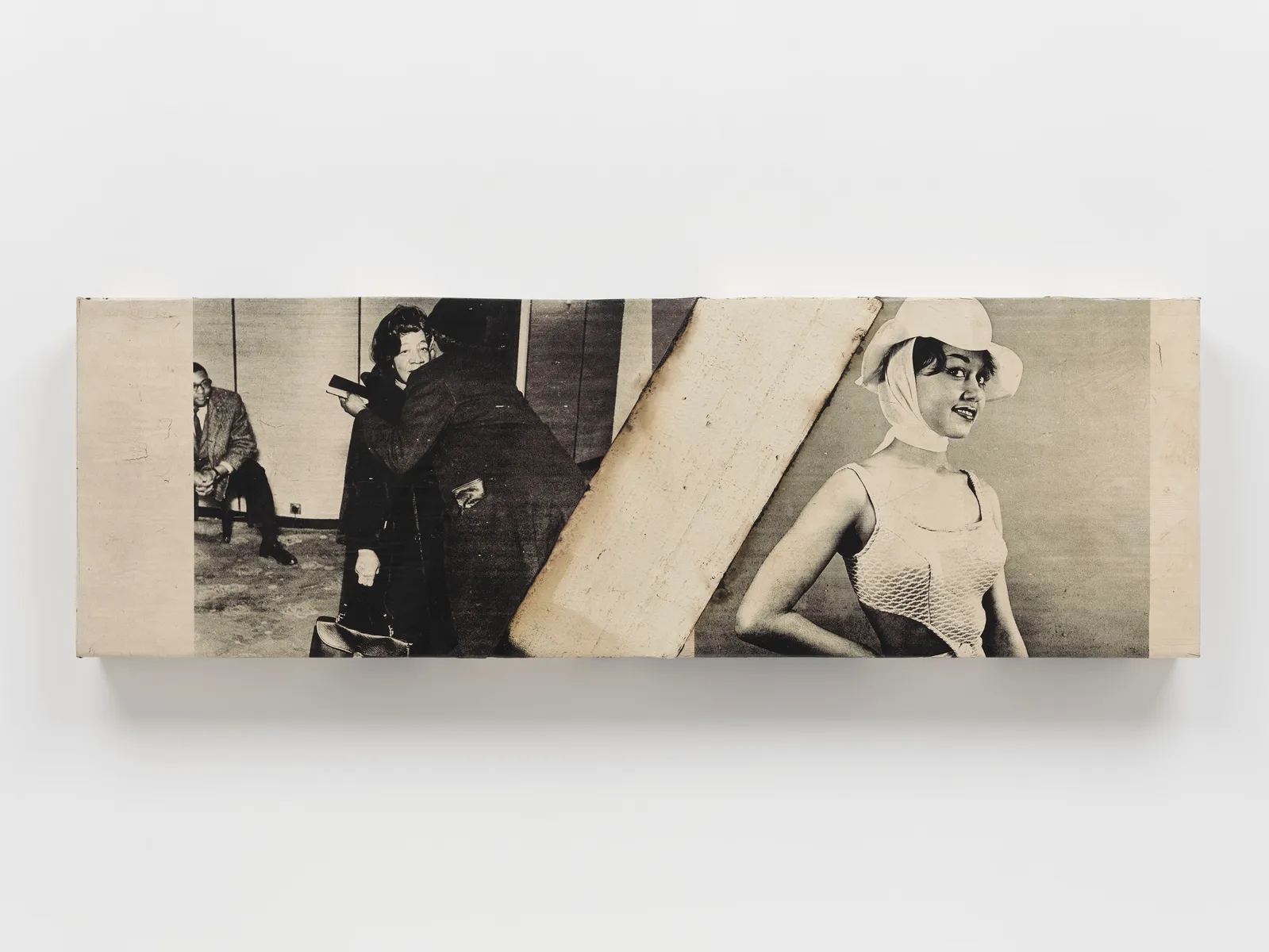
There is a particular density to the work of Theaster Gates—not simply visual, but historical, social, and material. In She Never Leaves Her Purse (2025), that density becomes tactile, almost architectural. Composed of industrial oil-based enamel, rubber torch-down roofing material, bitumen, and steel, the work resists the conventions of painting even as it inhabits them. It is less an image than a constructed surface, less a composition than a site—one that holds within it the weight of labor, infrastructure, and Black spatial history.
Gates has long operated at the intersection of art, urbanism, and cultural reclamation. This piece continues that trajectory, not as a departure but as a distillation. It is a painting that carries the logic of a building, the residue of a neighborhood, and the memory of systems that have historically shaped—and constrained—Black life in America.
archive
At first encounter, She Never Leaves Her Purse presents itself as an abstraction. Dark, viscous surfaces dominate the composition, punctuated by subtle shifts in texture and sheen. But Gates’s materials are never neutral. Bitumen, a petroleum derivative commonly used in roofing and roadwork, carries with it associations of protection, containment, and labor. Rubber torch-down—used to seal surfaces against the elements—introduces a sense of permanence, but also of repair.
These are not the materials of traditional painting. They are the materials of maintenance, of survival, of the built environment. By bringing them into the gallery, Gates collapses distinctions between fine art and manual labor, between aesthetic object and infrastructural necessity.
The enamel, meanwhile, acts as both binder and disruptor. Its industrial sheen reflects light unevenly, creating a surface that shifts depending on the viewer’s position. This instability is key. The work refuses to settle into a single reading, instead offering a constantly changing interplay between opacity and reflection.
In this way, the painting becomes an archive—not of images, but of processes. Each layer suggests an action: pouring, sealing, welding, covering. The surface is not simply seen; it is read, as one might read the stratigraphy of a city wall or the patched roof of a long-inhabited home.
idea
Despite the weight of its materials, She Never Leaves Her Purse is marked by a notable restraint. There is no overt dramatization, no excessive layering for its own sake. Gates’s gestures are deliberate, measured. The composition holds itself together through tension rather than excess.
This restraint is significant. In a contemporary art landscape often driven by spectacle, Gates’s work insists on a different mode of engagement—one that is slower, more attentive, more attuned to nuance.
The title itself introduces a narrative dimension, but one that remains oblique. She Never Leaves Her Purse suggests presence, continuity, perhaps even vigilance. The purse becomes a symbol—of identity, of value, of what is carried and protected. Yet Gates resists illustrating this idea directly. Instead, the title hovers over the work, inflecting its interpretation without resolving it.
This refusal of literal representation aligns with Gates’s broader approach. He is less interested in depicting Black experience than in creating conditions through which it can be understood—materially, spatially, and historically.
straddle
One of the most compelling aspects of She Never Leaves Her Purse is its ambiguous status. While categorized as a painting, the work pushes against the boundaries of the medium. The inclusion of steel elements introduces a sculptural dimension, while the thickness of the materials creates a relief-like surface.
This hybridity is central to Gates’s practice. Trained in urban planning as well as ceramics, he approaches art-making as a form of construction. His works are assembled rather than painted, built rather than depicted.
In this sense, the canvas becomes a site—a place where materials interact, accumulate, and transform. The viewer is not simply looking at an image, but encountering an object that occupies space, that has weight, that asserts its presence.
This shift has important implications. It challenges the traditional hierarchy between painting and sculpture, but also between art and architecture. Gates’s work exists in the space between these categories, drawing from each while belonging fully to none.
culture
Over the past decade, Gates has emerged as one of the most influential figures in contemporary art. His works are held in major collections, including the Museum of Modern Art, the Whitney Museum of American Art, and the Tate. This institutional recognition reflects not only the aesthetic power of his work, but its broader cultural significance.
Gates’s practice extends beyond the gallery. Through the Rebuild Foundation, he has spearheaded initiatives aimed at revitalizing neighborhoods on Chicago’s South Side, transforming abandoned buildings into cultural spaces. This work blurs the line between art and activism, positioning cultural production as a tool for social change.
She Never Leaves Her Purse can be understood within this expanded framework. It is not merely an object to be viewed, but part of a larger ecosystem of ideas and actions. It reflects Gates’s ongoing commitment to reimagining the relationship between art, community, and space.
sum
What ultimately defines She Never Leaves Her Purse is its quiet insistence. It does not demand attention through spectacle or scale. Instead, it draws the viewer in through material complexity and conceptual depth.
The work asks us to look closely—to attend to surfaces, to consider materials, to think about the histories embedded within them. It asks us to recognize that what might appear as abstraction is, in fact, deeply rooted in lived experience.
In this way, Gates redefines what painting can be. He transforms it from a medium of representation into a site of engagement, a place where material, history, and identity converge.
The result is a work that lingers—not because it resolves its questions, but because it refuses to. She Never Leaves Her Purse remains open, dynamic, and unresolved, much like the histories it invokes. It is a painting that carries weight, not only in its materials, but in its meaning.
n
From the DRIFT archive: Eric Stefanski and the Art of Selective Living: A 2025 Confession Painted in Plain Sight · Julie Mehretu’s Architectural Chaos: Mapping Memory Through Abstraction