DRIFT AUDIO
Listen to this story
Choose a voice, then press play.
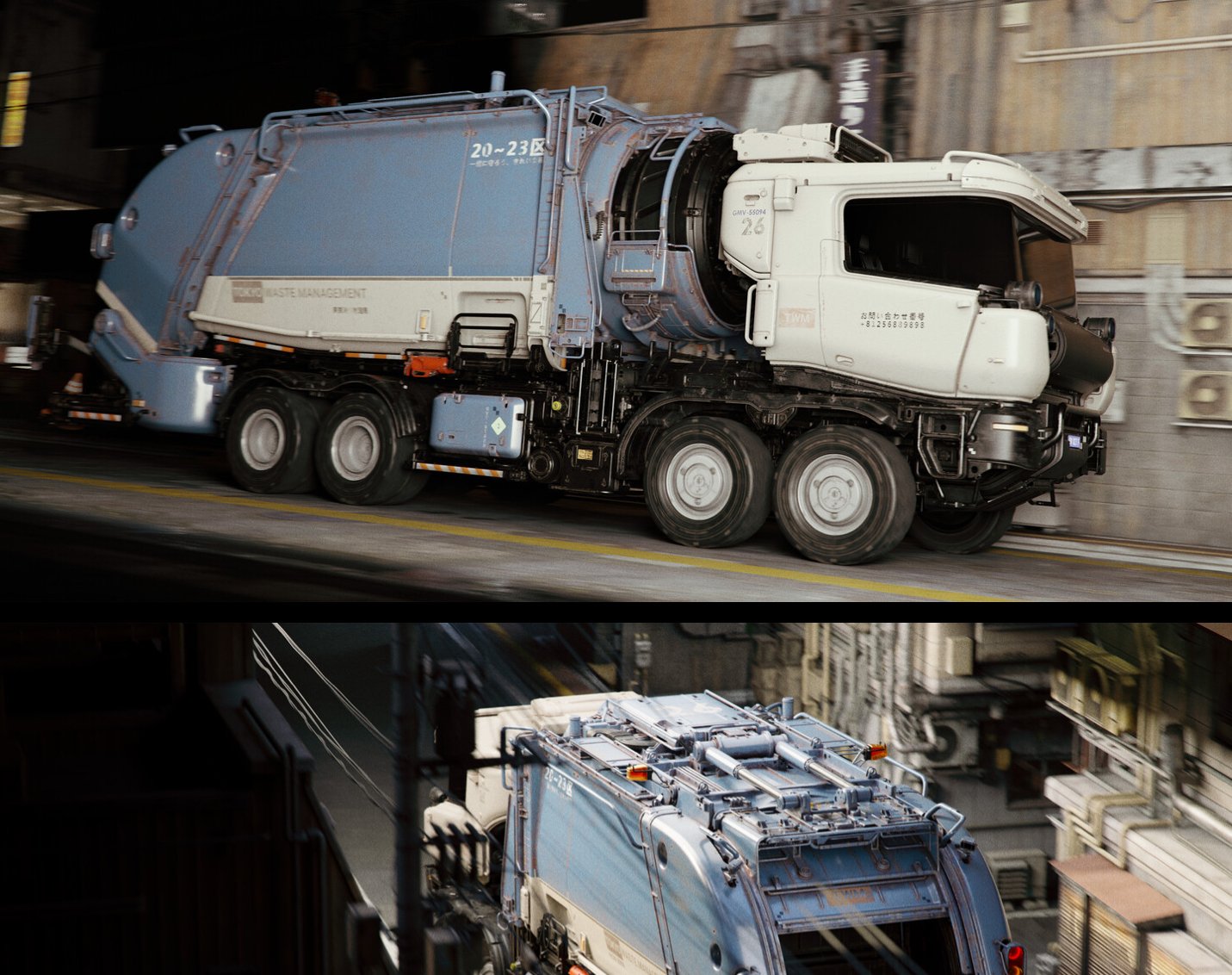
In the landscape of global urban evolution, few cities exemplify controlled chaos and infrastructural discipline quite like Tokyo. Beneath the neon skyline and deep subway veins lies a lesser-seen network—an intricate ballet of trucks, tunnels, and transfer stations that keep one of the world’s most populous cities remarkably clean. As Tokyo’s metropolitan sprawl pushes outward, and megablock districts emerge with machine-like precision, a new force has entered this invisible choreography: Twm-vector, the city’s next-generation waste management fleet.
These aren’t ordinary garbage trucks. They are intelligent systems on wheels—designed not only to collect waste but to contribute to the data ecology of the modern city. Developed in response to Tokyo’s expanding environmental needs, Twm-vector vehicles represent a new philosophy in urban maintenance: that sustainability is not an add-on, but a built-in, deeply embedded function of civic life.
a quiet revolution on wheels
The Twm-vector—short for Tokyo Waste Management – Vectorized Environmental Collection and Transport Optimization—was born from a fundamental question: how do you future-proof a city’s waste system for 50 million people? The answer, it turns out, isn’t simply “bigger trucks.” It’s smarter, quieter, cleaner, and more modular fleets integrated into the design of the urban fabric itself.
Launched in early pilot phases across select megablock districts such as Toyosu, Minami-Kawasaki, and the Smart Adachi-North redevelopment, these vehicles are the culmination of a three-year initiative between the Tokyo Metropolitan Government, infrastructure developer Tōkyō Kōgyō, and robotics manufacturer Nōtō Heavy Systems. Each truck blends electric drive systems, AI-assisted routing, modular interiors for on-the-fly sorting, and real-time environmental tracking.
These are not just machines for transporting garbage. They are mobile nodes in a city-wide network of environmental sensors—mapping waste, air quality, noise, and human behavior as they move through the veins of Tokyo’s living organism.
the megablock challenge: scaling urban efficiency
Tokyo’s approach to urban growth over the past decade has relied heavily on the megablock model: planned zones spanning 2 to 5 square kilometers, featuring vertically integrated towers that house residences, offices, and amenities in stacked configurations. Each megablock operates semi-autonomously, with internal logistics networks including underground tunnels, robotic delivery systems, and pneumatic waste chutes.
The megablock is efficient in form, but it presented a logistical puzzle: while internal waste transport was contained, external disposal remained bottlenecked. Enter Twm-vector, a system explicitly built to service these high-density nodes with minimal surface disruption. Their large-capacity, multi-chamber design allows for differentiated waste collection in a single pass—household refuse, plastics, compostables, and rare recyclables each stored in their own regulated compartments.
The trucks are wider, but pivot more tightly. They’re heavier, but glide with near-silent torque. Built to operate during nighttime hours without breaching Tokyo’s strict noise ordinances, they can run routes while residents sleep, leaving the city refreshed by sunrise.
inside the Twm-vector: design for adaptability
The brilliance of Twm-vector lies not in any single innovation, but in the seamless interlocking of many. These vehicles are a masterclass in integrated industrial design. Key features include:
- full-electric powertrains: Charged by Tokyo’s expanding grid of renewable energy stations, the Twm-vectors emit zero tailpipe emissions, and their regenerative braking recharges power during deceleration.
- compartmentalized storage: Designed with movable internal panels, the truck can reconfigure its space mid-route based on collected volumes. For example, if food waste volumes spike during a festival week, more internal volume can be allocated dynamically.
- noise-reduction hydraulics: Traditional garbage trucks operate above 85 decibels during loading. Twm-vector’s lift arms, internal compactors, and axle movement have been engineered to produce under 50 decibels—quieter than a normal conversation.
- data integration module: Each truck transmits geotagged data on waste weight, composition, contamination, and route anomalies to the Tokyo Environmental Data Grid (TEDG), helping planners adjust schedules, educate citizens, and fine-tune recycling incentives.
This is a truck that sees the city not as terrain to conquer, but as an ecosystem to harmonize with.
a civic interface, not just a service
Where the Twm-vector truly breaks from precedent is in its visual and emotional design. Rather than camouflaging the trucks or minimizing their presence, Tokyo has leaned into visibility with purpose. Each vehicle is finished in ward-specific colors—Shibuya blue, Koto green, Minato grey—with LED panels displaying environmental stats in real-time.
Messages like:
“Your ward diverted 28% more recyclables this week.”
“Air quality index: 18 (Excellent).”
“Plastic contamination rate: 6% (Goal: 4%).”
These dynamic displays turn every encounter with a Twm-vector into a brief civic interaction. They ask nothing of citizens, but offer gentle reminders of collective effort and environmental accountability.
In schools, children study simplified schematics of the trucks. Local artists have been commissioned to decorate truck hatches with seasonal motifs. In short: the trucks are becoming cultural citizens of the neighborhoods they serve.
data ecology and predictive maintenance
With each kilometer traveled, the Twm-vector is more than a trash vehicle—it’s an environmental data harvester. Sensors embedded in its chassis and compactor bays collect granular detail on temperature, moisture, noise, vibration, and composition.
Through integration with Tokyo’s TECG (Tokyo Environmental Coordination Grid), the data is used for:
- predictive maintenance: Trucks report early signs of mechanical wear, reducing downtime and repair costs.
- waste trend mapping: Data informs zoning, helps adjust bin placement, and shapes local legislation on packaging materials.
- emissions accounting: Each truck contributes to Tokyo’s real-time carbon offset dashboard, helping the city monitor its progress toward a net-zero 2040 goal.
This level of data feedback turns waste collection into a form of environmental literacy—not only for the government, but for institutions, neighborhoods, and eventually individuals.
challenges, adoption, and iterative design
No system of this complexity launches without friction. Early prototypes faced route clearance issues in older neighborhoods with narrow alleyways, prompting a scaled-down sibling vehicle—Twm-mini—to be introduced for Tokyo’s Edo-era quarters.
Some residents were skeptical of the real-time feedback panels, viewing them as intrusive or overly performative. But over time, trust built through transparency. In fact, participation in municipal recycling programs increased by 23% in pilot zones after Twm-vector deployment.
The program’s financial footprint is substantial: each Twm-vector unit costs approximately ¥95 million, and the first wave included 150 trucks. Yet lifetime cost savings, lower maintenance burdens, and decreased landfill fees have already begun to balance the equation.
exporting the model: Tokyo as template
With its success in Tokyo, the Twm-vector model has drawn international interest. Delegations from Seoul, Copenhagen, Singapore, and São Paulo have studied the program with plans to pilot similar systems. Tokyo’s forthcoming Green Logistics 2026 white paper will codify the design philosophy, providing open-access guidelines for adaptable urban waste systems.
The trucks themselves are modular enough to be licensed abroad, with current talks underway for manufacturing partnerships in Scandinavia and Southeast Asia.
waste as an emotional material
Perhaps what the Twm-vector captures best is that waste, for all its stigma, is an emotional material. It tells the story of consumption, aspiration, neglect, and possibility. In the act of collecting it thoughtfully—of acknowledging its origins, its sorting, its destination—we make peace with the parts of modern life we’d rather not see.
Twm-vector doesn’t just clean Tokyo. It rehumanizes waste. It gives it a route, a shape, a logic—and by doing so, invites us to rethink our role not just as consumers, but as custodians.
epilogue: the city that thinks before it throws
In the early hours of dawn, when most of Tokyo still slumbers, the Twm-vectors whisper down arterial streets and through neon back lanes. They do not honk. They do not shout. They glide—sensors blinking, arms folding, compartments sealing—and they do their work with dignity.
Each load they collect is more than refuse. It is a vote for order. A pledge of care. A fragment of civic discipline.
In a world that often builds without thinking of the aftermath, Tokyo has done something quietly radical: it has designed its waste system not as a response, but as a prelude—an opening note in the ongoing symphony of sustainable urban life.
Related Articles
Garage Italia’s Electric Spiaggina Puts the Fiat 500’s Riviera Years on Battery Power
Ten kilowatts, rattan seats and a €85,000 starting price: Garage Italia's 500 Spiaggina rebuilds Ghia's 1958 beach car for the yacht crowd.