DRIFT AUDIO
Listen to this story
Choose a voice, then press play.
Celebrating 60 Years of Iconic Subversion
To mark six decades of the 1460 boot, Dr. Martens has turned to one of fashion’s most formidable forces of introspection and disruption: Yohji Yamamoto. The result is the 1460 YY—a collaboration that doesn’t just update a silhouette but destabilizes its boundaries entirely. This isn’t just a design crossover. It’s a philosophical reworking of one of the most iconic forms in fashion history.
Yamamoto’s boot retains the scaffolding of Dr. Martens’ rebellious DNA, but he rearticulates it through his own design language—dark, asymmetrical, elegant, and uncompromising. The release is limited to 1,960 pairs, a symbolic nod to the year the 1460 was born. Every detail on the boot echoes decades of countercultural history, reframed through Yamamoto’s signature: deconstruction that constructs something new.
The Spiderweb Etching: Subculture as Structure
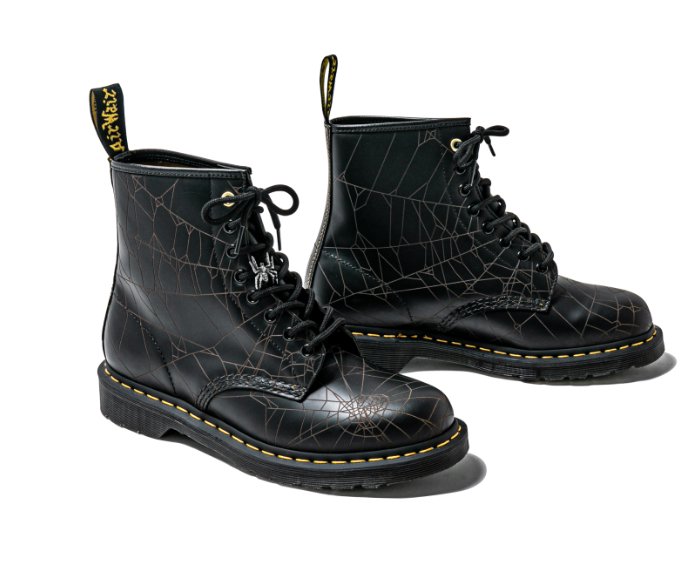
The visual centerpiece of the 1460 YY is a hyper-detailed spiderweb motif etched directly into the leather upper. It’s not painted or printed—it’s laser-burned with surgical precision. The web radiates across the boot’s surface, asymmetrical, distorted, and alive. According to Yamamoto, it represents the tension between cultures, aesthetics, and eras that have claimed the 1460 as their own—from skinheads and punks to grunge and goth subcultures.
It’s a metaphor, but it’s also a material decision. The etching doesn’t compromise durability. Instead, it becomes an integral part of the structure, warping slightly at the heel in reference to Yamamoto’s famous pattern-slashing and asymmetrical drapery techniques. The spiderweb becomes both a design element and a historical map of the very people who gave the boot its edge.
The Anatomy of a Reinvention
The materials and structural decisions behind the 1460 YY reflect a reverence for utility while injecting Yamamoto’s uncompromising precision. The leather upper, sourced from Italian tanneries, is thicker than the standard Dr. Martens boot—1.8mm of full-grain calfskin, with a dry, matte finish that absorbs shadow rather than reflecting light. The spiderweb etching gains tactile depth against this backdrop, more like a scar than a surface graphic.
The sole system fuses Dr. Martens’ classic AirWair bounce with a custom Vibram® compound that’s both 15% lighter and more aggressive underfoot. The translucent outsole is tinted with a smoky gradient, bridging Yamamoto’s dark romanticism with a future-facing utility.
Hardware across the boot—eyelets and speed hooks—is blackened and oxidized to resist tarnish and mimic the patina of vintage metal. Internally, a reinforced heel counter ensures structural support, and a newly engineered micro-suction insole—inspired by the surface of gecko feet—keeps the foot in place, even when worn without socks.
The elongated toe box—three millimeters longer than the original—echoes the line of Yamamoto’s tailored trousers, which taper gradually into shadow. The resulting silhouette isn’t just functional—it’s architectural.
A Cultural Dialogue: From British Workwear to Japanese Conceptualism
What makes this collaboration truly profound isn’t that it updates a beloved silhouette—it’s that it elevates it. The 1460 boot has long been a canvas for protest and identity. Originally designed for postmen and factory workers in 1960s England, the boot soon became the footwear of choice for youth in revolt.
By the late ’70s, it was synonymous with punk—a badge of anti-establishment resistance worn by everyone from The Clash to Siouxsie Sioux. In the ’90s, it found its way onto the stage with Kurt Cobain, battered and split, yet still iconic.
Enter Yohji Yamamoto, a designer who has built an entire career on challenging beauty, perfection, and orthodoxy. Since his explosive debut in Paris in 1981, Yamamoto has sent models down runways in clothes that look like they’re mid-decay, using asymmetry, absence, and blackness as tools of rebellion. His affinity with the 1460 is less about trend and more about shared values: an embrace of the outsider, the nonconformist, the iconoclast.
In past collections, Yamamoto has sent models stomping in Doc-inspired silhouettes, often covered in paint or torn at the seams. But this is the first time his reinterpretation of the original 1460 is official—and meticulously executed.
How to Wear a Philosophy
The 1460 YY isn’t just a collector’s piece. It’s meant to be styled with intent, whether that means walking the back alleys of Shibuya or pacing the tiled floors of a Paris showroom.
For those adhering to Yamamoto’s own visual language, the boots pair effortlessly with deconstructed tailoring or asymmetrical overcoats. Their longer toe and matte finish complement crushed wool trousers or long, draped silhouettes. Layering is key—garments that shift with movement, echoing the shifting lines of the etched web.
On the streetwear side, the boots fit into a more visceral aesthetic: cuffed raw denim, layered graphic tees, technical outerwear, and accessories worn with studied recklessness. Their functionality holds up; their form elevates the look.
Whether you style them like armor or relics, the 1460 YY demands presence. They aren’t boots that blend in. They don’t ask to be fashionable—they ask to be understood.
Exclusivity as Ethos
Only 1,960 pairs of the 1460 YY boots will be released globally—a symbolic gesture linking the original year of the silhouette’s creation to its contemporary reconstruction. Each pair is hand-assembled in Dr. Martens’ Wollaston factory in Northamptonshire, using traditional methods with modern upgrades.
The boots arrive in a matte black archival box screen-printed with a silver spiderweb motif and embossed logos from both brands. Inside, a numbered certificate signed by Yohji Yamamoto authenticates the release and marks its cultural significance.
Retailing at €980 / $1,050, the 1460 YY is more than an investment in materials. It’s a stake in fashion’s subversive past and an invitation into its future.
Where and When
The boots will be available from November 1, 2025, via:
- Yohji Yamamoto flagship stores in Tokyo, Paris, and New York
- Dover Street Market locations
- A limited online raffle hosted on Dr. Martens’ official website
The release will not be restocked. There are no alternate colorways. The 1460 YY is singular—by design.
Impression
Yamamoto’s version of the 1460 doesn’t scream. It resonates. It doesn’t chase trends—it haunts them. In a market where most collaborations are churned out to catch algorithms, this one offers something slower, deeper, and undeniably more personal.
This boot is not nostalgia. It is not a remix. It is a reconstruction, precise and poetic—a reminder that heritage is only meaningful if you’re willing to reshape it.
The spiderweb isn’t decoration. It’s declaration.