Keith Haring’s Untitled (Elephant) Takes Center Stage at Crystal Bridges’ Landmark 3D Exhibition

June 2, 2026
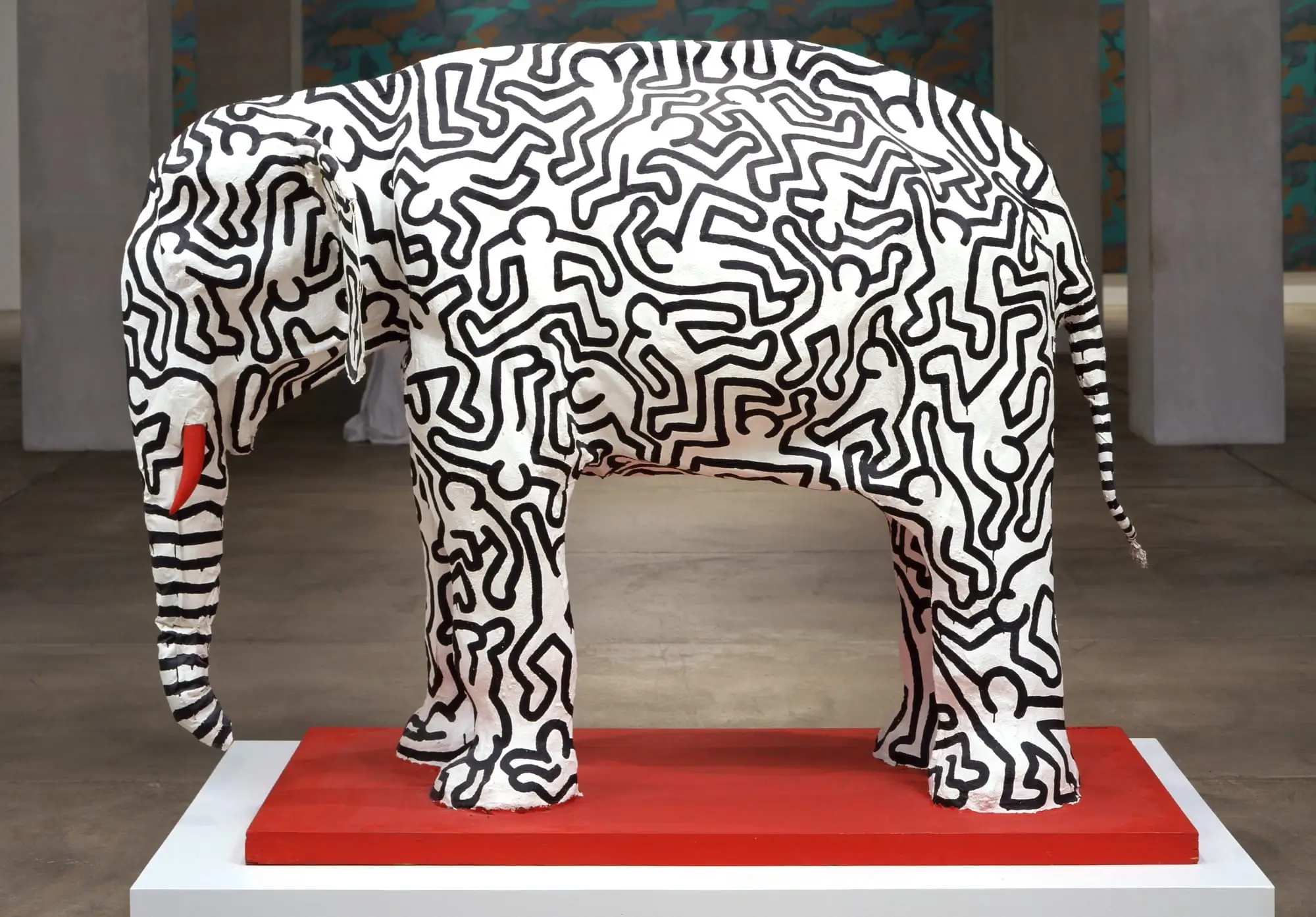
In the vibrant, pulsating mid of 1980s New York, where graffiti met fine art and activism intertwined with nightlife, Keith Haring created works that transcended traditional boundaries. Among his most memorable three-dimensional pieces stands “Untitled (Elephant)” (1985), a monumental acrylic-on-papier-mâché sculpture measuring 64 x 41 x 86 inches. Currently a highlight of the groundbreaking exhibition Keith Haring in 3D at Crystal Bridges Museum of American Art in Bentonville, Arkansas (on view from June 6, 2026, to January 25, 2027), this work embodies Haring’s philosophy that art should be accessible, interactive, and alive.
The sculpture, on loan from The Andy Warhol Museum in Pittsburgh with support from The Andy Warhol Foundation for the Visual Arts, Inc., and © Keith Haring Foundation, captures the essence of Haring’s energetic line work translated into three dimensions. Its bold black outlines on a white base, accented with vibrant colors, feature Haring’s signature motifs: dancing figures, crawling babies, barking dogs, and abstract symbols that pulse with life. All images courtesy of Crystal Bridges of American Art, shared with permission.
stir
Keith Haring (1958–1990) rose to prominence in the early 1980s as part of the downtown New York art scene alongside Jean-Michel Basquiat, Kenny Scharf, and others. His subway chalk drawings first brought him fame, but by the mid-1980s, he was exploring sculpture as a way to bring his two-dimensional “radiant baby” universe into the physical world.
“Untitled (Elephant)” has a particularly fascinating backstory. The papier-mâché base originally belonged to Andy Warhol, who had it as a decorative or studio piece. Warhol, a mentor and friend to Haring, encouraged the younger artist to paint on it. Haring transformed the neutral form into a lively, totemic creature covered in his iconic hieroglyphic language. This collide between two titans of Pop Art underscores the cross-gen dialogue that defined the era.
Created in 1985, the same year Haring debuted steel sculptures at Leo Castelli Gallery and showed paintings at Tony Shafrazi Gallery, the Elephant reflects Haring’s expanding ambitions. Sculptor George Condo and others in his circle pushed him toward three-dimensional work. Tony Shafrazi famously told Haring to “position his alphabet in the landscape, out there in the real world.” Haring wanted his sculptures to be touched, played with, and experienced up close — a radical departure from the “do not touch” ethos of traditional museums.
The choice of an elephant was no accident. Elephants symbolize strength, memory, and wisdom in many cultures, but in Haring’s hands, it becomes joyful and approachable. The massive scale (over seven feet long) commands attention, yet the skittish figures dancing across its surface invite interaction. It’s art as public monument and children’s toy simultaneously.
sig
Haring’s view language — bold black lines, repetition, and energy — was deeply influenced by comic books, hip-hop, breakdancing, and ancient hieroglyphs. In “Untitled (Elephant),” these elements come together in three dimensions. Viewers can walk around the sculpture, discovering new narratives from every angle: a figure climbing the trunk here, a barking dog there, radiant babies symbolizing hope and innocence amid chaos.
The 1980s were a time of profound contradictions — economic boom, the AIDS crisis, nuclear fears, and urban decay. Haring’s work often addressed these issues subtly through symbols. While “Untitled (Elephant)” appears purely coltish, scholars see deeper layers: the elephant as a stand-in for endurance in the face of adversity, the crawling babies as new life and vulnerability, and the overall energy as a celebration of life against the backdrop of mortality (Haring himself would be diagnosed with AIDS in 1988).
Art historian and curator for the Crystal Bridges exhibition, Meredith Palmer, notes that Haring’s sculptures represent a crucial but understudied aspect of his practice. Keith Haring in 3D is the first major exhibition dedicated to this side of his work, featuring not only the Elephant but also totems, masks, painted boomboxes, clothing, and even a customized 1963 Buick.
scope
Haring produced sculptures throughout his career, from small-scale works to large public commissions like the Crack is Wack mural and playground designs. “Untitled (Elephant)” bridges his gallery practice and public art ethos. It was exhibited in various contexts during his lifetime and has since become a beloved piece in the Warhol Museum’s collection.
Unlike his flat paintings, the sculpture invites physical engagement. Haring once said he wanted his art to be “for everyone,” and this piece literally embodies that ideal. Children (and adults) are drawn to its cartoonish charm, while art historians appreciate its technical innovation in translating line into volume.
The papier-mâché medium itself is significant — lightweight yet sturdy, echoing Haring’s democratic, anti-precious approach to materials. He often used everyday or industrial substances: vinyl tarps, steel, even human bodies in his body-painting performances.
three
Keith Haring in 3D, opening alongside Crystal Bridges’ major expansion, represents a milestone. Crystal Bridges, founded by Alice Walton and known for its commitment to American art and accessibility, is the perfect home for this show. The museum’s mission aligns perfectly with Haring’s belief that art belongs to the people.
The exhibition fills multiple galleries with over a hundred works, allowing visitors to move through, around, and sometimes within Haring’s creations. The “Untitled (Elephant)” serves as a centerpiece — imposing yet inviting. Accompanying programming includes family workshops, lectures, and interactive elements where visitors can create their own Haring-inspired works.
A major Phaidon/Monacelli catalogue accompanies the show, featuring new scholarship on Haring’s sculptural practice. This publication helps reposition Haring not just as a pop icon of the 1980s but as a visionary whose ideas about public space, participation, and art-as-activism remain urgently relevant today.
culture
Keith Haring died in 1990 at age 31, but his foundation continues his work through education programs, grants, and HIV/AIDS awareness initiatives. “Untitled (Elephant)” has been reproduced in countless books, postcards, and merchandise — a testament to its enduring appeal.
In today’s context, with renewed interest in public art, street art legitimacy, and social practice, Haring’s sculpture feels prophetic. It prefigures everything from Yayoi Kusama’s immersive installations to Banksy’s play interventions and the rise of experiential art fairs.
extent
Maintaining a large papier-mâché sculpture presents challenges. Conservators at the Warhol Museum have carefully preserved the vibrant acrylic paints while respecting the fragile substrate. In the Crystal Bridges installation, climate control and strategic lighting ensure the piece remains safe while maximizing its visual impact.
Close examination reveals the meticulousness of Haring’s hand: each line is confident and fluid, despite the awkward surface of the three-dimensional form. This translation from 2D to 3D required both technical skill and artistic intuition.
why
In an age of digital overload and screen fatigue, “Untitled (Elephant)” offers something tangible and joyful. It reminds us of art’s power to connect people across generations, backgrounds, and cultures. At Crystal Bridges, nestled in the beautiful Ozark landscape, the sculpture brings urban energy into a natural setting — much like Haring brought street energy into galleries.
Visitors to the exhibition often describe a sense of wonder upon encountering the Elephant. It’s big enough to awe, friendly enough to disarm, and layered enough to reward repeated viewings.
fin
“Untitled (Elephant)” is more than a sculpture — it is a portal into Keith Haring’s world of boundless creativity, social conscience, and unapologetic joy. As the centerpiece of Keith Haring in 3D at Crystal Bridges, it invites a new generation to discover (or rediscover) an artist who believed art could change the world, one radiant line at a time.
From its origins on Andy Warhol’s studio floor to its current home in Arkansas, this elephant has traveled far, carrying Haring’s message with it: Art is for everyone. Touch it. Play with it. Live with it. And most importantly, keep the lines moving.
Related Articles
Jason Limon Rips Open Vintage Packaging to Find a Skeleton Waiting Underneath
San Antonio painter Jason Limon’s latest trompe l’oeil work turns torn matchbooks, tins and biological […]