
DRIFT AUDIO
Listen to this story
Choose a voice, then press play.
There are brands that present watches, and then there is Hermès, which stages them. At Watches and Wonders, where neutrality often governs the visual language—glass vitrines, calibrated lighting, the choreography of discretion—Hermès consistently refuses the expected. It does not simply exhibit; it constructs. Each year, its presence becomes an authored condition, a spatial argument where time is not just measured, but interpreted.
Within that context, the arrival of the Hermès H08 Squelette feels less like a release and more like a continuation of a long-form thesis. When the H08 first appeared in 2021, it repositioned the idea of a contemporary sport watch—not as an instrument of performance, but as a study in proportion, tactility, and quiet urban identity. With the Squelette, that study is pushed further inward. Or outward, depending on how one reads exposure. The watch is no longer a contained object. It is opened, its interior logic revealed, its structure allowed to become surface.
This is not skeletonization as spectacle. It is skeletonization as language.
The Case as Structure
The H08 Squelette begins with its case, though even that term feels insufficient. Traditionally, the case protects, encloses, separates the external from the internal. Here, it operates more like a frame—an architectural boundary that defines space without fully containing it.
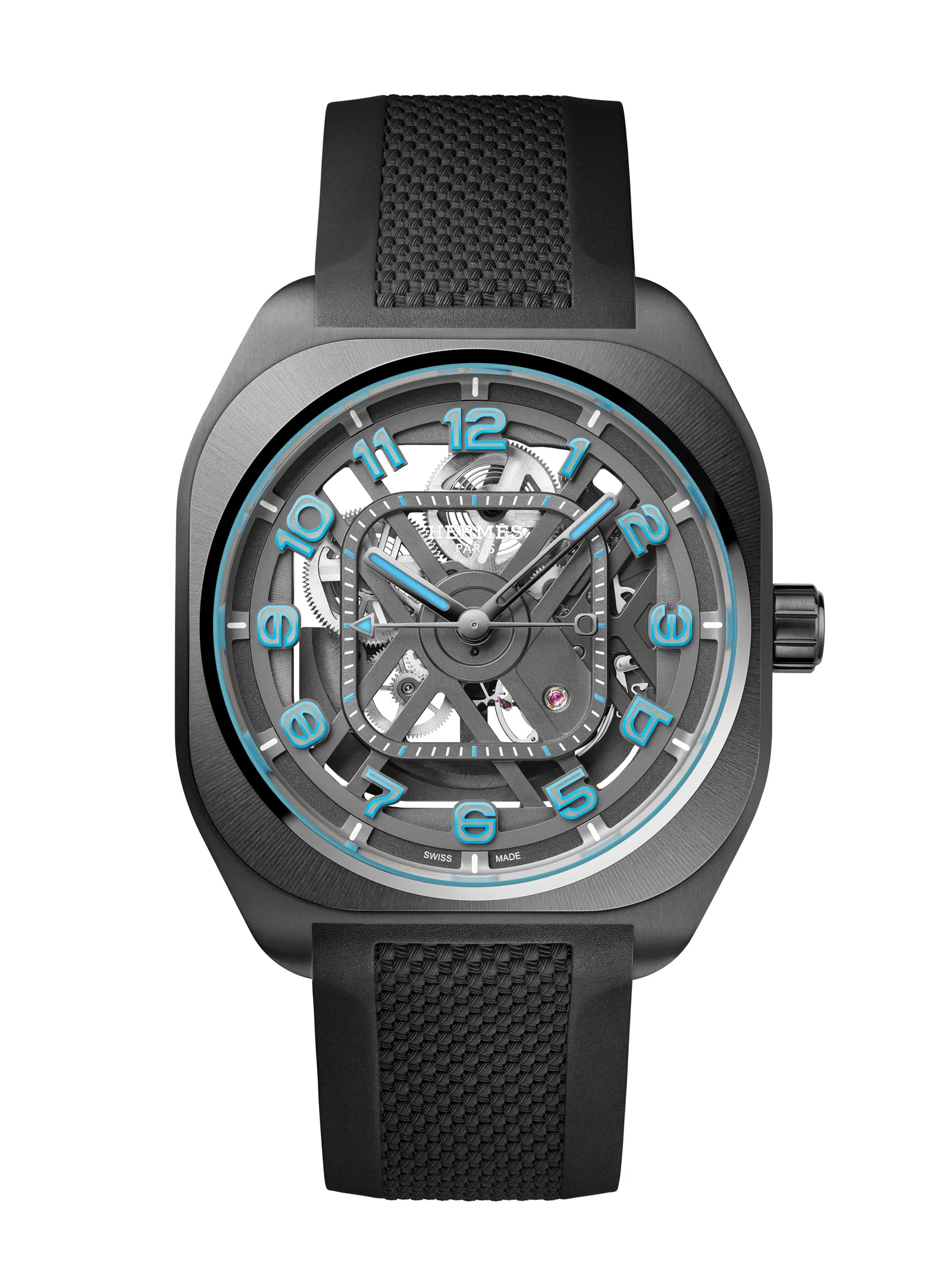
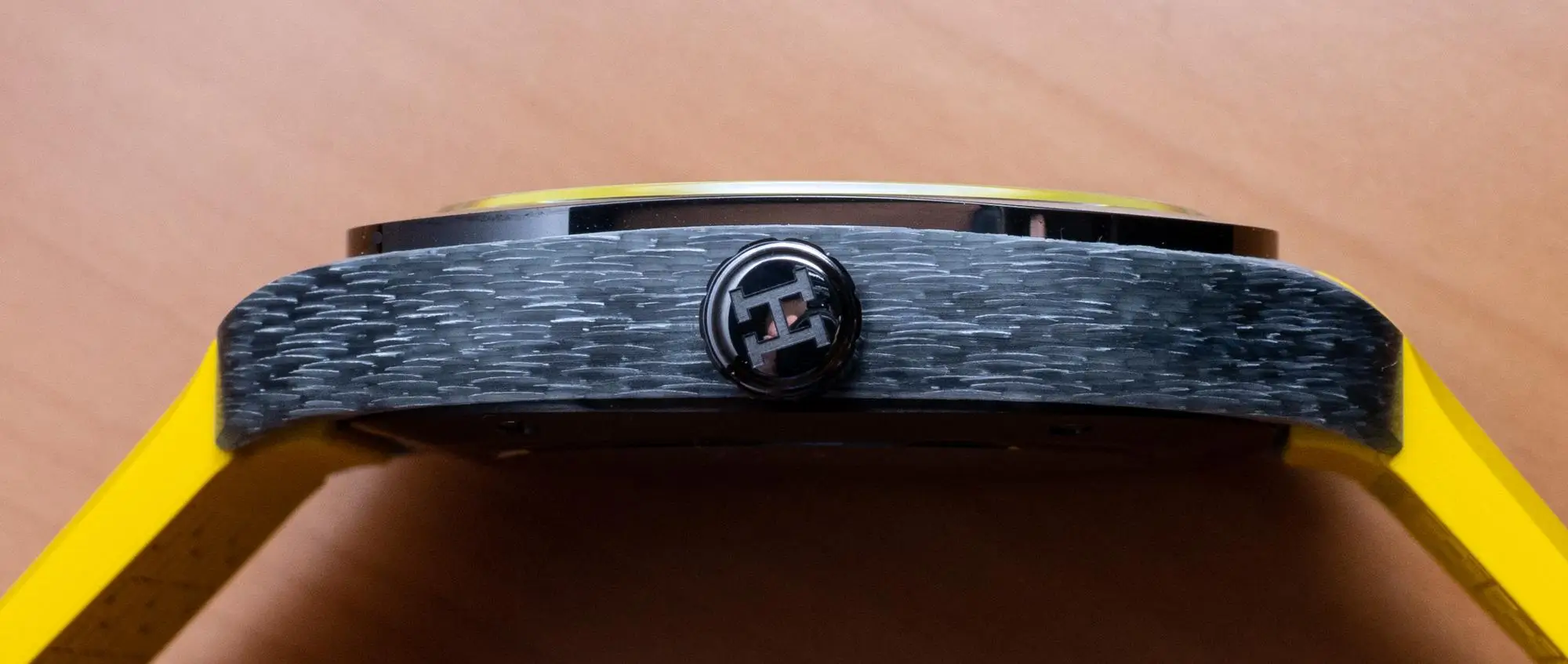
Executed in black PVD-treated titanium, the 39mm structure achieves a particular kind of equilibrium. Titanium brings inherent lightness, but Hermès refines that quality through finish rather than material alone. The matte black surface absorbs light rather than reflecting it, muting the watch’s visual volume while sharpening its outline. It is not designed to catch attention through brilliance; it holds attention through restraint.
The geometry complicates things further. The H08 does not conform to a single recognizable shape. It sits between an octagon and a circle, borrowing tension from both without fully committing to either. This ambiguity is deliberate. It avoids easy categorization, aligning instead with a wearer who moves fluidly between environments, identities, and expectations.
Worn on the wrist, the effect is immediate but understated. The watch does not impose itself. It integrates.
stir
Skeletonization, historically, has often leaned toward ornament—an opportunity to showcase technical prowess through density, layering, and complexity. The Hermès H08 Squelette takes a different approach.
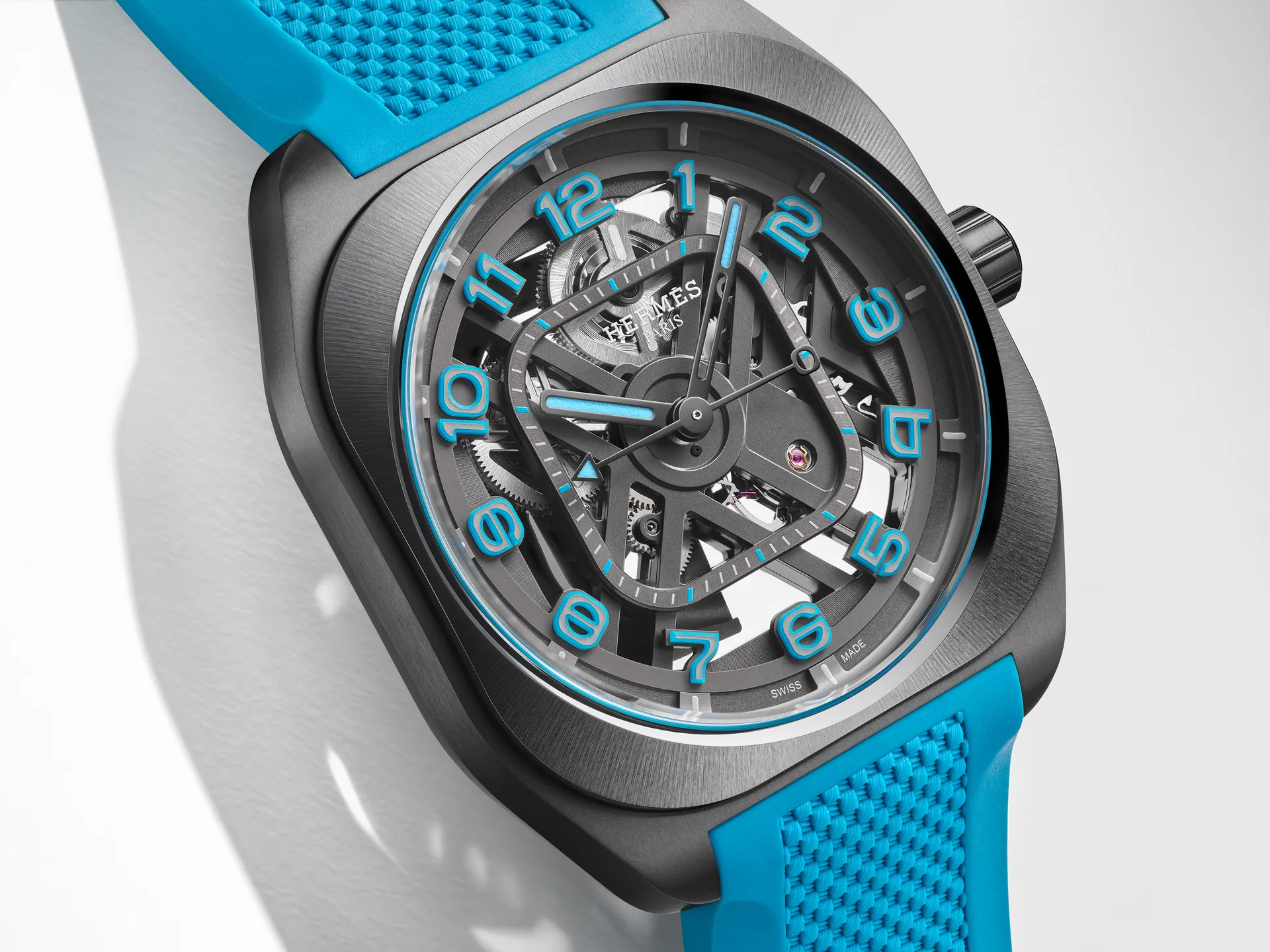
Here, the dial is no longer a surface to decorate but a threshold to remove. The movement is not framed as spectacle; it is treated as structure. Bridges and gears are arranged with clarity, not excess. Negative space is not incidental—it is designed, measured, and given equal importance to the mechanical elements themselves.
This is where Hermès demonstrates restraint as a form of confidence. The watch does not attempt to overwhelm the eye. It invites it to move, to navigate, to understand the internal rhythm of the piece without obstruction. The openness extends to the caseback, reinforcing the idea that the watch has no privileged viewing angle. Front and back become part of a continuous visual system.
What emerges is a watch that feels less like an object with a face and more like a system in motion—visible, legible, and quietly precise.
idea
Philippe Delhotal, creative director of Hermès Horloger, describes the H08 Squelette in terms of lightness—achieved through openwork and technical materials. But within the context of Hermès, lightness is not simply about weight. It is a methodology.
It is visual lightness: the reduction of density through transparency.
It is structural lightness: the elimination of unnecessary mass.
It is experiential lightness: the way the watch recedes into the rhythm of wear rather than interrupting it.
The strap underscores this philosophy. Rendered in rubber with a fabric-like texture, it bridges the tactile expectations of Hermès craftsmanship with the functional demands of a contemporary sport watch. It references heritage without replicating it. It translates rather than repeats.
The result is a watch that feels coherent at every level—not because it adheres to tradition, but because it refines it.
flow
Modern watchmaking often operates within established categories. Sport watches emphasize durability. Dress watches prioritize refinement. Hybridization exists, but often at the cost of clarity.
The H08 Squelette avoids this compromise by refusing the premise altogether.
Its titanium construction, lightweight profile, and adaptable strap position it comfortably within everyday use. It is a watch designed for movement—for commuting, traveling, navigating the unpredictability of urban life. Yet its formal qualities—its controlled geometry, its disciplined use of space, its matte black finish—allow it to transition seamlessly into more refined contexts.
This is not versatility as an added feature. It is versatility as a foundational principle.
Hermès understands that contemporary wearers do not compartmentalize their lives according to traditional categories. The same object must operate across multiple environments. The H08 Squelette answers this not by diluting its identity, but by sharpening it.
View this post on Instagram
event
To fully embrace the H08 Squelette, it must be considered within the environment of Watches and Wonders, where Hermès continues to redefine what presentation means.
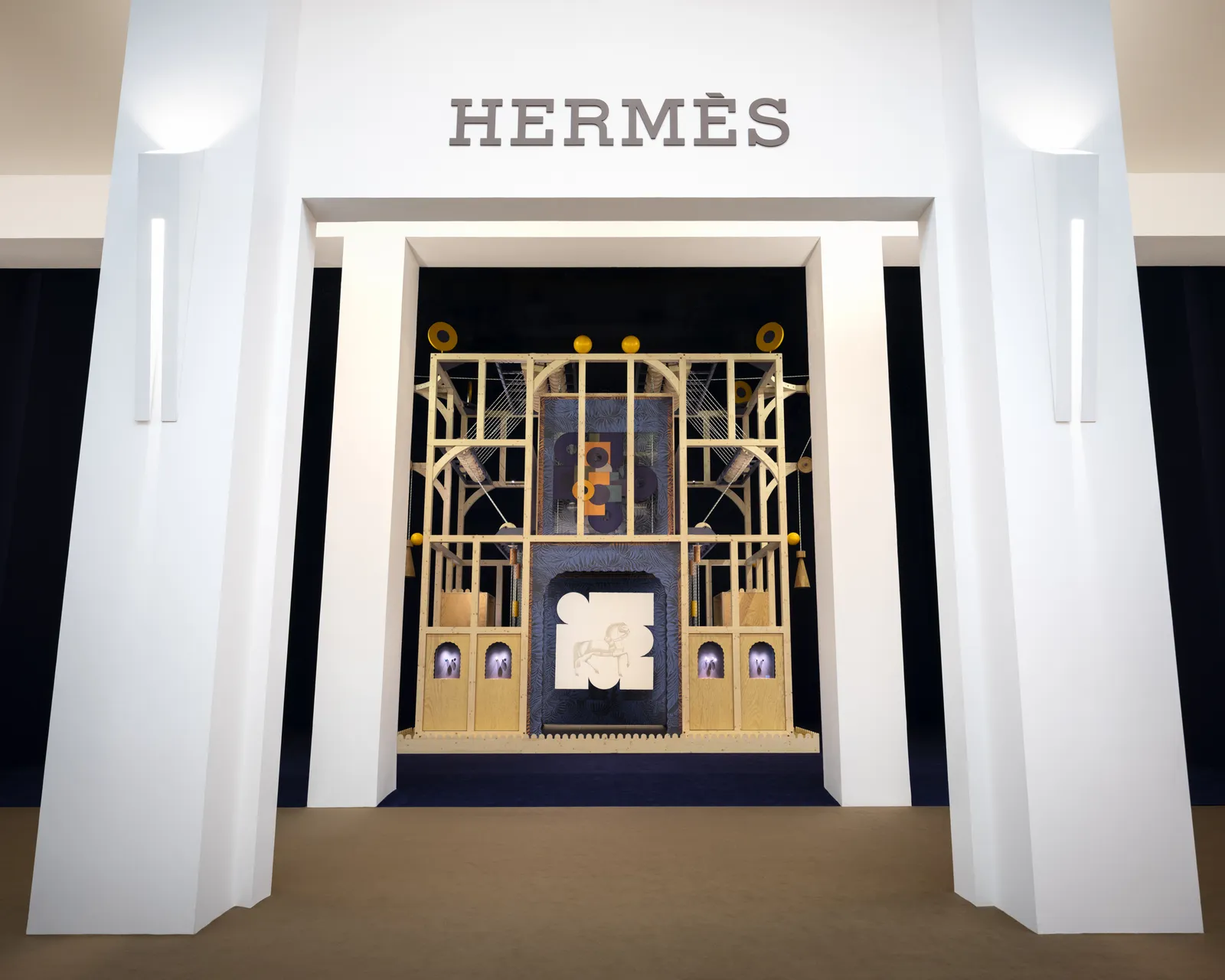
Rather than constructing a conventional booth, the brand builds environments—minimalist, architectural, and immersive. This year’s scenography mirrors the watch itself. Surfaces echo its matte finishes. Open spaces reflect its skeletonized structure. Light is used sparingly, precisely, to guide perception rather than overwhelm it.
Visitors do not simply encounter the watch. They move through a space that translates its design language into architecture. Object and environment collapse into one continuous narrative.
This approach is central to Hermès’ philosophy. A watch is not an isolated artifact. It exists within a broader system of meaning—one that includes space, movement, and experience.
frame
For much of its history, Hermès has been defined by elegance—its mastery of leather, its refinement of materials, its equestrian heritage. Its watchmaking division, while respected, was often perceived as adjacent to the more technically assertive maisons.
That perception has shifted, quietly but decisively.
The H08 Squelette does not present itself as a technical manifesto in the traditional sense. It does not rely on complications or overt demonstrations of mechanical dominance. Instead, it reveals technical confidence through control—through the ability to skeletonize a movement while maintaining coherence, readability, and structural integrity.
The decision to release the model in limited variations reinforces this approach. It is not about saturation. It is about precision—of idea, of execution, of audience.
Collectors will recognize the technical achievement embedded within the design. Design-oriented wearers will respond to its clarity and restraint. The watch exists between these audiences, without needing to prioritize one over the other.
sentiment
In an industry often anchored by heritage or complexity, the H08 Squelette proposes a different relationship to time.
By exposing its internal mechanics, it transforms time from abstraction into process. The wearer does not simply read the time; they observe it unfolding. The oscillation of the balance, the transfer of energy through gears, the regulated movement of components—these become visible, legible, continuous.
This shift reframes the watch’s role. It is no longer just a tool for measurement. It is an instrument of observation.
Time, in this context, is not something hidden behind a dial. It is something that happens in front of you.
sum
Ultimately, the Hermès H08 Squelette is best understood not as a watch in the traditional sense, but as a structure—one that happens to tell time.
It carries the codes of Hermès without relying on overt signals. It reflects a broader philosophy: that objects should be lived with, not merely displayed; that design should emerge from necessity rather than decoration; that restraint can be more powerful than excess.
In stripping the H08 to its mechanical essence, Hermès has not reduced it. It has clarified it.
What remains is precise, deliberate, and quietly radical. A watch that does not compete for attention, yet holds it. A watch that does not explain itself, yet invites understanding.
And in that invitation, it achieves something increasingly rare: it creates space—not only on the wrist, but in the way we think about time itself.
For related context, see IWC Schaffhausen’s Space Watch Revolution – CMO Talks Adventure at Watches & Wonders 2026.
Drift has also covered The Return of the Cartier Roadster at Watches & Wonders Geneva 2026: A 14-Year Hiatus Ends with Refined Automotive Elegance.
n
From the DRIFT archive: PANTONE’s 2026 Color of the Year Takes Shape With Play-Doh and Post-It Editions
Related Articles

Miffy Gets Her Ceremony Best: United Arrows Dresses Dick Bruna’s Rabbit for KIDDY LAND’s 80th
A Miffy mascot in United Arrows’ formal-occasion wardrobe, and a pouch where she peeks out […]