DRIFT AUDIO
Listen to this story
Choose a voice, then press play.
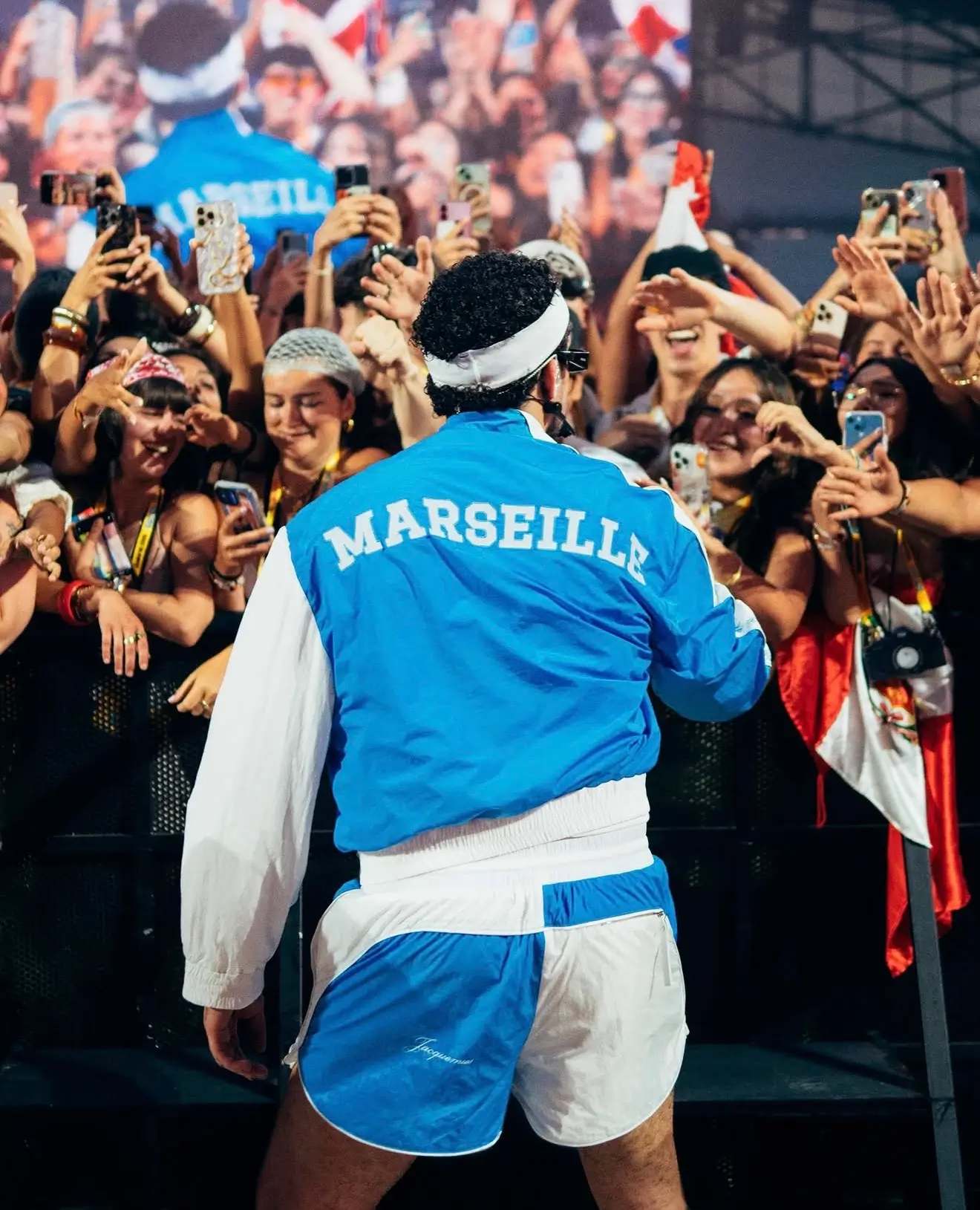
Bad Bunny closed his Marseille show in a custom Jacquemus tracksuit, turning a concert look into a tribute to Simon Porte Jacquemus’ southern French roots.
In This Story
- The Show
- The Look Itself
- A Friendship Built in Fashion
- Reading the Tribute
- Another Stamp on a Well-Traveled Passport
Bad Bunny‘s Debí Tirar Más Fotos World Tour landed in France for the first time on July 1, at the Stade Vélodrome in Marseille, and the stop carried a weight beyond the setlist. Nearly 60,000 fans packed the venue as the Puerto Rican artist alternated between salsa, plena, and reggaeton, backed by a band of roughly twenty musicians. The crowd, waving flags from across Latin America, joined in for a reworked rendition of “La Marseillaise” as fireworks lit the sky.
The night’s most-photographed moment, though, happened away from the main stage, around the “Casita” — the pink house-shaped installation Bad Bunny has made a recurring fixture of this tour. There, Jacquemus himself joined the celebration alongside musician Kalash, his partner and manager Clara Kata, and KATSEYE’s Manon, dancing among fans as Bad Bunny acknowledged the group repeatedly from the stage. He later spent close to fifteen minutes at the barricade greeting fans directly — handshakes, autographs, and even a fan cooled off with a handheld fan mid-interaction.
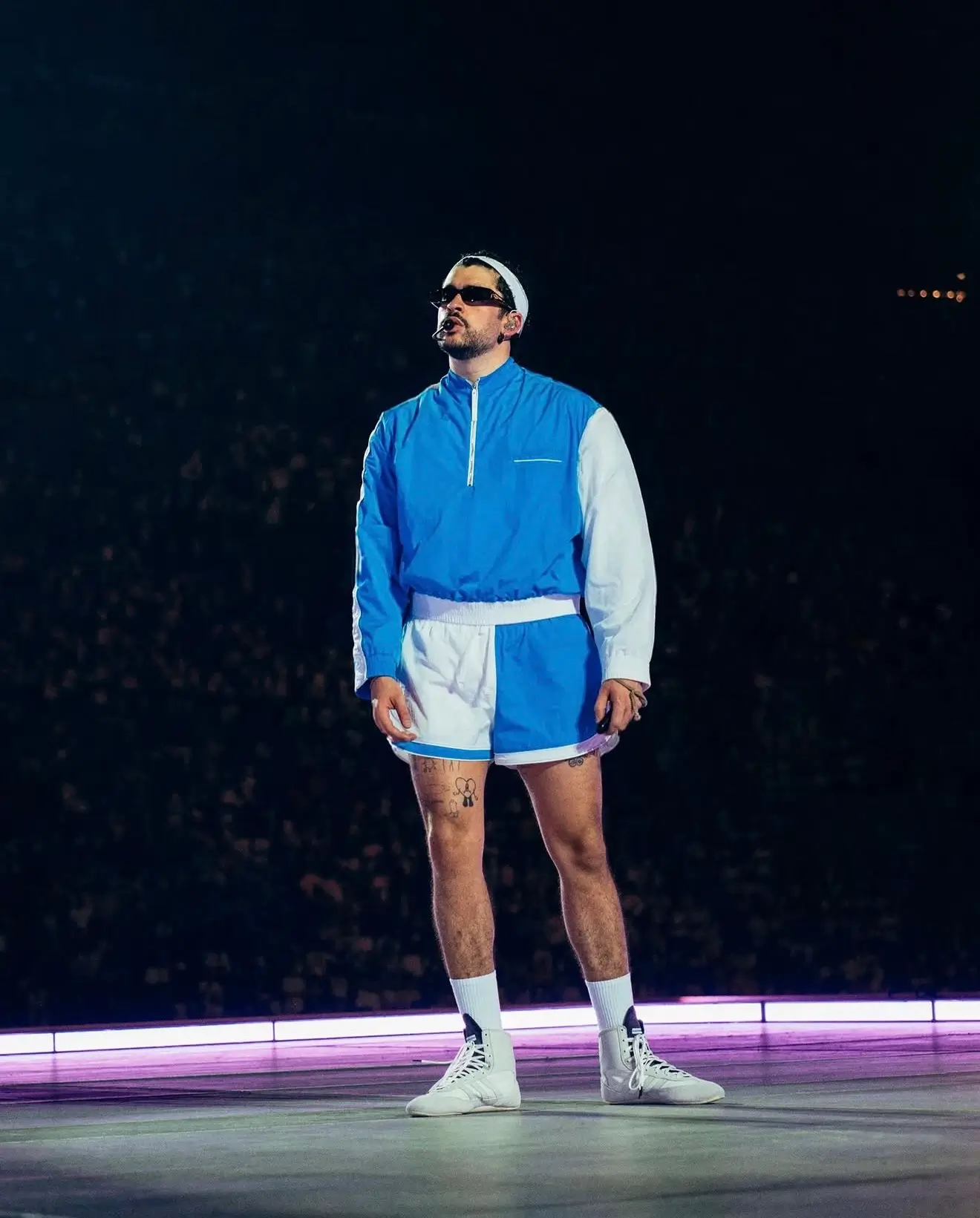
Blue-and-white Jacquemus athletic look combines a retro-inspired quarter-zip windbreaker and matching running shorts for a bold stage-ready performance outfit.
It was against this backdrop — a hometown-adjacent celebration for Jacquemus, whose brand has long drawn from Marseille’s identity — that the custom tracksuit made its appearance.
style
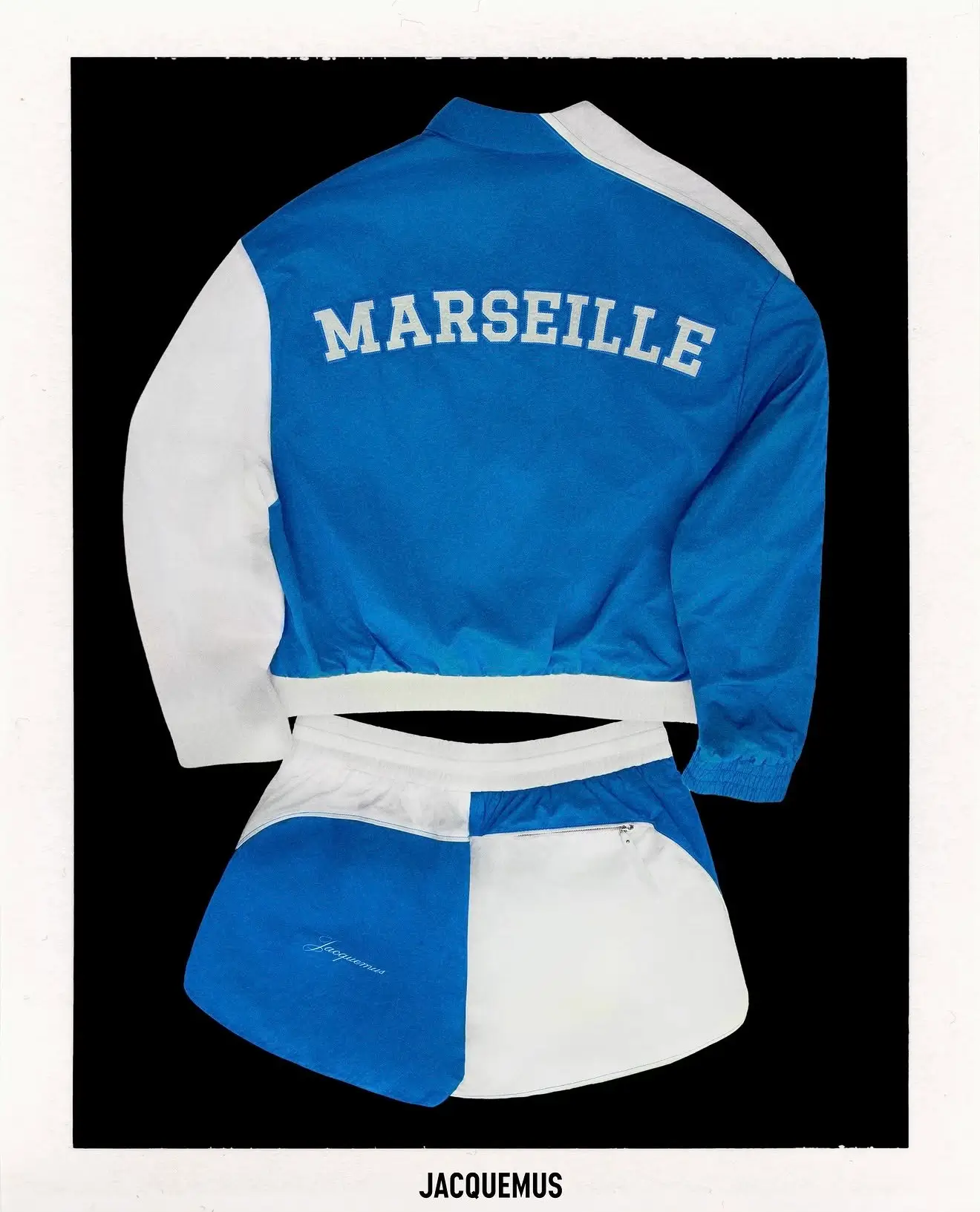
The garment itself was simple by design: a “custom Jacquemus Marseille tracksuit,” built specifically for the Marseille date and not, as of this writing, part of any retail collection. Rather than leaning into Jacquemus’ more sculptural or overtly Provençal signatures — raffia, gingham, sunbleached linen — the tracksuit translated the brand’s identity into something suited to Bad Bunny’s own uniform: off-duty, sport-inflected, easy to move in across a two-and-a-half-hour set.
That restraint is, in its own way, the point. Jacquemus has spent over a decade building a visual language around the south of France — its light, its color palette, its coastal ease — and a tracksuit named directly for Marseille distills that identity into something wearable on stage rather than staged for a runway. It’s a garment built to travel with the tour rather than sit in an archive.
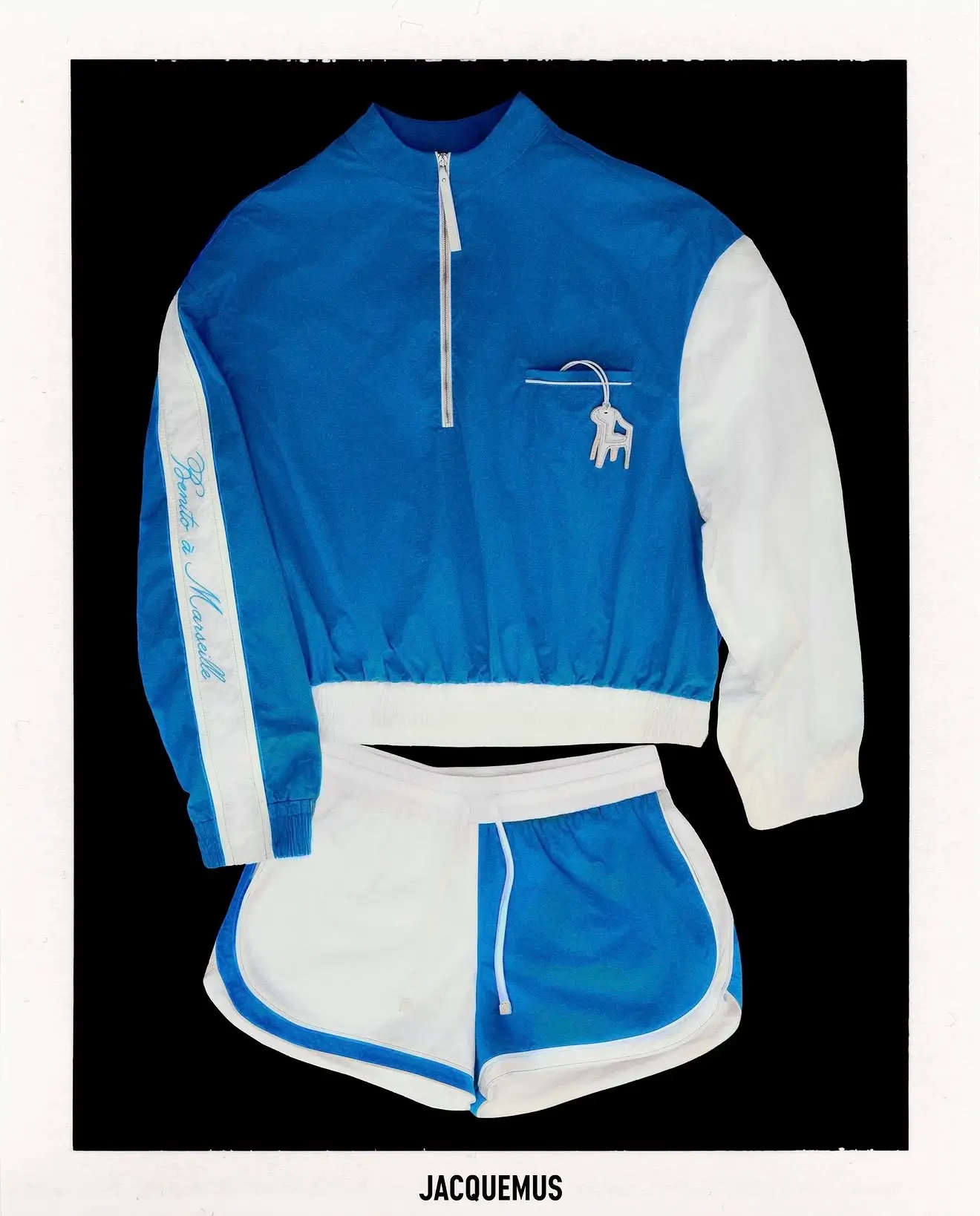
Blue-and-white Jacquemus athletic set features a retro-inspired quarter-zip windbreaker, matching split-color running shorts, and signature branded details with a clean sport-luxe aesthetic.
Jacquemus marked the moment himself, posting that seeing “Benito Antonio in our custom Marseille tracksuit” made for “what a night,” and calling Bad Bunny “one of my favorite artists and a longtime collaborator” — a framing that undersells, if anything, just how long that collaboration has actually run.
link
The Marseille tracksuit is the latest chapter in a partnership between Bad Bunny and Simon Porte Jacquemus that stretches back four years. It began in February 2022 with “Le Splash,” the campaign that first put Bad Bunny in Jacquemus’ orbit — fluorescent green suiting, a pink mini dress, pastel mule heels, all shot poolside in Miami. The pairing was, at the time, treated as a surprise: a reggaeton star known for eccentric fashion risk-taking stepping into a French luxury label’s world of gender-fluid tailoring.
By May 2023, the relationship had moved from campaign to red carpet. Bad Bunny attended the Met Gala in an all-white, backless Jacquemus suit featuring a 26-foot floral train — one of the more talked-about looks of that year’s event, and a clear signal that the collaboration had graduated from marketing exercise to genuine creative partnership.
The following year brought “Les Sculptures,” Jacquemus’ Spring/Summer 2024 collection, presented at the Fondation Maeght in Saint-Paul de Vence and inspired by Alberto Giacometti. Bad Bunny fronted the campaign for that collection as well, photographed in pieces including a leather aviator jacket and a reworked take on Jacquemus’ Repetto derby collaboration.
Each of these moments has reinforced the same dynamic: Jacquemus treating Bad Bunny not as a one-off ambassador but as a recurring muse, and Bad Bunny using Jacquemus as one thread in a broader fashion identity that also includes long-running ties to Adidas alongside appearances in Louis Vuitton, Gucci, and JW Anderson. The Marseille tracksuit extends that history onto the stage itself, folding a live performance into a relationship that has, until now, mostly played out through campaigns and red carpets.
trib
What makes the Marseille moment distinct from the earlier campaigns is its specificity. “Le Splash” and “Les Sculptures” were fashion-world productions, built around photographers, art references, and press rollouts. The tracksuit, by contrast, was made for a single night, in a single city, tied to a single milestone: Bad Bunny’s first-ever French tour date.
Marseille isn’t incidental to Jacquemus’ identity — it’s foundational. Simon Porte Jacquemus has built the brand’s entire visual mythology around the south of France, from runway shows staged in lavender fields and salt marshes to a stated devotion to “le soleil, les fruits, la vie… Marseille.” Naming a garment directly for the city, then dressing his friend in it on a Marseille stage in front of a sold-out Vélodrome, reads less like a product placement and more like a personal gesture — Jacquemus bringing Bad Bunny physically into the geography that defines his work, rather than simply dressing him for an occasion.
That distinction matters for how the moment lands. Where past Bad Bunny fashion moments have often been framed around spectacle — the pink dress, the backless train — this one is framed around place and relationship. The tracksuit itself is unassuming by Jacquemus’ own standards; its significance comes almost entirely from the context surrounding it.
fin
Bad Bunny’s fashion footprint has never been confined to any single lane — a reggaeton superstar equally comfortable in a mini dress, a floor-length train, or now, a custom tracksuit named for a French port city. The Marseille moment adds a new kind of entry to that itinerary: not a campaign, not a red carpet, but a live, in-the-moment tribute built for one specific night in one specific place. Given how consistently Bad Bunny and Jacquemus have returned to each other over the past four years, it’s unlikely to be the last.
From the DRIFT archive: No Me Quiero Ir De Aquí — The Story of Bad Bunny and FRSH Company’s Puerto Rican Streetwear Moment · Fashionably Late, Perfectly On Time: XO’s Arrival Shakes Up UK Pop