DRIFT AUDIO
Listen to this story
Choose a voice, then press play.
María Berrío’s 14-panel mosaic reopened a rebuilt Fort Hamilton Parkway station in 2019 with a Colombian myth folded into the tile.
For two years, the Coney Island-bound platform at Fort Hamilton Parkway did not exist for riders on the N train. It closed in July 2017, one of nine stations gutted between Fort Hamilton Parkway and 86th Street as part of a rebuild of the Sea Beach Line, a route that was more than a century old and, by most accounts, falling apart. The work ran six months over schedule after crews found advanced deterioration in the structural steel once they’d opened the walls up. When full N service finally returned on July 1, 2019, the more than 50,000 daily riders who depend on those nine stations came back to new staircases, new lighting, and, at Fort Hamilton Parkway specifically, an entirely new wall.
View this post on Instagram
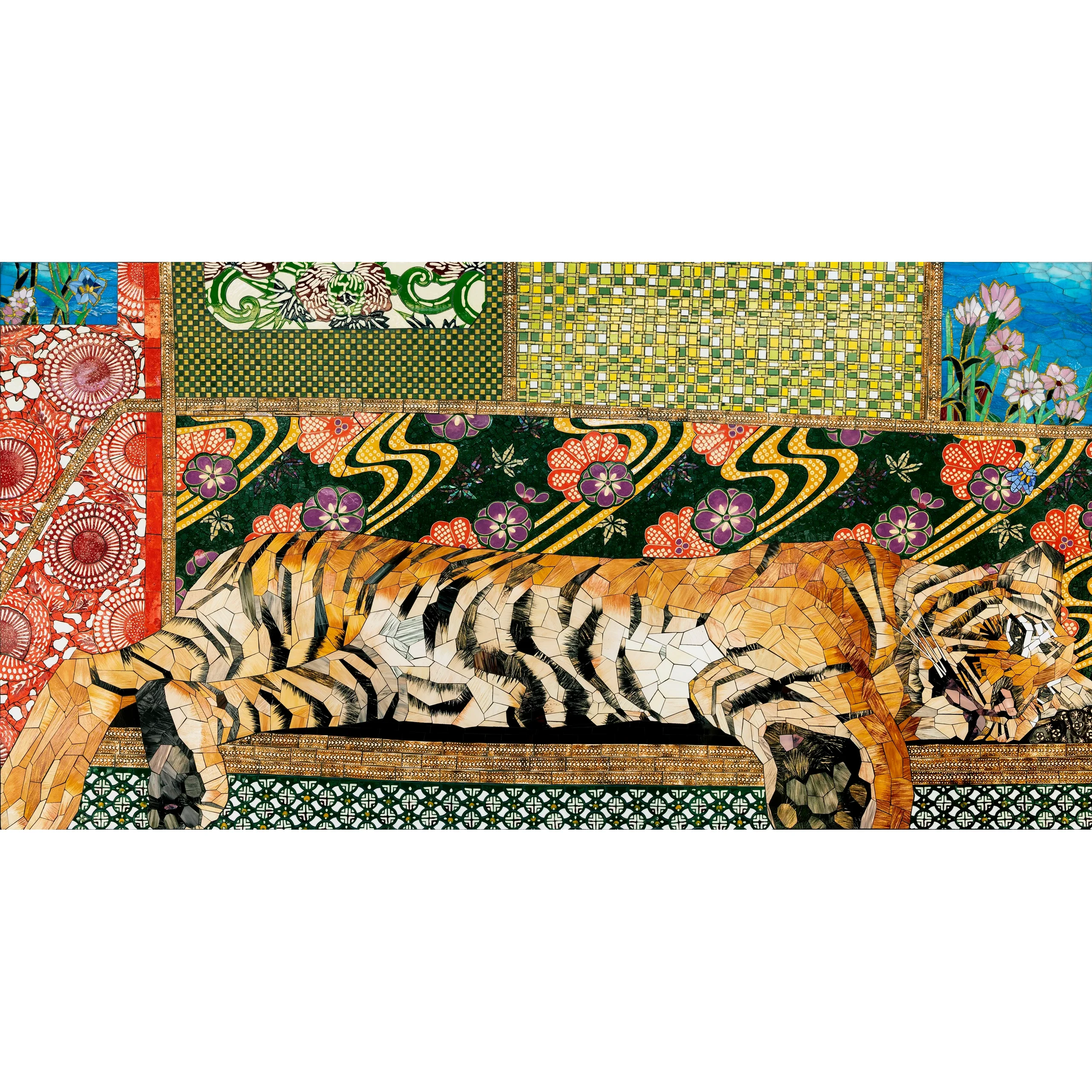
Fourteen panels of glass and ceramic mosaic now run along both platforms, visible from either side of the tracks, built from a body of paper collage paintings by the Colombian-born, Brooklyn-based artist María Berrío. One of those panels is a tiger, and it’s the one most likely to stop a commuter mid-stride. The animal stretches across a long horizontal section of wall in a reclining pose, its body built entirely from cut and shaped tesserae rather than paint, so the stripes read as angular slivers of black, cream and burnt gold that catch the platform light differently depending on where a rider is standing. It sits behind a metal bench, in front of a backdrop that owes nothing to any real habitat: a band of gold scrollwork carrying purple and red blossoms across dark green tile, a checkerboard field of yellow, green and white above that, and, further along, a formal cream-and-green floral panel boxed in red medallion patterning, with a sliver of blue sky and iris stems tucked into the corner. It reads less like a wildlife portrait than a textile pattern that happens to contain a tiger, which tracks with how MTA Arts & Design itself describes the whole series: not as natural history, but as “surreal and fantastical” composition.
stir
The tiger is one figure in a much larger cast. Elsewhere on the same platform, a cheetah walks with its cub through a bed of flowers, a deer sits upright inside an embellished subway car with orange seats against blue and black tile, and a woman in a flower crown plays an accordion. Swans, parrots and butterflies recur across the patterned grounds tying the panels together. MTA Arts & Design commissioned the piece, titled There Is Magic Underneath It All, and brought in Mosaika Art & Design, a Montreal fabricator, to translate Berrío’s collaged paintings, built from layered patterned papers, into the mosaic series.
The agency’s own description ties the cast of migrating, transforming, costumed figures to the drama of journeys taken by travelers who may have moved from another country, state or borough, lang that fits a station straddling Borough Park, home to one of the largest Orthodox Jewish communities outside Israel, a short ride from Bensonhurst, a historically Italian American neighborhood now also home to one of the city’s largest Chinese and Hong Kong-born populations. Berrío’s own stated aim, per MTA’s project page, is to remind passengers that they’re stood in a realm of possible, beauty and magic, and to invite them to explore their exterior and interior worlds alike. Nowhere in that frame, or anywhere else tied to this specific commission, does the tiger get singled out as a stand-alone symbol of courage or leadership. It’s one animal folded into a bigger fable about arrival, a few stops from a Bensonhurst where, per a 2023 city report, more than half of residents were born outside the United States.
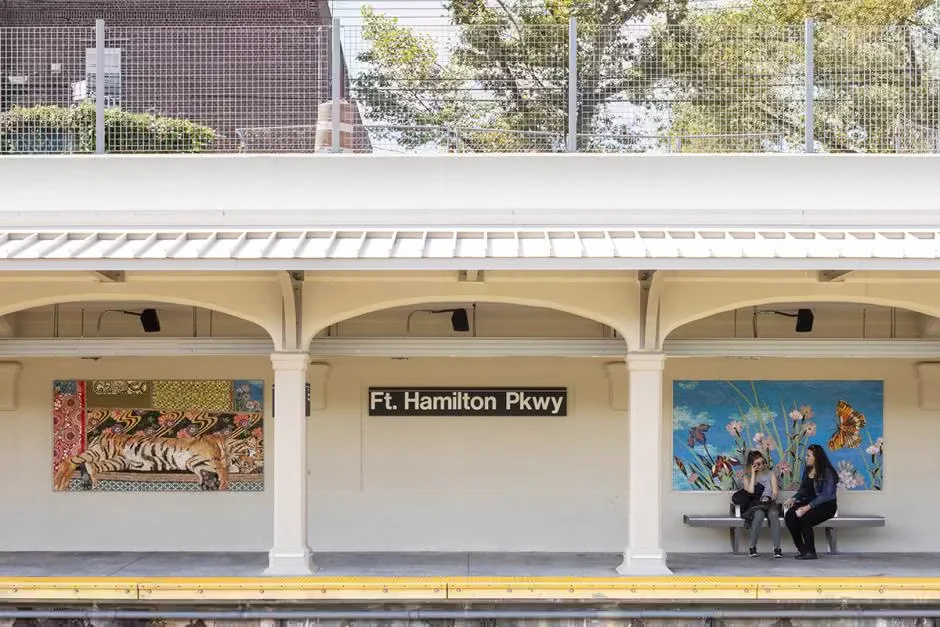
A day view of the Ft. Hamilton Pkwy subway station platform feature white arch pillars, a black and white station sign, two tincture murals (one with a tiger and one with butterflies), and two people sit on a bench.
to
Turning a paper collage into a permanent subway wall is its own discipline, and it isn’t Mosaika’s first MTA job. The studio, founded in Montreal in 1998, has fabricated other transit commissions in the system, including Alyson Shotz’s work at Smith-Ninth Street and Cadence Giersbach’s at Myrtle-Wyckoff, on top of a wider public-art client list that runs to San Francisco International Airport, Dallas Love Field, and a Harlem bus depot piece by Shinique Smith. For Berrío’s series, its craftspeople had to reproduce, tile by tile, the torn edges and layered texture of an artist who builds her originals from Japanese paper, cut and torn rather than painted, with detail added afterward in watercolor. Glass and ceramic were the practical choice for a station environment. They’re durable, they hold color, and they can survive decades underground with minimal upkeep, which is close to the exact language MTA Arts & Design’s longtime leadership has used to explain why mosaic became the program’s default medium in the first place: it’s one of the only materials that has reliably held up in the subway’s harsh, subterranean conditions, largely untouched by the graffiti and water damage that wore down other station surfaces over the decades.
arrive
Berrío’s tigers didn’t start on a subway wall. They recur across her studio practice, and according to an auction house essay on her 2013 painting Burrow of the Yellow, in which women recline alongside big cats and rabbits, the animals trace back to the mythology of the Kogi people of Colombia, sometimes rendered in translation as the people of the tiger. The same lineage runs through her 2017 canvas Aluna. Berrío has described the women in her paintings as embodiments of a specific femininity, strong, vulnerable, compassionate and courageous, and the tigers that lie beside them read less like symbols borrowed from heraldry than like characters pulled from a specific family of Colombian stories.
She was born in Bogotá in 1982 and spent part of her childhood at a remove from a country then shaped by drug-war violence in its forests, on a relative’s farm where she could still engage with nature directly. She moved to New York at eighteen, earned a BFA from Parsons School of Design in 2004 and an MFA from the School of Visual Arts in 2007, and picked up Japanese paper as a collage material only during that graduate program, after training primarily in charcoal drawing and painting. It has defined her work since. So has her recurring cast: women, usually surrounded by animals and dense pattern, staring directly back at whoever is looking at them rather than posing for the view, an approach one UK arts magazine has compared to the magical realism of Gabriel García Márquez and Laura Esquivel rather than to any single art-historical school. By the time a spring 2019 profile in The Georgia Review caught up with her, she was already, as the magazine put it, at work with the MTA on the public commission that would become There Is Magic Underneath It All, alongside murals she’d completed in Harlem and in Puebla, Mexico, and a spot in the 2017 Prospect.4 triennial in New Orleans, all before the Fort Hamilton Parkway piece had gone up.
scope
The Fort Hamilton Parkway commission sits inside a program with its own long institutional history. MTA Arts & Design, created in 1985 as the subway was being rebuilt out of decades of decline and graffiti, runs what the agency itself calls a Percent for Art program: a share of station construction and rehabilitation budgets, up to one percent, set aside for permanent commissioned artwork. The mechanism didn’t start from scratch. New York City’s own Department of Cultural Affairs had already been funding public art under similar legislation before the MTA’s board, prompted by former deputy mayor and MTA board member Ronay Menschel, decided the coming wave of station rebuilds was too large to manage from outside the agency and brought the program in-house under founding director Wendy Feuer. Four decades and more than 400 permanent commissions later, MTA Arts & Design describes its collection as one of the largest and most diverse displays of site-specific public art anywhere in the world, and 2025 into 2026 has doubled as its 40th-anniversary stretch, marked with a dedicated logomark and a year of station tours. Berrío’s tiger, cheetah, deer and accordion player belong to that same lineage, alongside a second Sea Beach Line commission a few stops away, Andrea Dezsö’s nature-themed installation at New Utrecht Avenue, unveiled as part of the same 2019 reopening. The choice of medium also reaches back further than 1985: when the first line of the subway opened in 1904, its builders declared it a great public work and lined its original stations with colored mosaic and terracotta specifically to invite a nervous public underground, a design instinct MTA Arts & Design has spent forty years reviving rather than inventing.
say
It’s worth being precise about what this particular piece claims and what it doesn’t. Wild tigers are genuinely endangered, and the animal is a real, ongoing conservation subject. The science on that point has also moved since some frequently repeated figures were set. The IUCN’s 2022 Red List assessment, led by the wild cat conservation group Panthera, put the global wild tiger population at somewhere between roughly 3,700 and 5,600 individuals, an estimated 4,500 on average, up from around 3,200 in 2015, a potential 40 percent increase and the first sustained climb in the species’ numbers in decades. That’s real, if fragile, progress, not the flatter “fewer than 4,000” figure still in wide circulation. Panthera’s chief scientist has said that if the trend holds, tigers could plausibly be reclassified from Endangered to the less severe Vulnerable category within seven to ten years, though several range countries, including China, Myanmar and Malaysia, still haven’t completed the kind of systematic national surveys that would make the global count more precise. None of that is a reason to doubt the numbers are moving in the right direction, only a reason to hold them loosely. But nothing in MTA Arts & Design’s own description of There Is Magic Underneath It All, and nothing findable in Berrío’s public statements about the commission, frames the piece as a conservation message, and no source ties this specific tiger to a stated symbolism of bravery or confidence. The verifiable meaning sits elsewhere: in Kogi myth, in migration, in a collage practice built from torn paper and watercolor.
View this post on Instagram
where
The tiger has been on that wall since before most of Berrío’s current profile existed. In November 2024, Hauser & Wirth announced it would represent her alongside her longtime gallery, Victoria Miro, and in September 2025 she opened Soliloquy of the Wounded Earth, her debut with the new gallery and her first New York solo exhibition since 2017. In between came a solo show at Boston’s ICA in 2023, a survey at the Norton Museum in West Palm Beach in 2021, a Victoria Miro present in Venice in 2022, a London show called The End of Ritual that closed in January 2025, and group exhibitions at the Whitney Museum, the Hepworth Wakefield and the Nasher Museum at Duke. A companion essay for that London show, by the writer Siddhartha Mitter, argued that the crowded, physically insistent figures in her newer paintings had started projecting outward into the room in a way her early, shh work never did. Her pieces now sit in the permanent collections of the Brooklyn Museum, the Whitney (which holds her 2018 painting A Universe of One), the Dallas Museum of Art, Crystal Bridges and the Ford Foundation.
None of that is viewfrom the platform. What’s view is fourteen mosaic panels that haven’t moved since 2019, and a tiger that has spent six years lying in the same patterned field, watching commuters wait for the same N train.
Related Articles
Winter Ran Down A Plywood Panel In Gaeta
Cy Twombly, Untitled (Winter Picture), 2004. Acrylic on plywood in the artist’s frame. Gagosian, Madison […]