
DRIFT AUDIO
Listen to this story
Choose a voice, then press play.
For his first Los Angeles show, Liu Xiaodong followed one Detroit tattoo artist through combat, ink and a hot tub to paint an entire city.
Liu Xiaodong went to Detroit last year without a script. The Beijing base figure painter has spent three decades building large scale canvases out of whole communities: displaced workers from China’s Three Gorges Dam project, Syrian refugees, orphans in Greenland, Mexican migrants, casino goers in Macau. Detroit was supposed to work the same way. He had loose ideas about who he might paint there, maybe retired autoworkers from the city’s motor industry, maybe rappers pulled from its influential music scene. Then, on the ground, the plan dissolve the way his plans on location tend to. Instead of a chorus of Detroit residents, he settle on one person, for the first time in a career built almost entire on group. John Mcintyre is a Detroit based tattoo artist and a member of a local medieval combat club, and he became the sole subject of what turned into Liu’s first solo exhibition in Los Angeles.
stir
That exhibition, titled Host, opened April 15 at Lisson Gallery‘s Los Angeles space on North Sycamore Avenue and runs through June 13, with an opening reception held from 6 to 8pm on its first night. Rather than survey the city broadly, Liu built the whole project around Mcintyre’s own orbit, painting him in a snowbound forest in full armor, at work inking a client’s leg, and at rest in a backyard hot tub. The gallery describes Mcintyre as “the host and conduit for all of the artist’s interactions with the city,” which is also where the show gets its title: one person stood in for the wide community he moves through. Liu also works predominan en plein air, paint from life on site rather than from photo, which made a brace Michigan midwinter its own kind of obstacle course for a project already improvised on the fly. His own gallery biography describes his choice of sit as a way of supply ancillary nar to a landscape or a situation, using one figure to unlock a much larger set, and Detroit is the most literal version of that idea yet: rather than splitting his attention across a cross-section of the city, he let a single host carry the entire assignment.
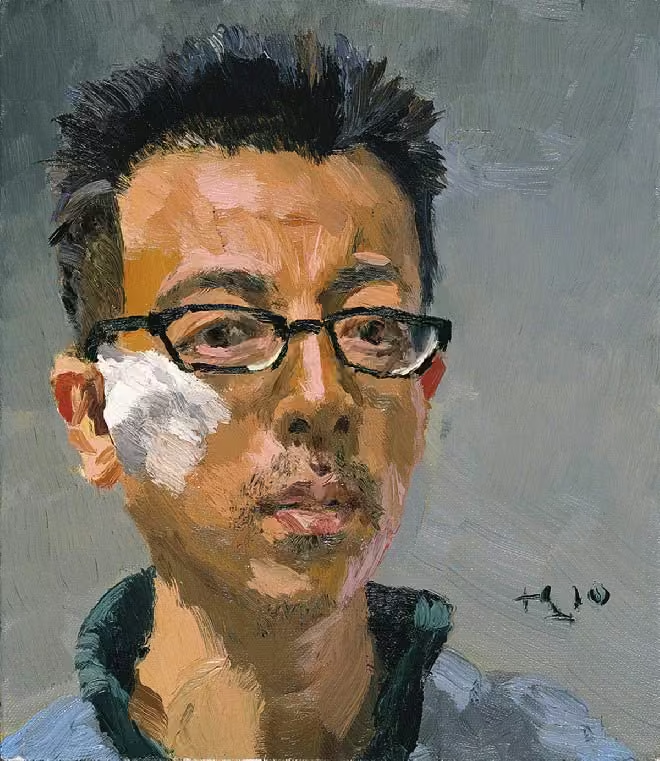
Liu Xiaodong Self-Portrait: A poignant oil painting depicting the artist with a bandaged eye, rendered in a realistic yet expressive style.
Among the works in Host is Painter John (画家John), a 200 by 150 centimeter oil on canvas dated 2026, one of the largest and newest pieces in the show. Where most of the Detroit paintings carry a 2025 date, tying them to the winter Liu actually spent on location, Painter John and a companion piece titled Body both carry a 2026 date, suggesting Liu carried the project forward after leaving Michigan and kept work from it once he was back in his Beijing studio. It is a small but tell detail about how the series actual arrive together: not a single winter’s output deliver whole, but a project still being finished the following year.
The title itself reads like a small joke, aimed either at Mcintyre or at Liu himself. 画家 translates direct to painter, a trade Mcintyre does not practice: he draws on skin with a tattoo needle, not on canvas with a brush. The show is full of this kind of double. Elsewhere in Host, in the blizzard scene Snowlight in Detroit, Liu paints himself into the corner of his own composition, a small figure in a blue jacket working en plein air while Mcintyre’s combat club fights around him. Lisson’s own materials do not spell out exact how that joke lands in Painter John specific, and no extend wall text for the individual canvas was avail at the time of write, so the connection is offer here as a reading of the title rather than a confirm curator note. It fits a habit view across Liu’s catalogue more broad, where title often double as diary entries: works elsewhere in his archive carry dates and locations baked direct into their names, a document impulse that shows up as much in how he titles a painting as in how he paints it.
straddle
The armor in question is not incidental. Since 2019, Mcintyre has fought with Knyaz USA, a Michigan based club that competes in buhurt, also called Historical Medieval Battles, a full contact sport in which armored opponents strike each other with blunted steel weapons under strict rules, sometimes in team battles of up to 30 fighters a side. The sport itself traces back to Russia, where it is generally describe as having taken shape in the early 2000s before spread to clubs across Europe and North America. Knyaz USA takes its name and its red sun sigil from a longer running club of the same name based in Kharkiv, Ukraine, one of the more established outfits in the international HMB scene, and Lisson’s material describe the two clubs as partners.
Liu’s canvas Snowlight in Detroit puts that world on a snowbound stage, Mcintyre and his teammates swing axes and haul shield through stray away. The gallery’s own frame reache past Detroit entire for a compare, describe the scene as closer to a pre-Raphaelite fantasy or a medieval battlefield in the style of Paolo Uccello or Piero della Francesca, the Italian quattrocento painters best known for turning armor combat into pattern and shine. It is a deliberate old fashion ref for a paint built out of a very current American subculture, and it sets up the rest of the series: elsewhere, Host turns to a quieter kind of armor, the tattoos across Mcintyre’s own chest, arms and stomach, rendered in Body (2026) and John and His Tattoos (2025). Those two works, along with John in His Armor (2025), share almost identical dimension, close to 100 by 85 centimeters, suggesting they were conceived and likely painted as a matched set. It is a piece of visual rhyming that Lisson leans on directly in its own frame of the show, treating the ink as a second, permanent kind of shell worn without a helmet.
View this post on Instagram
Liu has been called a document painter for most of his career, and the label predates Host by two decades. In 2006, the director Jia Zhangke followed him for the film Dong, watching Liu paint demolition workers near the Three Gorges Dam and later a group of women in Bangkok. Liu had already crossed into film himself by then, having taken the lead role in Wang Xiaoshuai’s The Days and served as art director on Zhang Yuan’s Beijing Bastards, both in 1993, placing him inside the loose circle of directors now grouped as China’s Sixth Generation.
He trained at the Central Academy of Fine Arts in Beijing, earning a BFA in 1988 and an MFA in 1995 in a curriculum still shaped by the legacy of Chinese Socialist Realism, and later studied at the Complutense University of Madrid. He now holds a professorship at his alma mater, and is generally counted among the leading figures of the Chinese Neo-Realist painters who emerged in the 1990s, artists for whom sticking with figurative painting was itself something of a conceptual stance in a contemporary art world increasingly dominated by photographic and digital media. His gallery describes the resulting body of work as a kind of history painting for an emerging world, and traces his underlying project, to see people as they really are, back to the years right after his CAFA graduation. That project has taken him well outside China: Syrian refugees, orphans in Greenland, Mexican migrants, socialites in Indonesia, casino goers in Macau, a royal family in the Middle East, gathered across twenty three countries on five continents. A 2018 retrospective in Düsseldorf, titled Slow Homecoming, included his Berlin based Transgender/Gay series, centered on portraits of the transgender woman Sasha Maria, one more example of Liu finding a single sitter to carry an entire social world, the same method now applied to Mcintyre in Detroit. A 2013 London project, Half Street, and a 2012 to 2013 project in China’s Xinjiang province, The Hotan Project, extended the same method abroad and at home, and in Borders (2021), staged at the Dallas Contemporary, he embedded himself in Texas border communities on the American side of a different kind of dividing line altogether. He has also pushed the documentary idea somewhere stranger, building an automated painting apparatus called Weight of Insomnia that translates a live digital video feed of passing traffic and human movement into new canvases in real time, versions of which have been built in both Beijing and at a BMW plant in Dingolfing, Germany.
View this post on Instagram
Host marks his first solo show in Los Angeles but not his first with Lisson Gallery, which has show him through prior exhibit include Shaanbei in 2023, Spring in New York and an East Hampton show in 2020, and Weight of Insomnia in 2019. His work has also tour through major surveys at the Dallas Contemporary, UCCA Edge in Shanghai, the Louisiana Museum in Denmark, NRW-Forum and Kunsthalle Düsseldorf, and Palazzo Strozzi in Florence, along with inclusion in the Venice Biennale, the Shanghai Biennale, the Gwangju Biennale and the Biennale of Sydney. Earlier painting show the same appetite for scale that runs through Host: Three Gorges: Newly Displaced Population (2004) stretches ten meters across, while Out of Beichuan and Into Taihu, both from 2010, run roughly three by four meters apiece, and Xiao Yi (2007) approaches three meters square. Not all of that catalogue runs through Lisson either. At least one earlier canvas, Steel 7 (2016), has changed hands through the gallery MASSIMODECARLO, a reminder that a career this long has passed through more than one dealer.
Lisson itself, founded in London in 1967 by Nicholas Logsdail, built its early reputation on Minimal and Conceptual artists including Donald Judd, Sol LeWitt and Robert Ryman, before expand into a roster that today runs from Ai Weiwei and Marina Abramović to Hiroshi Sugimoto, with gallery spaces now spread across London, New York, Los Angeles, Shanghai and Beijing. The Los Angeles outpost is a comparatively recent addi to that footprint, open on April 15, 2023, three years to the day before Host, inside a renovat two-story building of more than 8,000 square feet on Sycamore Avenue, in a stretch of Hollywood now known as the Sycamore District. The building had previously operated as a nightclub before its conversion by the New York design firm Ashe Leandro, and its inaugural show was a solo presentation of work by the Cuban-American painter Carmen Herrera, her first exhibition in Los Angeles, in a neighborhood that now also counts Regen Projects, Various Small Fires and Matthew Marks among its galleries.
end
Host runs at Lisson Gallery’s Los Angeles location, 1037 North Sycamore Avenue, through June 13, with the space open Tuesday through Saturday, 10 a.m. to 6 p.m. Alongside the paintings, the gallery is producing a documentary film and an accompanying catalogue drawing on Liu’s own diary entries and preparatory drawings from the Detroit trip, plus folkloric illustrations and tattoo designs contributed by Mcintyre himself, extending the documentary record of the project past the canvases on the wall. The paintings on view span the intimate scale of Body and Painter John up to the larger battlefield composition of Snowlight in Detroit, with further scenes in Backyard, John and His Tattoos, John in His Armor, One Man, One City and One Person on a Snowy Night, all of them built around the same single, host figure Liu found in his first weeks in Michigan.
Related Articles
Modigliani’s Limestone ‘Tête’
Carved from a single block of limestone in Montparnasse more than a century ago, one of Modigliani's rare stone heads goes to auction for the first time…