DRIFT AUDIO
Listen to this story
Choose a voice, then press play.
Jordi Iranzo casts discarded sports and construction netting in resin, building furniture that stays suspended between memory and use.
In This Story
- The object that will not settle
- Who is behind Permanent Souls
- From waste net to structural form
- What the collection actually holds
- A quiet debut in Valencia before Milan
- Baggio Military Hospital and the weight of Alcova
- Where Permanent Souls sits in a wider conversation
- What comes after the fair
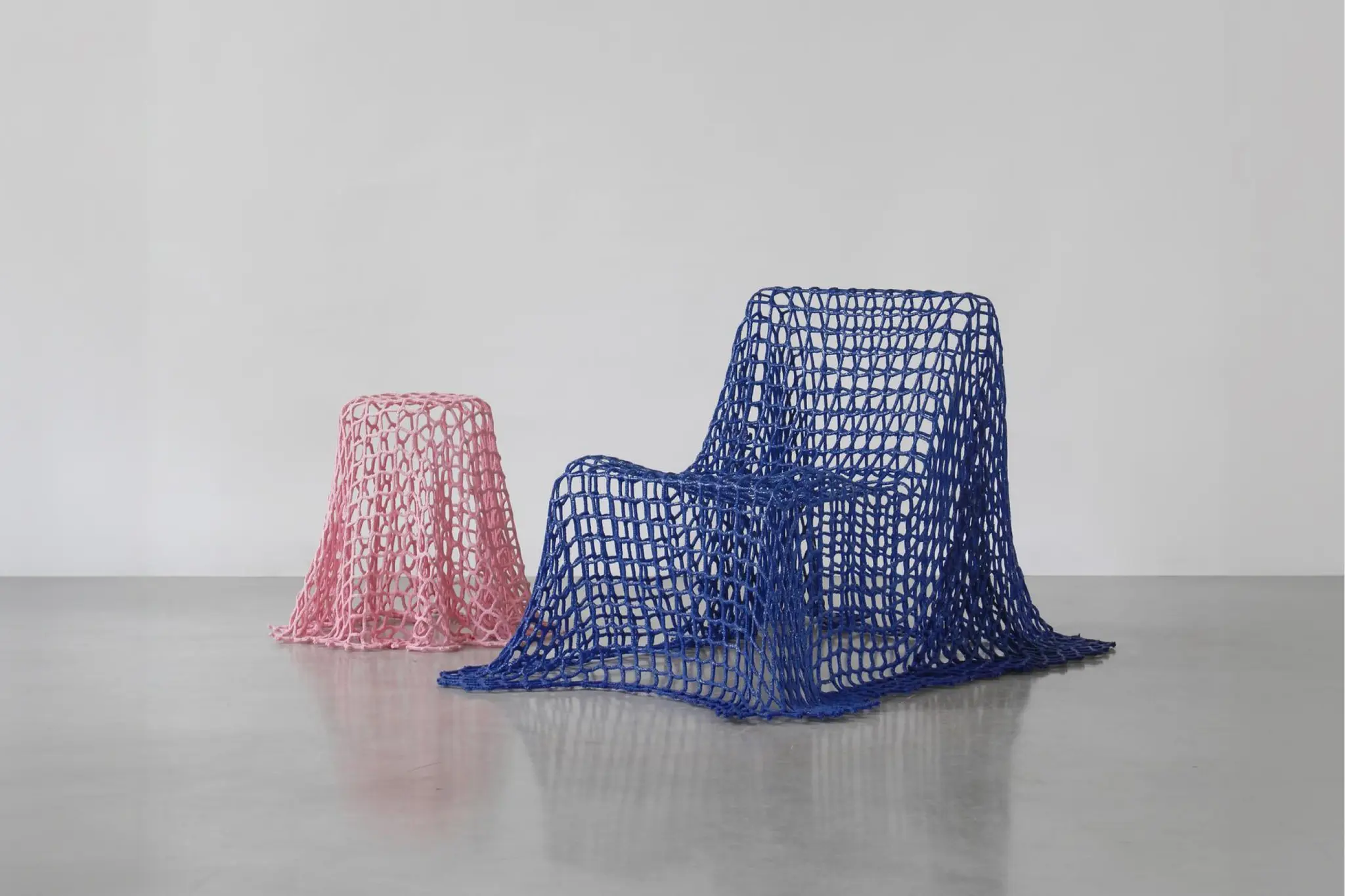
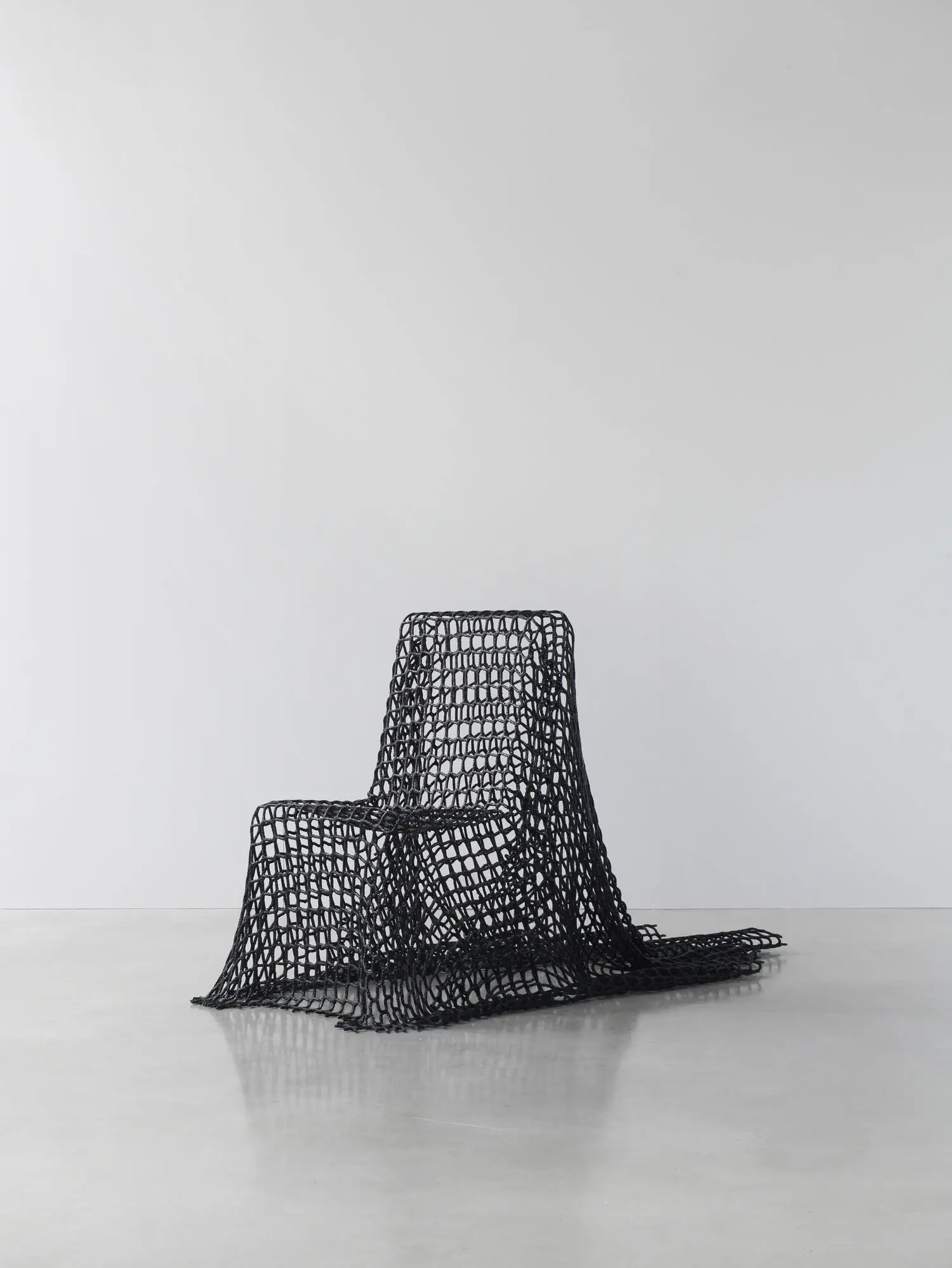
A chair that looks like it is still falling. That is the first impression Jordi Iranzo‘s Permanent Souls collection leaves, and it is entirely intentional. Look at any single piece from the series long enough and the eye starts hunting for the moment it stopped moving, because nothing about the silhouette reads as fixed. A tall stool holds the shape of a draped cloth caught mid fall. A slender vase reads as a grid pulled taut around a cluster of aluminum tubes. An armchair in cobalt blue drapes over its own frame the way a wet net drapes over a fence post left out too long. None of it looks upholstered, welded, or joined in any conventional sense. It looks poured, then left to set exactly where gravity put it.
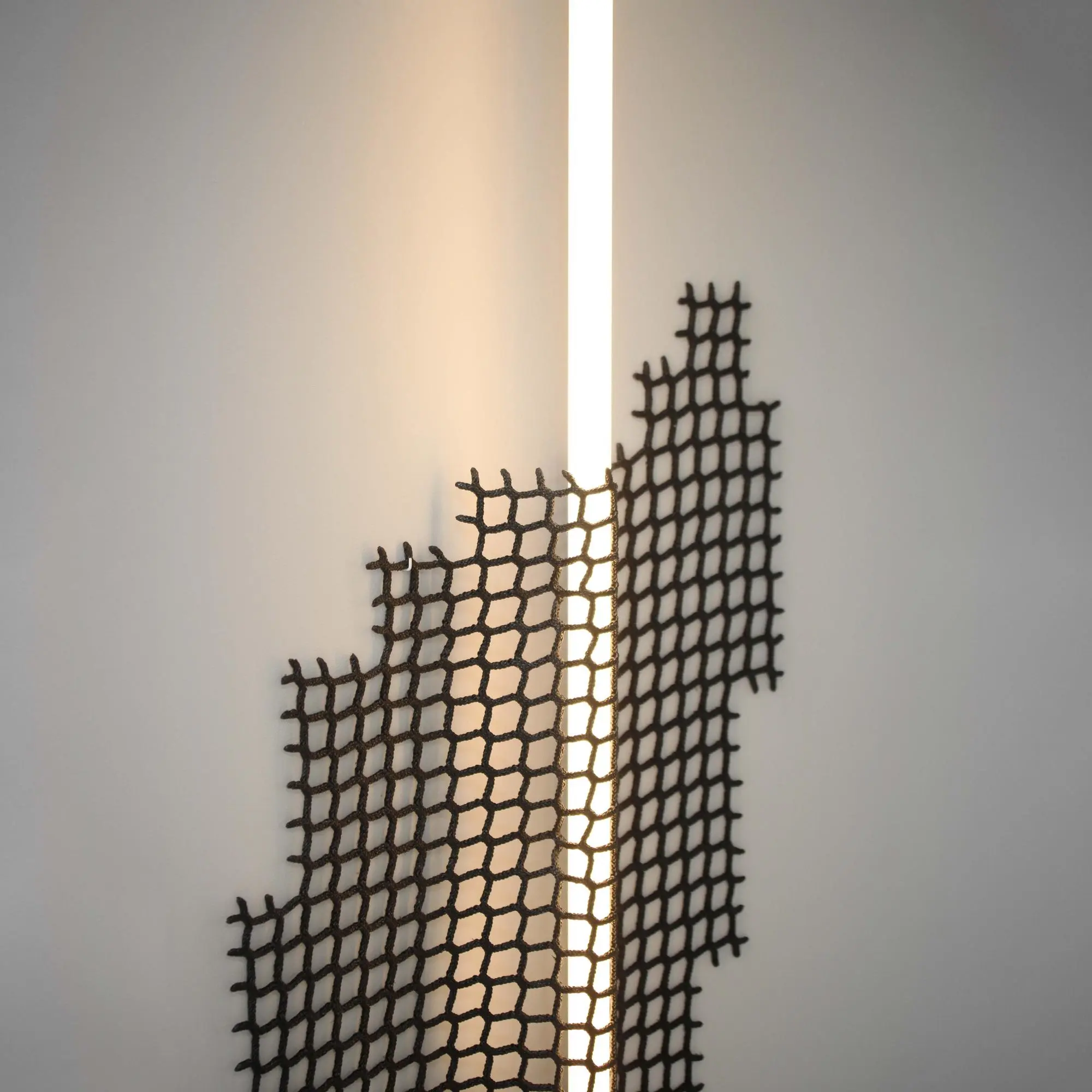
That effect is not a trick of styling. It is the entire premise of the work. Iranzo, a Valencia based designer better known until recently as co-founder and creative director of the interiors studio Clap Studio, builds these pieces from discarded polypropylene netting, the kind stripped from sports facilities and construction sites once it has outlived its original job. He soaks that netting in epoxy resin and lets the material find its own resting shape before the resin cures, which means the final geometry of every stool, chair, and vase in the collection was decided by gravity and tension rather than by a sketch. The studio calls the resulting pieces functional sculptures, and the phrase holds up under scrutiny better than most design world taglines do.
View this post on Instagram
who
Iranzo’s day job gives the project an unusual kind of credibility. He trained first at the EASD in Valencia before continuing his studies at the Burg Giebichenstein University of Art and Design in Halle, Germany, and in 2017 he and Àngela Montagud founded Clap Studio, a Valencia practice built around interiors, product design, and installation work for hospitality and retail clients. The studio has picked up a German Design Award, a Restaurant & Bar Design Award, and, in 2023, Spain’s National Design Award in the Young Designers category, recognition that put Iranzo and Montagud in company with some of the country’s most closely watched young practices. Clap’s client list runs through nightlife and retail projects across Valencia, among them the OVEN Club renovation and the Baovan Foodexperience restaurant, both built around the studio’s signature mix of color, concept, and theatrical restraint.
Permanent Souls sits outside that commercial practice. It is issued under Iranzo’s own name rather than the Clap Studio banner, positioned closer to art than to interior architecture, and built with a much smaller, tighter collaboration. Design and fabrication support on the collection comes from Héctor Montes, who works under the name Velado Studio, and the credited materials for every piece are simply epoxy resin and polypropylene, a materials list about as short as any credible design credit gets in 2026.
trsnsition
The process itself is closer to textile work than to furniture making, at least at the start. Iranzo sources netting that has already done a full life of work somewhere else, pulled from goalposts, scaffolding wraps, or safety fencing on building sites, material that is normally landfill bound the moment it frays or tears. Rather than discarding the imperfections, he keeps them. Loose knots, uneven tension, and small holes in the mesh survive into the finished object, which is part of the point: the pieces are meant to carry visible evidence of a former life rather than erase it.
Once a length of net is selected, it gets soaked in epoxy resin and then draped, stretched, or pulled over a support structure, sometimes a simple armature, sometimes nothing more than the floor itself. The resin stiffens the net permanently in whatever position it happens to be holding when it sets, so the final form is closer to a photograph of a specific moment of physical tension than to a designed silhouette. That is why the stools in the collection appear to billow outward at the base like fabric caught by wind, and why the armchair’s back legs seem to buckle slightly under weight that is not actually there. Nothing in the piece is load bearing in the conventional furniture sense. The resin locked net is rigid enough to hold its shape and, in several pieces, sturdy enough to be sat on, but its structural logic has nothing to do with joints, frames, or fasteners.
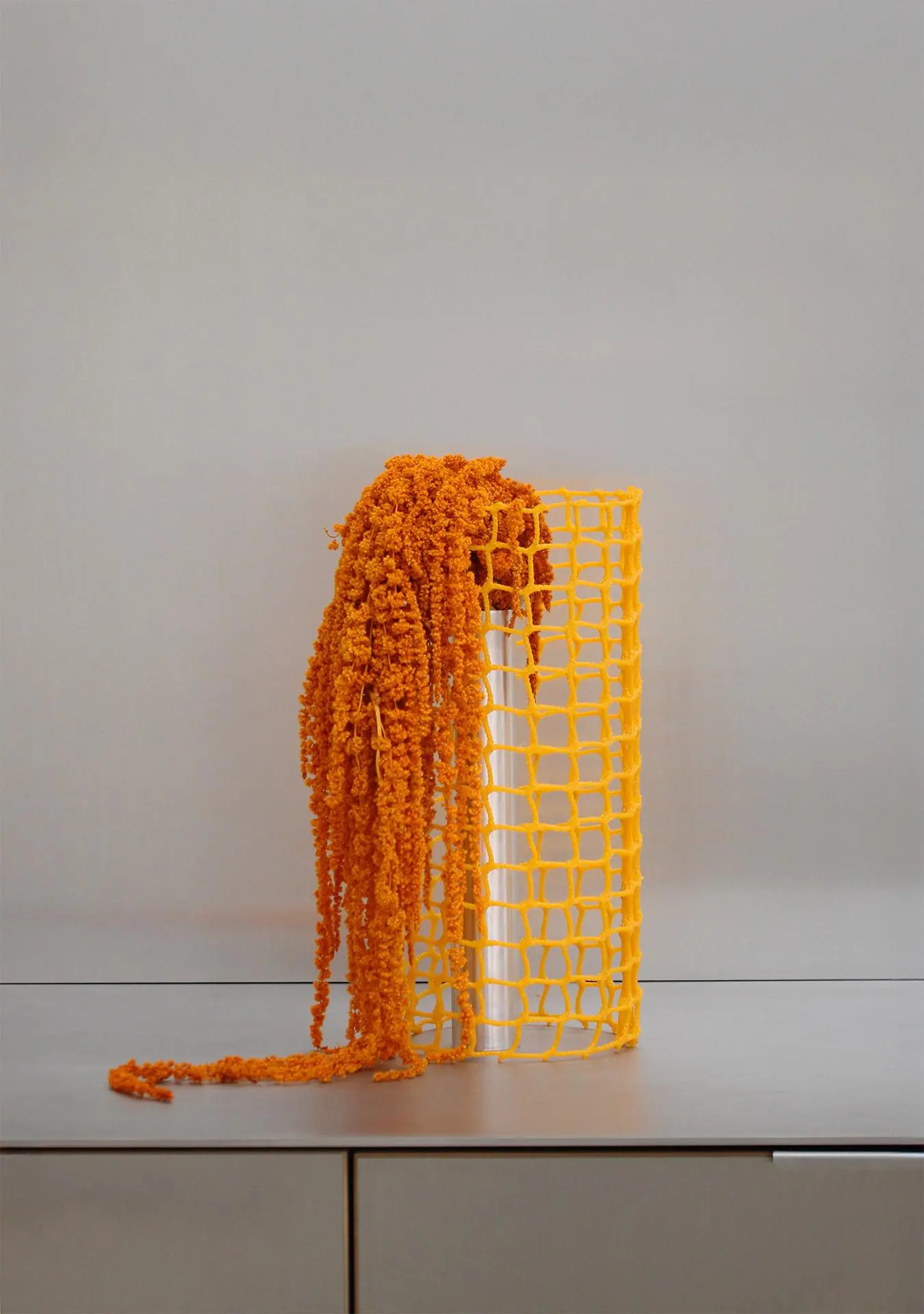
Tincture plays its own role in the collection, and it is handled with restraint. The earliest pieces were cast in undyed white, which lets the resin’s own slight translucency read as something closer to bone or bleached coral than plastic. Later works introduce saturated color, including a cobalt blue armchair and a blush pink stool that were shown together, and a mustard yellow floor piece built around a cascade of dried amaranth flowers threaded through the netting. The yellow piece in particular reads less like furniture and more like a study in what happens when an artificial material is asked to hold something organic and fragile without crushing it.
contain
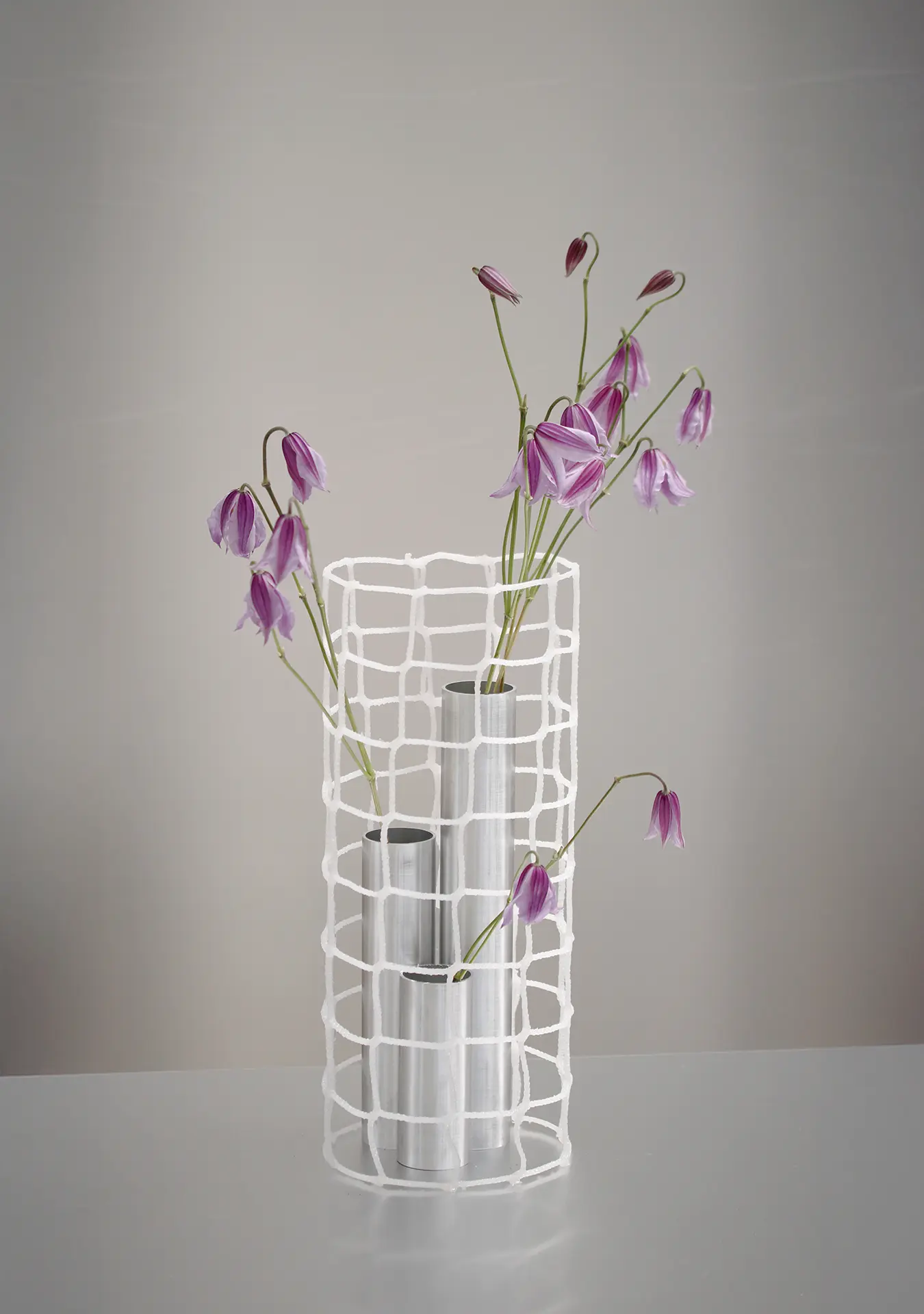
Two pieces make the functional argument for the series most directly. The first is a tall cylindrical vase, its net skin gridded like a loose fishing net stretched vertical, holding a cluster of aluminum tube inserts that carry the actual water and stems. Flowering clematis spill out of the top of it in one presentation image, their weight visibly straining against the mesh without breaking it, which is presumably the entire test the object was built to pass. The second is the armchair, the most literal furniture piece in the collection and also the one that makes the strongest case that Permanent Souls is not simply sculpture wearing furniture’s clothes. It has a seat, a back, and arms in roughly the right proportions for a body, but the entire surface between those points sags and folds the way loose cargo netting does when nothing is pulling it taut, so sitting in it would mean settling into something that looks unfinished by design.
That tension between object and gesture is the thesis the designer keeps returning to in interviews around the release. Iranzo has described the starting question behind the work as what remains of an object or a space once it stops existing, but continues to live on in memory, which is a fairly literary way of describing furniture, and the collection earns the description by refusing to resolve into anything as simple as a finished, symmetrical, upholstered piece. The stools and chairs suggest posture and scale rather than dictating them. A person can read a place to sit into almost any piece in the series, but the object itself never insists on it.
shh
Before the collection reached an international audience, it had a smaller, local unveiling. Iranzo first showed Permanent Souls at Pasaje 94, a gallery space in Valencia, in a presentation framed less as a product launch and more as a study in memory, absence, and permanence, according to coverage of the show in the Spanish design press. That framing matters, because it positions the Valencia showing as the conceptual anchor for everything that followed. The Milan presentation that came later added scale and an international audience, but the ideas driving the work, the argument that memory does not preserve objects exactly as they were, but as fragments of posture, scale, and sensation, were already fully formed by the time the collection left Spain.
mil
The collection’s larger stage arrived at Milan Design Week 2026, where Iranzo presented Permanent Souls as part of Alcova, the itinerant design platform founded in 2018 by Valentina Ciuffi and Joseph Grima. Alcova’s eleventh edition ran from April 20 to 26, 2026, and split across two sites: the Baggio Military Hospital, a sprawling, partially reclaimed post-World War I complex in Milan’s Primaticcio district, and Villa Pestarini, the only Milan building by rationalist architect Franco Albini, opened to the public for the first time through the fair.
Being selected for Alcova carries its own kind of signal in the design calendar. The platform has built its reputation specifically by avoiding the polish of the main Salone del Mobile floor, instead activating disused factories, former abattoirs, and military complexes as backdrops for work that would look flattened under a trade fair’s usual lighting. Design press covering this year’s edition singled Permanent Souls out among the presentations at Baggio, describing Iranzo’s approach as one that draws volume out of material that is normally hidden or discarded, and ranking the project among the more conceptually serious work on view at the fair this cycle. Photography from the presentation, distributed through Alcova’s own channels and picked up by outlets like the Australian Design Review, shows the pieces set against the hospital’s raw plaster walls and worn floors, a pairing that does the collection real favors, since the roughness of the venue matches the visible imperfection built into every net.
perm
Iranzo is not the first designer to try to give physical form to absence, and Spanish coverage of the collection has drawn a direct line to Rachel Whiteread’s practice of casting the negative space inside rooms, staircases, and furniture, turning what is normally empty air into solid volume. The comparison is a useful one, though the two practices arrive at the idea from different directions. Whiteread solidifies the void left by an object that has been removed. Iranzo does something closer to the reverse, keeping the object itself, but letting it retain only a partial, frozen record of the tension it once held, so the finished piece reads as a fragment of a gesture rather than a complete, symmetrical form.
That distinction lines up with a broader shift visible across recent design seasons, where a growing number of practices are treating discarded industrial material less as a sustainability talking point and to be quietly recycled out of sight, and more as the entire visual and conceptual subject of the work. Permanent Souls fits that pattern closely. The netting’s prior life on a construction site or sports field is not disguised or refined away in the finished piece. It is the whole reason the piece exists.
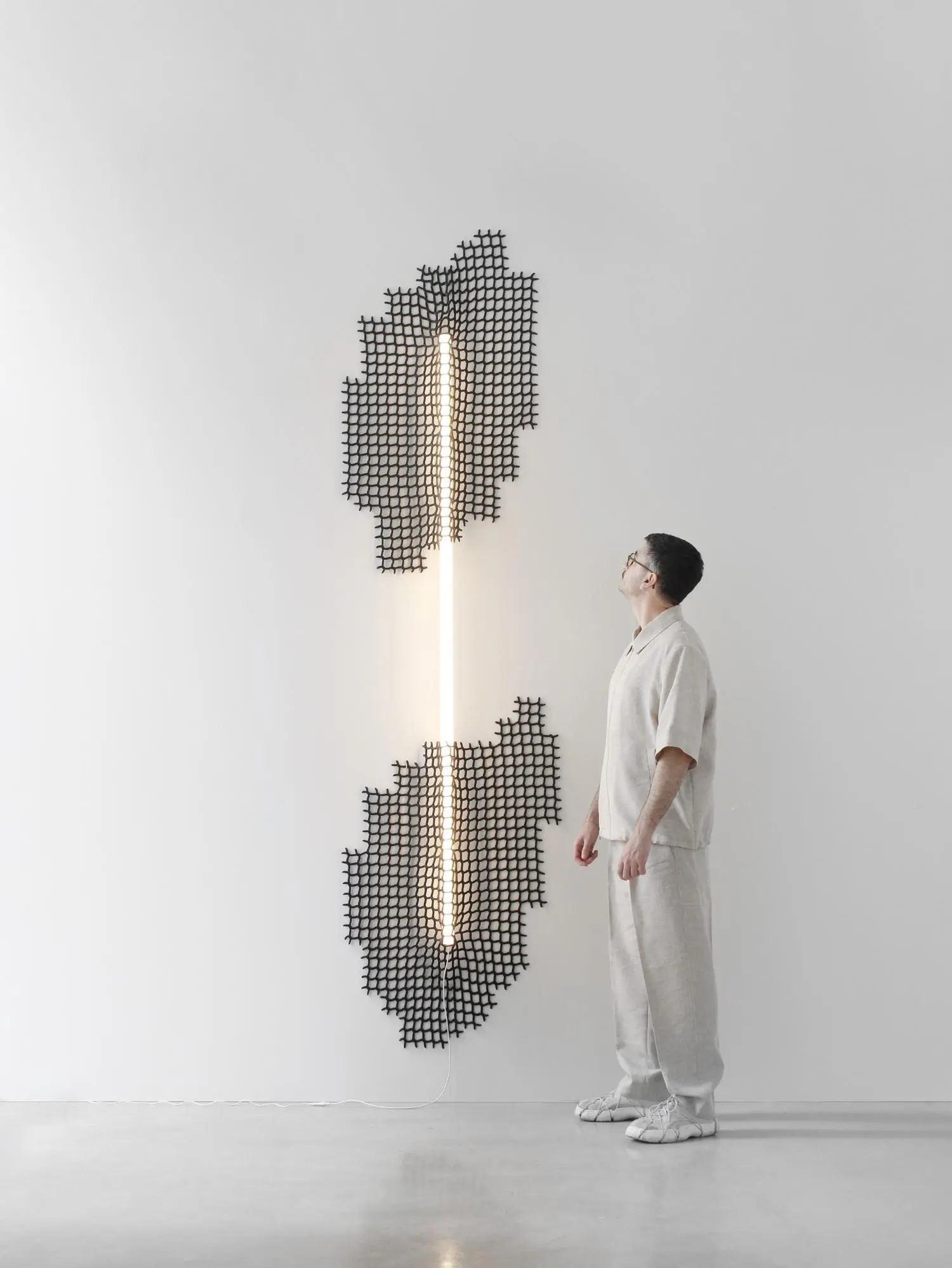
A gallery visitor observes Permanent Souls’ illuminated woven installation, where reclaimed fishing nets and vertical LED lighting merge into a sculptural work exploring material transformation and spatial presence.
That same instinct, keeping the evidence of a former use rather than sanding it away, shows up across several other projects that shared floor space with Iranzo’s work at Baggio this year, from studios reworking bamboo and spent tea leaves into social furniture to others building lighting fixtures out of laboratory glass offcuts. Alcova’s curators have never organized the fair around a single theme, but the concentration of designers pulling from waste streams this cycle suggests the idea has moved well past a niche interest and into something closer to a shared working method among younger European practices. What separates Permanent Souls from a lot of that company is how little the collection tries to disguise its process. Nothing about the finished chairs or stools hides the fact that they began as scrap netting pulled taut and locked in resin. The rawness is the design decision, not a byproduct of one.
There is also a quieter argument buried in the choice of materials themselves. Polypropylene netting and epoxy resin are both petrochemical products, hardly the first materials that come to mind when a designer talks about sustainability, and Iranzo has not framed the work primarily as an environmental statement. The project reads more convincingly as a study in memory and material persistence than as a circular economy pitch, which may be exactly why it has landed with critics the way it has. It asks what an object retains once its function disappears, rather than asking viewers to feel good about where the raw material came from.
fin
For now, Permanent Souls remains a small, tightly controlled body of work rather than a production line, which tracks with how Iranzo has talked about the project publicly, framing it as research rather than as a commercial furniture launch. Whether individual pieces move toward limited edition sales through a gallery, in the way collectible design frequently does after a strong Milan showing, has not been detailed publicly at the time of writing. What is clear is that the project marks a distinct expansion of Iranzo’s practice beyond the hospitality and retail interiors that built his reputation with Clap Studio, into a register closer to material research and gallery-facing sculpture, carried out under his own name and built around a single, tightly held idea about what an object keeps and what it loses once its first purpose is gone.
Related Articles
Pocket-sized Xbox Ctrl
Xbox Nano Controller. Announced 14 October 2026 by James Hunter. $49.99. Rechargeable battery. Programmable Action Button. Xbox Wireless and Bluetooth.