DRIFT AUDIO
Listen to this story
Choose a voice, then press play.
Blooms by Play-Doh marks the brand’s first adult line ever, joining Lego and Mattel in a kidult market now worth billions in annual toy sales.
In This Story
- The Kidult Economy Is No Longer a Niche
- Why Flowers, and Why Now
- A Brand That Has Reinvented Itself More Than Once
- A Crowded Shelf, and a Brand With Nothing to Lose
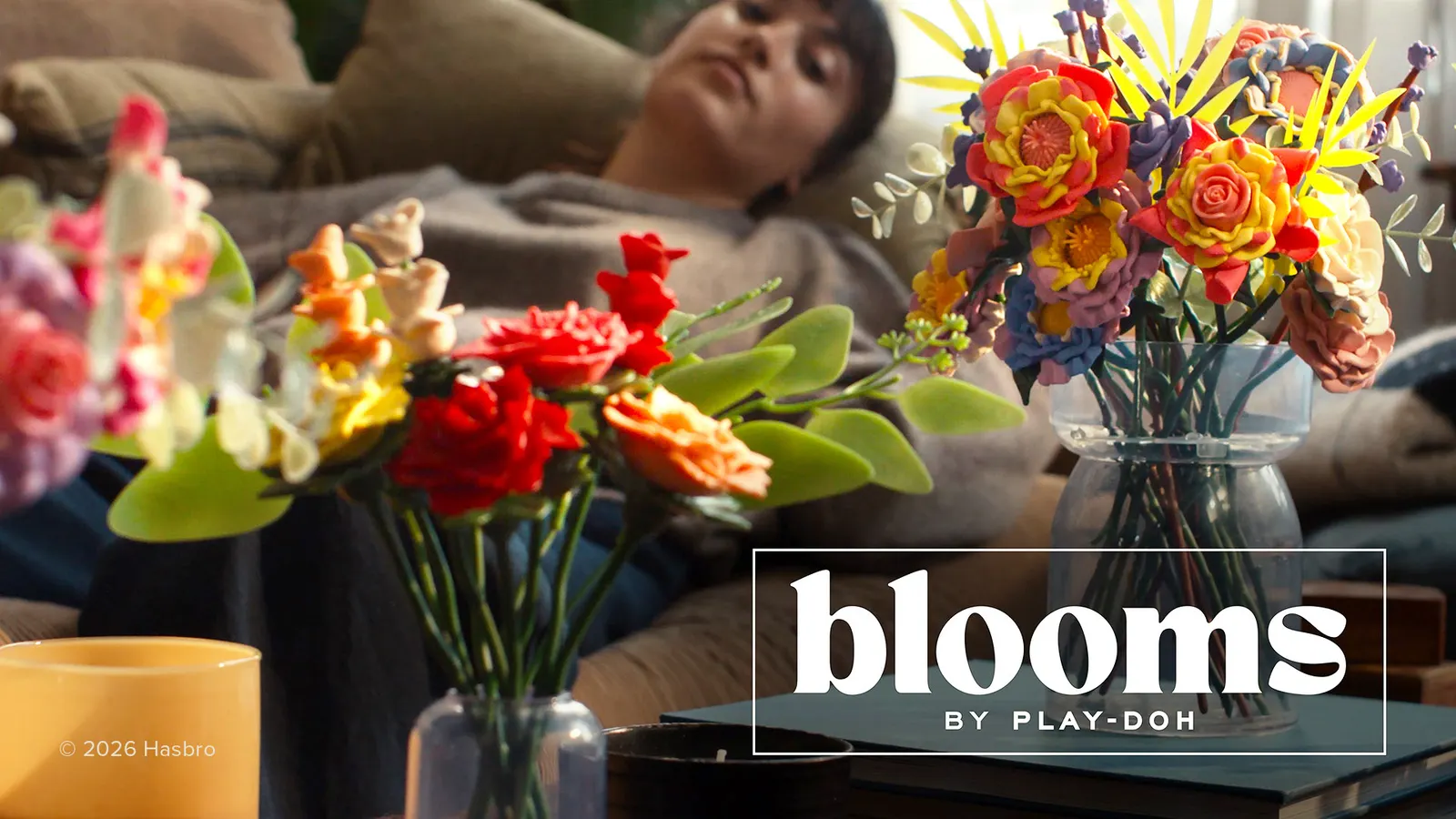
There is a version of nostalgia that toy companies have been chasing for the better part of a decade now, and this week Hasbro found its own entry point into it: flowers. Not real ones. Play-Doh ones. On Thursday, the company announced Blooms by Play-Doh, its first product line built entirely for adults in the 70-year history of the brand, and in doing so it made official something that has been obvious to anyone paying attention to the toy aisle for a while — the customer buying the toy and the person who’s going to use it are no longer reliably the same age.
Blooms by Play-Doh is, on its surface, a simple idea. Each kit comes with the familiar dough-like compound, along with molds, tools, a vase, and a finishing spray that hardens the finished piece so it can survive on a shelf for months rather than getting mashed back into a ball at bath time. You shape petals, you build a stem, you assemble something that looks — from a few feet away, at least — like a real, cut flower arrangement. Kits start at $24.99 and are rolling out now at Amazon, Target, and Walmart, with a selection landing on TikTok Shop on July 16, which will also mark the brand’s first appearance on that platform. There’s a modest content ecosystem to go with it too: how-to videos live on a dedicated Blooms by Play-Doh YouTube channel, presumably for anyone who hasn’t sculpted anything more ambitious than a snake or a pinch pot since third grade.
Brian Baker, the senior vice president overseeing Play-Doh at Hasbro, framed the launch in the company’s release less as a pivot and more as a continuation. The pitch, roughly: the feeling of unstructured, hands-on creativity that made Play-Doh a fixture in households for seven decades doesn’t disappear once you age out of the compound’s traditional target demographic — it just changes shape. Blooms, in his telling, is meant to give that impulse somewhere to go: a slower, more deliberate version of the same tactile satisfaction, aimed at people who want to end up with something they can actually display rather than something they’ll eventually step on in socks.
It’s worth sitting with how strange this sentence would have sounded ten years ago: a Play-Doh product line built for the coffee table instead of the playroom floor. But Hasbro is not exactly walking into unfamiliar territory. It is, more accurately, arriving fashionably late to a party its competitors have been throwing for years.
View this post on Instagram
flow
The industry has a name for the buyer Hasbro is chasing, and it is not a flattering one: the “kidult,” shorthand for an adult who buys toys — often expensive ones — for themselves, with no child anywhere in the transaction. It sounds like a punchline, and toy executives spent years treating it that way, largely because admitting your growth strategy depends on 35-year-olds buying building blocks felt like an odd thing to put in an earnings call. Nobody is being cagey about it anymore.
Lego started courting adult buyers in earnest about a decade back, launching a dedicated “Adults Welcome” line in 2020 that has since grown past 140 sets, including a Millennium Falcon that runs $850 and a Titanic replica priced similarly. That bet has paid out: the company’s consumer sales climbed 12 percent in a year when the broader toy industry actually shrank. Mattel has run its own version of the playbook — a $75 LeBron James doll aimed squarely at adult collectors sold out almost immediately, and the company has opened pop-up “UNO Social Clubs” where grown adults gather specifically to play cards together, no children required. Hasbro itself already has skin in this game through Wizards of the Coast: Magic: The Gathering, whose player base skews around age 30, has quietly become one of the company’s single biggest revenue drivers, north of a billion dollars annually.
The numbers underneath all of this are not subtle. Adults 18 and up now account for roughly a quarter of all toy sales in the U.S., and that slice has been the fastest-growing segment in the industry even as sales to children have stagnated or dipped. One widely cited industry estimate pegs kidult spending at around $9 billion a year globally. A separate market analysis projects the “kidulting toys” category specifically — as distinct from toys that simply happen to appeal to some adults — growing from roughly $38.7 billion in 2025 to over $43 billion this year, and toward nearly $68 billion by the end of the decade. Whatever the precise figure, the direction of travel is not in dispute: toy companies are no longer treating adult buyers as a bonus audience sitting on top of the “real” business. For a growing number of product lines, adults are the business.
Fast Company‘s framing of the Blooms launch cut right to this: it described the release as one of Hasbro’s most direct swings yet at the kidult segment, arriving in the wake of similar moves from Lego and Mattel rather than ahead of them. That’s a fair read. Hasbro isn’t inventing the adult-crafting moment here so much as finding a Play-Doh-shaped door into a room its rivals already walked into.
why
The specific choice of florals is not arbitrary, and it says something about what toy companies think stressed-out adults actually want from a hobby right now. Hasbro’s own research, drawn from more than 10,000 adults surveyed globally, found that roughly one in seven engage in arts and crafts specifically to relieve stress. Layer that against another figure the company cited — nearly 80 percent of Gen Z and Millennial respondents reporting feelings of burnout — and the strategic logic becomes fairly legible: this is less a toy pitch than a wellness pitch wearing a toy company’s branding.
That instinct tracks with what’s happening elsewhere in the category. Lego’s Botanicals line, launched in 2021 and inspired by flower arrangements employees originally made as gifts for each other, has become one of the company’s best-selling adult product families, explicitly marketed around the idea of quiet, repetitive, screen-free focus. The broader “cozy culture” trend — low-tech, sensory, deliberately unhurried hobbies — has been flagged by toy-industry trend trackers as one of the defining threads going into 2026, running alongside (and in some tension with) flashier, more collector-driven fandom crazes like Labubu figures or trading cards. Blooms lands closer to the Lego Botanicals end of that spectrum than the frantic, blind-box, resale-market end. Nobody is going to flip a Play-Doh bouquet for profit on the secondary market. That’s arguably the point — it’s being sold as an antidote to that kind of consumption, not a new venue for it.
View this post on Instagram
There’s also a home-decor angle that Hasbro is leaning into more directly than a typical toy release would. The company’s own language around the launch describes it as an entry into “adult crafting and home décor,” not merely adult crafting — positioning the finished flowers less as a completed project to be proud of and more as a decorative object with a shelf life measured in months, thanks to that finishing spray. That’s a meaningfully different value proposition than, say, a jigsaw puzzle or an adult coloring book, categories that dominated the last wave of “grown-up craft” products roughly a decade ago. Those were about the process and then the product got put away. Blooms is selling the process and a permanent-ish object for your mantel.
manifesto
There’s a bit of trivia that keeps surfacing in coverage of the Blooms launch, and it’s worth dwelling on because it undercuts the idea that Play-Doh is some untouchable, static piece of Americana that Hasbro is finally daring to modernize. The compound wasn’t invented as a toy at all. According to Smithsonian Magazine‘s account of the brand’s history, it started life in the early twentieth century as a wallpaper cleaner, a putty-like product designed to lift soot and grime off walls, before a schoolteacher’s observation that kids liked conjure with the stuff led to its reinvention as a children’s product in 1956. In other words, the single defining fact about Play-Doh, if you zoom out far enough, is that it has already been repurposed once before, for an entirely different demographic doing an entirely different task. Blooms isn’t a betrayal of what the product has always been. It’s arguably the compound doing what it’s always done: getting handed to a new group of people who find a new use for it.
That history also explains something about why Hasbro can move into adult crafting without much brand risk. Play-Doh was never precious about its own identity the way a franchise built on characters or lore has to be. It’s a substance, not a story, and substances are infinitely more elastic than stories. You can point a wallpaper cleaner at a kindergarten classroom, and sixty years later you can point the toy that grew out of it at a stressed-out thirty-four-year-old with a finishing spray and a vase. Nothing about the underlying product has to change its meaning to make that leap.
theory
Retail Dive‘s coverage of the announcement noted something worth flagging on its own: more than half of toy category growth between January and April this year came from women, according to Circana data — a detail that matters given how squarely floral crafting, as a category, skews toward a female buyer relative to, say, action figures or trading card games. If Hasbro’s internal data holds up, Blooms may be less a general kidult play than a fairly targeted bet on where the growth inside that broader trend is actually concentrated.
It’s also a low-risk one for the company to make. Play-Doh has 70 years of brand recognition and essentially zero reputational baggage to protect against — it’s about as safe and universally trusted a name as a toy company can put on a new product. There’s no franchise fatigue to worry about, no fandom to alienate, no long-running collector community with strong opinions about canon or authenticity. It’s a blank, familiar, slightly beloved substance getting pointed at a new job. Compare that to the tightrope Hasbro walks with something like its recently announced multi-year Harry Potter licensing partnership with Warner Bros. Discovery, tied to the upcoming HBO series — a deal with real upside but also real exposure to a franchise with a famously divided fanbase. Blooms carries none of that risk. Worst case, it just doesn’t sell, and Hasbro quietly folds it back into the regular Play-Doh line’s marketing calendar.
The TikTok Shop debut is the one piece of this launch that reads as genuinely new territory rather than a familiar playbook applied to a new product. Play-Doh, as a brand, has never sold directly through the platform before, and the choice to debut Blooms there — rather than through a more traditional retail-first rollout — suggests Hasbro is treating this less as a toy-aisle product and more as a discovery-driven, algorithm-fed lifestyle purchase, closer in spirit to how a skincare brand or a home-goods label might launch a new SKU than how a toy company traditionally introduces anything.
Whether Blooms becomes a durable pillar of the Play-Doh brand or a one-off seasonal experiment probably depends less on the product itself — which by most early accounts is well executed, approachable for total beginners, and reasonably priced against comparable adult craft kits — and more on whether Hasbro treats it as a genuine long-term bet or a single press cycle. The company has, after all, spent the better part of the last two years talking about “engaging fans across life stages” as a strategic priority, and Blooms is the clearest physical expression of that language to date. If the kidult numbers keep climbing the way Circana and the rest of the industry’s trackers suggest they will, this almost certainly won’t be Play-Doh’s last product built for someone old enough to remember when the compound only came in four colors.
Related Articles

Blown Spheres On An Extruded Bar
Luce Sferica by Ronan Bouroullec for Flos. Modular suspension. Glass spheres ~180 mm. Dual LED strips. Touch dimmer. Three lengths.