Acrylic Truths: The Singular Vision of Sabina Sinko’s AP VII

May 19, 2025
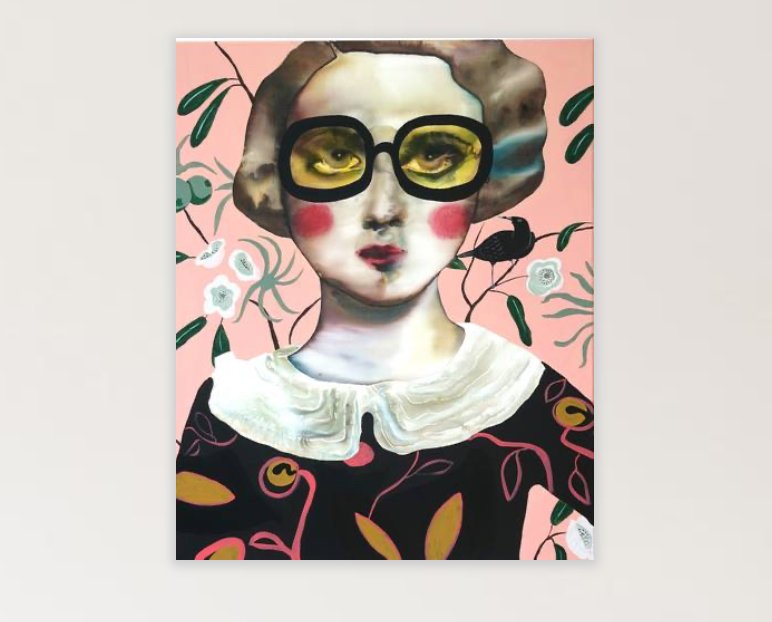
In a world overstimulated by digital imagery and algorithmic artifice, painting—especially painting on canvas—retains its stubborn humanity. Its slowness. Its refusal to be instantly consumed and discarded. It demands attention, and in doing so, reclaims a kind of primal intimacy between viewer and maker. Sabina Sinko’s AP VII, executed in acrylic on canvas, confronts this exchange head-on. It is a painting that does not whisper but asserts, not through volume but through density. Through layered presence. It’s the seventh in what appears to be an ongoing conceptual arc—AP, possibly “Artist’s Proof,” or perhaps “Abstract Process,” or even “Another Painting.” Sinko keeps the title cryptic, leaving the viewer unmoored, uncertain, and utterly compelled.
Sabina Sinko and the Language of Acrylic
Acrylic paint is often misunderstood—seen as plastic’s attempt at oil, or watercolor’s tougher cousin. It dries fast, resists easy blending, and punishes hesitation. But for artists like Sinko, it’s a weapon, a tool of precision and urgency. There’s no indulgence in her brushwork, no self-pity. Just assertion.
Sinko isn’t working with nostalgia. Her use of acrylic rejects the fetishism of oil’s sensuality. Instead, she’s more interested in friction—between color and surface, gesture and restraint, emotion and structure. Acrylic lets her say what she needs to say fast, and without apology. This is not art as seduction. It is art as confrontation.
Composition as Resistance
AP VII doesn’t beg to be liked. It doesn’t offer a focal point, a narrative, or an easy color story. At first glance, it might even seem indifferent. But this is the brilliance of its construction. It resists the instinct to explain itself. Every line, every layer of pigment, has been placed with the precision of someone who knows exactly what they’re doing—and knows that not everyone will understand it. That, too, is part of the point.
The composition leans into imbalance. There’s a spatial asymmetry that borders on collapse, but never falls. It teeters. A thick, nearly violent sweep of charcoal grey diagonally bisects the canvas, crashing into an oblong shape of dirty saffron. There’s a jarring swatch of crimson just off-center—bloodlike, but not dramatic. Almost casual in its violence.
The tension is constant. One gets the sense that Sinko spent more time knowing when not to add a stroke than when to add one. Restraint is the hidden architecture here.
Thematic Density and Emotional Understatement
There’s a kind of minimalism in AP VII, but not the clean, Scandinavian kind. This is more brutalist—raw, textured, emotionally complex. Sinko doesn’t decorate. She distills.
Some might call it abstract, but that word’s too lazy here. This painting is not a representation of nothing. It is a portrait of feeling, eroded and redacted until only the bones remain. Look long enough, and it starts to feel like a document. A map. A confession.
There’s a deep fatigue in the palette—earthy umbers, rust-streaked whites, muddled greens that never quite settle into harmony. The energy is not chaotic, but haunted. It speaks of repetition, of cycles. Of trying again and again to say something unnamable.
Art Historical Echoes
Sinko doesn’t live in a vacuum. Her work hums with influence, but never mimicry. There are echoes of Antoni Tàpies in the surface textures, of Cy Twombly in the near-gesture of writing, and even of Lee Krasner in the emotional rigor. But Sinko pulls it into the now.
If anything, she belongs to a lineage of women who refused to be categorized—who used painting as a kind of rebellion. AP VII rejects the male bravado of traditional Abstract Expressionism. There’s no ego in its marks. No desperate need to perform. It is quieter. Harder. More honest.
The Politics of Obscurity
In a time when so much art is about accessibility and social engagement, AP VII does something brave: it insists on ambiguity. It invites misunderstanding. It denies the viewer easy answers. That is a political act.
We live in a time that worships clarity. But clarity can be a lie. Sinko gives us complexity instead. A kind of visual opacity that mimics emotional reality. This is not just a painting. It’s a confrontation with our desire for resolution.
Materiality and Surface Tension
Close inspection reveals the true depth of Sinko’s practice. The canvas is not flat. It’s built up in layers, scraped down, repainted. There’s evidence of process—ghosts of earlier ideas buried beneath the final image. A palimpsest.
In this way, AP VII feels like memory. Not a snapshot, but a sedimented collection of impressions. Something has happened here. Something has been lost. Something remains.
The material choices—acrylic applied with brushes, palette knives, perhaps even rags—speak of urgency and revision. She is not afraid of failure. In fact, failure is part of the work. It’s what gives it weight.
Context and Series
As the seventh piece in what appears to be a series, AP VII raises questions of continuity. What came before? What comes next? Does each painting stand alone, or are they part of a larger architecture of meaning?
Sinko refuses to spoon-feed these answers. Her series does not operate like a traditional narrative. It’s more like a poem cycle—each piece a stanza in a larger, nonlinear articulation of thought and emotion. There is no final “meaning” to decode. There is only the work. And the looking.
Viewer as Participant
This painting doesn’t just hang on a wall. It implicates you. It demands patience, attention, and a willingness to feel uncomfortable. In an era of short attention spans, this is radical.
Sinko’s refusal to explain forces the viewer to project. You don’t “understand” AP VII. You live with it. You wrestle with it. You let it infect your thoughts.
Impression
AP VII is not a decorative object. It is not here to be pretty. It’s not “instagrammable.” And that’s its power.
Sinko makes painting dangerous again. She reminds us that to paint is to risk sincerity. That abstraction, when done with conviction, can tell truths realism can’t touch.
This is a painting for those willing to do the work—willing to look longer, to think harder, to feel more deeply. It does not entertain. It challenges. And in doing so, it offers something rare: a moment of real encounter.
Related Articles

KAWS Brings FELLOWS Into the Dark With a New All Black Vinyl Figure
KAWS has confirmed FELLOWS, a new 11.2 inch vinyl and paint figure, releasing later this […]