
DRIFT AUDIO
Listen to this story
Choose a voice, then press play.
stir
Founded in 2019, Aether emerged from a long-form collection between Hannes Unt, Andy Shi, and Raymond Shi—three specialists whose backgrounds span product design, branding, and creative direction. Their working relationship traces back to 2014, when projects like Memorieslab began shaping a shared language around design and experimentation.
Unt’s trajectory into design began early, building digital platforms as a teenager in Estonia before transitioning into agency work and eventually founding his own studio. His later merges with the Shi partners refined a multidisciplinary approach—one that would ultimately define Aether. Together, they identified audio eyewear as a category still in formation, one capable of supporting both aesthetic refinement and technical innovation.
The brand’s philosophy draws heavily from Scandinavian minimalism, but it avoids purity for purity’s sake. Instead, it introduces a subtle avant-garde edge—what Aether frames as a balance between technology and spirit. The goal is not to overwhelm the user with features, but to integrate them quietly, allowing experience to unfold naturally.
flow
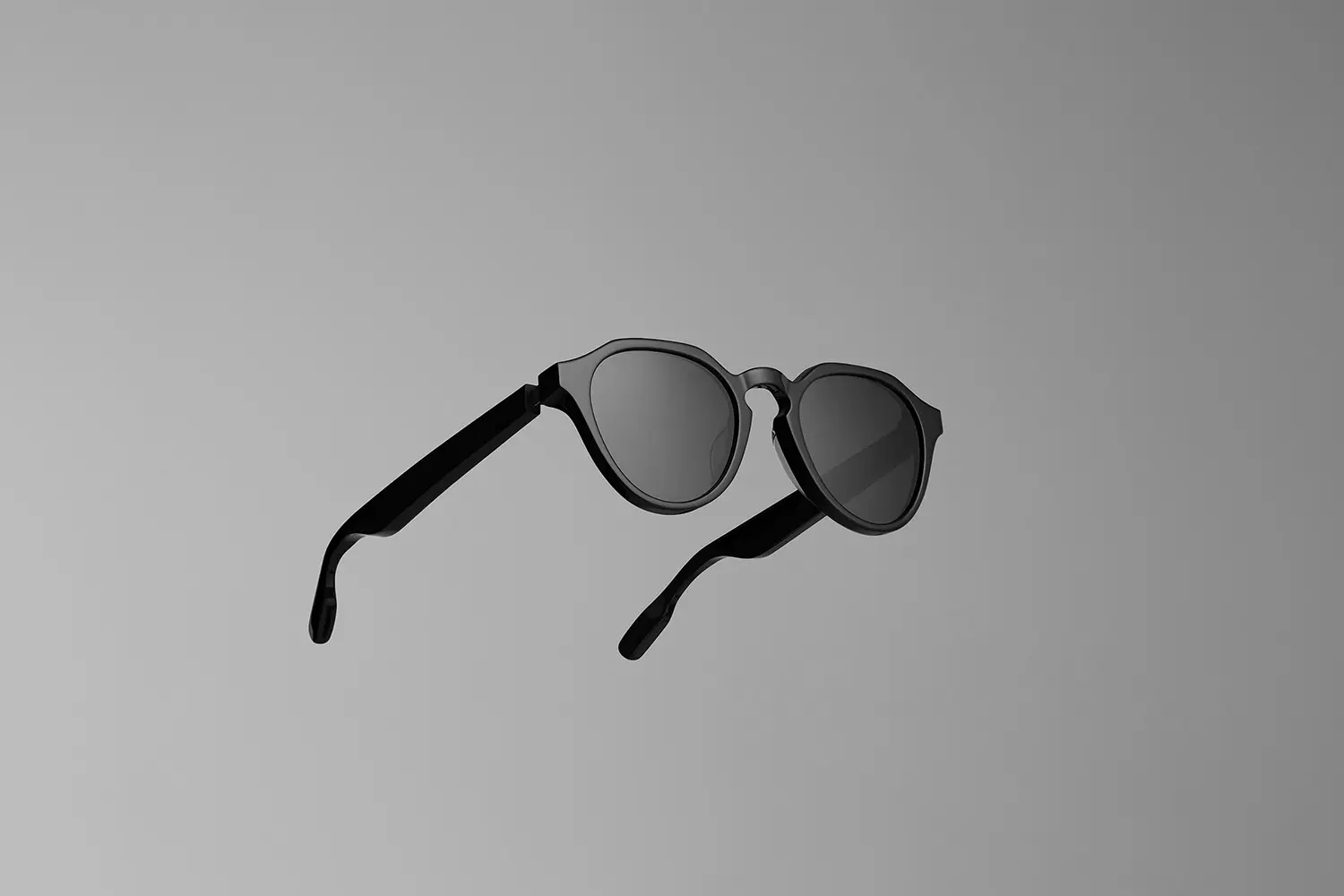
Aether’s first collection, introduced around 2021, established a clear design framework: five core models offered as both sunglasses and optical-compatible frames, including blue-light variants. The palette remains controlled—black, dark grey, and smoke brown—allowing form and material to carry the visual weight.
Each pair weighs under 40 grams, emphasizing all-day wearability. The frames are constructed using Mazzucchelli 1849 acetate from Italy, mechanically cut and hand-finished through a detailed multi-step process that prioritizes durability and tactile refinement. Lenses are supplied by Carl Zeiss Vision, incorporating UV protection alongside anti-reflective, scratch-resistant, and fog-resistant treatments.
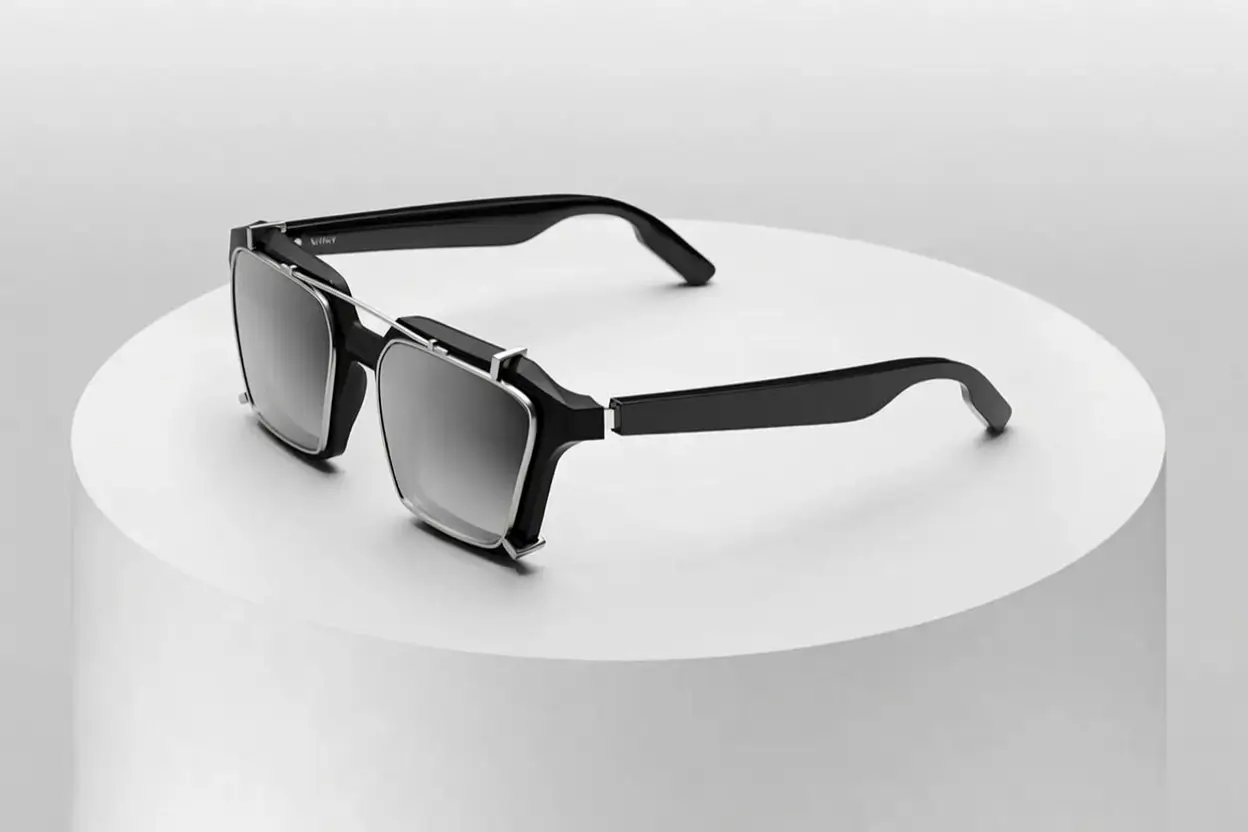
The collection’s structure is straightforward but intentional. Square silhouettes (S1, S2) balance familiarity with subtle variation, while D-frame and round options (D1, R1, R2) introduce shifts in geometry and proportion. The R2, in particular, leans toward a more expressive identity, combining angular shaping with contrasting surface finishes.
What remains consistent across all models is the principle of invisibility. The technology is not showcased—it is absorbed into the object. The eyewear reads first as a design piece, only secondarily as a device.
idea
The defining feature of Aether Eyewear lies in its open-ear audio system. Discreet speakers are embedded within the temples, directing sound toward the ear while minimizing leakage. Powered by Bluetooth 5.1 with Qualcomm aptX support, the system delivers stable, high-quality audio across music, calls, and media.
The experience differs fundamentally from traditional headphones or earbuds. There is no physical occlusion, no separation from the surrounding environment. Instead, sound exists alongside ambient noise, creating a layered listening experience. The effect is subtle but distinct: an augmentation of reality rather than an escape from it.
Interaction remains minimal. A simple tap on the frame activates connectivity, maintaining the product’s emphasis on intuitive use. Reviews often note that while the system does not aim for deep bass or isolation, it succeeds in clarity and convenience—particularly for calls and everyday listening.
scope
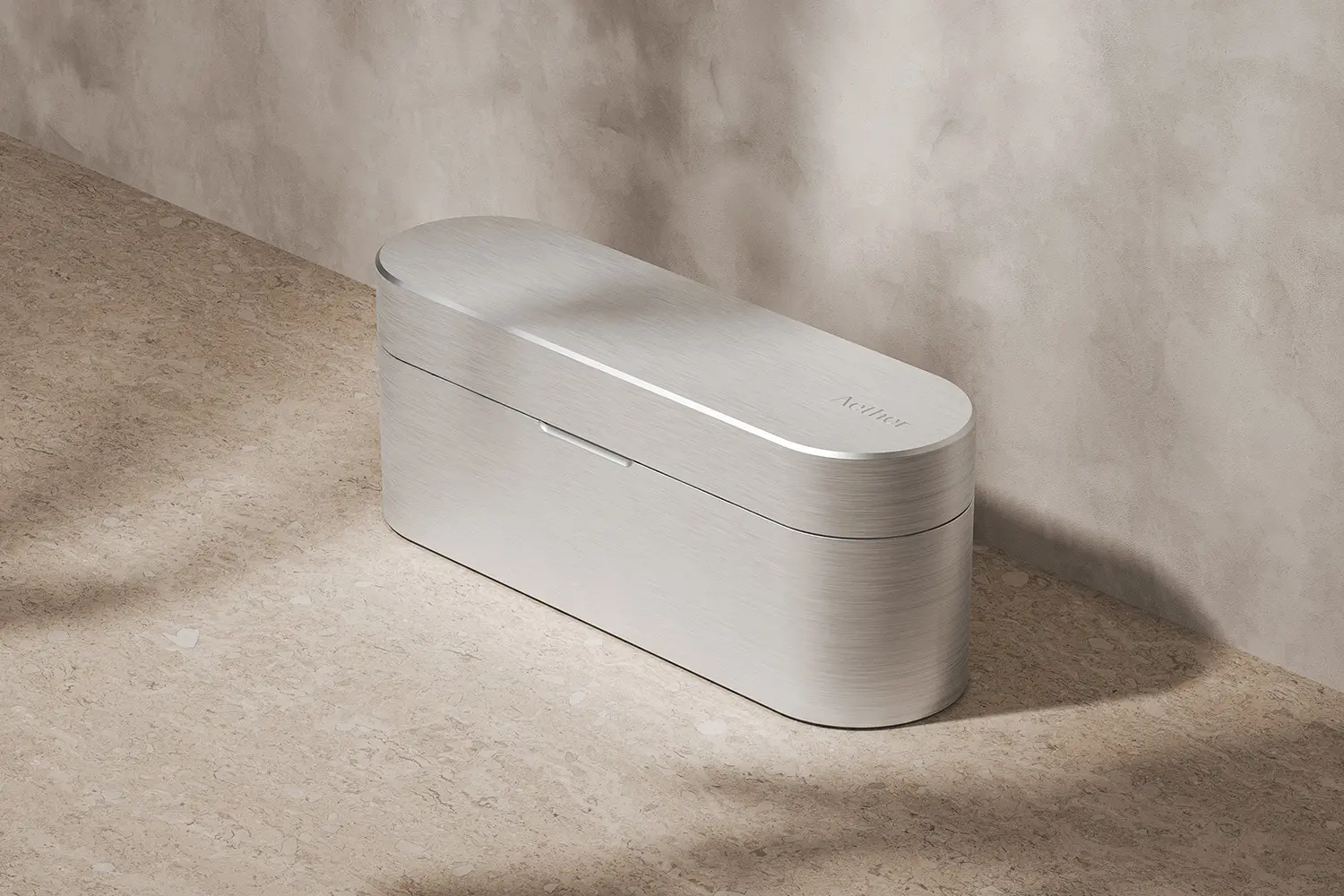
Beyond the glasses themselves, the charging case extends Aether’s design philosophy into the broader user experience. Constructed from brushed aluminum, it functions as both a storage unit and a portable power source, offering multiple charges while maintaining a compact, sculptural form.
This attention to peripheral design transforms routine interaction into a considered ritual. The weight of the metal, the precision of the finish, the simplicity of the form—all reinforce the idea that Aether operates within a lifestyle framework rather than a purely technological one.
Users often describe a shift in how they engage with audio. Without the isolation of earbuds, everyday moments—walking, commuting, moving through space—become layered rather than divided. Sound becomes additive, not dominant.
position
Within the broader smart eyewear market, Aether occupies a distinct position. While companies like Bose and Oakleyexplore similar integrations, their products often retain a visible, gadget-oriented identity. Aether moves in the opposite direction, prioritizing discretion and timelessness over overt technological expression.
This distinction extends to longevity. As hardware evolves, Aether’s frames remain viable as standalone objects. The emphasis on material quality and classic design reduces the risk of obsolescence, positioning the product closer to traditional luxury eyewear than to disposable tech.
Sustainability, in this sense, is approached through durability and restraint rather than overt messaging. The product is designed to last—view, materially, and functionally.
relev
In 2026, Aether’s relevance lies in its response to a broader cultural condition: a landscape defined by constant noise, distraction, and overstimulation. Rather than competing within that noise, the brand offers a quieter alternative—one that reframes technology as an enhancer of presence rather than a tool of escape.
Initiatives like Aether Research and Aetherapy extend this philosophy beyond hardware, exploring intersections between AI, sound, and human perception. These projects suggest a future in which the brand evolves not just as a product manufacturer, but as a curator of sensory environments.
Challenges remain. Battery life, geographic availability, and the inherent limitations of compact audio systems all present ongoing considerations. Yet Aether’s iterative, design-led approach positions it to adapt, refining both form and function over time.
fin
Aether Eyewear ultimately reframes the role of wearable technology. It shifts the conversation away from feature accumulation and toward integration—how technology can exist within objects without dominating them.
For a user, the appeal is not purely technical. It is experiential. The ability to move through space with a subtle, personal soundtrack—without losing awareness of the environment—creates a new kind of interaction with the everyday.
In this sense, Aether does not attempt to redefine reality. It simply adjusts its texture. View and sound align, quietly, within a single object—an equilibrium that feels less like innovation for its own sake, and more like a considered evolution of how we experience the world.
Related Articles

BAPE Opened An iPhone 18 Order Window And Put Camo On The New Last
Four cases. Shark with a magnetic mini pouch. Glow solid camo. City camo. Color camo. […]