DRIFT AUDIO
Listen to this story
Choose a voice, then press play.
A motorcycle crossing volcanic salt flats, a Teddy Afro sample, and a debut album called Zero — the London-raised Ethiopian-Egyptian artist explains why Afar was the only place this video could exist.
In This Story
- A Video Shot at the Edge of the Earth
- Riding the Volcanic Plains
- A Sample With Sentimental Weight
- Maktoub Within Zero
- The Artist Behind the Lens
There are easier places to shoot a music video than Afar. The region sits at the point where the Arabian, Nubian and Somali tectonic plates pull apart from one another, a slow-motion rupture that geologists say will, over millions of years, split East Africa and let the ocean flood in. It is also, by most measures, one of the most punishing environments on the planet: temperatures regularly climb past 50°C, and stretches of the Danakil Depression sit some 125 metres below sea level, making it among the lowest and hottest inhabited places on Earth.
For Alewya, the London-based Ethiopian-Egyptian artist, producer and visual creative, that combination of extremity and origin was the entire point. Afar is widely regarded by paleoanthropologists as one of the cradles of early human life, and it’s this lineage — humanity’s own beginning — that drew her back for the video accompanying her single “Maktoub,” the fifth cut from her debut album Zero.
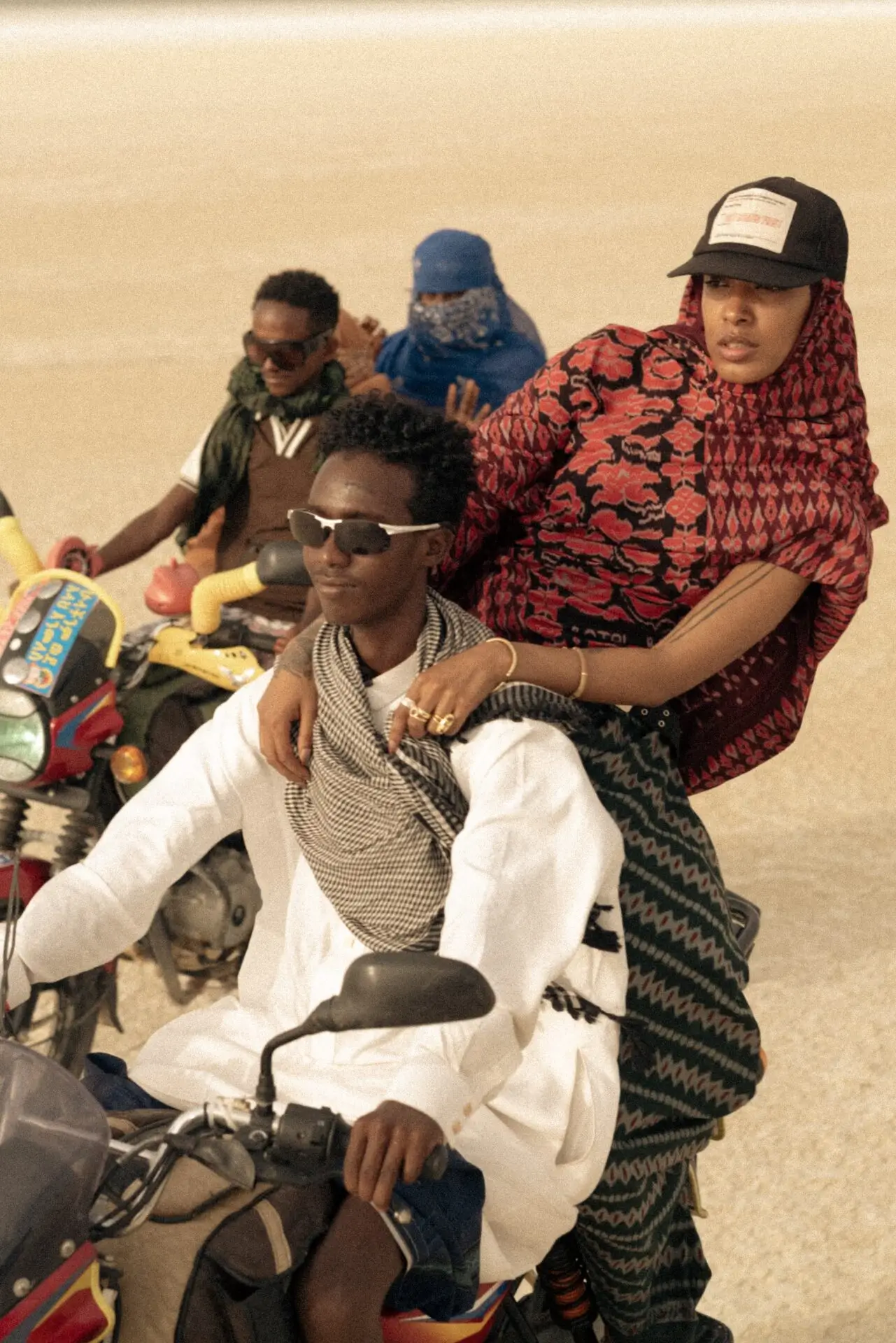
Models ride across a vast salt flat on motorcycles, combining layered contemporary fashion with local influences in a cinematic desert editorial.
Reaching the location was itself an undertaking. Alewya and a small crew flew two hours from Addis Ababa, then drove a further eight hours across the country, camping and hiking through the volcanic terrain before arriving at the salt lakes where the video was ultimately filmed. She has described the wider Afar region as feeling almost extraterrestrial — dune fields, salt pans, and stretches where the soil runs purple and the rock splits into crystal-veined layers, remnants of a landscape still being pulled apart at a geological level.
The Afar people themselves carry a particular significance for the artist. Long known for surviving in one of the harshest climates on Earth, the nomadic Afar have also maintained a fierce independence, resisting both neighbouring empires and European colonial powers throughout their history. “The Afar people are warriors who have lived on their own terms for centuries, and the women carry a grace that makes me feel close to God,” Alewya has said of the community, framing the shoot less as a location choice and more as a homecoming to “the closest place to the beginning.”
That framing matters when weighing why this particular corner of Ethiopia, rather than a studio or a more conventionally photogenic location, was worth the physical toll of reaching it. Afar isn’t easy to get to, and it isn’t easy to work in once a crew arrives — the heat alone rules out large stretches of the day for filming, and the terrain is unforgiving on people and equipment alike. For an artist whose catalogue is preoccupied with origin, resistance and self-determination, the difficulty of the location reads as part of its meaning rather than an obstacle to it. Afar isn’t used here as scenery; it’s treated as a place with its own agency, one the artist has to meet on its own terms rather than bend to a shoot schedule.
flow
The “Maktoub” video, directed by Lee Trigg, follows Alewya and a small crew of friends riding motorcycles across the plains of Afar, intercut with footage of the group running barefoot across the salt-crusted earth. The visual leans into stillness as much as motion — vast, near-empty frames of desert broken only by the bikes, the dust they kick up, and the human figures moving through terrain that dwarfs them.
It’s a deliberate rejection of spectacle for its own sake. Rather than treating Afar as an exotic backdrop, the video positions the landscape as a collaborator: the tectonic instability underfoot becomes a visual echo of the song’s own preoccupations with fate, resistance and self-determination. Alewya has said the region felt like “another planet” when she was there, noting that several other equally striking parts of Afar — including areas resembling Mars-like terrain — went unshot due to weather constraints during the trip.
The imagery also builds directly on Alewya’s visual language established across her earlier work, where she has repeatedly folded her own drawings, Ethiopian Niksat-style body art and painterly instincts into her videos. Describing herself as “a painter who makes music,” she has said that her route into music ran through painting, graffiti and animation before it ever touched a microphone — a background that shows in the way “Maktoub” is composed more like a moving painting of a place than a conventional performance video.
Notably, the motorcycle-and-desert visual isn’t the only version of “Maktoub” circulating. A separate visualiser pairs the track with footage of the Addis Girls Skate collective, a Addis Ababa-based skateboarding community, extending the song’s themes of movement and self-determination into an entirely different setting and cast. Taken together, the two visuals suggest an artist treating a single piece of music as a starting point for multiple, complementary stories about contemporary Ethiopian identity — one rooted in ancestral land, the other in a younger, urban subculture — rather than settling on one fixed reading of the song.
There’s also a formal patience to the “Maktoub” video that’s worth noting. Rather than cutting rapidly between performance shots, long stretches of the video simply let the landscape breathe — wide, static-feeling frames that hold on the horizon line, the shimmer of heat off the salt crust, or the dust trail behind a single motorcycle for several beats longer than a typical music video would allow. That patience mirrors the song’s own structure, which favours groove and repetition over rapid melodic movement, and it reinforces the sense that the video was built to be felt as an environment rather than consumed as a sequence of shots.
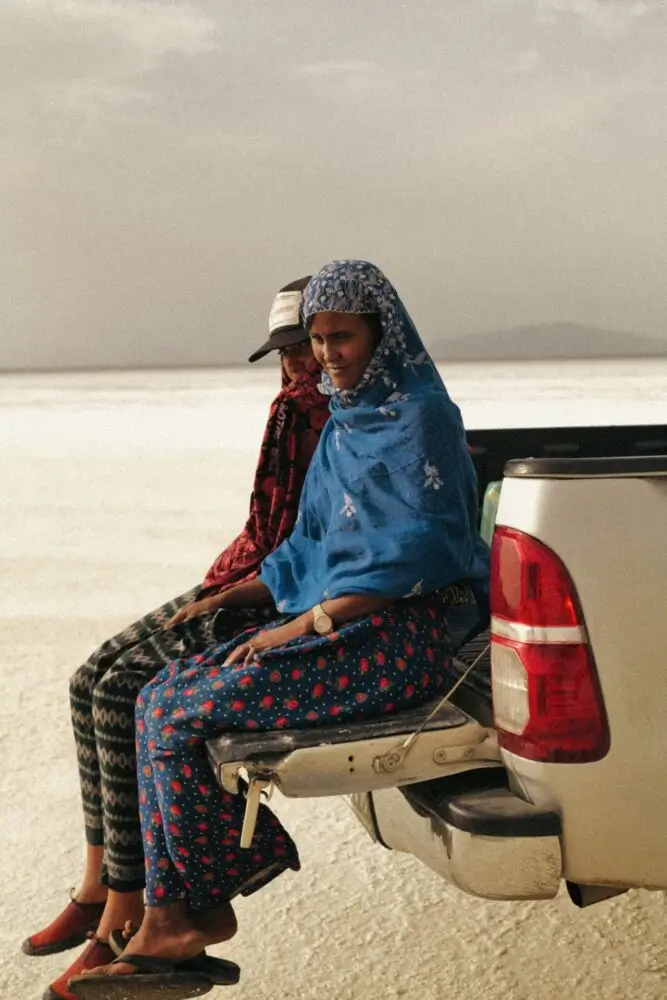
Two figures rest on the tailgate of a pickup truck overlooking a vast salt flat, blending vibrant textiles with a serene, sunlit landscape.
biopic
Underpinning “Maktoub” is a sample from Teddy Afro, the Ethiopian singer-songwriter widely regarded as one of the most significant artists in the country’s modern musical history. Alewya has said the choice was rooted in sentiment rather than strategy: Teddy Afro’s music was a constant presence for her growing up, as it was for several generations of Ethiopians and Eritreans before her.
That generational weight matters here. Teddy Afro’s catalogue — from his early reggae-inflected records through to the historically minded Tikur Sew and Ethiopia albums — has long doubled as a kind of national soundtrack, at times a politically charged one. Folding his vocal into a dancehall-reggae-adjacent, trap-inflected production is Alewya’s way of placing her own genre-blurring sound in direct lineage with the music that shaped her, rather than sampling it as texture alone.
The track itself moves between hard-hitting, riddim-led rhythm and Alewya’s own reggae-influenced vocal, carrying lyrics that touch on resistance, destiny and self-determination — themes she has described as fiercely feminist and pro-Black in intent. “Maktoub,” the Arabic word for “it is written” or “destined,” gives the song its title and its emotional register: a sense that the direction of the track, much like the direction of the video, arrived more through instinct than planning. “Sometimes songs take time to reveal themselves, but Maktoub felt immediate and effortless from day one,” Alewya has said of the writing process. The track received its radio premiere from Jamz Supernova on BBC 6Music ahead of the video’s release.
Teddy Afro’s own career has rarely been separable from Ethiopia’s political life, which adds another layer to the sample’s presence on “Maktoub.” His 2005 single “Yasteseryal” became a flashpoint during a contested general election, and its subsequent radio ban — along with a widely disputed criminal conviction that saw him imprisoned for several years — only deepened his standing as an artist whose music carries weight beyond entertainment. Records like Tikur Sew, built around the 1896 Battle of Adwa, and the aptly titled Ethiopia have gone on to become some of the best-selling releases in the country’s history. Placing his voice inside a song about faith and destiny, on a video shot in the literal cradle of humanity, reads less like a guest feature and more like a deliberate act of lineage-building — one artist audibly passing something down to another across generations of Ethiopian music.
single
“Maktoub” arrives as the fifth single from Zero, Alewya’s debut album, released via LDN Records. The record follows a run of singles that each explored a different corner of her sound: “City of Symbols,” “Night Drive” (featuring Dagmawit Ameha), the piano-and-modular-synth-driven “Eshi,” and “Selah,” produced with Busy Twist. Where those tracks range across Afro-electronic percussion, traditional Ethiopian piano lines and club-facing production, “Maktoub” pulls the album toward its most physical, rhythm-forward register.
Zero was co-produced by Alewya alongside longtime convincers Craigie Dodds and Dean James Barratt, with additional contributions from Busy Twist and executive production from Shy FX, the producer and mixer who has worked with Alewya since her earliest singles. The album’s title draws partial inspiration from Charles Seife’s book Zero: The Biography of a Dangerous Idea, with the record exploring the number as both absence and infinite possibility — a place of surrender and renewal that mirrors the “birthplace” framing of the Afar shoot itself.
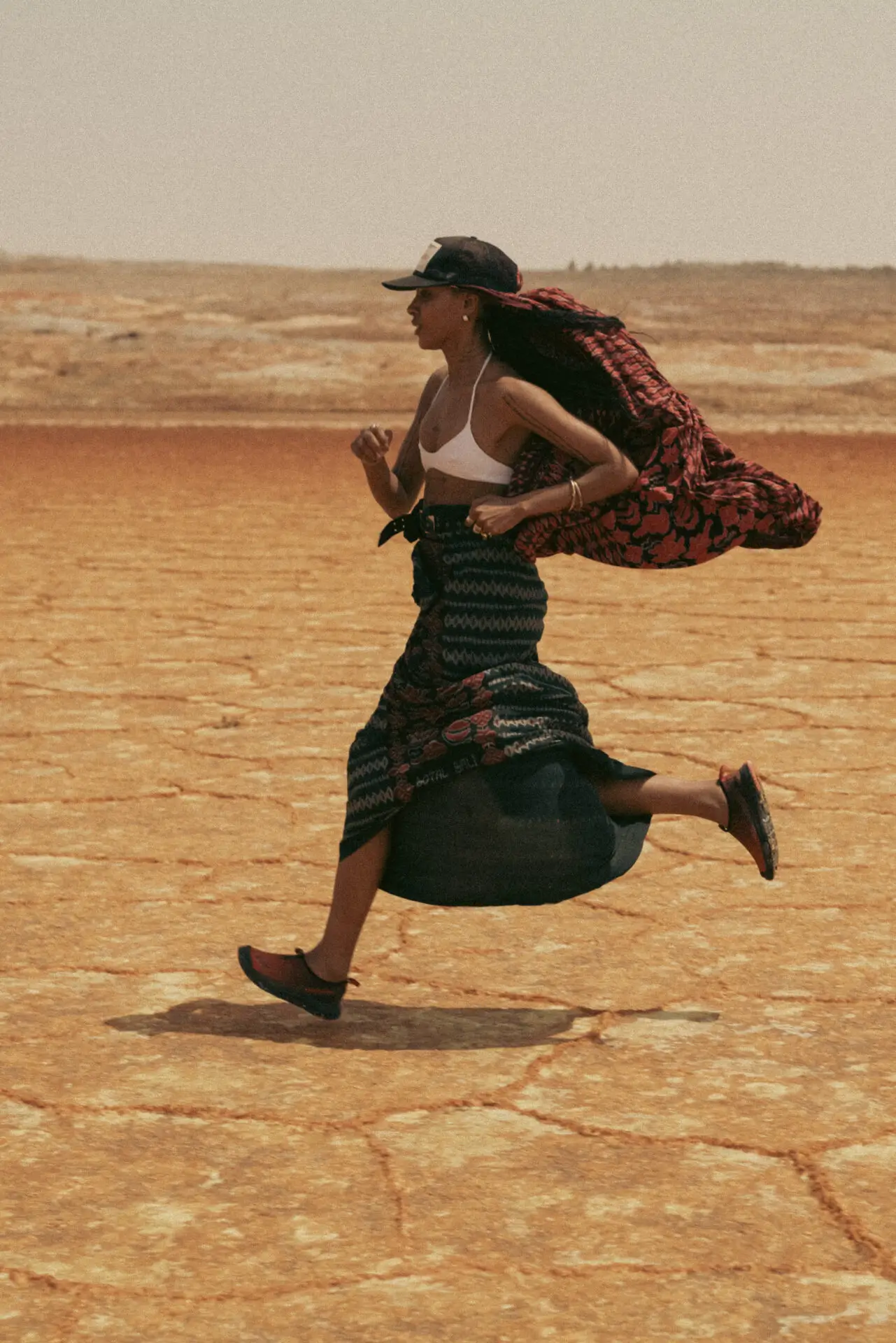
A model sprints across a cracked desert plain as a patterned scarf billows behind, capturing movement and contemporary style against an expansive arid landscape.
Zero continues a creative throughline that runs across Alewya’s catalogue: an insistence on treating heritage as raw material rather than aesthetic reference. That approach first drew wider attention through her guest verse on Little Simz’s“Where’s My Lighter,” and has since carried through festival stages including Glastonbury and Pitchfork Paris, as well as a tour supporting Little Simz and a prior collaboration with jazz drummer Moses Boyd on “The Code.”
The album arrives roughly five years after Alewya’s debut project, Panther in Mode, and follows a run of standalone singles — among them the drum & bass-inflected “Jagna,” a track whose title translates from Amharic as “warrior” and which earned Alewya a headline slot on the BBC Introducing Stage at Glastonbury. Where Jagna dealt in confrontation and release, Zero as a whole appears to be reaching for something closer to resolution: a body of work that treats the number zero not as an absence but as a kind of open threshold, a way of describing a state before definition rather than after it. “Maktoub,” sequenced late in that arc, functions almost like a statement of acceptance — the point in the record where fighting gives way to trusting whatever comes next.
That thematic arc is echoed structurally, too. Across “City of Symbols,” “Night Drive,” “Eshi” and “Selah,” Alewya and her collaborators move between Afro-electronic percussion, traditional Ethiopian piano lines run through modular synthesis, and hypnotic, club-adjacent production — each single functioning as its own self-contained mood rather than a step toward a singular sound. “Maktoub” pulls several of those threads together at once: the dancehall-reggae pulse recalls the record’s club instincts, the Teddy Afro sample anchors it in Ethiopian musical heritage, and the video’s stark, elemental imagery ties the whole thing back to the album’s preoccupation with beginnings.
lens
Alewya’s own path to the desert of Afar reflects a wider pattern in her career: an artist who treats her Ethiopian and Egyptian heritage not as a fixed identity to represent, but as a living source she keeps returning to and reinterpreting. Raised in West London after her family relocated from Sudan when she was five, she has spoken about the layered soundscape of her childhood — a local mosque’s call to prayer, Moroccan neighbours, Afro-Caribbean friends — as foundational to a sound that resists single-genre categorisation.
That resistance to categorisation extends to her visual identity as well. Before music, Alewya worked through painting and graffiti, later moving into animation and eventually production, using her own beats as a way of bringing her visual world into sound rather than the reverse. It’s a lineage that makes the “Maktoub” video feel less like a departure and more like a continuation — an artist who has always made images alongside music finally shooting on a landscape vast enough to hold both at once.
With Zero now released in full, “Maktoub” stands as one of its most direct statements: a song built on faith, destiny and roots, shot in the one place its author has called the closest thing to the beginning of everything.
From the DRIFT archive: Jodie Foster Narrates Morgan Neville’s Breakdown: 1975: A Cultural Autopsy of the Most Radical Year in American Cinema