DRIFT AUDIO
Listen to this story
Choose a voice, then press play.
A single steel-cut still life shows how Tom Wesselmann spent his final decades pulling drawing off the page and into physical space.
In This Story
- A Steel Garden: The Work at a Glance
- From Doodle to Drawing in Steel: Wesselmann’s Laser-Cut Innovation
- Reading the Composition: Four Roses, One Pear, and a Blue Pillow
- Still Life as Pop Language: Wesselmann’s Lifelong Genre
- Provenance, Market, and Where to See It
- Why It Still Matters
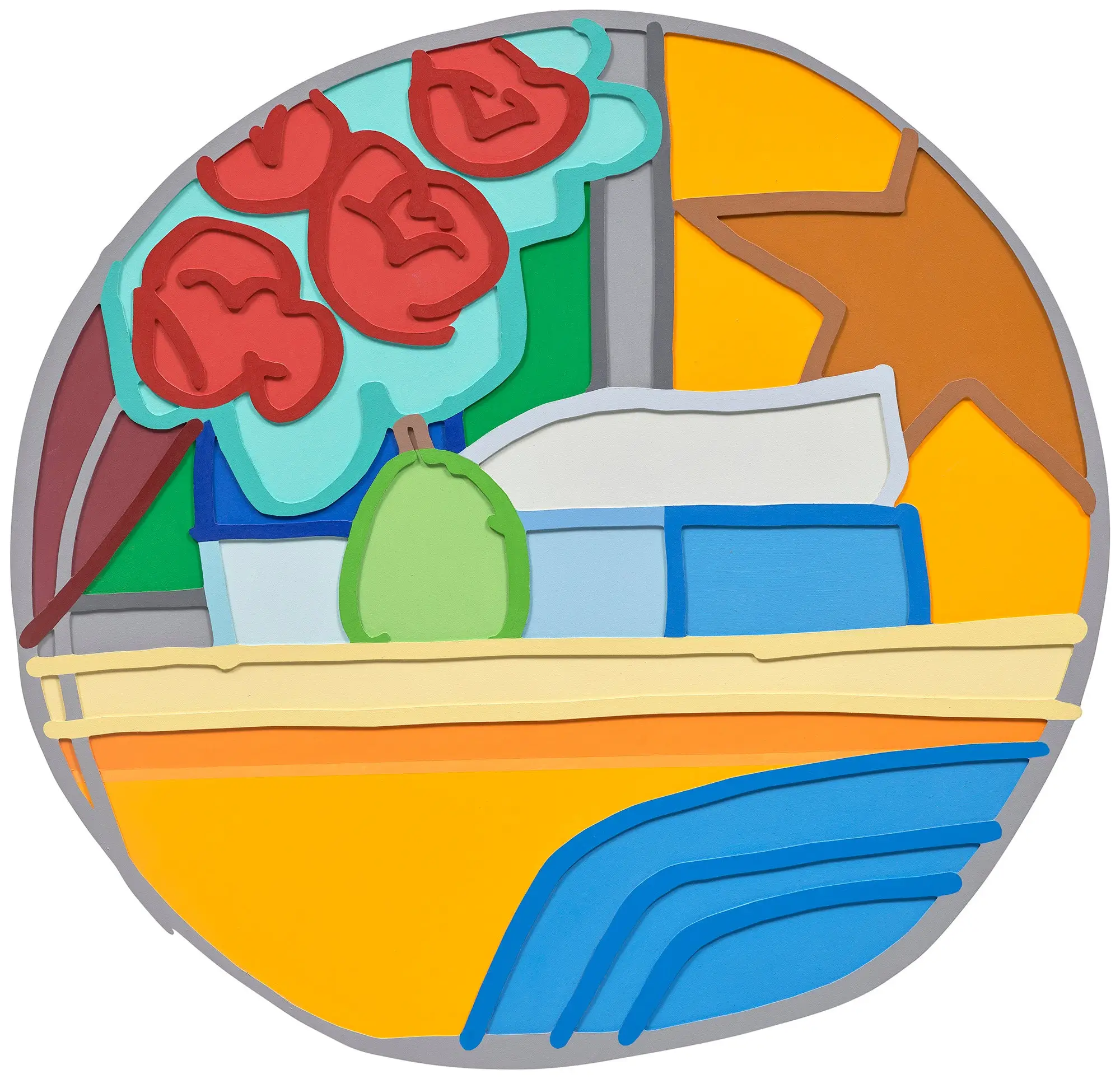
Still Life with Four Roses and Pear (Blue Pillow) is a compact but technical ambitious work by Tom Wesselmann, the American Pop artist best known for the Great American Nude series and his decades-long reinvention of the still life genre. Dated 1993 (with a related state marked 1968/1993), the piece is executed in alkyd paint on laser-cut steel that has been “filled in” — meaning the steel is not left as bare line but built up into solid, tincture-blocked shapes. The work measures roughly 55.9 by 59.7 centimeters, or about 22 by 23.5 inches, a scale that keeps the composition intimate rather than monumental, unlike the room-sized still lifes Wesselmann was producing in aluminum around the same period.
The subject is exactly what the title promises: four roses, a single pear, and a blue pillow, rendered as flattened, hard-edged shapes cut directly from sheet steel rather than painted onto canvas or panel. The gallery listing for the piece confirms the medium as alkyd on laser cut steel, filled in, with dimensions of 55.9 by 59.7 centimeters.
Versions of the work have circulated through the secondary market and specialist Pop Art dealers, including a recorded auction result in which the piece sold for $24,510 against a $15,000–$20,000 estimate, and listings at galleries including Bernard Jacobson Gallery in London.
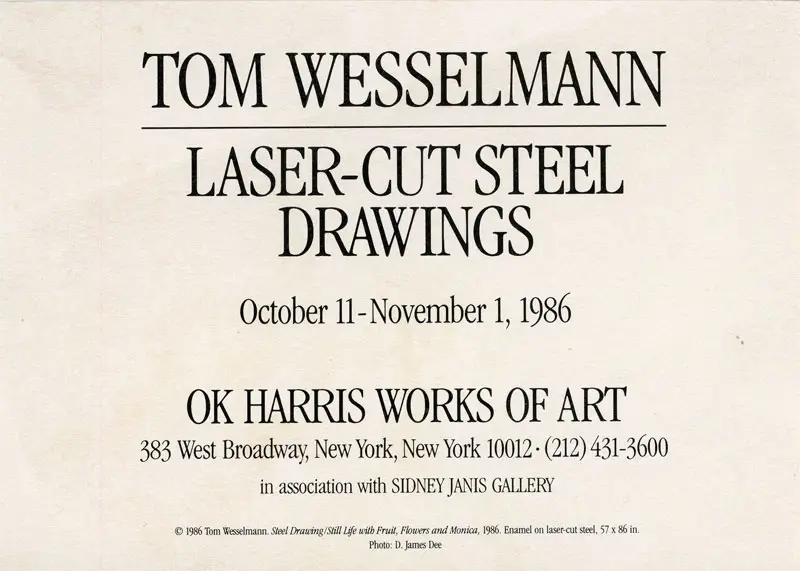
Original exhibition poster announcing Tom Wesselmann’s 1986 Laser-Cut Steel Drawings exhibition at OK Harris Works of Art in New York.
stir
In 1983 and 1984, he set out to solve a problem that, at the time, had no obvious solution: how to take a spontaneous ink line — the kind of quick, one-pass scribble an artist makes without lifting the pen — and translate it into solid material without losing its looseness. Working over roughly a year with metalworks fabricator Alfred Lippincott, Wesselmann developed a technique that could cut steel with the precision his drawings demanded, since the laser-cutting technology he needed did not yet exist in a form accurate enough for his purposes.
The results, once achieved, delighted him. He described the sensation of receiving the first laser-cut piece back, saying he could hold the drawing in his hands and pick it up by the lines themselves, off the paper, and that it felt like becoming a whole new artist. Wesselmann was particular about which sketches earned the steel-cut treatment: he required drawings with the right look and feel, ones that could not be tampered with and that had to be executed in a single, unbroken pass.
The technique put Wesselmann in an unusual position art-historically. He was, by his own account, wary of the computers and lasers that made the work possible even as he depended on them. He said plainly that he did not like technology, and that the laser pieces came not from any fascination with lasers or computers but from a single idea — to make drawings in steel — adding that he never missed a chance to criticize computers even while being glad to have them at his disposal. The ambiguity extended to how institutions classified the resulting objects. After the Whitney Museum of American Art acquired one of his steel works in 1985, its curators asked Wesselmann why he had labeled it a drawing rather than a sculpture; he maintained it was a pure drawing, conceding only that life is not always as simple as one might wish.
Bernard Jacobson Gallery, which has historically listed Still Life with Four Roses and Pear (Blue Pillow), is among several galleries — alongside Solway Gallery and Cristea Roberts Gallery — that have exhibited pieces from this body of steel-cut work, which spanned nudes, landscapes, self-portraits, and still lifes throughout the 1980s and into the 1990s.
idea
Formally, the piece sits comfortably within the view language Wesselmann had been refining since the early 1960s: bold, flattened shapes; a restricted, high-contrast palette; and everyday objects isolated from any narrative or symbolic weight, treated instead as pure containers of tincture and line. The roses are rendered as simple, almost cartoon-outlined forms rather than botanically faith studies, and the pear sits alongside them as a rounded counterweight — the kind of solid, uncomplicated shape Wesselmann favored throughout his still-life production, from oranges and lemons to radios and clocks.
The blue pillow, named specifically in the title, functions as a ground for the composition, its flat tincture block anchor the more intricate cut lines of the flowers and fruit above it. This pairing of a soft domestic object with hard-edged steel construction is characteristic of the tension Wesselmann built into the series: material that reads as industrial and mechanically produced depicting subjects — flowers, fruit, bedding — that are about as domestic intimate as subject matter gets.
The steel-cut process itself changes how the eye moves across the image. Because the lines are physically cut through the metal rather than drawn on top of it, negative space becomes structure; the gaps between roses, stem, and pillow are literal voids in the steel sheet, not areas of unpainted canvas. This gives even a modestly sized work like this one a sculpture presence that a same-scale painting would not have, an effect Wesselmann pursued deliberately as he moved his practice further from flat picture-making and toward what he sometimes called drawing as object.
The existence of a related state marked “1968, 1993” — the same composition dated to both years — points to Wesselmann’s practice of returning to earlier drawings and translating them into the steel medium decades after the original sketch, a working method consistent with how he selected source drawings for the process more broadly.
There is also a formal argument to be made for scale here. Wesselmann was, by this point in his career, equally capable of producing still lifes that filled an entire gallery wall — pieces like Still Life with Two Matisses, built at over five feet across in cut aluminum. Working instead at roughly 22 by 23.5 inches with Four Roses and Pear keeps the piece closer to a tabletop object than a mural, and that smaller scale changes how the steel reads. At mural size, the cut lines of a Wesselmann steel work behave almost architecturally, punctuating a wall the way a window or doorway would. At the scale of this still life, the same cutting technique reads more like a drawing pinned directly to the wall — closer to Wesselmann’s own description of wanting to lift a line off the page and hold it in his hands.
lang
The still life was not a late addition to Wesselmann’s practice; it ran through his career from its earliest moments. His first works to carry the “Still Life” title date to 1962, made in the same period as his participation in the landmark “New Realists” show at Sidney Janis Gallery, and concentrated on juxtaposing disparate elements — a cigarette advertisement alongside other found and painted imagery. Those early still lifes were built through collage, incorporating printed reproductions and advertising material clipped from magazines and posters, a method that let Wesselmann treat consumer imagery with the same detached, formal interest that Andy Warhol and Roy Lichtenstein were bringing to soup cans and comic panels.
Wesselmann’s biography shaped this sensible as much as any art-school training did. Born in Cincinnati in 1931, he began his creative career as a cartoonist rather than a painter, selling gag strips to magazines before a landscape-painting trip while at Cooper Union convinced him painting could be a career rather than a hobby. That cartooning background is view in the reductive, outlined quality of his mature line work — including the steel cuts — where contour does most of the descriptive labor and interior detail is stripped away.
Over the following three decades, the still life genre gave Wesselmann room to experiment formally in ways the nude paintings, for all their notoriety, did not always allow. He produced still lifes in oil on shaped canvas, in aluminum cutout, and eventually in the laser-cut steel that produced this piece, frequently returning to a stable vocabulary of flowers, fruit, and domestic objects rendered at scales ranging from tabletop-sized studies to room-filling wall works. Related pieces from the same steel-cut period — with titles referencing Matisse, Johns, lilies, and mixed fruit — show Wesselmann treating the still-life tradition itself, and its art-historical lineage, as material worth quoting and flattening in his own idiom.
extent
Still Life with Four Roses and Pear (Blue Pillow) has moved through several channels associated with Wesselmann’s estate and gallery representation. Listings identify the piece, sometimes noted as “(With Black)” to distinguish a variant state, at Bernard Jacobson Gallery in London, alongside dealer listings on platforms including 1stDibs and Incollect. A recorded auction sale places the work at $24,510, above its pre-sale estimate range.
The broader steel-cut body of work has been the subject of dedicated survey exhibitions, including presentations at Carl Solway Gallery, Cristea Roberts Gallery in London, and earlier shows such as “Tom Wesselmann Steel Cutouts” at Tasende Gallery in 1991 and “Tom Wesselmann, Steel Landscapes” at Sidney Janis Gallery in 1990. Today, the Estate of Tom Wesselmann is represented worldwide by Gagosian and Almine Rech Gallery, with Cristea Roberts Gallery holding exclusive representation of his prints and multiples, and the Wildenstein Plattner Institute maintaining an ongoing digital catalogue raisonné of the artist’s full body of work.
why
Wesselmann died in 2004, but the steel-cut technique he spent years developing with Alfred Lippincott has outlived him as a recognizable strand of Pop and post-Pop practice. Laser-cut paper and metal are materials now used by countless artists, a diffusion Wesselmann was reportedly protective of during his lifetime, having pushed to have his own steel-cut exhibitions timed to assert priority over the technique.
What a small work like Still Life with Four Roses and Pear (Blue Pillow) demonstrates is how thoroughly Wesselmann folded industrial process into the most domestic of art-historical genres. Flowers and fruit have been still-life subjects for centuries; rendering them as voids cut from sheet steel, filled with flat alkyd tincture, and hung on a wall like a drawing that has somehow acquired weight and edge, is a distinctly late-twentieth-century move — one that keeps this modestly sized, easily overlooked piece firmly inside the larger story of how Pop Art’s founding generation kept reinventing its own vocabulary well into the 1990s.
The renewed institutional attention Wesselmann has received in recent years — including a major Fondation Louis Vuitton exhibition pairing him with the broader history of Pop Art, and the Wildenstein Plattner Institute’s ongoing catalogue raisonné project — has largely focused on the Great American Nude paintings that made his reputation in the 1960s. Works like Four Roses and Pear sit outside that spotlight, but they are arguably where Wesselmann’s formal ambitions were most experimental: a still life that is simultaneously a drawing, a sculpture, and an industrial object, made by an artist who spent a decade arguing with a metal fabricator to get a single line right. That argument between hand and machine, and between a soft domestic subject and a hard industrial material, is exactly what a collector or curator is buying into with a piece this size — a compressed, workable-scale example of the technique Wesselmann considered one of his defining late-career achievements.
Related Articles
Where the Face Should Be, Rafael Silveira Paints Open Sky
A pink shirt, shoulder-length hair, then no face at all: in “Surprise,” Rafael Silveira lets flowers and a clear blue sky stand in for the person.