DRIFT AUDIO
Listen to this story
Choose a voice, then press play.
Bocci’s second Foundry exhibition, curated with Johannes Schön’s backing, opens September 4 and asks what design owes to the astronaut’s-eye view of Earth.
“The Overview Effect” opens with a private preview on September 4, followed by public days on September 5 and 6, a pause on September 7 and 8, and a second run from September 9 through 13. The venue is The Foundry, a 1,680-square-meter cultural and event space Bocci carved out of Wilhelm Hallen, a 120-plus-year-old former iron foundry in Berlin’s Reinickendorf district. The show is curated by Anna Carnick and marks the second time Bocci has staged a major Carnick-curated design exhibition in the space, following last year’s “Crafting Community.” A separate, smaller Foundry show titled “Unexpected Guests 2” ran in 2024 and reportedly drew 18,000 visitors, though it isn’t clear from available reporting whether Bocci counts that earlier show in the same series or treats this year’s as a distinct second chapter.
The exhibition sits inside a much larger event. It’s one strand of Hallen 07, the seventh edition of an annual festival that turns the wider Wilhelm Hallen complex, more than 9,000 square meters across several buildings, into a temporary showcase for over 50 Berlin galleries, museums, and private collections, running September 5 through 13 alongside the official dates of Berlin Art Week. Regular admission to Hallen 07 is listed at 15 euros, with a 10 euro reduced rate, through the city’s own events listing.
The Foundry isn’t Bocci’s first Berlin outpost. The company first put down European roots in 2015 with “Bocci 79,” a roughly 2,200-square-meter showroom and archive built inside a former 1896 courthouse, where it displayed more than a decade of founder Omer Arbel’s prototypes and catalog pieces. Bocci moved into Wilhelm Hallen in 2019, converting a section of the historic ironworks into The Foundry as a dedicated space for exhibitions and cultural programming rather than retail. Reinickendorf itself sits well outside Berlin’s usual gallery circuit around Mitte and the Museum Island, a quieter, more industrial pocket of the city’s north that the Hallen 07 organizers have leaned into rather than apologized for, framing the compound’s brick walls and high ceilings as part of the draw rather than an inconvenience.
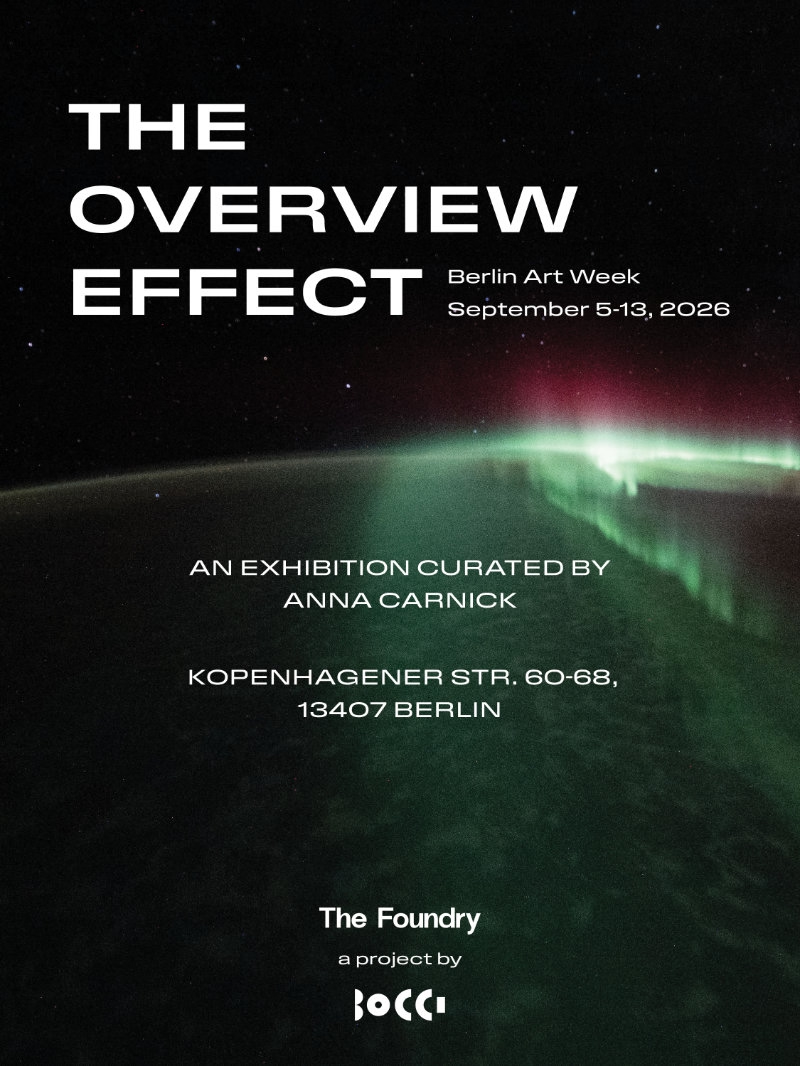
THE OVERVIEW EFFECT: An Exhibition Curated by Anna Carnick at Berlin Art Week
stir
The show takes its name from a documented psychological phenomenon: astronauts who look back at Earth from orbit or from the surface of the moon often describe a sudden, overwhelming shift in perspective, a collapse of borders and divisions into the recognition of one fragile, shared planet. Writer Frank White coined the term in his 1987 book on the subject, drawing on interviews with astronauts and cosmonauts who described the sensation in strikingly similar terms regardless of nationality or era. Researchers who have studied it since characterize it as a state of awe with self-transcendent qualities, typically bringing an appreciation of Earth’s beauty, an unexpected emotional intensity, and a lasting sense of interconnection with other people and the planet as a whole. Carnick’s exhibition borrows that framework directly, and according to the show’s own curatorial description, asks how art and design can reconnect people with nature, with each other, and with a shared future on the planet, using that astronaut’s vantage point as a way of thinking about scale, distance, and belonging.
It’s a more abstract prompt than last year’s, which centered explicitly on craft and community. But the underlying question carries over. Carnick has spent much of her career asking what design can do beyond decoration, and Schön has described Bocci’s own approach to The Foundry in nearly identical terms, as a space meant to dissolve the usual distance between disciplines and between the people who make things and the people who encounter them.
scope
Among the artists confirmed for the show are Christine Jacobs and Lionel Jadot, both represented by the Brussels gallery Objects With Narratives, which announced their participation ahead of the opening. Jacobs, a South African designer and fine artist, grew up on a sheep farm near Trompsburg in the Free State, where her family has produced Merino wool for six generations, a background that shows up directly in her felted wool sculptures and in a practice built around tracing the link between land, craft, and manufacturing. Her solo show “Enfold” opened at Cape Town’s Southern Guild gallery in 2023, followed by a second solo presentation, “Enfold: Unearthing Her Layers,” at Cavalli Gallery in 2024.
Jadot works from the opposite end of the same instinct. Born in Brussels in 1969 into a sixth-generation family of chairmakers, the self-taught designer, filmmaker, and interior architect builds furniture and installations almost entirely from salvaged and reclaimed material, treating scrap wood, broken antiques, and even asphalt picked up off the street as raw material for new forms, an instinct he’s traced back to childhood, gathering workshop offcuts his father’s business had already written off. He was named Designer of the Year in the Hospitality category at Maison&Objet in 2024, and he’s also a co-founder of Barrosinha, a 2,000-hectare estate near Comporta, Portugal, built around art, agriculture, and community in the mold of Brussels’ Zaventem Ateliers. Full details of the rest of the “Overview Effect” lineup, including how many artists are involved and whether the show carries a companion checklist the way “Crafting Community” did, hadn’t been published at the time of writing.
length
The partnership behind the show goes back further than either exhibition. Carnick, an American-born, Berlin-based writer, editor, and curator, cofounded the design agency Anava Projects in 2019 with Wava Carpenter, and has curated design programming at Milan’s 5VIE district, the Miami Design District, Carpenters Workshop Gallery, and EDIT Napoli, in addition to serving as Design Miami’s Curatorial Director in 2023 and, through 2024, as co-editor-in-chief of the fair’s online magazine. That 2023 fair carried its own curatorial theme, “Where We Stand,” which Carnick built around questions of place and belonging, a throughline that isn’t hard to trace forward into an exhibition named for the moment an astronaut realizes there’s only one place any of us actually stand. She’s also the author of two books on design, “Nendo: 10/10” and “Design Voices.”
Schön holds the title of Director of Brand and Cultural Strategy at Bocci, the Vancouver-founded lighting and design studio started in 2005 by architect-turned-designer Omer Arbel and businessman Randy Bishop, whose first product, a hand-blown glass pendant called “14,” was assembled in a converted barn outside Vancouver and became an instant design classic. Schön has described himself as a longtime fixture of the Berlin art and design scene, drawing a direct line in a 2025 interview between today’s design-showcase moment and the mid-1990s, when he remembers artists showing work in squatted buildings across the city and sometimes becoming gallerists themselves out of necessity. He’s said his working relationship with Carnick stretches back roughly two decades, calling last year’s “Crafting Community” show “a continuation of what we’ve been doing for 20 years” rather than a one-off project. Discussing that exhibition at the time, Schön said it reflected Bocci’s own core principles, framing the goal as showing “how design can be a universal language that fosters empathy and connection,” a line that reads almost as a preview of this year’s title.
“Crafting Community” itself drew 19 international artists and designers, including Rooms Studio from Georgia, Noe Kuremoto from the UK, Beatriz Morales from Mexico, and Yassine Ben Abdallah, whose centerpiece sculpture recreated a plantation machete in melting sugar. Its full roster of participants spanned Guatemala, Mexico, Colombia, Ukraine, Austria, Lebanon, Tunisia, the United States, Georgia, Martinique, and Japan, a spread Carnick has said was less about geographic box-checking than about finding practitioners who treat their work as an offering to a specific community rather than an abstract audience. It was later named a finalist for the 2026 Créateurs Design Awards in the Excellence in Art & Design Curation category. Carnick has described the working relationship behind both shows as noncommercial by design, telling one interviewer the exhibitions exist explicitly outside the gallery system’s usual sales pressure, framed instead as a shared belief that art and design can function as bridges between people. It echoes something she said in a separate 2023 interview about her curatorial work more broadly, quoting the novelist Elif Shafak’s line that stories bring people together while untold stories keep them apart, and describing storytelling, whether built from words or from wood, as a way of accessing another person’s humanity.
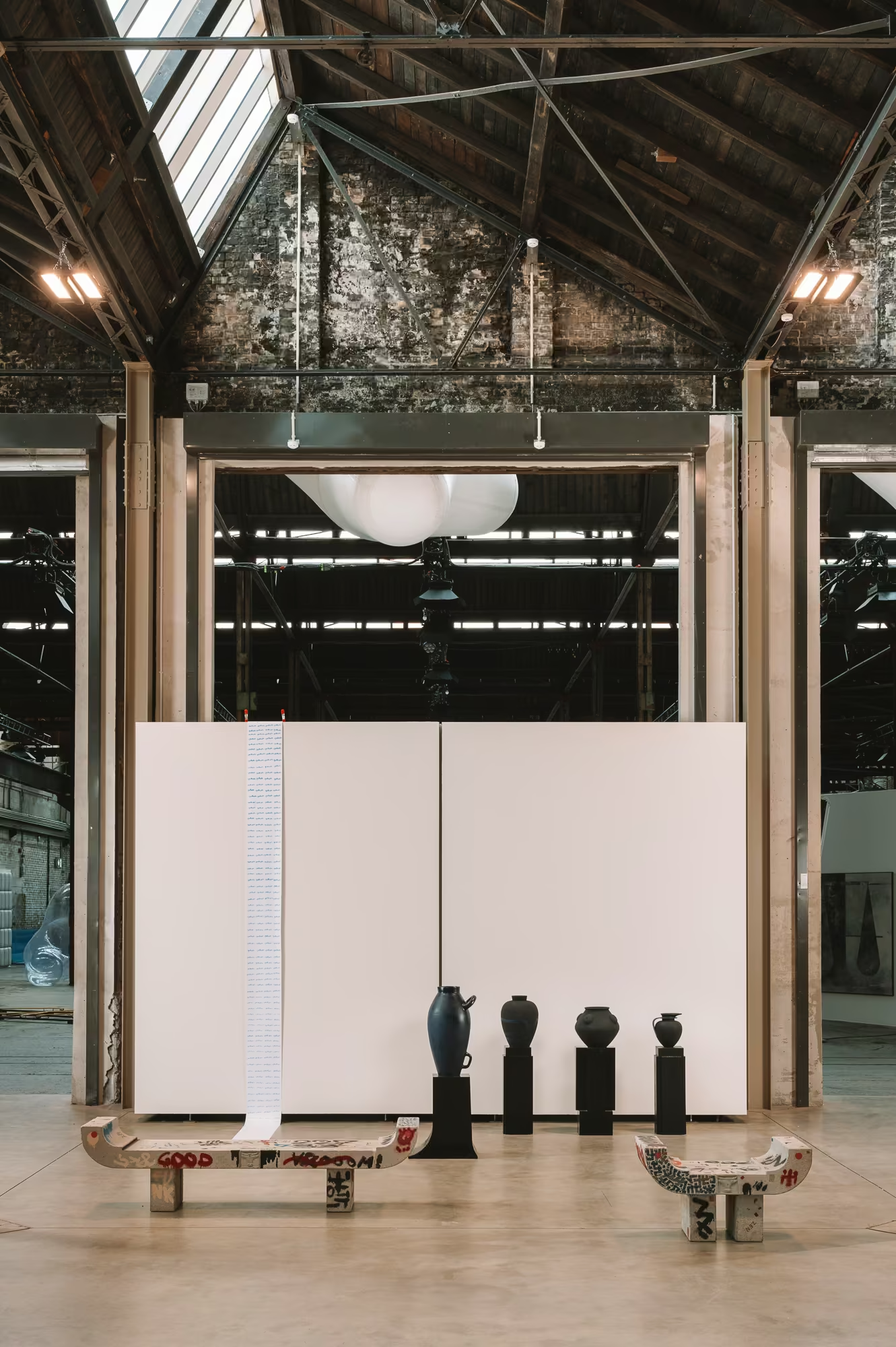
Contemporary Art Installation in an Industrial Warehouse Space
fin
“The Overview Effect” is only one part of what’s happening at Wilhelm Hallen this September. Hallen 07 brings in institutional lenders including the Berlinische Galerie, the Mercedes-Benz Art Collection, the Kunstmuseum Wolfsburg, and the Schirn Kunsthalle Frankfurt, alongside Berlin gallery regulars like Esther Schipper, ChertLüdde, and Mehdi Chouakri. This year’s invited Hallen guest artist, Christian Jankowski, known for work that folds together art, media, and social role-play, is showing a selection of neon works from his ongoing “Castles in the Air” series across both indoor and outdoor sections of the complex. The festival closes on September 13 with chamber ensembles from the Deutsches Symphonie-Orchester Berlin, which relocated its rehearsal spaces and offices to Wilhelm Hallen in 2025, performing informally throughout the grounds, in front of artworks and inside installations, rather than in a conventional concert hall.
That crowding is by design as much as coincidence. Berlin Art Week itself runs a formal five-day program, but Hallen 07 deliberately opens four days earlier, giving visitors a way to see the festival’s centerpiece venue before the rest of the city’s galleries and museums fall into the same weekend. For Bocci, now operating creative-exchange spaces in Vancouver, Milan, and Berlin, staging its second consecutive Carnick-curated show inside that window keeps The Foundry positioned as one of the week’s more consistent design fixtures rather than a one-time novelty. Whether “The Overview Effect” lands with the same reach as last year’s 19-artist “Crafting Community,” or the earlier “Unexpected Guests 2” and its reported 18,000 visitors, won’t be clear until the show has actually opened its doors on September 4. What’s already clear is that Carnick and Schön are treating Wilhelm Hallen as a fixture rather than a venue they’re renting for a season.
Related Articles
Pocket-sized Xbox Ctrl
Xbox Nano Controller. Announced 14 October 2026 by James Hunter. $49.99. Rechargeable battery. Programmable Action Button. Xbox Wireless and Bluetooth.