DRIFT AUDIO
Listen to this story
Choose a voice, then press play.
Damien Hirst has shelved Eminem’s twelve albums beside pill packets, and one cabinet stocks every drug the rapper has named in a lyric. A selection is in Soho until October 19.
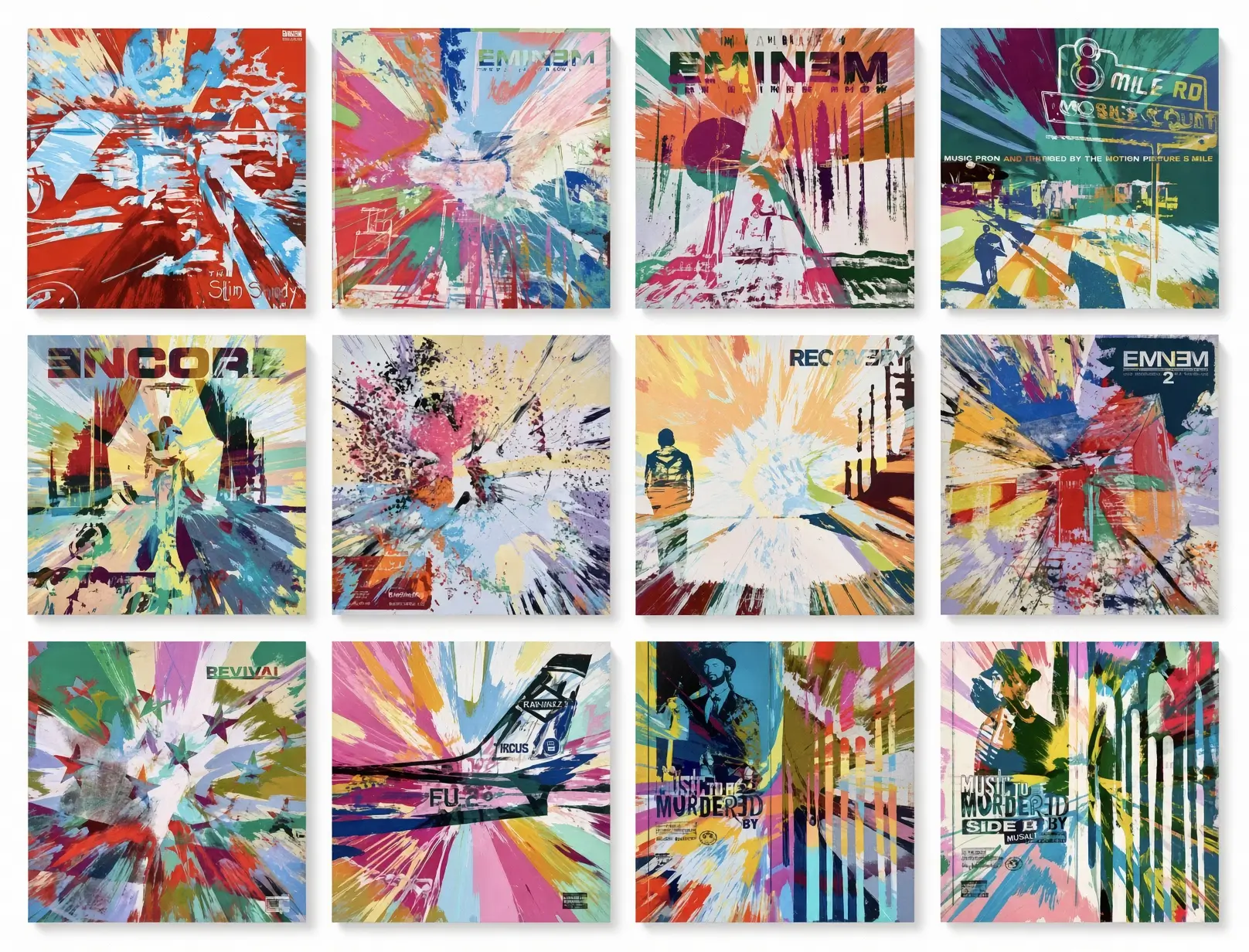
Admission is free, nobody needs an appointment, and the doors at HENI Gallery on Lexington Street in Soho open at 10am every day of the week. Since October 2 the room has held American Dream, a release credited jointly to Damien Hirst and Eminem that folds the rapper’s discography into two of Hirst’s longest running series, the Medicine Cabinets and the Spin Paintings. On the walls are twelve prints made from Eminem album covers, shown with a selection of the original works behind them. The cabinets are hand signed by both artists on the front, and the original paintings and the larger prints carry both signatures on the label.
Signal. What happened: HENI Gallery in London opened American Dream, a joint release by Damien Hirst and Eminem, on October 2, 2026, with the works sold through HENI’s online platforms alongside the show. Exact object: three Medicine Cabinets titled Re-up ($35,000), Riot ($50,000) and Addict ($75,000), each holding Eminem’s twelve-album discography on vinyl; original spin paintings in household gloss on canvas at two sizes; and twelve prints on aluminum panel, offered signed at $5,000 or unsigned at $450, all prices before taxes. When and where: HENI Gallery, 6-10 Lexington Street, London W1F 0LB, October 2 to 19, open daily from 10am to 6pm with free entry, and the release window closes at 17:00 BST on October 19. Source: the rel pages on HENI Primary and HENI Editions set out the works, editions, prices and dates. Why it matters: it turns a 2022 record label commission into a body of work signed by both artists, and it moves music inside Hirst’s cabinets from the titles on the label to the objects on the shelves.
event
The project started life as a set of record sleeves. To mark its 30th anniversary in early 2022, Interscope Records invited visual artists to choose albums and songs from its catalog and respond to them, producing pairings such as Ed Ruscha with 2Pac, Takashi Murakami with Juice WRLD and Toyin Ojih Odutola with Kendrick Lamar. Hirst’s pairing was Eminem, and he reworked twelve of the rapper’s album covers rather than one. The commissions went on show in Artists Inspired by Music: Interscope Reimagined at the Los Angeles County Museum of Art, which gathered more than 50 works in the museum’s Resnick Pavilion for two weeks from January 30, 2022.
The covers then went to vinyl. Each of the 47 albums in the label’s anniversary series was pressed in an edition of 100 copies with a giclée printed cover, and in late January 2022 Eminem told his followers that Hirst had reimagined twelve of his covers, pointing them to a limited vinyl drop. Profits from the series went to the South Los Angeles high school founded by Jimmy Iovine and Dr. Dre.
American Dream picks the thread back up four years later. Hirst and Eminem developed the covers further as a collection of original paintings, then used those paintings as the basis for the twelve prints. The album list runs from The Slim Shady LP through The Marshall Mathers LP, The Eminem Show, the 8 Mile soundtrack, Encore, Relapse, Recovery, The Marshall Mathers LP 2, Revival, Kamikaze and Music to Be Murdered By, closing on that record’s Side B edition from late 2020. Infinite, the 1996 debut Eminem released independently before his Interscope years, is not on it. Neither is The Death of Slim Shady, which arrived in July 2024, two years after Hirst made the covers.
View this post on Instagram
and
Depth is the quickest way to tell the three cabinets apart. Each stands 136 centimeters tall. Re-up is 10.5 centimeters deep and Riot 14, while Addict, at 23.4 centimeters, is more than twice the depth of Re-up, which is roughly what happens when a shelf of records has to make room for a pharmacy.
Every cabinet holds the full twelve-album run in sleeves carrying the reworked covers, and the sleeves are not props. The vinyl records are inside them, so a collector can take an album off the artwork and put it on a turntable. In Riot and Addict the records share the shelves with medicine boxes and pills, the clinical arrangement Hirst has worked with since the series began. Addict pushes the idea furthest. According to HENI, the medication in that cabinet reflects every drug mentioned in Eminem’s lyrics.
The editions narrow as the contents get heavier. Re-up is the widest release, 100 examples plus 20 artist’s proofs at $35,000. Riot and Addict are each limited to 50 plus 10 proofs, at $50,000 and $75,000, with taxes added to all three prices. At least one of the titles has a precedent in the rapper’s own catalog: Re-up shares its name with Eminem Presents: The Re-Up, the 2006 Shady Records compilation whose cover art Eminem drew himself.
huh
Hirst was a student at Goldsmiths in London when he made his first two cabinets, Sinner in 1988 and Enemy, begun the same year, from packets and bottles that had belonged to his grandmother. A longer run followed, each cabinet named after a track on the Sex Pistols’ 1977 album Never Mind the Bollocks, Here’s the Sex Pistols, and four of them went into his 1989 degree show. He has explained the titling as wanting more than one way of saying something, “like songs on an album,” a line that Phillips quotes in its catalog notes for an early cabinet.
The format scaled up quickly. In 1992 Hirst made Pharmacy, a room-sized installation of a chemist’s shop first shown at a New York gallery, which Tate bought in 1996. Tate notes that in the cabinets, though not in Pharmacy itself, Hirst ordered the drugs like a body, with remedies for the head on the upper shelves, the stomach in the middle and the feet at the bottom. Medicine cabinets have appeared in every major survey of his work since, including his 2012 retrospective at Tate Modern.
Music has run through the series from the start. Beyond the Sex Pistols, Hirst has titled cabinets after songs by The Clash, but in those works the music lived in the titles while the shelves held medicine. American Dream puts the albums themselves on the shelves and, in two of the three cabinets, the medicine right beside them.
flow
The catalog on those shelves is one of the largest in the genre. HENI’s own release notes put Eminem at more than 164 million albums sold, with 15 Grammy Awards and an Academy Award, and count The Death of Slim Shady as his eleventh consecutive studio album to debut at No. 1 on the Billboard 200.
It also carries a story he has told publicly for well over a decade. Eminem has said his reliance on prescription pills grew once his career took off. He went to rehab in 2005, was hospitalized after a methadone overdose in December 2007, and has been sober since April 20, 2008, marking several anniversaries since by posting his sobriety coin online. Relapse, released in 2009 as his first album after getting clean, and Recovery a year later both deal with addiction and the climb out of it, and Recovery went on to become the first album in the United States certified platinum on digital sales alone. When Revival arrived in December 2017, its promotional campaign borrowed the look of prescription drug marketing.
All of that sits inside the cabinets at HENI. Addict, stocked from the drugs named across his records, is the work most directly shaped by it, and it is also the most expensive object in the release. In Riot and Addict, the sleeves for Relapse and Recovery share the shelving with medicine boxes and pills, which makes the link to Hirst’s earliest cabinets far more literal than a borrowed song title.
twelve
The paintings come from Hirst’s other machine. He began experimenting with spin painting in 1992, ran a spin art stall with fellow artist Angus Fairhurst at the 1993 street fair A Fete Worse Than Death, where passersby made their own, and formalized the series in Berlin in 1994 with a purpose-built machine and circular canvases. Paint is poured onto a rotating surface and centrifugal force does much of the composing, which leaves Hirst only partial control over any single result. In 1995 David Bowie visited his studio to make a spin painting with him.
For American Dream, Eminem’s covers went onto that machine. The original paintings are household gloss on canvas in two square formats, 121.9 and 213.4 centimeters a side, and the chance interplay of color gives each version of a cover its own composition. Some titles follow the convention Hirst has used for spin paintings for decades, opening with the word beautiful: one 121.9 centimeter canvas is called Beautiful Encore Painting. Others keep to the album name, among them Eminem Show and M.M.2., both at the larger size. All are hand signed by both artists on the label and offered by application, and no prices for the paintings appear on the release page.
The prints carry twelve of those paintings onto aluminum. Every title comes in two formats, both UV Giclée prints direct on aluminum composite panel. The large version, 94.5 centimeters square, is numbered and hand signed by both artists, sold by application at $5,000 in an edition of 60 plus 15 artist’s proofs. The small version, 31.5 centimeters square, is numbered but unsigned and costs $450 at checkout, with the edition size set by demand during the release window, and buying all twelve small prints takes 15 percent off the total. Edition numbers are assigned at random, the artist’s proofs are not for sale, and HENI states that none of the American Dream works come with a certificate of authenticity.
fin
Only the small prints can be bought outright. Everything else in American Dream is allocated by application, a system HENI uses to spread works broadly rather than reward whoever clicks first. For the large prints, applicants can name preferences and opt into partial or alternative allocations, which HENI says can improve their chances. Card details are collected at the point of application, payment is taken only if an allocation is confirmed, and a follow-up payment link lapses after 48 hours. Cabinet and painting buyers deal with a business development manager and may face identity checks. Prices are in US dollars, works ship internationally from the UK with any duties and local taxes on the buyer, and HENI estimates that the prints will be dispatched within four months of the window closing.
The show is the latest in a steady run of Hirst projects at the Lexington Street space. Depictions, a group of butterfly paintings, closed there on September 30, two days before American Dream opened, following the ICA Spin Stools in February and The Civilisation Watercolours in January. The rel window for every format closes at 17:00 BST on October 19, an hour before the gallery shuts on the final day of the show.
Related Articles
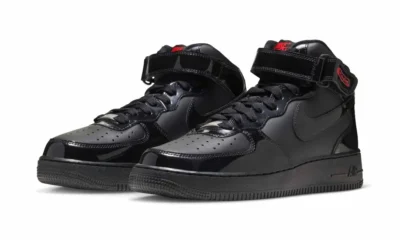
Victory Lap Radio Signs On in Black Patent With Its Own Nike Air Force 1 Mid
The tongue label reads like a station ident, the outsole carries the logo underfoot, and the whole Mid is cut in black patent for a Holiday 2026 broadcast.