DRIFT AUDIO
Listen to this story
Choose a voice, then press play.
In a retail landscape where visibility is currency, A.PRESSE chooses descent. The decision is not incidental. It is structural. While most brands rise—toward glass façades, street-facing dominance, architectural scale—this moment unfolds beneath the surface, in the basement of one of Hong Kong’s most refined commercial environments.
The implication is immediate.
This is not about being seen.
It is about being found.
View this post on Instagram
stir
A.PRESSE has never relied on the architecture of spectacle. It has never required height, glass, or exterior expression to define its presence. Instead, it has operated through a different logic—one that privileges material, proportion, and silence.
The BELOWGROUND installation does not contradict this logic. It extends it.
Where most brands would treat a temporary activation as an opportunity to amplify—larger visuals, louder messaging, increased density—A.PRESSE approaches it as a compression. A reduction. A distillation of its existing ethos into a more contained environment.
The anti-flagship flagship, relocated underground.
No spectacle.
No overt branding.
No digital overload.
Only garments. Only space. Only time.
shift
The transition begins before the garments are visible.
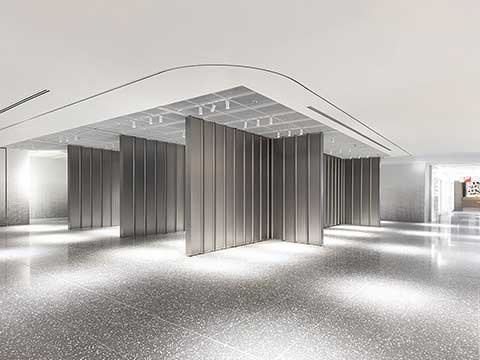
You descend into the atrium, into a space that is already quieter than the city above. Landmark’s BELOWGROUND is designed with intention—controlled lighting, softened acoustics, a certain architectural restraint. Yet within it, the A.PRESSE installation introduces another layer of quiet.
A subtle separation.
There is no large sign announcing its presence. No perimeter that demands entry. The boundary between the installation and the surrounding space is perceptual rather than physical.
You recognize it not by branding, but by absence.
Less density.
Less noise.
Less urgency.
And then, within that absence, the garments begin to appear.
space
Inside, the logic is unmistakable.
Garments are placed, not stocked. Each piece occupies a defined position, surrounded by space that is neither empty nor decorative—it is functional. It allows the eye to rest, to isolate, to return.
There is no path imposed on the visitor. No directional cues. The layout does not guide you toward a conclusion. It allows you to wander, to pause, to return to the same object multiple times without interruption.
Time stretches.
In most retail environments, time is compressed—encouraged to move quickly, efficiently, toward transaction. Here, time expands. It becomes elastic, responsive to attention rather than demand.
You are not being moved through the space.
You are being held within it.
xp
A denim jacket draws your attention.
It is not positioned centrally. It does not command the room. And yet, it holds it. The weight of the fabric, the density of the weave, the subtle irregularities in tone—these elements begin to articulate themselves as you approach.
You touch it.
This is the moment where A.PRESSE diverges completely from contemporary retail language. The garment does not rely on explanation. It does not need a screen, a tag, or a narrative panel to contextualize it. Its construction carries its own logic.
The stitching reveals intention.
The fabric reveals process.
The finish reveals time—simulated, yet convincing.
The garment is not new in the conventional sense. It is newly realized. A reconstruction of something that feels as though it has always existed.
In this space, garments do not decorate the room.
They anchor it.
flow
Elsewhere in Landmark, screens glow. Displays shift. Content cycles. Retail performs continuously, adapting itself to the expectations of a digitally mediated audience.
Within the A.PRESSE installation, none of this occurs.
There are no screens.
No projections.
No interactive layers.
The absence is not nostalgic—it is strategic. It removes mediation. It ensures that nothing stands between the viewer and the object.
This is not a rejection of technology as a whole. It is a refusal to allow technology to define the experience.
The garments are sufficient.
The space acknowledges this, and then steps back.
below
A conversation begins—not initiated, but invited.
The person assisting does not approach with urgency. There is no script, no rehearsed introduction. Instead, there is attentiveness. A recognition that the interaction will unfold at its own pace.
You ask about the denim.
The response is precise. Not embellished, not simplified. It traces the garment back through references—decades, techniques, intentions. It explains without persuading. It informs without directing.
This is clienteling without data.
There is no profile being accessed, no recommendation algorithm operating in the background. The interaction is built on knowledge—accumulated, internalized, and shared when relevant.
You are not guided toward a purchase.
You are guided toward understanding.
rare
The temporary nature of the installation intensifies something already present in A.PRESSE’s model: scarcity.
The selection is limited. Not in the sense of incomplete, but in the sense of deliberate. What is here is what is available. What is absent is not hidden—it simply does not exist within this moment.
This creates a different kind of awareness.
You do not assume that another size will appear. You do not expect restock. The garment in front of you becomes singular—not because it is unique, but because its availability is.
The space communicates this without stating it.
Through emptiness.
Through spacing.
Through restraint.
Scarcity is not announced.
It is felt.
fin
The installation exists for seven days.
Monday to Sunday.
A fixed duration within which everything must occur. And yet, within that constraint, time behaves differently. It slows. It expands. It resists the pressure of its own limitation.
You become aware of the temporality, but it does not create urgency. It creates presence.
You are here, now, within a space that will not remain. That knowledge sharpens perception. It does not rush it.
The garments, already constructed to simulate time, now exist within a real temporal boundary.
Past and present converge.
Related Articles
Eric Haze Stitches a Nineties Friend Into TOKYO Capsule
Five pieces carry Eric Haze's embroidered tagging for TOKYO No.1 SOUL SET, sold online and in Osaka around the band's Oct 25 BAYCREW'S FESTIVAL set.