DRIFT

new 

There are moments when a brand does not merely release a campaign—it recalibrates the language through which it speaks. With The CC League, Chanel Beauty proposes a shift that feels both inevitable and quietly radical. Beauty, here, is no longer framed as a static condition, nor as an aesthetic endpoint. It becomes motion. It becomes force. It becomes a field in which identity is not displayed but lived.

“Beauty is a movement” is not a slogan. It is a repositioning.

In an industry historically anchored in stillness—posed faces, perfected surfaces, controlled light—Chanel introduces velocity. The body is no longer a site of correction but of capability. The face is no longer a canvas alone, but an extension of action, intention, and presence.

This is beauty not as image, but as energy.


View this post on Instagram


A post shared by CHANEL (@chanelofficial)

think

At the core of this shift lies a sentence that has long defined the house:
“To be irreplaceable, you have to be different.”

Gabrielle Chanel did not conceive of beauty as conformity. Her revolution was not only sartorial but philosophical—liberating the body from constraint, redefining elegance as autonomy rather than ornament.

The CC League extends this ethos into the present. It does not reinterpret Chanel’s legacy; it activates it.

Difference, in this context, is not aesthetic deviation. It is self-authorship. It is the capacity to exist outside prescribed narratives of femininity, strength, or desirability. It is the refusal to be interchangeable.

And in a cultural moment saturated with replication—filters, trends, algorithmic sameness—this insistence on difference acquires renewed urgency.

theory

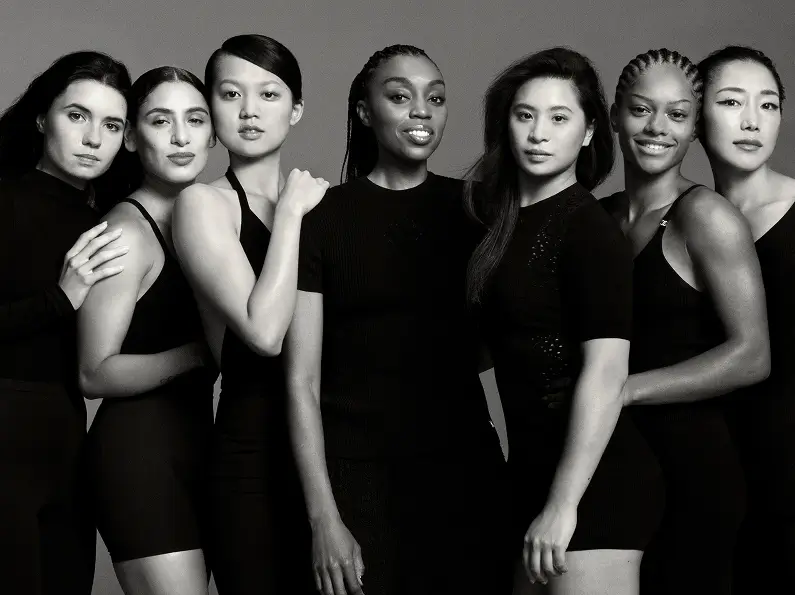
The CC League is composed of seven athletes. The number is deliberate.

Seven is often associated with balance, completion, and harmony. Yet within this campaign, it functions less as a symbol of closure and more as a framework for plurality. Each athlete represents a distinct discipline, a distinct rhythm, a distinct relationship to movement and to self.

Together, they do not form a uniform group. They form a constellation.

Each point emits its own light. Each trajectory remains independent. The collective exists not to homogenize but to amplify difference.

This is a critical distinction. Where traditional campaigns often seek cohesion through sameness—aligned aesthetics, synchronized poses—The CC League constructs cohesion through divergence. Unity emerges not from uniformity, but from shared intention.

idea

By centering athletes, Chanel Beauty engages with a body that is inherently active. This is not incidental.

The athletic body resists passivity. It is defined by training, by repetition, by resilience. It carries marks of effort—muscle, tension, breath. It is a body that does not simply appear; it performs.

In the context of beauty, this introduces a profound shift.

Perfection gives way to process. Surface gives way to function. The emphasis moves from how the body is seen to what the body does.

Yet Chanel does not abandon aesthetics. Instead, it expands them. Strength becomes beautiful not as a metaphor, but as a visible, embodied reality. Grace is no longer synonymous with delicacy; it becomes a quality of control, of precision, of presence within movement.

The face, within this framework, is not erased. It becomes expressive in new ways—flushed, focused, alive.


View this post on Instagram


A post shared by CHANEL BEAUTY (@chanel.beauty)

flow

One of the most enduring narratives within beauty has been that of correction—the idea that products exist to fix, conceal, or improve.

The CC League disrupts this narrative.

Transformation, here, is not about becoming something else. It is about becoming more fully oneself. It is an expansion rather than an adjustment.

This aligns with Chanel Beauty’s broader trajectory, which increasingly emphasizes individuality over standardization. The products are not presented as tools of conformity but as instruments of expression—extensions of identity rather than replacements for it.

In this sense, beauty becomes a practice. It is something one does, not something one achieves.

lang

Movement, within the campaign, operates as a form of language.

Each athlete speaks through her discipline—through gesture, rhythm, repetition. The body articulates what words cannot: determination, hesitation, release, control.

This non-verbal language carries a particular resonance within the context of beauty. It bypasses the prescriptive. It resists categorization. It invites interpretation.

In visual terms, this is expressed through imagery that privileges motion over stillness. Blur replaces sharpness. Sequence replaces singularity. The viewer is not presented with a fixed image but with a continuum.

This introduces a temporal dimension to beauty. It is no longer captured in a single frame; it unfolds.

focus

The campaign repeatedly returns to the pairing of power and grace. Historically, these qualities have been gendered—power aligned with strength, grace with softness.

The CC League dissolves this binary.

Power is shown as endurance, as focus, as the capacity to persist. Grace is shown as fluidity, as adaptability, as the ability to inhabit movement fully.

Both coexist within each athlete. They are not opposing forces but complementary ones.

This redefinition carries broader cultural implications. It challenges the expectation that women must choose between strength and elegance, between authority and beauty. It asserts that these qualities are not mutually exclusive but inherently intertwined.

role 

While individuality is central to The CC League, the collective remains essential.

The athletes are presented not as isolated figures but as part of a shared field. Their differences are not barriers but points of connection.

This reflects a broader shift within contemporary culture, where identity is increasingly understood as relational rather than singular. One becomes oneself not in isolation, but in dialogue with others.

The CC League embodies this dynamic. It creates a space in which multiple expressions of beauty can coexist without hierarchy.

There is no singular ideal. There is only multiplicity.

xp

For Chanel Beauty, this campaign represents an expansion rather than a departure.

The house has long engaged with notions of freedom, from Gabrielle Chanel’s early interventions in fashion to its ongoing exploration of femininity as autonomy. What changes here is the medium.

By incorporating athletes, movement, and performance, Chanel extends its narrative into new territories. Beauty intersects with sport, with discipline, with physicality.

This intersection reflects broader cultural currents. The boundaries between categories—fashion, beauty, sport, wellness—are increasingly porous. Consumers do not experience these domains separately; they experience them as part of a continuum.

The CC League responds to this reality. It situates beauty within life, rather than apart from it.

eco

Despite its thematic emphasis on movement, the campaign maintains a visual restraint that is distinctly Chanel.

The palette is controlled. The compositions are deliberate. There is an absence of excess.

This restraint functions as a counterbalance to the dynamism of the subject matter. It creates space for the viewer to engage, to project, to interpret.

It also reinforces the brand’s identity. Chanel does not need to overwhelm. Its authority lies in precision, in clarity, in the confidence to do less.

fwd

The CC League ultimately gestures toward a future in which beauty is not dictated but discovered.

It suggests that the most compelling expressions of beauty emerge not from adherence to external standards, but from alignment with internal ones. From knowing oneself. From inhabiting one’s body fully. From moving through the world with intention.

This is not an easy proposition. It requires effort, awareness, and, at times, resistance. But it is precisely this difficulty that gives it value.

Beauty, in this framework, is not effortless. It is earned—not through conformity, but through authenticity.

sum

“To be irreplaceable, you must be different.”

The repetition of this statement within the campaign is not redundant. It is rhythmic. It echoes, much like movement itself.

The CC League does not conclude with a single image or a single message. It continues—through the athletes, through the audience, through the ongoing evolution of what beauty can mean.

In positioning beauty as movement, Chanel does more than redefine a category. It opens a space.

A space in which difference is not only accepted but essential. A space in which power and grace coexist. A space in which the individual and the collective are not in opposition but in dialogue.

A space in which beauty is no longer something to be seen, but something to be lived.


Related Articles
Modern data center facility with a solar-panel-clad exterior, bright green administrative offices, and secure perimeter fencing, showcasing sustainable digital infrastructure and renewable energy integration

Lombardy’s Data Center Boom: Balancing Digital Ambition with Environmental Responsible

Lombardy has emerged as Italy’s primary hub for new digital infrastructures, particularly data centers—vast complexes […]

In a highly anticipated reunion after 24 years, Adidas Originals and Coca-Cola have joined forces once again to celebrate the FIFA World Cup 2026™. The collaboration revives their iconic 2002 partnership from the Japan-South Korea tournament, now reimagined for the biggest global sporting event of 2026, co-hosted by the United States, Canada, and Mexico. Set to launch on June 6, 2026, this collection masterfully blends Adidas' streetwear heritage with Coca-Cola's timeless branding, creating a vibrant fusion of football culture, nostalgia, and modern style. The drop arrives at a perfect moment. With the World Cup kicking off on June 11, 2026, fans worldwide are gearing up for a summer of football excitement. This collaboration isn't just merch—it's a cultural statement that merges two legendary brands under the banner of "Originals are the Real Thing," a clever twist on Coca-Cola's famous slogan. Historical Context: A Reunion 24 Years in the Making Adidas and Coca-Cola first collaborated during the 2002 FIFA World Cup, producing limited-edition pieces that captured the era's energy. That partnership helped define early 2000s football-streetwear crossover culture. Fast-forward to 2026, and the brands are back with fresh energy, leveraging Adidas' deep FIFA ties (as an official partner) and Coca-Cola's long-standing sponsorship of the tournament. The 2026 edition promises to be historic as the first 48-team World Cup, spanning three countries and generating unprecedented global hype. This collab taps into that momentum, offering fans wearable pieces that celebrate both brands' legacies while looking forward to the future of football fashion. Collection Overview and Design Philosophy The Adidas Originals x Coca-Cola collection fuses 2000s street style with classic sporting aesthetics. Expect bold reds, creams, whites, and silver accents inspired by Coca-Cola's iconic packaging—think classic script logos, droplet detailing, and can-inspired motifs. The lineup spans footwear, apparel, and accessories, divided into two visual directions: one logo-heavy and graphic-forward, the other drawing from vintage advertising aesthetics. Designs pay homage to Coca-Cola's visual language while staying true to Adidas Originals' archival roots. High-quality materials, attention to detail, and versatile silhouettes make these pieces suitable for both match-day wear and everyday street style. The campaign, featuring young football star Lamine Yamal and a diverse cast in everyday scenes building anticipation for the tournament, reinforces themes of originality and shared cultural moments. Footwear Highlights Footwear takes center stage in this collaboration, with reimagined takes on iconic 2000s Adidas silhouettes: Samba and Superstar Models: These classics get Coca-Cola treatment with white/cream/red colorways and prominent script branding. The Samba blends street heritage with football roots, while the Superstar II features weathered bases and bold side panels. Expected pricing around $110–$130. Adistar Control 5: A standout with droplet detailing mimicking condensation on a cold Coke can. This model brings performance-inspired design into lifestyle territory. Predator Sala: Indoor/hybrid style with silver-and-red accents, nodding to predatory precision on the pitch and Coca-Cola's bold energy. Climacool 1: Revived with breathable tech and Coke-inspired graphics, perfect for warm summer days. Megaride F50: A highlight paying tribute to the iconic Coca-Cola glass bottle, with unique contours and refreshing design cues. Each pair incorporates thoughtful details like embroidered logos, custom insoles, and packaging that mimics vintage Coke crates or cans. These shoes are built for durability and comfort, appealing to sneakerheads, football fans, and casual wearers alike. Apparel and Accessories Beyond kicks, the collection offers a full lifestyle range: Track Tops and Jerseys: Standout jerseys fuse retro Coca-Cola advertising from different eras into cohesive football designs. Track jackets feature signature three stripes alongside Coke branding, in vibrant reds and classic whites. Shorts and T-Shirts: Relaxed fits with graphic prints, ideal for casual wear or layering. Expect motivational football motifs blended with refreshing beverage references. Accessories: A bright red airliner bag stands out as a functional statement piece. Additional items may include caps, socks, and tote bags carrying the collaborative spirit. The apparel emphasizes comfort with premium cotton blends, mesh panels for breathability, and oversized silhouettes popular in contemporary streetwear. Unisex sizing and inclusive fits make the collection accessible to a broad audience. Cultural Impact and Fan Appeal This collaboration resonates on multiple levels. For football fans, it represents national pride and global unity ahead of the 2026 tournament. Sneaker enthusiasts will appreciate the nostalgic 2000s revival mixed with modern execution. Streetwear collectors see it as a prime example of how heritage brands can innovate through partnerships. In an era where sports and fashion increasingly intersect, Adidas and Coca-Cola deliver pieces that transcend the pitch. Wear them to watch matches at home, attend watch parties, or hit the streets in any host city—New York, Los Angeles, Toronto, or beyond. The designs are versatile enough for gym sessions, festivals, or daily commutes. The timing aligns perfectly with rising interest in football in North America, boosted by the co-hosting nations. Young talents like Lamine Yamal in the campaign help bridge generational gaps, attracting newer fans while satisfying longtime supporters. Where to Buy and Release Details The collection launches globally on June 6, 2026, via: Adidas CONFIRMED app (for early access and raffles) Adidas.com Select retailers and flagship stores worldwide Some regions may see staggered drops, with Japan and other markets getting early access. Prices are expected to range from $50–$150 depending on the item, making it relatively accessible compared to ultra-limited drops. Pro Tips for Copping: Enable notifications on the CONFIRMED app. Check local stock at Adidas stores in major cities. Monitor resale platforms post-drop for exclusive colorways, but be wary of markups. Size up slightly for oversized apparel fits. Given the World Cup hype, popular items like the Sambas and jerseys are likely to sell out quickly. International shipping is available, but factor in potential customs delays. Styling Suggestions Match Day Look: Pair a collaborative jersey with classic black shorts and Samba sneakers for effortless fan style. Streetwear Rotation: Layer a track top over a graphic tee with wide-leg pants and the Megaride F50 for a bold urban ensemble. Casual Summer: White Superstar with denim shorts and the airliner bag for a refreshing, vacation-ready vibe. These pieces mix seamlessly with existing Adidas or neutral wardrobes, maximizing versatility. Broader Context in 2026 Fashion and Sports The Adidas x Coca-Cola drop is part of a larger wave of high-profile collaborations tied to the World Cup. Adidas continues its dominance in football kit design, while Coca-Cola leverages its sponsorship with collectibles, bottles, and experiential activations like the Trophy Tour. In the sneaker industry, this collab exemplifies the ongoing trend of lifestyle reinterpretations of performance silhouettes. It also highlights how global brands use major events to drive cultural conversations around unity, originality, and joy—core values for both companies. Sustainability notes (based on Adidas' broader initiatives) suggest some pieces may incorporate recycled materials, aligning with modern consumer expectations. Looking Forward: Legacy and Excitement As the countdown to kickoff continues, this collection serves as the perfect prelude to an unforgettable summer of football. Whether you're a die-hard supporter, a fashion-forward collector, or someone seeking motivation through style, the Adidas Originals x Coca-Cola FIFA World Cup 2026 lineup delivers. Expect potential restocks, special event exclusives in host cities, and continued campaign content featuring more athletes. This isn't just clothing—it's a ticket to participate in the global celebration of the beautiful game. Mark your calendars for June 6, 2026. Refresh your wardrobe, lace up those Sambas, and get ready to cheer on your team in style. The "Real Thing" meets the Originals in what promises to be one of the most talked-about releases of the year. This collaboration captures the essence of football's universal appeal: bringing people together through shared passion, iconic brands, and unforgettable moments. As the world prepares for 2026's expanded tournament, Adidas and Coca-Cola remind us that some partnerships are truly timeless.

Adidas Originals x Coca-Cola Collection: FIFA World Cup 2026

In a highly anticipated reunion after 24 years, Adidas Originals and Coca-Cola have joined forces […]

Loewe shoulder bag crafted in brown and black leather with minimalist lion face detailing and a matching fur tail charm

180 Years Unfolded: The Full Story Behind Loewe’s New Campaign

The year was 1846. Queen Victoria was on the British throne and the telephone, the […]