DRIFT AUDIO
Listen to this story
Choose a voice, then press play.
Long before he was a household name stitched onto a flag-colored crest, Tommy Hilfiger was a teenager in upstate New York learning the fashion business the hardest way possible — by nearly losing it all first.
In This Story
- A Stockroom, Not a Runway
- The Trunk-of-a-Volkswagen Retail Model
- People’s Place and the First Taste of Scale
- Bankruptcy Before the Brand
- What the Failure Actually Taught Him
Every origin story about Tommy Hilfiger tends to jump straight to the good part — the bell-bottoms, the Elmira storefront, the eventual billboard in Times Square. But by his own account, as part of Vogue’s ongoing “My First Job in Fashion” series, his actual entry point into the industry was far less glamorous: a stock boy job at a sporting goods shop in his hometown, restocking football and basketball jerseys and taking a genuine interest in how well the equipment was made. It’s a detail that tends to get flattened out of the bigger legend, but it lines up with the version of Hilfiger that’s shown up consistently across his own retrospectives over the decades — someone whose fascination with fashion started with materials and craft long before it had anything to do with a label of his own.
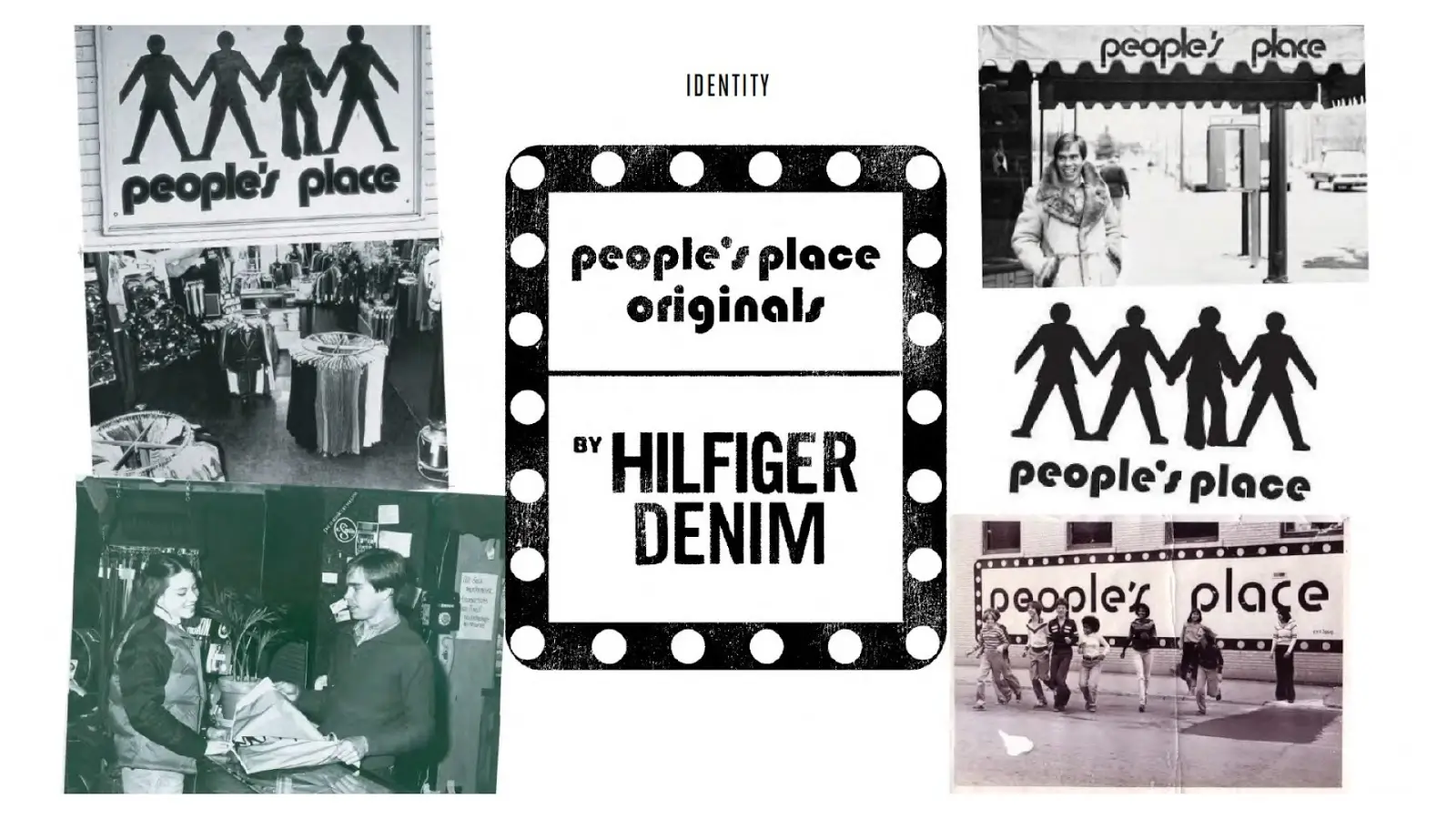
Archival People’s Place Originals by Hilfiger Denim identity board showcasing vintage logos, retail spaces, storefronts, and early brand history.
That early curiosity about how things were actually made would resurface again and again throughout his career, eventually shaping the way he’d talk about the difference between chasing trends and building something that could last. But at 13, none of that was on his mind. He was just a kid in Elmira, New York — the second of nine children in a working-class household — who liked the way a well-made jersey felt in his hands.
The Elmira of Hilfiger’s childhood wasn’t exactly a fashion capital. It was a modest upstate New York city a four-hour drive from Manhattan, the kind of place where a stock boy gig at a sporting goods store counted as an early education in retail rather than a stepping stone to one. According to family accounts documented at the Tommy Hilfiger Gallery at Elmira College, curated by his sister Betsy Hilfiger, his very first job was actually pumping gas at a local Hess station — a detail that predates even the sporting goods stint, and one Betsy has pointed to as the moment Tommy’s fascination with clothing first took hold, since he was drawn less to the job itself than to the branded patches on the uniform shirts. It’s a small, almost incidental beginning for a designer whose entire later career would be built on the power of a recognizable logo.
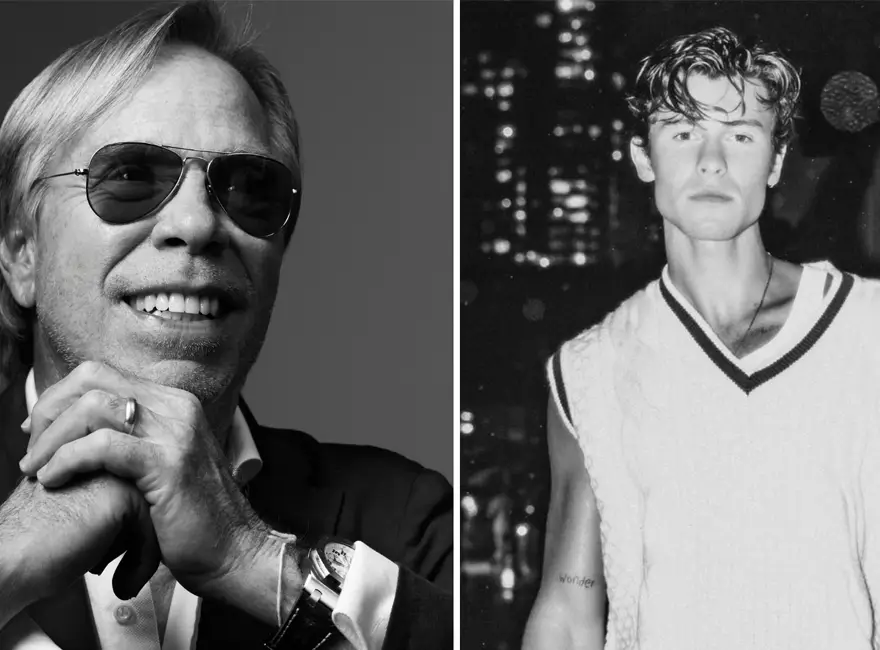
A side-by-side portrait contrasts Tommy Hilfiger with a new-generation model, reflecting the brand’s evolution from heritage to contemporary style.
stir
The turn from stockroom curiosity to actual entrepreneurship happened a few years later, and it happened because of a road trip. As Hilfiger has told it in interviews over the years, a teenage visit to New York City exposed him to bell-bottom jeans for the first time, and he immediately clocked the gap between what was available four hours south in Manhattan and what nobody in his hometown had access to yet. According to an account published by Bloomberg, Hilfiger used the roughly $150 he’d saved pumping gas to make the drive down Highway 17, buy a stack of jeans, and bring them back to sell out of the trunk of his Volkswagen Beetle — reportedly moving his first pair to a girl visiting Elmira College for cheerleading camp, according to reporting from northcentralpa.com.
It’s an almost absurdly small-scale version of what would later become a multibillion-dollar retail operation, but the mechanics are identical to what any founder recognizes: identify a gap, source cheap, sell direct, reinvest. There was no brand yet, no design sensible beyond taste — just arbitrage, a car, and a hunch that his hometown was underserved.
flow
The trunk-sales operation scaled quickly enough that Hilfiger and two friends, Larry Stemerman and Jon Allen, pooled their money — $150 each, by Hilfiger’s own account — to open an actual storefront in 1969, in the basement of a shoe shop owned by Stemerman’s family. They called it People’s Place. It sold the bell-bottoms Hilfiger had been driving down to buy, along with incense, records, and the general trappings of countercultural retail: black-painted walls, loud music, the whole late-’60s package. Per Hilfiger’s own description of the concept, the goal was to make it a hangout as much as a shop — somewhere the “cool people” in town could gather, not just transact.
The store worked. Word spread across nearby college towns, and what started as a single Elmira location eventually grew into a small regional chain — accounts vary between seven and ten locations across upstate New York. Hilfiger, still a teenager, wasn’t just buying and reselling anymore. He’d started designing and altering the jeans himself, tweaking fits and details — the first real evidence of a design instinct that had nowhere formal to go yet, since he’d never had design training and never attended college.
Staffing the expansion largely meant hiring from the same pool of college students the store had first courted, according to the Elmira College retrospective — a practical solution that also kept the shop culture connected to the customers it depended on. It’s worth noting how much of what would become Hilfiger’s signature brand instinct was already visible at this stage: leaning on subcultural cues, treating the retail environment itself as part of the product, and staying close to the exact demographic buying the clothes rather than designing at a remove from them. None of it was formalized yet, but the underlying logic that would carry through decades later into the Tommy Hilfiger label’s courting of music-scene tastemakers was already operating at a much smaller, scrappier scale in a shoe-store basement.
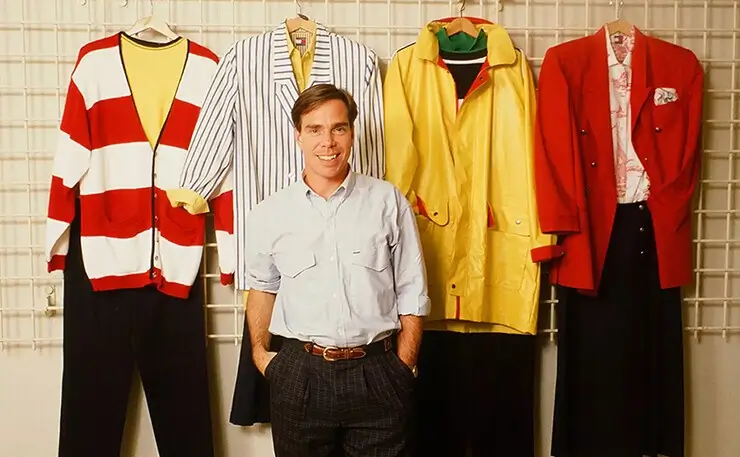
An archival image captures Tommy Hilfiger with early apparel designs, showcasing the bold colors and preppy aesthetic that helped define the brand’s identity.
By most tellings, the business was successful enough to be genuinely life-changing for a kid barely out of high school — reportedly profitable enough to afford him a Porsche at an age when most of his peers were still commuting to community college. It was also, by his later admission, badly under-managed.
challenge
People’s Place didn’t survive. A broader economic downturn in the mid-1970s hit the business hard, and by 1977 — with Hilfiger around 25 years old — the chain filed for bankruptcy. It’s a detail that rarely makes it into the version of the Hilfiger story most people know, which tends to skip straight from “teenager sells jeans” to “global fashion mogul,” but the years in between were genuinely rough. He’d married Susie Carona, an employee at one of the stores, and the couple relocated to Manhattan not long after the collapse, both of them essentially starting over.
That move to New York wasn’t smooth, either. Hilfiger and his wife were briefly hired as a husband-and-wife design team at Jordache — the denim brand — before being let go within a year. It’s the kind of setback that, in hindsight, reads as a necessary detour: without a design degree or an obvious résumé, Hilfiger spent the next several years building a reputation as a hardworking, if unproven, young designer, eventually catching the attention of established houses before Indian entrepreneur Mohan Murjani offered him something no one else had: a men’s sportswear line built entirely under his own name.
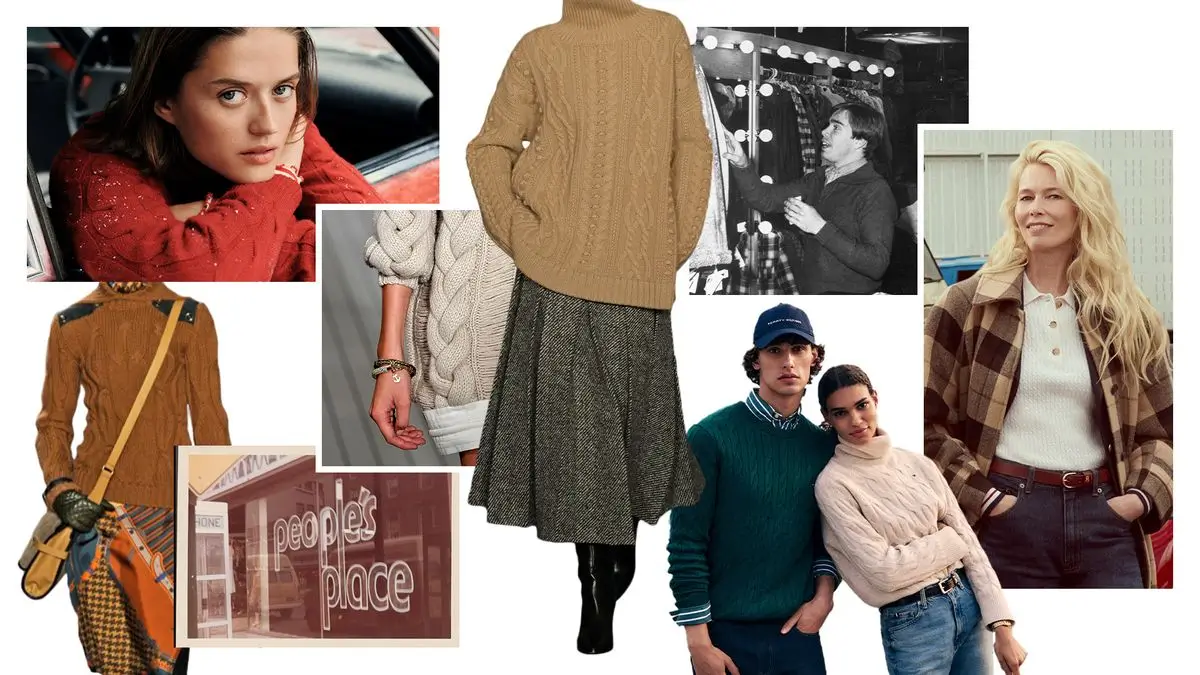
A mood board tracing People’s Place from its retail roots to modern Tommy Hilfiger collections through archival photos, cable-knit styles, and contemporary campaign imagery.
Those in-between years mattered more than the brevity of the Jordache stint suggests. Hilfiger was reportedly considered for design roles at both Perry Ellis and Calvin Klein during this stretch — an indication that whatever damage the People’s Place bankruptcy had done to his finances, it hadn’t done much to his credibility among people who’d actually seen his work. What he lacked in formal training he was apparently making up for in output and persistence, sketching and shopping his designs around a New York fashion establishment that had no obvious reason to take a bankrupt jeans-store owner from Elmira seriously. That gap between pedigree and persistence would become something of a throughline in how Hilfiger has talked about his own career ever since — the idea that the industry’s gatekeepers can be won over by proof of work even when the résumé says otherwise.
learn
What makes the People’s Place chapter worth returning to isn’t the jeans, or even the eventual comeback — it’s how directly Hilfiger has credited the bankruptcy itself with shaping the businessman he became. Reflecting on the collapse decades later in the same Bloomberg feature on Elmira College’s fashion business program (a program Hilfiger personally helped establish), he said plainly that a better understanding of the business side of fashion back then would likely have kept the company from failing in the first place, and that the experience is what convinced him a real brand requires understanding every part of the operation, not just the product.
That lesson didn’t just inform his eventual comeback — it became the entire premise of the brand he’d go on to build. When Murjani gave him the platform to launch his own label in 1985, Hilfiger didn’t just bring a design sensibility; he brought a founder’s understanding of margins, retail, and scale that most first-time designers never get to learn the hard way before their name is on the door. The blitz marketing campaign that announced his arrival — a now-famous Times Square billboard positioning him alongside Ralph Lauren and Calvin Klein as the next great American designer — worked in part because Hilfiger had already lived through what happens when a business outruns its own infrastructure. He wasn’t going to make that mistake twice.
It’s worth sitting with the fact that the two halves of this story rarely get told together: the failed teenage jeans empire and the billion-dollar menswear label are usually treated as separate chapters, one a footnote and one the main event. But by Hilfiger’s own account, there’s no main event without the footnote. The stockroom job, the Volkswagen full of denim, the black-painted basement shop, and the bankruptcy that followed it all functioned as an informal apprenticeship — one he’s referred to as effectively his real-world degree, and arguably the only credential that actually mattered when Murjani came calling. For a designer whose brand has spent five decades signaling American classicism through a crisp logo and a clean color story, the mess of the actual beginning is a useful reminder that very few origin stories are as tidy as the finished product they eventually produce.
From the DRIFT archive: Levi’s® Launches De La Soul T-Shirt Collection Inspired by Vintage Samples: A Cultural Revival Rooted in Hip-Hop History
Related Articles

WACKO MARIA Brings Its Leopard Lining to the Big Leagues
Black nylon outside, leopard fur inside: WACKO MARIA’s first Major League Baseball collection reached Japan […]