DRIFT AUDIO
Listen to this story
Choose a voice, then press play.
King Gnu add another major anime tie-in to their run, soundtracking Science SARU’s new take on Ghost in the Shell as it heads to Prime Video this July.
- A New Opening for an Old Icon
- King Gnu’s Anime Pedigree
- Inside The Ghost in the Shell’s New Adaptation
- Rel
King Gnu have been confirmed as the performers of “GO GHOST,” the new opening theme song for The Ghost in the Shell, the upcoming television anime adaptation of Masamune Shirow’s seminal manga. The song was officially unveiled during a fifth promotional video for the series, following an initial confirmation at Anime Expo 2026 earlier in the week. The ending theme, “Blue,” will be handled separately by MILLENNIUM PARADE alongside Saya Gray and Daniel Caesar, giving the series two high-profile musical anchors heading into its debut.
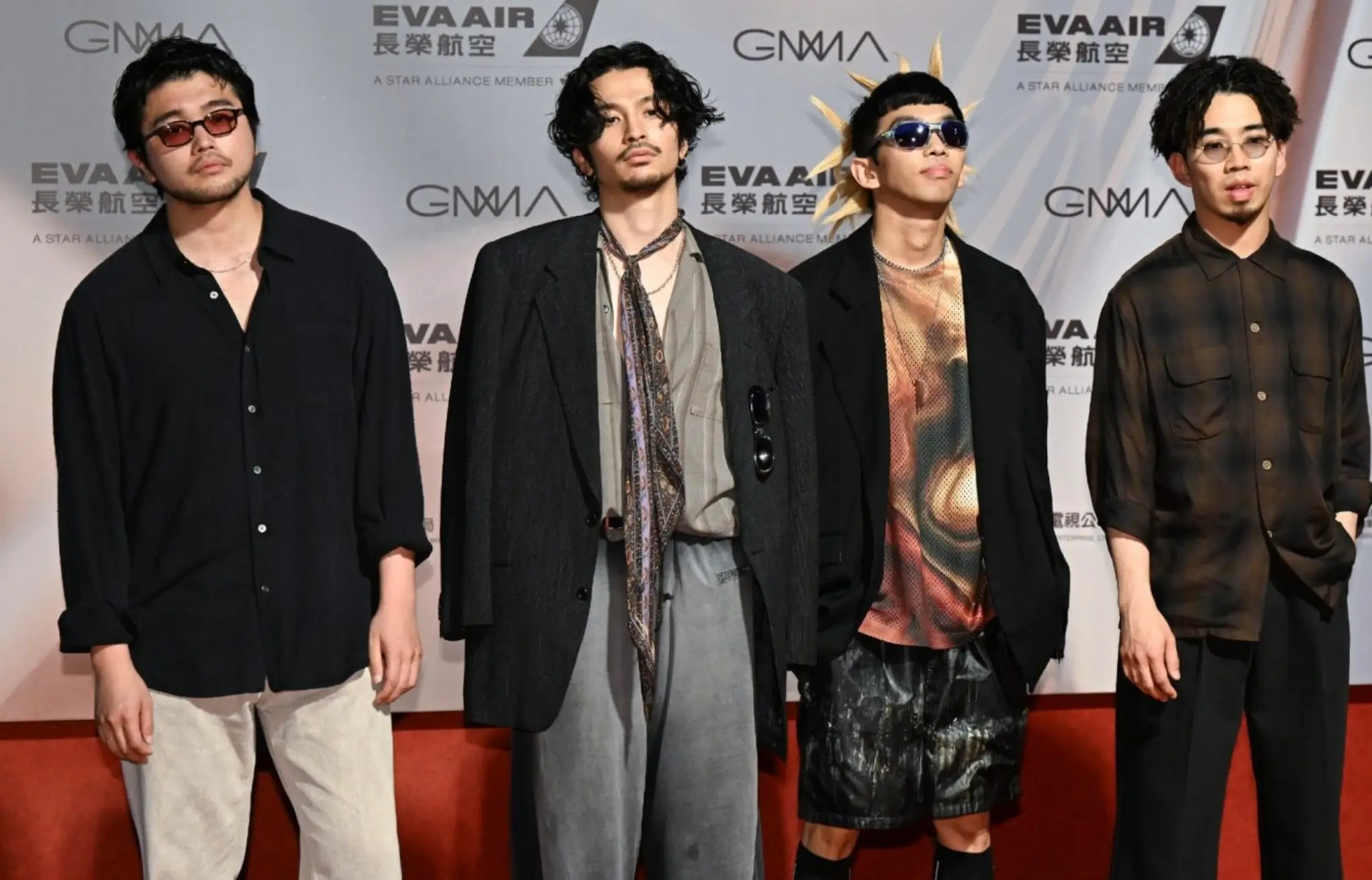
The band arrives at the GMA Gala in eclectic fashion, blending tailored silhouettes, layered styling, and bold accessories against the event’s sponsor backdrop.
The pairing of King Gnu with one of Japanese pop culture’s most enduring science-fiction franchises is, on paper, an unusually good fit. Ghost in the Shell has spent nearly four decades asking questions about identity, consciousness, and where the line between human and machine actually sits — themes that dovetail neatly with the moody, genre-blending, occasionally unsettling territory King Gnu have made their own across a catalogue that swings between arena-scale pop hooks and denser, more experimental songwriting. “GO GHOST” arrives as the band’s latest entry in what has become one of the most consistent anime tie-in résumés in contemporary J-pop.
The reveal itself followed a familiar pattern for how major anime franchises now roll out their theme song news: a teased fifth promotional video, an Anime Expo panel appearance to generate a first wave of buzz among an international convention crowd, and then a fuller trailer confirming both the artist and, in this case, a snippet of the track itself. Fan reaction across social platforms in the hours following the reveal was immediate and largely enthusiastic, with clips of the preview circulating quickly across video platforms even ahead of any official single release — a reflection of how closely the anime fanbase now tracks these theme song announcements as events in their own right, independent of the series they’re attached to.
There is also a thematic logic to the pairing worth drawing out. King Gnu’s biggest hits — “Hakujitsu,” “Teenager Forever,” “Specialz” — tend to sit in a space between melancholy and defiance, songs that pair anthemic choruses with lyrics preoccupied with identity, alienation, and the gap between who a person appears to be and who they actually are. That is, more or less, the exact emotional register Ghost in the Shell has operated in since its earliest incarnation: a Major whose cybernetic body raises constant questions about what, if anything, remains distinctly “her” beneath the augmentation. Whatever “GO GHOST” ultimately sounds like in full, the thematic overlap between artist and source material is closer than a typical anime tie-in pairing, where a hit act’s inclusion is sometimes more a marketing decision than a creative one.
stir
King Gnu’s relationship with anime theme songs goes back several years and has become a defining thread of the band’s mainstream profile, running alongside their arena and stadium touring career. The band first tied into anime scoring with “Boy,” the opening theme for the Ranking of Kings anime, released in 2021. That was followed by two songs for the Jujutsu Kaisen 0 film, “Ichizu” and “Sakayume,” and then “Specialz,” the opening theme for the second season of Jujutsu Kaisen covering the Shibuya Incident arc — one of the most-watched anime seasons of its year. More recently, the band contributed the theme song for the Detective Conan: One-Eyed Flashback film, and in 2026 struck up what has been described as an even deeper relationship with the Jujutsu Kaisen franchise through a further tie-in.
That track record places King Gnu in genuinely elite company. Recent years have seen Japan’s biggest anime franchises pull almost exclusively from J-pop and rock’s top tier for their theme songs — LiSA on Demon Slayer, Kenshi Yonezu on Chainsaw Man — and King Gnu’s now-repeated presence across Jujutsu Kaisen, Ranking of Kings, and now Ghost in the Shell puts them squarely inside that same bracket of artists whose involvement functions as a signal of a series’ ambitions. For a franchise as internationally recognised as Ghost in the Shell, securing King Gnu for the opening slot is as much a statement of intent as it is a musical choice, telegraphing to both domestic and international audiences that the new adaptation is being positioned as a major release rather than a niche revival.
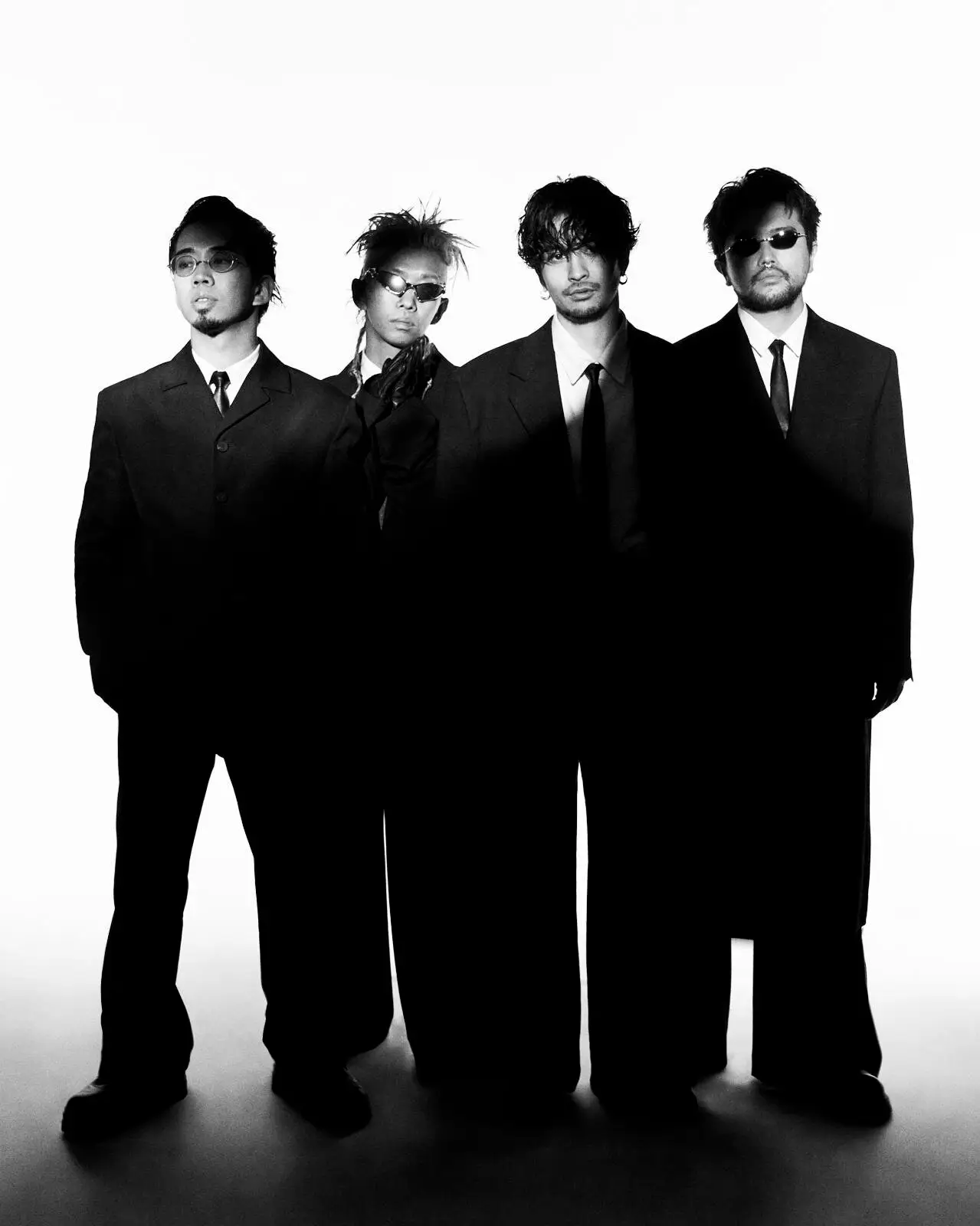
The band itself has built toward this position steadily. Formed in 2013 under the name Srv.Vinci by vocalist and guitarist Daiki Tsuneta, the group rebranded as King Gnu in 2017 and built its early identity around a distinctive visual and sonic collaboration with the creative agency PERIMETRON, also helmed by Tsuneta. The current lineup — Tsuneta on vocals and guitar, Satoru Iguchi on vocals and keyboards, Kazuki Arai on bass, and Yu Seki on drums and sampler — has cultivated a sound that draws on rock, jazz, hip-hop, and J-pop in roughly equal measure, resisting easy categorisation even as the band has become one of the most commercially dominant acts of its generation in Japan.
Breakthrough single “Hakujitsu,” released in 2019, became a genuine crossover hit, reaching No. 4 on the Billboard Japan Hot 100 year-end chart and earning the band their first appearance on NHK’s Kōhaku Uta Gassen, the New Year’s Eve broadcast widely regarded as the biggest stage in Japanese music. Their 2020 album Ceremony topped the Oricon and Billboard Japan album charts and became one of the best-selling albums worldwide that year, moving over a million copies despite touring plans being disrupted by the COVID-19 pandemic. The band has since headlined Tokyo Dome — playing to more than 100,000 fans across two nights in November 2022 — and mounted a stadium tour across Japan in 2023, cementing a status that few guitar-driven bands of their generation have matched. That combination of chart-topping commercial success and a genuinely distinctive, hard-to-classify sound is likely a large part of why anime production committees have returned to King Gnu repeatedly: the band brings mainstream pulling power without sacrificing the kind of tonal weirdness that suits genre-driven, high-concept storytelling.
in
The Ghost in the Shell — styled without the definite article dropped, distinguishing it from Mamoru Oshii’s landmark 1995 film of a similar name — is produced by Science SARU, working alongside Bandai Namco Filmworks, Kodansha, and Production I.G. The series is billed as a more faithful adaptation of Shirow’s original manga, which first debuted in a 1989 supplement to Kodansha’s Young Magazine, than several of the franchise’s prior screen adaptations. Toh Enjoe, known for his work on Godzilla Singular Point and Space Dandy, is writing and overseeing the series scripts, while Shūhei Handa, whose credits include Little Witch Academia and Scott Pilgrim Takes Off, serves as character designer and chief animation director. Taisei Iwasaki, known for his work on the film Belle, is music director, composing the score alongside Ryō Konishi and Yuki Kanesaka.
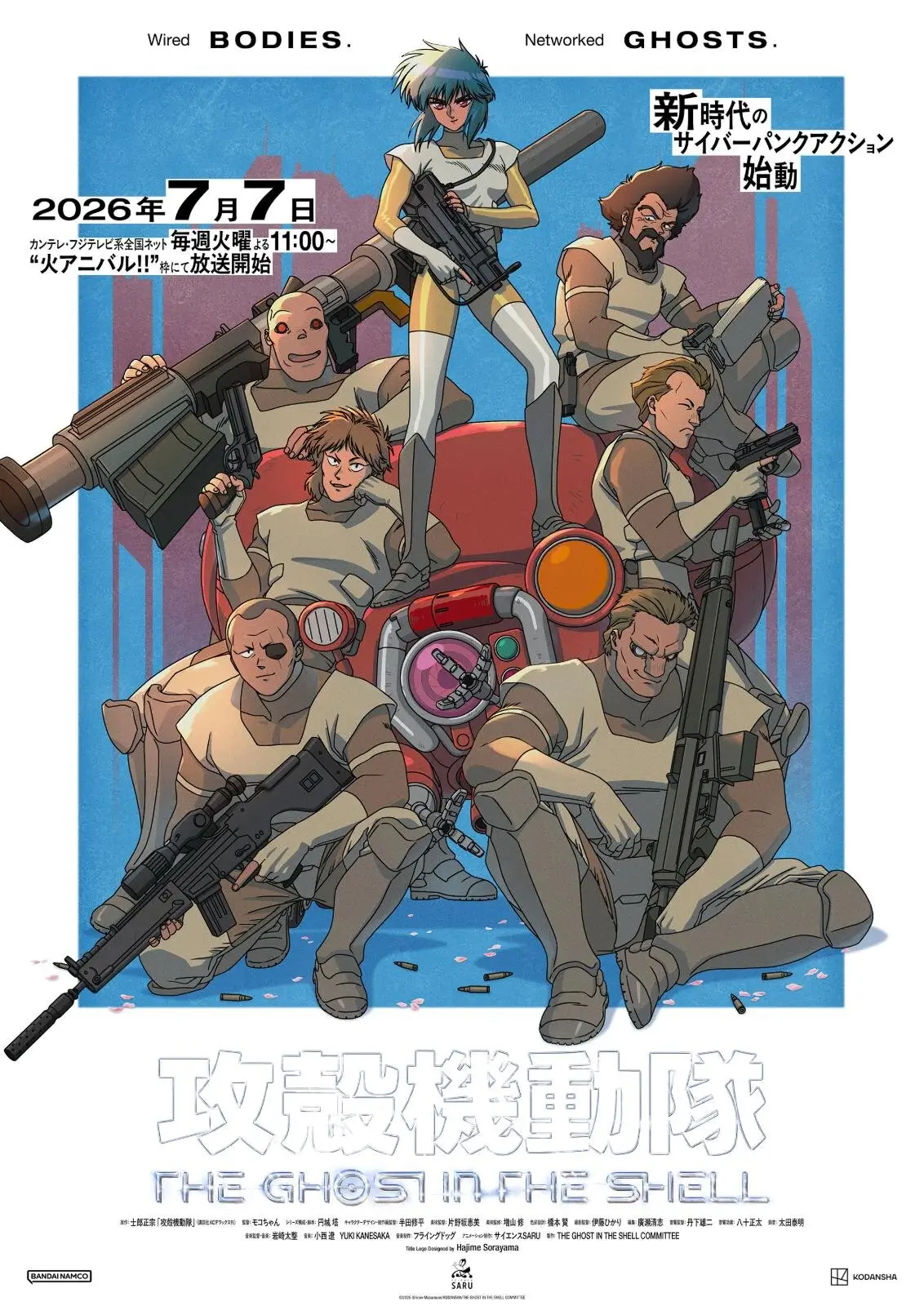
Promotional artwork for The Ghost in the Shell highlighting Major Motoko Kusanagi and Section 9 in a cyberpunk-inspired composition celebrating the series’ 2026 television release.
Ghost in the Shell’s screen history is extensive, and The Ghost in the Shell arrives as the latest entry in a lineage that includes Oshii’s original 1995 film and its sequel Innocence, Kenji Kamiyama’s Stand Alone Complex television series and its follow-ups, the youth-focused Arise film series, and the 3DCG SAC_2045 continuation. Oshii’s 1995 film in particular is widely credited as one of the most influential pieces of science-fiction cinema of its era, its visual language and philosophical preoccupations with consciousness and digital identity having shaped work well beyond anime, including The Matrix and a generation of subsequent cyberpunk filmmaking. Whichever version of the story a given viewer first encountered, the franchise’s core premise — a cybernetically enhanced special-operations unit navigating a world where minds can be hacked as easily as networks — has proven durable enough to sustain new interpretations roughly once a decade since the manga’s debut.
The franchise’s central character, Major Motoko Kusanagi, has been voiced across various Japanese-language adaptations by Atsuko Tanaka, who died in August 2024; the Japanese cast for this new series had not been announced at the time of the most recent promotional reveal. Set in the year 2029, in a near-future Japan defined by a hyper-connected, information-saturated corporate network, the new series returns to the cyberpunk foundations that made the franchise internationally influential, with Science SARU’s involvement carrying its own set of expectations given the studio’s reputation for distinctive, often boundary-pushing animation direction on prior projects. Pairing that visual pedigree with a script overseen by a novelist as conceptually ambitious as Toh Enjoe suggests a production aiming to distinguish itself clearly from its predecessors, rather than simply refreshing the franchise’s visuals for a new streaming-era audience.
rel
The Ghost in the Shell is set to premiere on 7 July 2026, streaming via Amazon Prime Video in more than 240 countries and regions, excluding mainland China, Russia, and Vietnam, with an exclusive early streaming window in Japan the same day. In Japan, the series will also broadcast on Kansai TV and Fuji TV as part of the “Ka-Anival!!” late-night programming block, airing Tuesdays at 11:00 p.m. JST. “GO GHOST” will serve as the series’ opening theme from launch, with “Blue,” by MILLENNIUM PARADE featuring Saya Gray and Daniel Caesar, closing out each episode. Neither a standalone single release date nor a music video for “GO GHOST” had been confirmed at the time of writing.
That simultaneous global-and-domestic release structure is itself a notable part of the strategy behind The Ghost in the Shell. Rather than staggering an international rollout months behind Japan’s broadcast, as many prior franchise adaptations have done, Prime Video’s day-and-date approach across the vast majority of its markets suggests Bandai Namco Filmworks and its partners are treating the international audience as a primary consideration from the outset, not an afterthought. Given how central Ghost in the Shell’s overseas influence has been to its cultural standing — its imprint on Western science fiction arguably rivals its domestic popularity — that global-first distribution model is a fitting way to bring a new adaptation to market, and one that puts additional pressure on a strong opening theme to make an immediate impression with audiences who may be encountering both the franchise and the band for the first time.
For King Gnu, “GO GHOST” lands at a point in the band’s career where anime tie-ins have become less a side project than a parallel discography of their own — a run of songs that regularly reach audiences well beyond the band’s core rock and pop fanbase, and that have arguably done as much as their stadium tours to cement King Gnu’s name internationally. For The Ghost in the Shell, meanwhile, a King Gnu opening theme gives the new adaptation a piece of built-in culture credible before a single episode has aired — a signal, alongside the MILLENNIUM PARADE, Saya Gray, and Daniel Caesar ending theme pairing, that this version of Shirow’s story is being launched with the kind of music-industry weight usually reserved for a franchise’s biggest possible moment.