DRIFT AUDIO
Listen to this story
Choose a voice, then press play.
At Watches & Wonders Geneva 2026, Cartier once again proved its mastery as the “Watchmaker of Shapes.” Among a lineup rich in heritage revivals and technical showcases, the headline-stealing return of the Cartier Roadster stood out—a collection absent from the catalog for roughly 14 years since its discontinuation around 2012. Originally launched in 2002, the Roadster brought bold, automotive-inspired design to Cartier’s repertoire of iconic shaped watches like the Tank, Santos, and Baignoire. Its comeback is not a mere reissue but a thoroughly refined evolution that preserves the original’s charismatic DNA while addressing modern expectations for comfort, finishing, and versatility.
View this post on Instagram
stir
The Cartier Roadster emerged at the turn of the millennium as the maison sought to expand beyond its classical dress watches into more dynamic, sporty territory without abandoning its identity. Launched officially around 2002 (with some references appearing as early as 2001), it drew direct inspiration from the golden age of motoring—particularly the sleek, aerodynamic lines of 1950s sports cars like the Porsche 356 and the broader culture of grand touring and racing.
Cartier has deep roots in the automotive world through its association with pioneering aviator Alberto Santos-Dumont, but the Roadster took a more terrestrial, high-speed direction. The name itself evokes “roadster”—an open-top sports car designed for exhilarating drives on winding roads or straight-line dashes. This thematic choice allowed Cartier to experiment with form in ways that felt fresh yet aligned with its heritage of unconventional shapes.
Key design hallmarks established in the original series included:
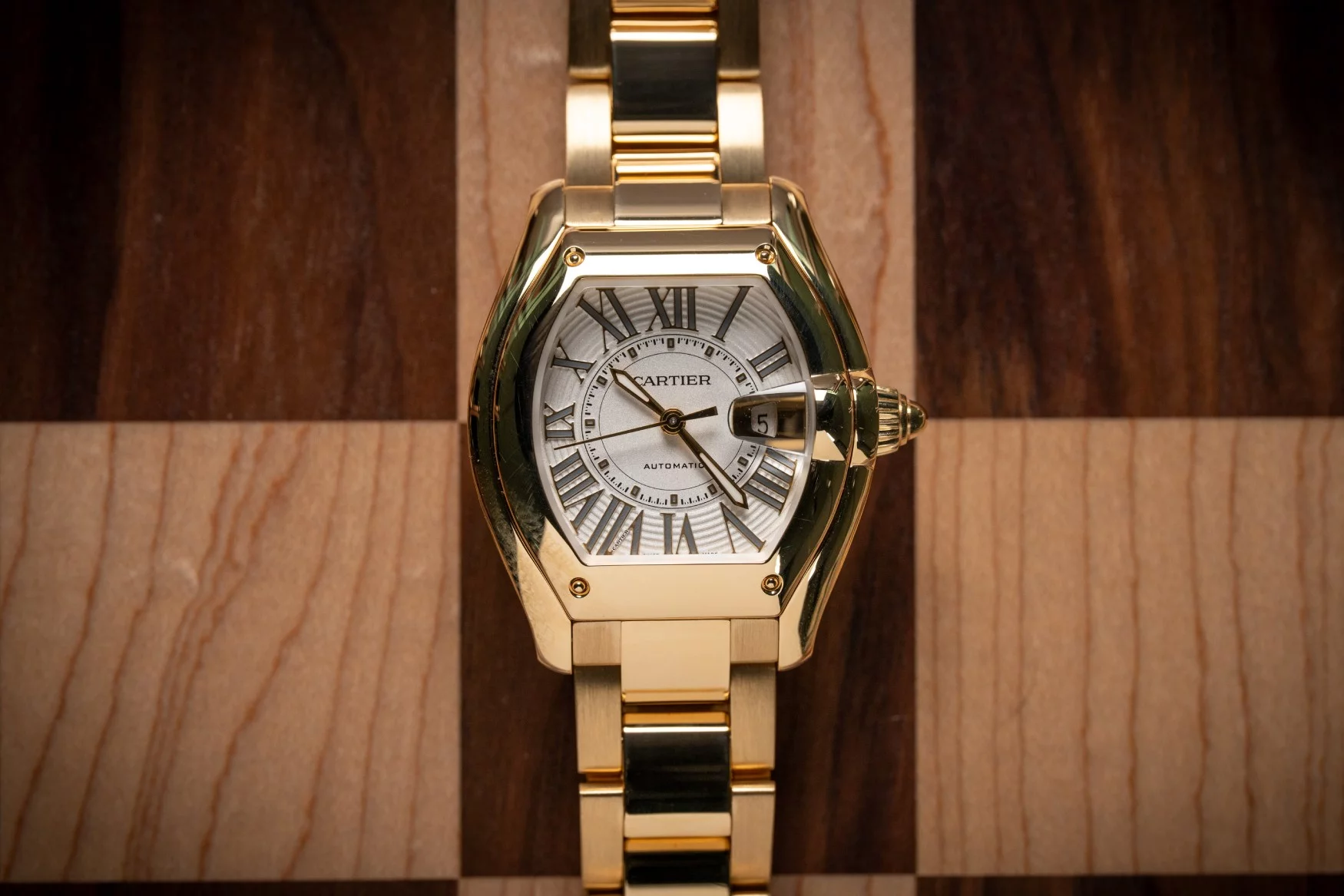
- Tonneau (barrel-shaped) case: Curved to hug the wrist while echoing the flowing fenders and bodywork of vintage automobiles.
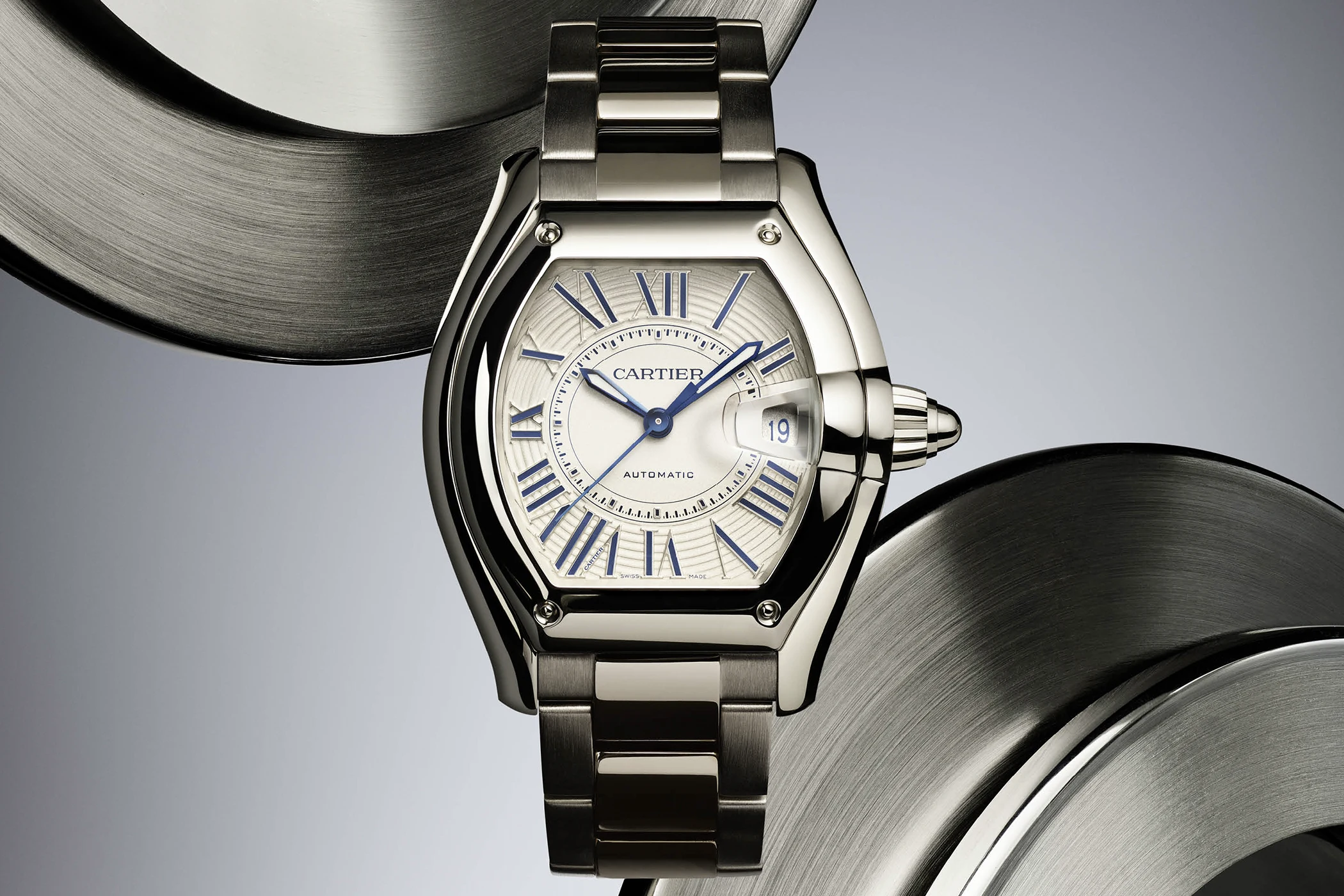
- Speedometer-inspired dial: Concentric circular grooves, a chemin de fer (railway track) minute scale, and applied Roman numerals that mimicked instrument clusters.
- Headlight-style date magnifier: A prominent cyclops lens over the date window at 3 o’clock, designed to resemble a car’s headlamp.
- Conical crown: Bold and integrated, often compared to a gear shift knob, radiator cap, or taillight fin—highly functional for gloved hands and visually striking.
- Integrated bracelet or strap system: Early models featured quick-change capabilities, allowing easy transitions between metal and leather for different occasions.
The original Roadster was produced in various sizes (typically around 38-44mm widths depending on reference) and materials, including stainless steel, two-tone, yellow gold, and even some chronograph variants. Movements ranged from reliable ETA-based automatics to quartz options, making the collection accessible yet luxurious. Water resistance reached up to 100 meters in many steel models, positioning it as a genuine everyday sports-luxury watch rather than a fragile dress piece.
Production ran until approximately 2012, spanning about a decade. During this period, it developed a dedicated following among collectors who appreciated its quirky charm in a sea of more conventional round sports watches from competitors.
why
Discontinuation around 2012 left a void. Cartier shifted focus toward refining core icons like the Santos (which enjoyed a major resurgence), Tank, and high-jewelry pieces, while exploring complications and métiers d’art. The Roadster, with its bolder, more polarizing aesthetic, perhaps felt slightly out of step during an era emphasizing minimalism or ultra-thin dress watches.
Yet absence made the oeuvre grow fonder. On the secondary market, well-preserved original Roadsters became sought-after, often commanding premiums due to their distinctive character. Collectors praised the watch’s versatility—dressy enough for a suit yet sporty for weekends—and its ability to stand out without screaming for attention. The quick-strap system (present in many originals) was ahead of its time, hinting today’s widespread adoption of easy-change mechanisms.
By 2026, the timing felt right for revival. The luxury watch market had embraced nostalgic yet updated heritage models (think Rolex’s perpetual calendar celebrations or Patek’s archive dives). Cartier’s growing emphasis on shaped watches and “form following function” aligned perfectly with reintroducing the Roadster in a more polished form.
revive
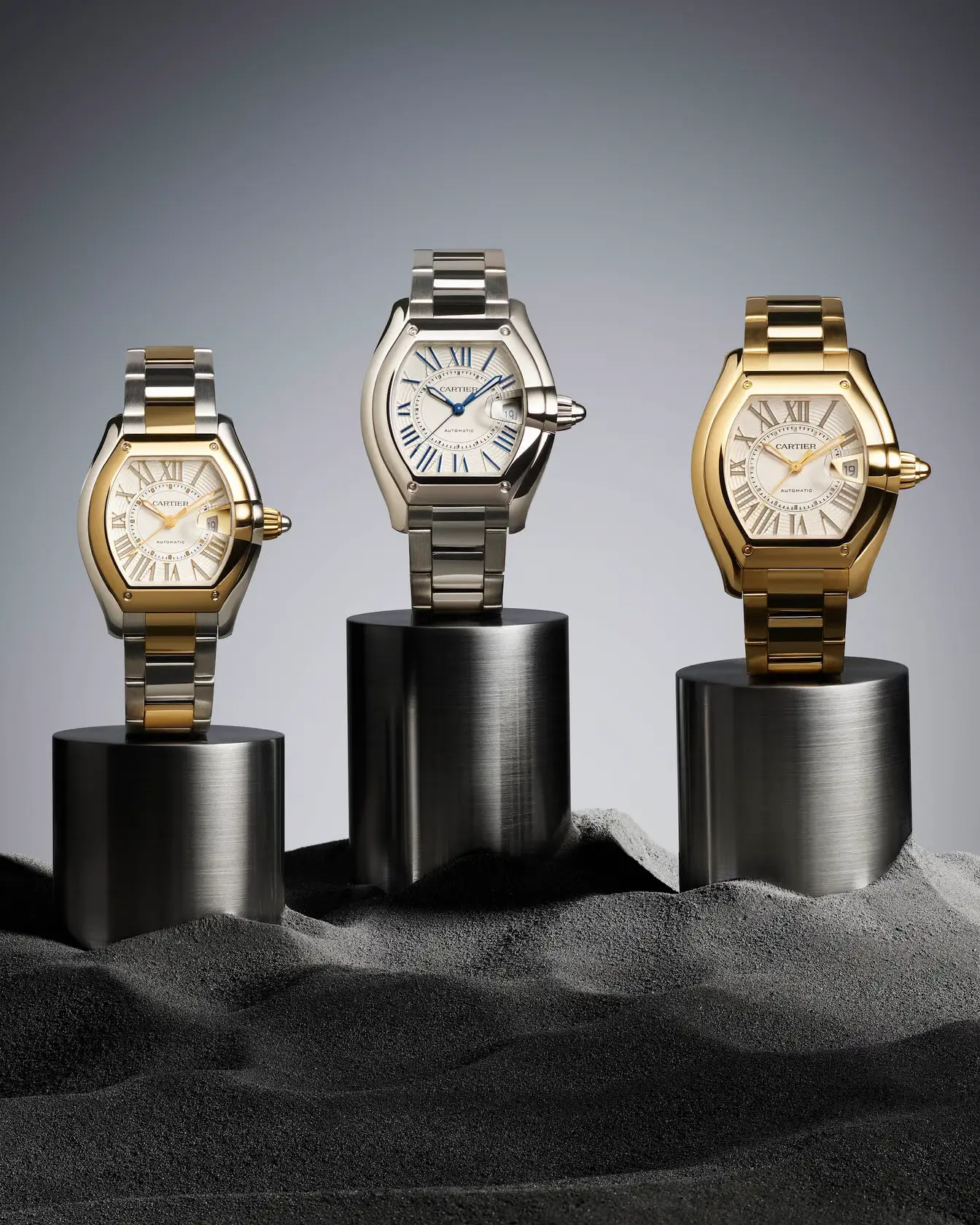
Unveiled at Watches & Wonders Geneva 2026, the new Roadster collection comprises seven references across two sizes: Large (approximately 47.2mm lug-to-lug x 38.8mm width, 10.06mm thick) and Medium (42.5mm x 34.9mm, 9.7mm thick). Both maintain 100m water resistance, a welcome practical upgrade for a Cartier shaped watch.
Case and Design Updates: The tonneau shape remains the star, but proportions are more harmonious. The bezel-to-case relationship is smoother, with refined curves and four visible rivet-like details on the bezel that nod to automotive engineering. The crystal and date magnifier integrate more seamlessly into the overall silhouette. Ergonomics have improved significantly—the watch sits better on the wrist with updated lugs and a more fluid profile.
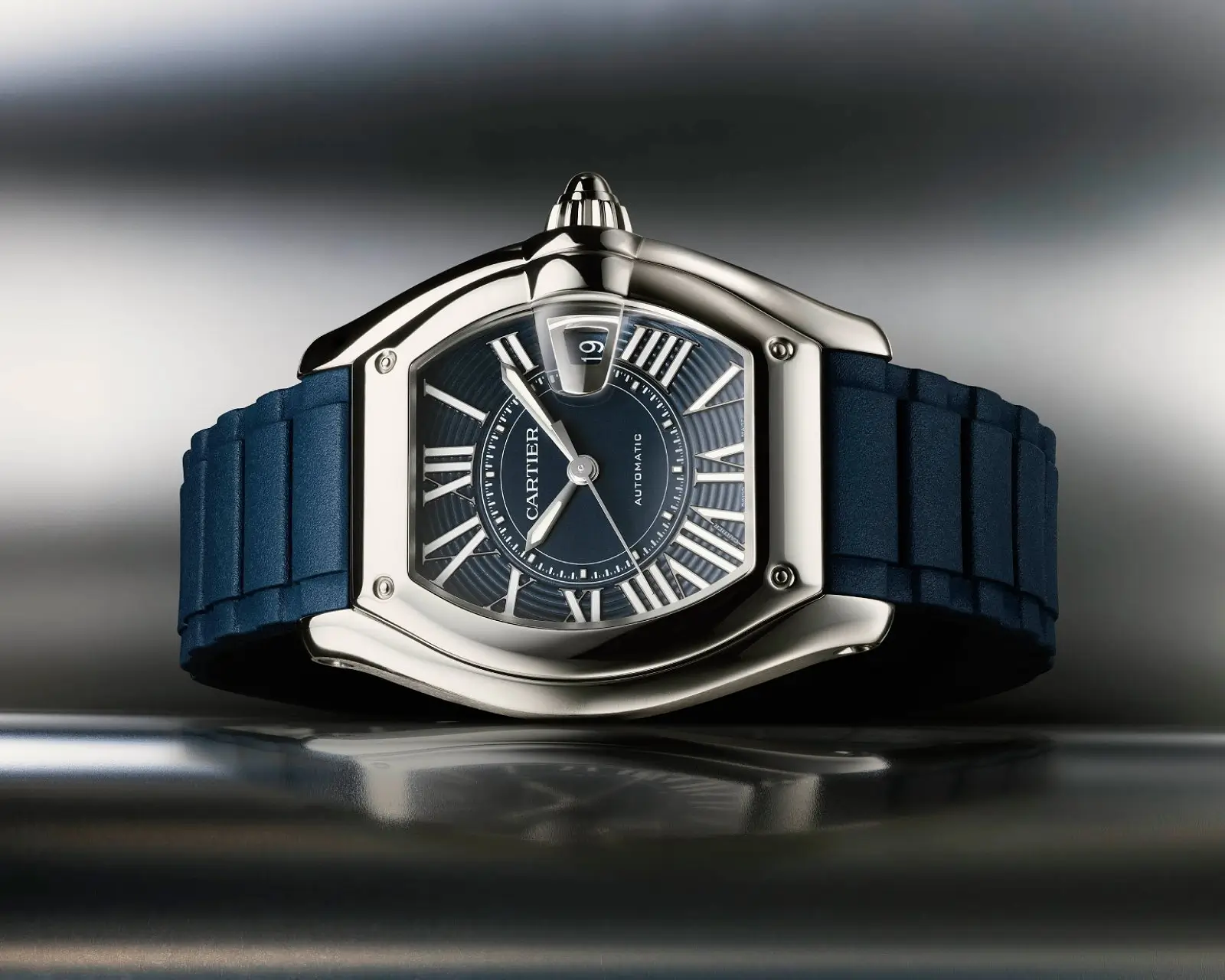
Materials include stainless steel (most accessible), steel-and-yellow-gold two-tone, and full 18K yellow gold (some limited). Dials are predominantly silver-white with applied Roman numerals, blued or gold hands with Super-LumiNova, and the signature hidden Cartier signature near 7 o’clock. A standout is the Large steel model with a dark blue PVD-coated dial, paired with a matching navy rubber strap—adding a modern, sportier edge.
Dial Details: Expect the classic speedometer aesthetic: concentric grooves, rail-track minutes, and that bold date cyclops. Sword-shaped hands (blued steel or gold) complete the instrument-panel vibe. All dials receive high-quality varnish and lume for low-light readability.
Movements:
- Large models: Cartier Calibre 1847 MC (automatic, 4Hz, ~42-hour power reserve).
- Medium models: Cartier Calibre 1899 MC (automatic, ~38-40-hour power reserve).
These are in-house manufacture movements offering solid reliability and Cartier’s signature finishing. While not the most advanced (no silicon components or extreme power reserves here), they prioritize precision and serviceability befitting a daily-wear luxury sports watch.
Bracelet and Strap System: One of the biggest upgrades is the enhanced QuickSwitch interchangeable system. The new H-link bracelet features shorter links for superior drape and comfort, with polished central elements contrasting brushed sides. Owners receive an additional alligator leather strap (various colors) or rubber strap for the blue-dial version. Switching requires no tools—perfect for transitioning from boardroom to beach or track day.
dekko
1-4. Large (47.2 x 38.8mm):
- Steel, white dial, bracelet.
- Steel, blue dial, rubber strap.
- Steel + Yellow Gold two-tone.
- Full Yellow Gold (limited).
5-7. Medium (42.5 x 34.9mm):
- Steel, white dial.
- Two-tone.
- Full Yellow Gold.
Pricing (approximate, depending on market):
- Steel Medium: starting ~$9,300
- Steel Large: ~$10,200
- Two-tone: $18,000–$20,000
- Gold variants: $51,500–$57,000 (some limited)
refine
On the wrist, the updated Roadster feels more wearable than its predecessors. The Large size offers commanding presence without bulk, ideal for those who enjoy statement pieces. The Medium strikes an excellent balance—substantial yet elegant, potentially appealing to a broader audience including women or smaller wrists.
It pairs effortlessly with tailoring (the white dial and gold accents evoke classic elegance) or casual attire (blue dial and rubber strap scream weekend adventurer). The automotive theme invites storytelling: imagine it on the dashboard of a vintage Jaguar or modern Porsche, complementing leather interiors and polished chrome.
show
The Roadster’s return taps into broader trends: nostalgia for early-2000s bold designs, renewed interest in shaped watches, and demand for versatile “daily beaters” in haute. Unlike ultra-complicated pieces, it offers approachable horology with strong personality—perfect for collectors building a Cartier stable alongside a Santos or Tank.
Critics and enthusiasts have largely welcomed the revival, noting improved finishing and proportions while lamenting the absence (so far) of a chronograph version. Some purists prefer the slightly quirkier original, but most agree Cartier has “dialed it in” for contemporary tastes.
fin
With this strong 2026 foundation, expect Cartier to expand the Roadster line—perhaps with skeletonized editions, additional complications, or more material experiments. It strengthens Cartier’s position in the competitive sports-haute segment, proving that shaped watches can be as wearable and desirable as round ones.
The Roadster embodies Cartier’s know: timepieces that are not just functional but expressive extensions of personal style. Its return after 14 years reaffirms that great designs, like great cars, never truly go out of fashion—they simply await the right moment to roar back onto the scene.
In Geneva’s halls of horological wonders, the Cartier Roadster reminded everyone why the maison remains unmatched in blending form, function, and flair. Whether you’re a longtime fan rediscovering an old love or a newcomer drawn to its unique curves, the 2026 Roadster delivers an invitation to hit the road—in style.
From the DRIFT archive: PANTONE’s 2026 Color of the Year Takes Shape With Play-Doh and Post-It Editions · Timex x MM6 Maison Margiela T80: A Digital Classic Reimagined in Gold-Tone Steel
Related Articles

Under Rue de Castiglione, Liaigre Gives Hôtel Costes a Spa With No Hard Corners
A 20-meter lap pool, eight treatment rooms and not one sharp angle: Studio Liaigre’s spa […]