DRIFT AUDIO
Listen to this story
Choose a voice, then press play.
A Shanghai bar founded by TCM students is turning pulse readings into cocktails, and the same culture current is already funding acupuncture studios and skincare labs backed by the money behind Louis Vuitton and Dior.
In This Story
- The Pulse Before the Pour
- What “Punk Wellness” Actually Means
- Five Locations in Under a Year
- Where the Big Luxury Money Already Landed
- Two Tracks, One Convergence
- What the Numbers Say About Where This Goes
Helen Zhao is a graduate student, and before she can order a drink at Niang Qing, a bar tucked into a softly lit corner of Shanghai, she has to hold out both wrists. A doctor in a white coat reads her pulse the way a bartender elsewhere might ask about spirit preference. From there, a mixologist goes to work, pulling from apothecary drawers stocked with goji berries and angelica root instead of the usual back bar of spirits, building a cocktail keyed to whatever the reading turned up.
Zhao told the wire service AFP that the bar functions as a kind of permission slip. She described her routine as fairly typical for someone her age: late nights, convenience food, a schedule that leaves little room for anything resembling self care. At Niang Qing, that same lifestyle gets acknowledged rather than lectured about, and the drink in front of her becomes a small correction rather than an indulgence she has to feel guilty about.
Cici Song, a 41 year old office worker who was also at the bar, put it more bluntly. She called her evenings out her only real personal time, and said the tension between wanting to unwind and wanting to look after her body gets resolved, at least for a night, in a glass. Her drink that evening was built around a diagnosis of what TCM practitioners call a phlegm damp constitution, and she described the whole exercise as a kind of balance, having fun while trying to limit the damage.
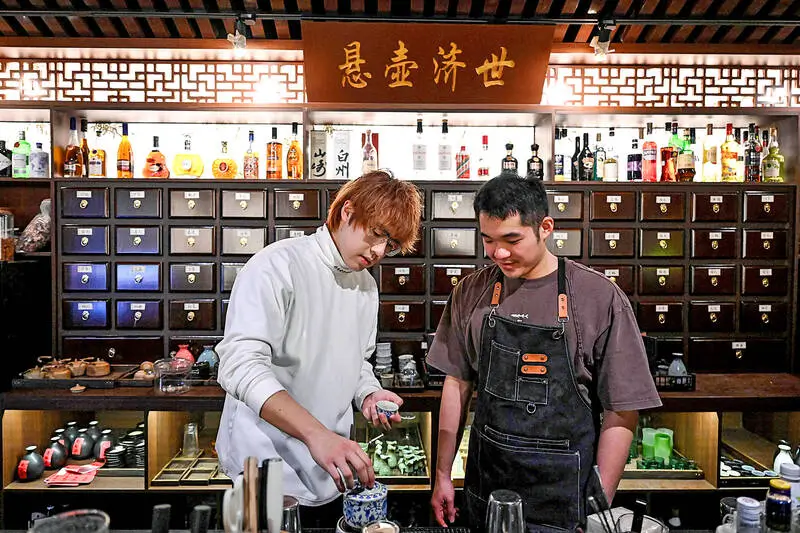
Staff prepare herbal ingredients inside a traditional Chinese medicine-inspired wellness bar framed by apothecary drawers and botanical spirits.
huh
The phrase making the rounds in Chinese youth culture is “punk wellness,” a term that captures the contradiction at the center of this trend better than any marketing copy could. The literal translation carries a sense of wrecking yourself while saving yourself, a shorthand for a gen trying to hold two incompatible habits in one hand: the burnout culture that dominates their working lives, and a genuine desire to counteract it.
That burnout culture has a name too. China’s “996” schedule, nine in the morning to nine at night, six days a week, remains common across large parts of the private sector, and it shows up in the health data. A 2024 survey found that more than 60 percent of young people in China consider their own health suboptimal, and reports of employees dying from overwork have circulated widely enough to keep the topic in public conversation.
Hua Hui, a professor at Shanghai Jiao Tong University, told AFP that bars like this one are answering a need that goes beyond any single country. He described the pressure young people are under as a worldwide issue, and framed TCM bars as a new kind of socializing built specifically for that pressure, one that moves people from scrolling alone to sitting across from each other in a room that smells like a pharmacy and looks like a bar.
Hua’s framing points at something worth sitting with. TCM bars are not simply pulling people away from their phones. They are giving people a reason to leave the house that does not require pretending everything is fine. A regular bar asks a customer to order and move on. Niang Qing asks a customer to first admit, out loud, to a stranger in a white coat, that their sleep has been bad or their stomach has been off, and only then does the night start. That small ritual of disclosure appears to be doing as much social work as the cocktail itself.
five
Niang Qing was started by students from the Shanghai University of Traditional Chinese Medicine only a year before it had already grown to five locations across the country. Co founder Wu Siyuan, 22, said the idea came from a simple observation: plenty of young people are genuinely curious about TCM culture, but the traditional ways of engaging with it can feel dry. Wrapping the practice in a bar setting, with a doctor doing diagnostics and a mixologist doing the translation into flavor, turned something academic into something people wanted to go out for.
Wu also said the bar has been drawing more foreign visitors, which tracks with a broader pattern researchers have flagged: young Chinese consumers gravitating toward products that repackage older domestic traditions for a contemporary audience, and that repackaging finding an audience well outside China’s borders. On TikTok, a trend called “Becoming Chinese” has pulled in hundreds of thousands of likes from overseas users brewing herbal infusions, drinking hot water instead of cold, and picking up traditional physical practices, all borrowed from the same wellness vocabulary that built Niang Qing’s menu.
Wu was careful to draw a line around what the bar actually offers, telling AFP that it targets health awareness, not treatment. That distinction matters for a business operating in a gray zone between hospitality and medicine, and it is the same distinction that will matter to any larger company thinking about how to build on this idea without walking into regulatory trouble.
The speed of that expansion, five locations inside a single year, is the detail that tends to catch the eye of anyone in brand strategy. Most food and beverage concepts take years to prove a format works before a second or third location gets greenlit. Niang Qing scaled that timeline down dramatically, which suggests the founders were not so much inventing demand as uncovering demand that was already sitting there, waiting for a format that made it feel current rather than dated. That is precisely the kind of signal a larger, better capitalized operator watches for before deciding where to put money next.
The overseas interest Wu described is not an isolated data point either. TCM adjacent content has been building an audience on Western platforms for several years now, well before “Becoming Chinese” became a named trend. Herbal tea recipes, gua sha routines, and cupping demonstrations have circulated widely on social video platforms, often stripped of clinical context and repackaged as lifestyle content. Niang Qing’s model effectively does the same repackaging in physical space rather than on a screen, which may explain why a bar built by TCM students in Shanghai is drawing customers who never studied the subject and live thousands of miles away.
as
While Niang Qing was opening its fifth location on a shoestring, the largest luxury group in the world had already placed two separate bets on the exact same cultural material, just packaged for a different price point and a different customer.
LVMH founded Cha Ling in 2016 under Guerlain, building the brand around Pu’er tea sourced from Yunnan’s Xishuangbanna region and marketing it explicitly as a bridge between French skincare craft and Chinese herbal tradition. The brand had a rocky retail run, closing its physical stores and WeChat shop during the pandemic years, and it now lives primarily through Sephora, but the underlying thesis never left LVMH’s playbook: traditional Chinese medicine, dressed in the language and packaging of French luxury, sells.
View this post on Instagram
Cha Ling’s launch in 2016 was, by most accounts, a shh one. It arrived with a single press release on LVMH’s corporate site rather than a splashy campaign, and it was built around ingredients sourced deep in Yunnan Province, in the Xishuangbanna region, an area chosen specifically for producing what the brand describes as the world’s oldest variety of Pu’er tea leaves. Guerlain’s then chief executive, Laurent Boillot, is credited as the founder, and the pairing of French cosmetic expertise with a raw material this specific to Chinese herbal tradition was, at the time, a genuinely unusual bet for a European luxury house to make.
That bet has not run in a straight line. Cha Ling closed its standalone stores and its WeChat shop during the pandemic years, a retreat that industry press at the time read as a sign of how difficult it can be for a foreign brand to hold a niche position in China’s retail landscape. The brand kept going through Sephora rather than folding entirely, which says something about how committed LVMH remained to the underlying idea even after the retail format around it stumbled.
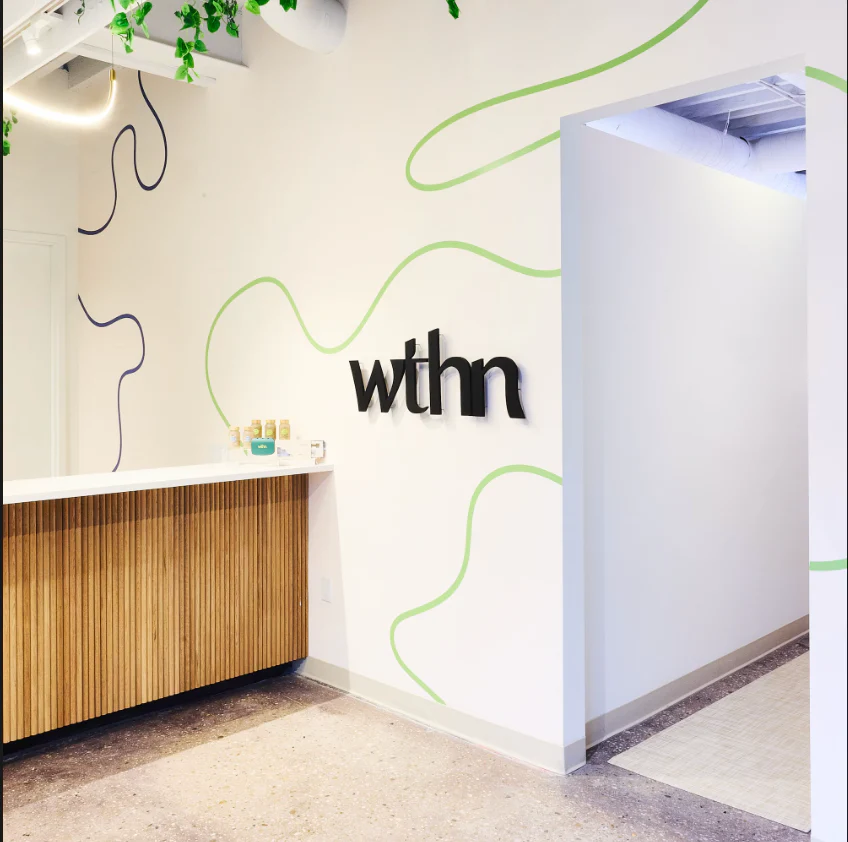
That underlying commitment resurfaced more recently through L Catterton, the private equity firm backed by LVMH and the Arnault family, which put five million dollars into WTHN, a modern acupuncture and TCM wellness brand operating studios across Manhattan and Brooklyn. The check size is small by LVMH standards, but the signal is not. WTHN describes its own offering as effective, holistic solutions for mind body wellness rooted in traditional Chinese medicine, built for modern life, language that could sit comfortably in a Niang Qing menu description despite the two businesses operating on opposite sides of the world and opposite ends of the price spectrum. It tells you where a company that built its fortune on handbags and champagne thinks the next decade of luxury spending is headed: toward the body, not just the wardrobe.
coalesce one
What makes this moment worth watching is not that a Shanghai bar exists, or that LVMH has a skincare line built on tea leaves. It is that two very different tracks, one grassroots and student run, the other institutional and Paris headquartered, are converging on the same raw material at the same time.
Niang Qing did not need outside capital to prove the appetite exists. Its founders read the room correctly: young Chinese consumers want traditional medicine translated into something social, photographable, and fun, not clinical. LVMH, through Cha Ling and through its L Catterton bet on WTHN, arrived at a version of the same conclusion from the opposite direction, working from consumer research and brand strategy rather than a dorm room idea, but landing on the same culture terrain.
Neither company invested in the other, and there is no reported financial link between Niang Qing and any LVMH entity. What connects them is timing and instinct. A wellness category once associated with your grandmother’s medicine cabinet is being actively rebuilt by two very different kinds of operators into something that reads as current, and in some cases genuinely luxurious, at almost the exact same moment.
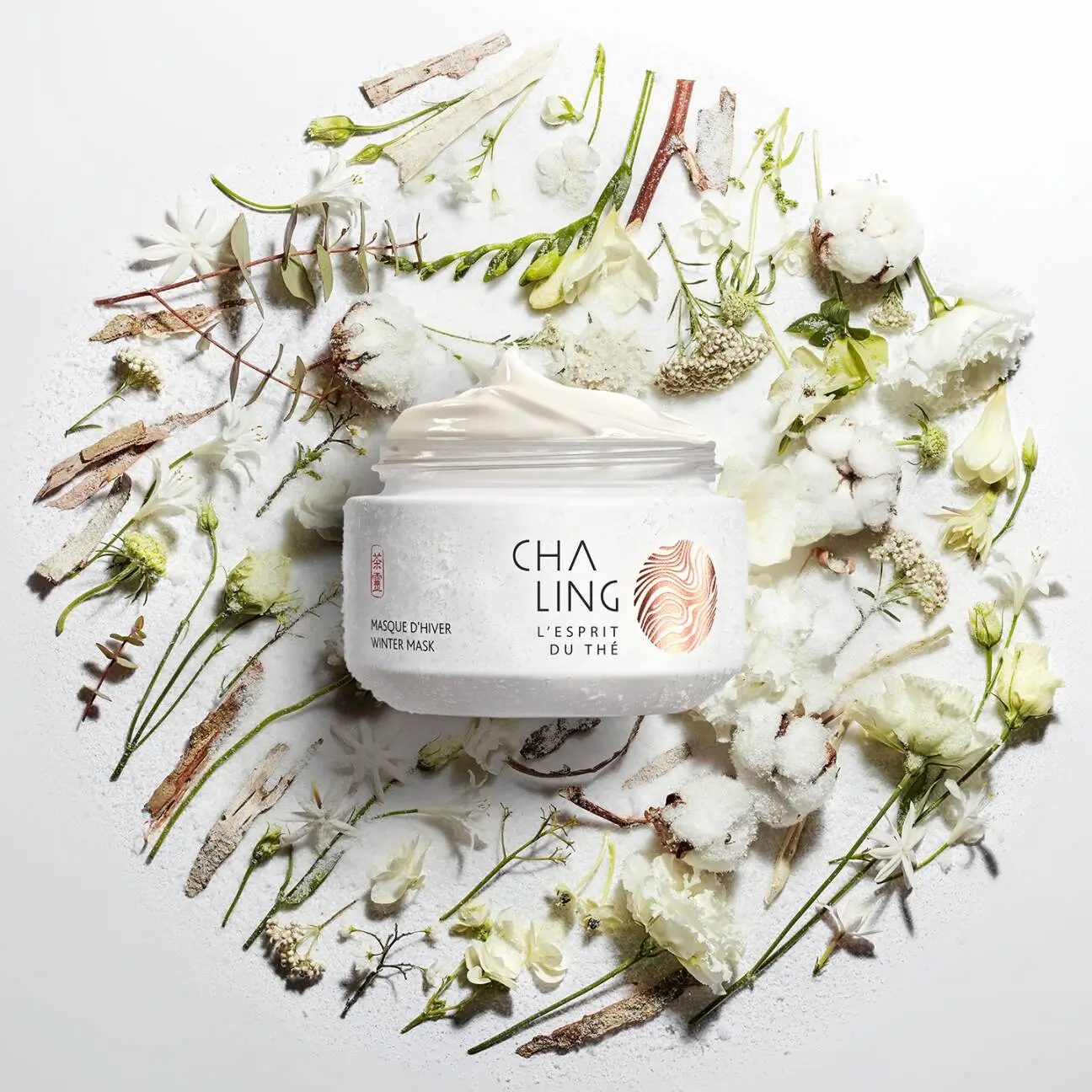
CHA LING Winter Mask presented in a botanical flat lay with white florals, cotton, and herbal elements highlighting the brand’s nature-inspired skincare philosophy.
forward
The broader context helps explain why both tracks are moving now rather than five years ago. Chinese consumers already account for a large share of global luxury spending, with industry analysts putting the figure somewhere between a quarter and nearly half of global luxury revenue depending on how the category is measured. LVMH’s own China strategy, from flagship openings in Beijing’s Sanlitun district for Louis Vuitton, Dior, Tiffany, and Loro Piana to its long running bet on Cha Ling, has treated the market as too important to leave any cultural opening unaddressed, even as the group navigates a more cautious near term demand picture and shares that have traded well off their highs. Analysts covering the sector have also flagged that Chinese consumer preferences are shifting toward experience and wellbeing alongside physical goods, a shift that a TCM cocktail bar and an LVMH backed acupuncture studio are, in their own ways, both built to capture, even if neither was built with the other in mind.
That backdrop also explains why a five location bar chain run by graduate students and a five million dollar minority investment out of a Greenwich, Connecticut private equity office can both be read as leading indicators of the same shift. Big luxury conglomerates rarely move first into a cultural trend. They tend to watch it prove itself at a smaller, cheaper scale, then buy or build their way into a cleaned up version of it once the appetite is confirmed. Cha Ling suggests LVMH is willing to lead occasionally, but the WTHN check looks more like the second, more typical pattern: modest capital, deployed early, into a category a bar in Shanghai is currently proving out for free.
For now, the two tracks remain distinct in scale. Niang Qing is a five location bar chain run by young graduates who are explicit that they are selling awareness, not medical treatment. WTHN operates a network of studios in one American city with a modest strategic investment behind it. Cha Ling has already been through one retreat, from standalone stores to a single distribution channel through Sephora. None of these are proof of a finished business model.
What they are proof of is an appetite. A generation stretched thin by long hours wants something that acknowledges the toll without asking them to give up their evenings out, and a luxury industry built on translating tradition into desirable objects has noticed. Whether that appetite becomes a durable new corner of the luxury economy, or settles into a passing aesthetic the way so many wellness trends do, is still an open question. Right now, in a dimly lit room in Shanghai, that question looks a lot like a doctor taking someone’s pulse before handing them a drink.
Related Articles
Dior and A24 Just Turned a Hundred-Year-Old Theatre Into Their Shared Stage
A two-year partner makes Dior the lead patron of A24’s Cherry Lane Theatre, unveiled with […]