DRIFT AUDIO
Listen to this story
Choose a voice, then press play.
In This Story
- The Murder on Thunderboat Row
- A Brooklyn Lifeguard Builds an Empire
- The Boat Named After a Rum Runner
- A Boat for Presidents, and a Boat for the Job
- The Racers Who Were Also the Smugglers
- When Television Made It Glamorous
- What’s Left on Thunderboat Row
On the afternoon of February 3rd, 1987, a man walked into a boat dealership on a quiet industrial street in North Miami Beach. He gave a fake name, asked vague questions about a 60-foot boat, and mentioned, almost in passing, a powerful man he worked for — a man he said he’d kill for if he had to. A few minutes later he left. Later that same afternoon, on that same street, a 59-year-old boat builder named Don Aronow rolled down his car window to talk to the driver of a blue Lincoln that had pulled up beside him. He was shot multiple times and died almost instantly.
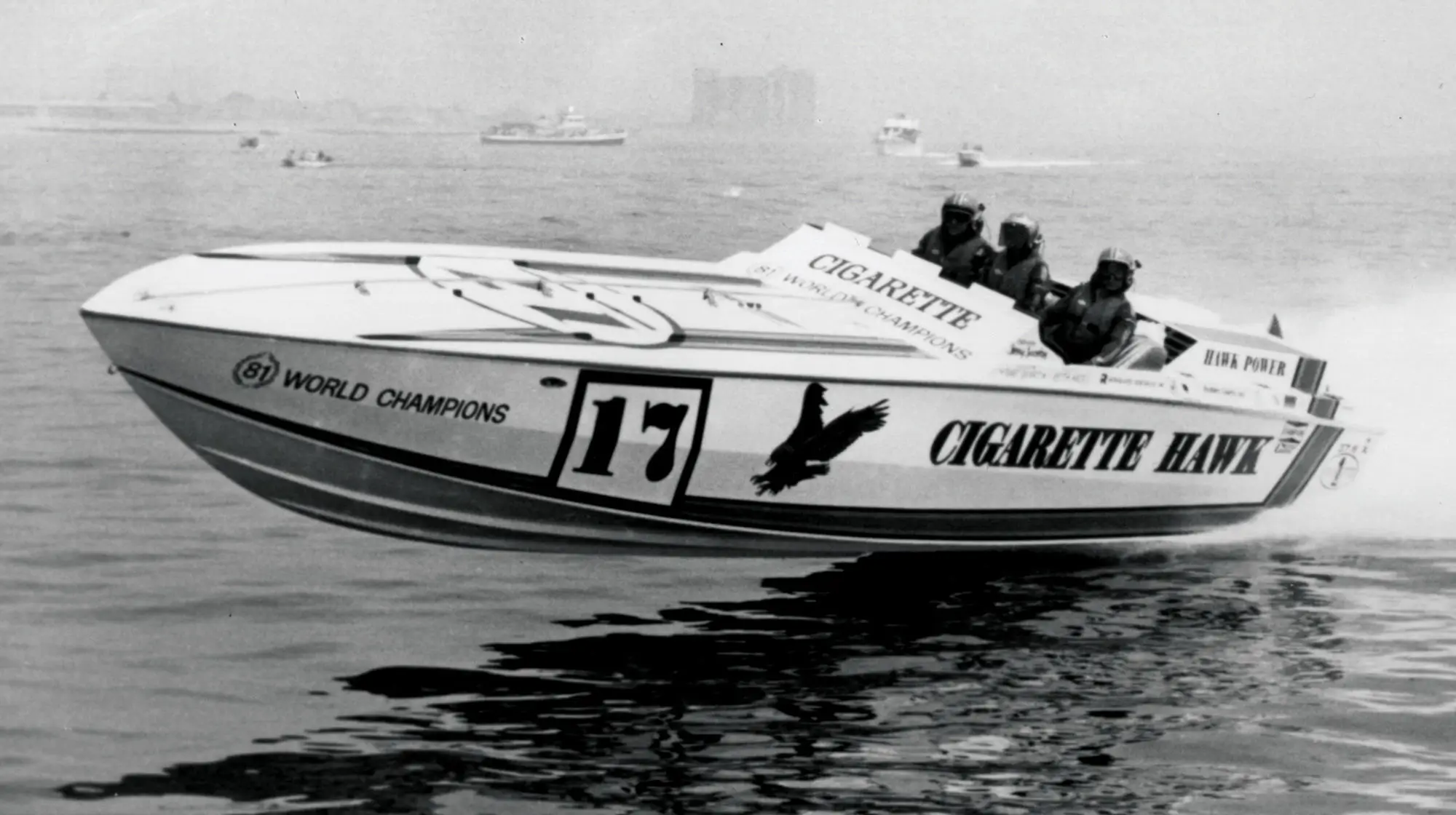
The street was called NE 188th Street, though everyone in the boating world just called it Thunderboat Row. Aronow had built it himself, brick by brick, two decades earlier. And the company whose name would outlive him, whose boats would become shorthand for an entire era of American excess, was Cigarette Racing — a brand that started as one man’s racing hobby and ended up tangled, almost inescapably, in the biggest drug boom in American history.
The Murder on Thunderboat Row
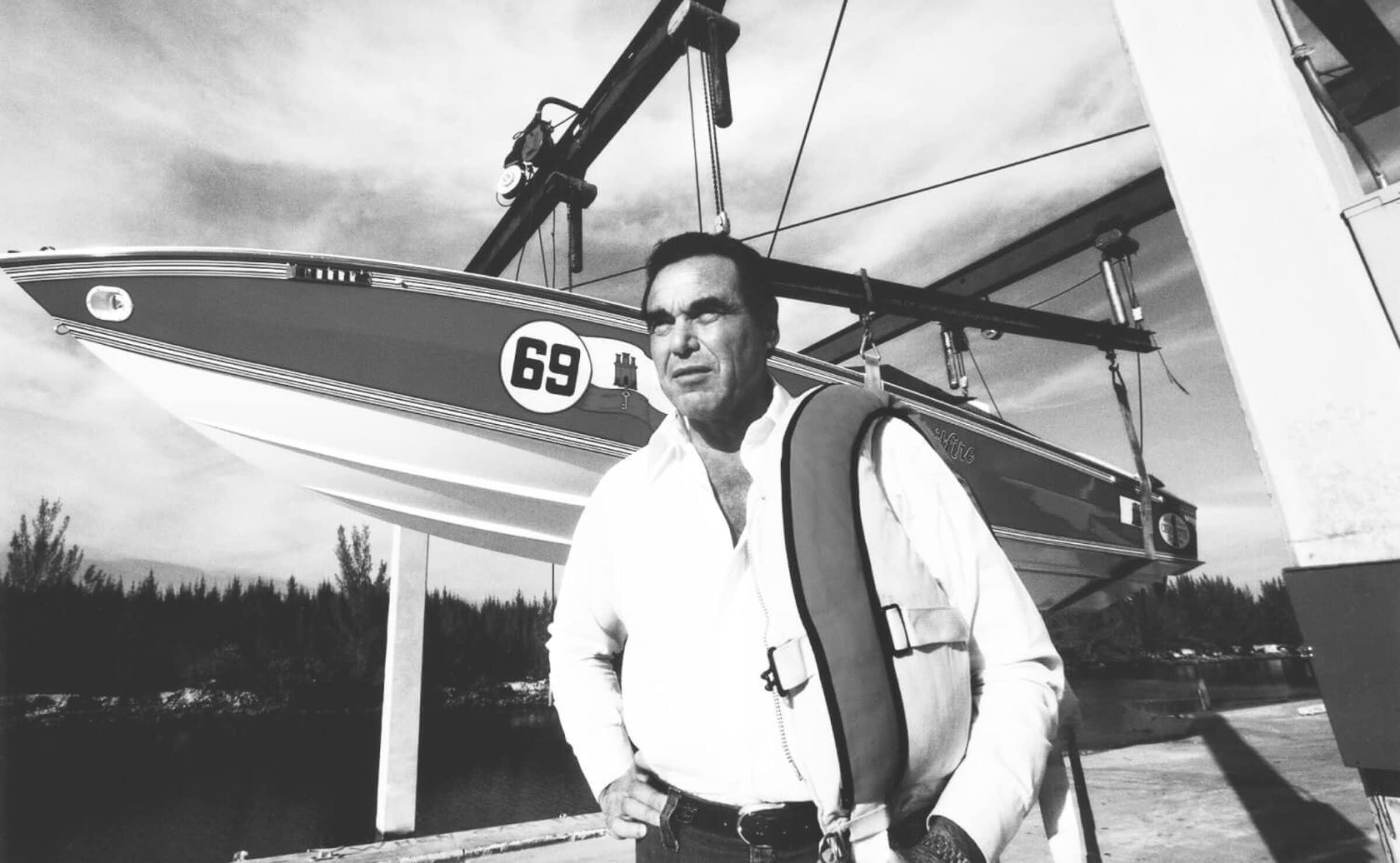
The street was called NE 188th Street, though everyone in the boating world just called it Thunderboat Row. Aronow had built it himself, brick by brick, two decades earlier. And the company whose name would outlive him, whose boats would become shorthand for an entire era of American excess, was Cigarette Racing.
stir
Don Aronow didn’t grow up around boats. He was born in 1927 in Sheepshead Bay, Brooklyn, the son of Russian-Jewish immigrants, and spent his teenage summers working as a lifeguard at Coney Island. He served in the Merchant Marine at the end of World War II, finished a physical education degree at Brooklyn College, and then did something that had nothing to do with any of that: he went into construction, and by his late twenties, he was already a millionaire.
It wasn’t until 1959 or 1960, after selling his New Jersey construction business, that Aronow moved south to Miami looking for something closer to a retirement than a second act. What he found instead was offshore powerboat racing. A friend introduced him to the sport, and in 1962 he entered his first real race — the legendary Miami-to-Nassau run — in a 27-foot cruiser. He led for most of the race before a mechanical failure dropped him to fourth place. By his own account, that one taste was enough. He was hooked for life.
What followed was one of the strangest runs of serial entrepreneurship in American sports. Aronow didn’t just race boats — he built companies, sold them, and started new ones, sometimes within the same calendar year. He founded Formula Marine in 1962 and sold it within about two years. He started Donzi Marine in 1964 and sold that one too, within months. In 1966 he founded Magnum Marine with a partner named Elton Cary, and won his first world championship driving one of his own boats the following year. Each company he built got faster, sleeker, and more dialed-in than the last, because Aronow treated boatbuilding the way other people treated chess: every sale just set up his next move.
flow

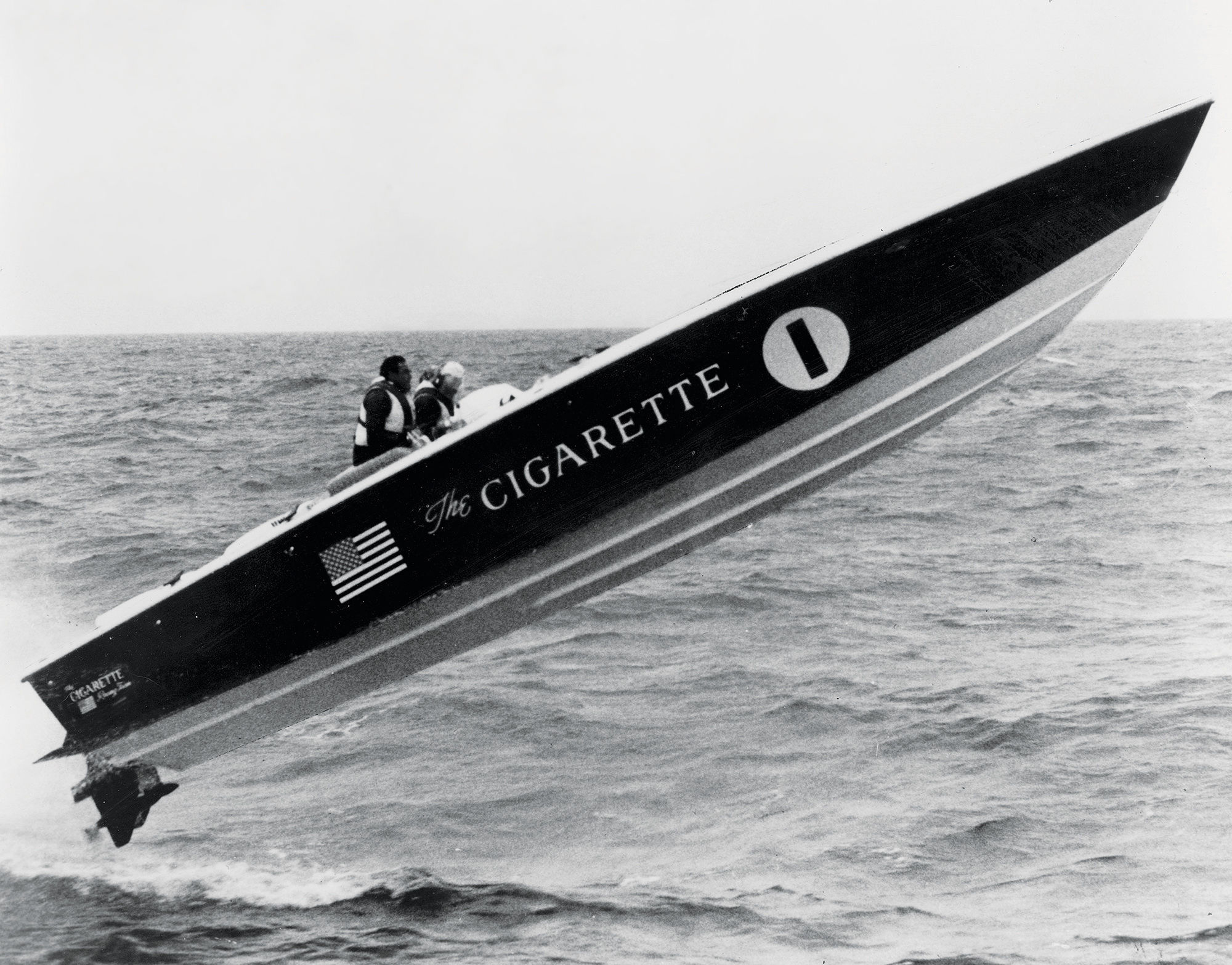
By the time Aronow founded Cigarette Racing Team in 1969, on that same stretch of 188th Street, he wasn’t just building boats anymore — he was building a brand identity. And the name itself carried a wink that almost nobody caught at the time. “Cigarette” wasn’t a reference to smoking. It was a tribute to a famous Prohibition-era rum-running boat from the 1920s, a vessel built specifically to outrun the Coast Guard while hauling illegal liquor up the Eastern Seaboard. Aronow had actually used the name once before, on an earlier Formula model, simply because he liked the history behind it.
He had no way of knowing how prophetic that choice would turn out to be.
The boats themselves were genuinely revolutionary. Working with an engineer named Jim Wynne and a hull designer named Walt Walters, Aronow refined a deep-V hull design that let his boats cut through rough open water at speeds nothing else on the market could match — pushing past 90 miles an hour in conditions that would have torn apart a conventional hull. That speed and stability made Cigarette boats dominant on the offshore racing circuit. It also, completely incidentally at first, made them the single best tool in America for getting something across open water quickly, quietly, and without getting caught.
A Boat for Presidents, and a Boat for the Job


Through the 1970s, Cigarette became the boat that everybody with money wanted to be seen in — owned by Vice President George H.W. Bush, Malcolm Forbes, the Shah of Iran, and European royalty. But the same qualities also made them irresistible to the growing drug smuggling trade in South Florida.
Nobody captures that overlap better than Ben Kramer, Willy Falcon, and Sal Magluta — championship racers who simultaneously ran massive cocaine operations. Money, racing, and the drug trade converged at places like the Mutiny hotel in Coconut Grove.
When Television Made It Glamorous

By the time NBC’s Miami Vice premiered in 1984, the cultural alchemy was basically already complete — the show just put a soundtrack and a pastel color palette on something that had been true on the water for a decade. Cigarette boats appeared constantly throughout the series’ run, visually cementing the brand in the popular imagination as the literal vehicle of choice for drug traffickers, even as it remained, simultaneously, a status symbol for the legitimately wealthy. That tension is exactly what made the brand so culturally durable: a Cigarette boat photographed well whether the person behind the wheel was a Saudi prince or a federal fugitive, and for a few strange years in the 1980s, nobody watching really needed to ask which one they were looking at.
Aronow, for his part, had already sold the Cigarette brand by then — in 1982, after buying it back and reselling it more than once over the years — and moved on to what should have been the most ironic chapter of his career. His final venture, USA Racing Team, built 39-foot “Blue Thunder” catamarans specifically for the U.S. Customs Service, designed to give law enforcement boats fast enough to actually catch the smugglers running boats built on his own earlier hull designs. George H.W. Bush, his old Cigarette-owning friend, personally tested the catamarans before the government signed off on the contract.
It was a business dispute connected to that very program that investigators believe got Aronow killed. Ben Kramer had purchased Aronow’s USA Racing Team outright, only to have the Customs Service refuse to work with a company tied to a known drug trafficking suspect, forcing Aronow to buy the company back — a reversal that reportedly cost Kramer $600,000 and, by most accounts, permanently soured the relationship between mentor and protégé. Kramer was already serving a life sentence on unrelated drug and racketeering charges when, in 1996, he pleaded no contest to manslaughter in connection with Aronow’s murder. The actual triggerman, a man named Bobby Young, admitted his role in 1995 and gave a full confession in 2009, shortly before his death — more than two decades after the killing itself.
fin

Cigarette Racing survived all of it. The brand changed hands repeatedly after Aronow’s death before finding stable footing in 2002 under new ownership, building a modern production facility in Opa-locka and launching an annual partnership with Mercedes-AMG in 2007 that still produces a custom go-fast boat unveiled every year at the Miami International Boat Show. In 2021, the company changed hands again, purchased by a Miami attorney and a private investment firm betting that the Cigarette name still carries enough mystique, more than five decades after Aronow first put it on a hull, to be worth building around.
That mystique was never really about the boats alone. It was about a moment when speed, money, and crime briefly became indistinguishable from each other on the water off Miami — when the fastest boat in the harbor might belong to a head of state, a championship racer, or a man moving cocaine for the Medellín cartel, and there was genuinely no way to tell just by looking. The deep-V hull that won Aronow his world championships is the same hull that let smugglers outrun the Coast Guard at night, and that’s not an accident of timing — it’s the whole story in one design choice. Don Aronow built the boat that made that ambiguity possible. He just never got to see how the story ended, and the case built around his own death took more than two decades to even partially close.
Related Articles

Where the Face Should Be, Rafael Silveira Paints Open Sky
A pink shirt, shoulder-length hair, then no face at all: in “Surprise,” Rafael Silveira lets flowers and a clear blue sky stand in for the person.