Julio Larraz’s “Autumn at Cumae”: Inside the Cuban Master’s Mythic Italian Landscape

June 26, 2026
recall
- The Lot, At a Dekko
- Who Is Julio Larraz
- Reading “Autumn at Cumae”
- Why Cumae
- The Inscription on the Reverse
- Larraz on the Market
stir
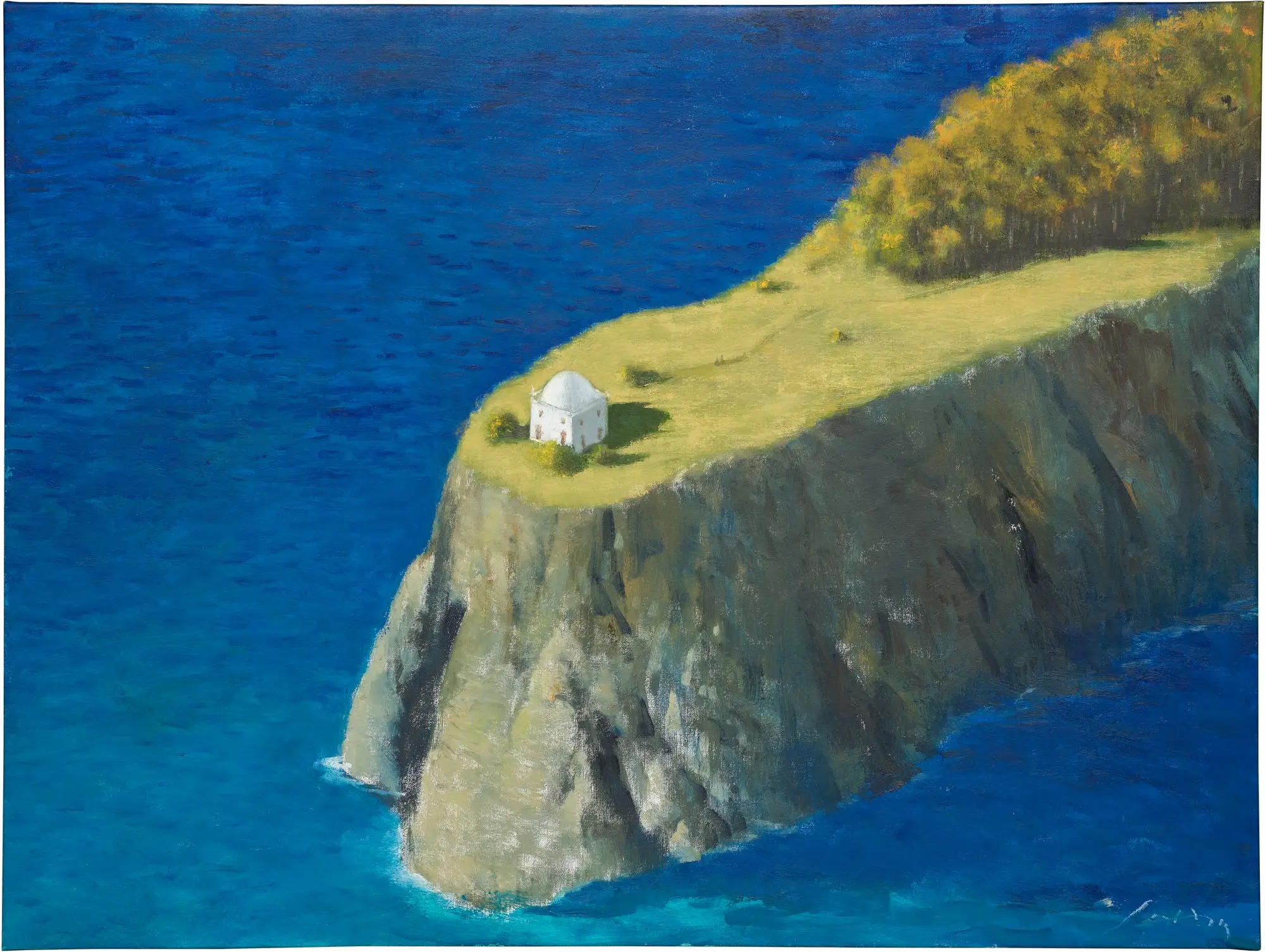
A shh theatrical autumn scene by Cuban-American painter Julio Larraz has surfaced at Phillips’ summer online sale in New York, and it’s the kind of lot that rewards a slow look. Titled Autumn at Cumae, the oil on canvas is listed as Lot 25 in Phillips’ Modern & Contemporary Art: Online Auction, New York, running from June 16 through June 30, 2026, with lots closing consecutively in one-minute intervals starting at noon ET on closing day.
The work is signed “Larraz” lower right, and on the reverse it carries the artist’s own title and inscription, rendered as “Il autumno a Cumae” III 7 59 2. It’s an oil on canvas measuring 29 3/4 by 39 1/2 inches (75.6 by 100.3 centimeters), painted in 2005 in the United States. The lot comes with a certificate of authenticity issued by the Julio Larraz Foundation, which today serves as the keeper of the artist’s catalogue raisonné and the official verifier of his work’s provenance.
It’s a relatively modest entry by Larraz’s auction standards (his market has produced six-figure results for larger, more populated canvases), but Autumn at Cumae is a useful entry point into what makes Larraz’s landscapes so distinctive: a painter who learned to see the world through a caricaturist’s eye for irony, then spent five decades rendering that irony in oil paint that looks, at first glance, like it could hang in the Prado.
flow
Julio César Ernesto Fernández Larraz was born in Havana, Cuba, on March 12, 1944, into a family that owned and ran the newspaper La Discusión. His father had been a political activist who was imprisoned for three years under an earlier Cuban regime before going on to run that paper, and his mother, a law student, eventually took over as its director. That household — newsprint, politics, and a healthy suspicion of power — shaped almost everything Larraz would go on to paint.
In 1961, the year of the failed Bay of Pigs invasion, the family fled Cuba for Miami, with Larraz only sixteen years old at the time. The family later moved on to Washington, D.C., and then New York. Larraz first worked as a political caricaturist and cartoonist, signing his early work “Julio Fernandez,” and his caricatures of figures including Indira Gandhi, Golda Meir, and Richard Nixon ran in Esquire, The New York Times, Rolling Stone, and The Washington Post, among others.
The shift to painting came gradually. In the 1970s he began painting in earnest and changed his signature to “Julio Larraz.” He studied technique under the American realist painter Burt Silverman in New York, and is largely self-taught as a painter beyond that mentorship — known, as one Italian gallery representing him puts it, for an extraordinary use of white and light. His first solo exhibition opened in 1971 at the Pyramid Gallery in Washington, D.C., and from there his career expanded steadily through galleries and museums across the Americas and Europe.
Stylistically, critics keep returning to the same handful of reference points: Surrealism and, in particular, Giorgio de Chirico, alongside American Realists like Edward Hopper and Andrew Wyeth. Artsy’s house assessment captures the blend well — Larraz paints imaginative-yet-realistic snapshots of Caribbean life, characterized by a unique subtlety and precise, detailed technique, with the artist drawing on references to Surrealist, early modern European, and seventeenth-century Spanish painting. The work returns again and again to bullfights, white linen suits, and maritime scenes — and, just as often, to the shh menace of unchecked power, even when the painting’s surface reads as a sun-washed still life or a coastal vista.
Today Larraz divides his time between the United States and Italy, and is represented in institutional collections including the Museo de Monterrey in Mexico and the World Bank in Washington, D.C. He’s the recipient of honors including the 1975 Cintas Foundation Fellowship and the 2011 Gold Medal from Casita Maria’s Center for the Arts and Education in New York, and in 2019 his family established the Julio Larraz Foundation to preserve and authenticate his body of work going forward — the same foundation that issued the certificate accompanying this lot.
scope
Larraz’s landscapes rarely settle for being merely beautiful, and that tension is part of what collectors are paying for. As the gallery representing him in Italy frames it, his pictures present an apparent realism that, the deeper you look into it, reveals an evident complexity accompanied by a narrative universe — what the same source calls a fusion of magical realism with social and political criticism. A Larraz seascape or hillside is rarely just a seascape or a hillside; it’s staged.
That staging is the through-line of his career, even when the subject shifts from the tropics to Italy. Auction-house cataloguers describe his work as marked by a simplicity of touch, dramatic lighting, sensuous colors, exaggerated scale, and a combination of reality and fantasy that is generally tropical in feeling — and Autumn at Cumae, despite its Mediterranean setting, fits that description closely. The painting’s title locates it on the Italian coast near Naples rather than in the Caribbean waters that dominate Larraz’s most famous canvases, but the sensibility crosses the Atlantic intact: a constructed, theatrical light; a sense that the landscape is a stage set rather than a snapshot; and, characteristically for Larraz, a quiet ambiguity about what, exactly, is being observed.
By 2005, when this canvas was painted, Larraz had spent decades refining a personal visual language built on exactly this kind of tension between documentary calm and staged unease. The painting belongs to a period in which the artist, by his own account and by gallery biographies, was splitting his time increasingly between the United States and Italy — a geography that shows up directly in Autumn at Cumae‘s subject matter.
why
The choice of setting is not incidental. Cumae — Cuma, in Italian — is the first ancient Greek colony of Magna Graecia on the Italian mainland, founded by settlers from Euboea in the 8th century BCE, located on the coast west of Naples in the volcanic region known as the Phlegraean Fields. It became one of the most significant Greek colonies in the western Mediterranean and later a thriving Roman city, and was, crucially, probably the oldest Greek mainland colony in the west.
Cumae’s real claim on the Western imagination, though, has nothing to do with trade routes. The city was a major religious and cultural center, famed for its sanctuary of Apollo and the prophetic Cave of the Sibyl, which attracted pilgrims and leaders seeking divine guidance. The Cumaean Sibyl was the priestess presiding over the Apollonian oracle at Cumae, and thanks to her starring role in Virgil’s Aeneid, she became the most famous sibyl among the Romans. In the Aeneid, the hero Aeneas asks the Sibyl to help him find the nearby entrance to the underworld so he can visit his father’s spirit — a passage that has made Cumae, for two thousand years of European art and literature, shorthand for prophecy, mortality, and the thin membrane between the visible world and whatever lies beneath it.
For a painter as attentive to symbolic freight as Larraz, that history is hard to treat as scenery. An autumn light falling over a site historically associated with oracles and the underworld gives Autumn at Cumae a layer of allusion well beyond its surface description of a season and a place — the same instinct for embedding myth and memory into ostensibly straightforward landscape painting that runs through Larraz’s Caribbean work, here transplanted to a setting freighted with its own deep mythology.
sig
One detail worth flagging for anyone tracking the painting’s documentation: the reverse inscription reads “Il autumno a Cumae” III 7 59 2″ — a hybrid, partly Italianized version of the English title, followed by a string of numbers. Pre-publish note: the meaning of the numerical sequence “III 7 59 2” has not been independently confirmed. It may correspond to an internal studio dating or cataloguing convention Larraz has used elsewhere in his practice, but Phillips’ listing does not gloss it, and no public source consulted for this piece decodes it. Treat any specific interpretation of that sequence as unverified until the Julio Larraz Foundation’s catalogue raisonné, or the artist’s studio, confirms it.
extent
Autumn at Cumae‘s $25,000–$35,000 estimate sits comfortably within the working range for a mid-sized Larraz oil at a secondary-market auction outside the marquee evening sales. Recent results give a sense of the spread: Christie’s sold Larraz’s “The Shadow of the Hunter,” a 40-by-49¾-inch oil on canvas, in late February 2025, and moved “Naturaleza muerta,” a larger 48-by-70-inch canvas, in October 2024. Smaller works on paper and watercolors, including a 180-by-130-centimeter watercolor and pastel titled “The Skipper,” also from 2005 and sold through Marlborough Gallery’s Madrid provenance via the French house Piasa in March 2025, have traded in adjacent ranges, while major canvases at the top of his market have cleared well into six figures.
Larraz’s gallery representation remains active and global — current and recent solo exhibitions include Galeria Duque Arango in Colombia (2020), Ascaso Gallery in Miami (2019), Galleria D’Arte Contini in Venice (2018), and Miles McEnery Gallery in New York (2018), with Contini’s Venice gallery hosting a major retrospective-style show, The Allegory of Dreams, that ran from mid-2023 into early 2024. That sustained gallery presence, paired with steady secondary-market turnover at Christie’s, Phillips, and regional houses, points to a collector base that has only broadened as Larraz has moved further into his eighth decade of work — last year’s exhibitions reportedly marked something close to his eightieth birthday as an active milestone for galleries representing him.
Related Articles

A Man In A Purple Coat, Green Faced And Floating Above A Vanished Town
Marc Chagall’s fiddler stands on two rooftops at once, one foot in memory and one […]