DRIFT AUDIO
Listen to this story
Choose a voice, then press play.
Vanna Camp. South Tyrol. Two modules. 1.9 meters standing. Kitchen that swings into a shower. Orders summer 2027.
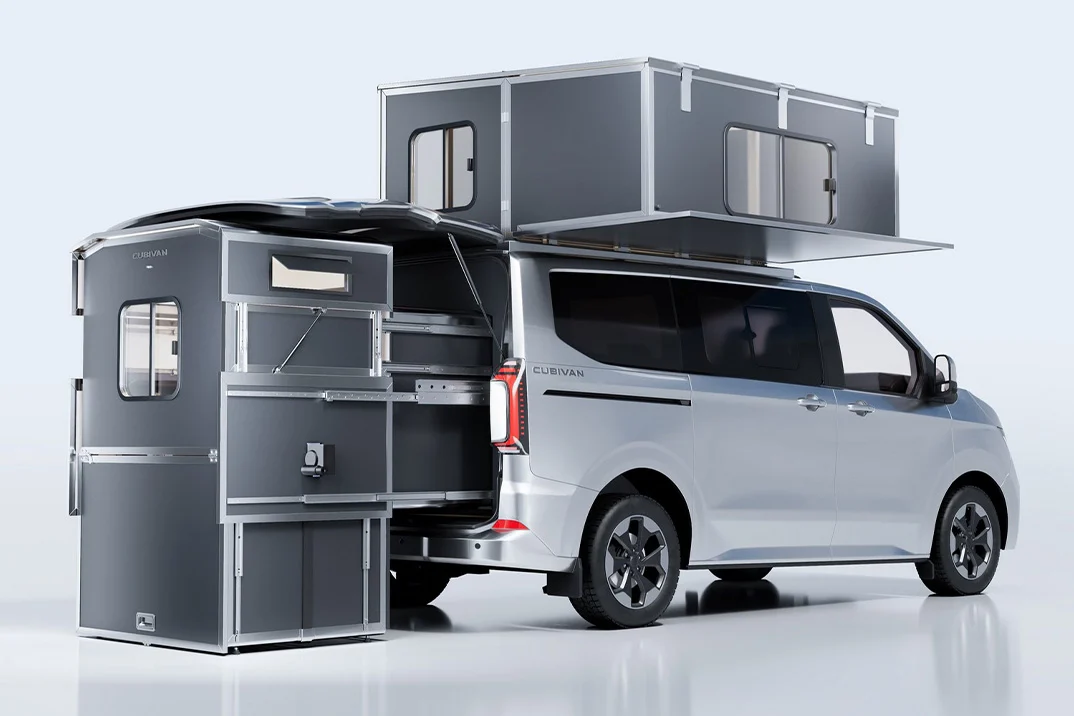
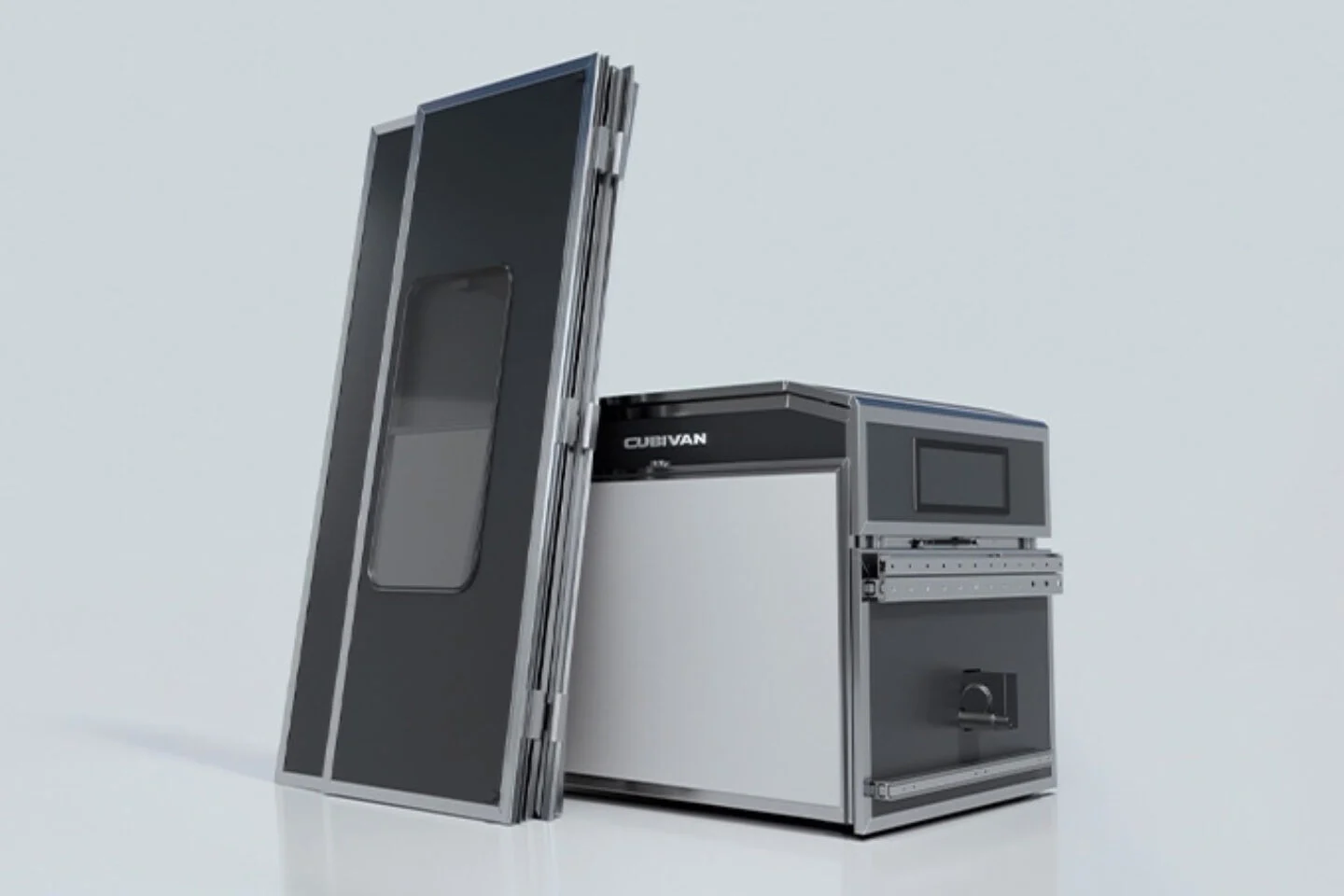
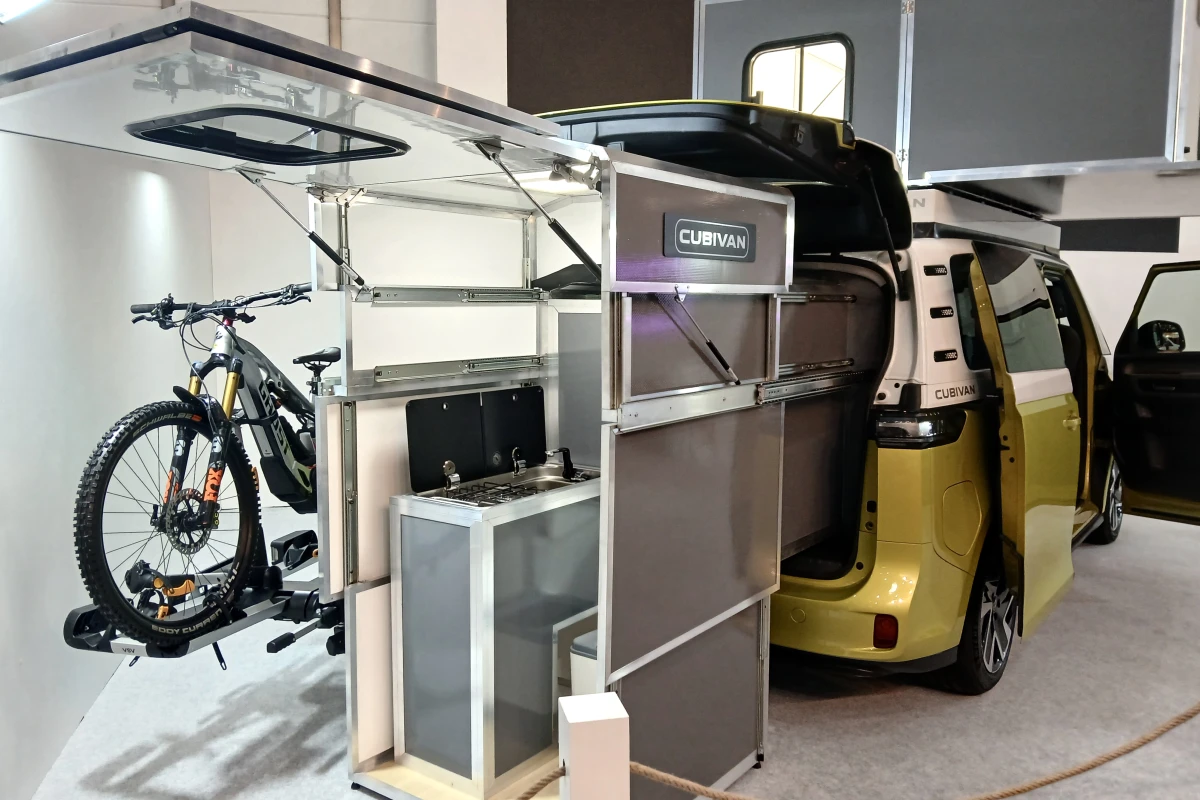
Vanna Camp showed the Cubivan Camping System at the 2026 Düsseldorf Caravan Salon on a Volkswagen ID. Buzz. Founder Florian Haller spent twenty years on plastic body parts for the auto industry. The CCS is two hard-walled modules: a rear cube that slides out of the trunk and becomes a 1.9-meter room with a kitchen that trades the floor with a wet bath, and a roof pod that sits 10 centimeters above the stock line closed and opens into a 200-by-200-centimeter bed. Compatible vans named: VW Caravelle, Ford Tourneo Custom, Mercedes Vito. The Buzz was the salon mule.
Camping boxes already exist. They give you a burner and a thin mattress and leave the toilet in a bag. Permanent conversions give you a bathroom and kill the third row. Cubivan’s claim is the third option: unfold a room, then lift the cube out so the same van does school on Monday.
Signal. What happened: Vanna Camp debuted the Cubivan CCS at Düsseldorf 2026. Exact product: rear kitchen/bath cube plus folding rooftop bedroom. When and where: reservations now, order books summer 2027, deliveries targeted end of 2027. Source: company spec and salon prototype. Why it matters: a family van keeps seats and still gets a door that closes in rain. Earlier DRIFT: none on CCS.
Cubivan Camping System
stir
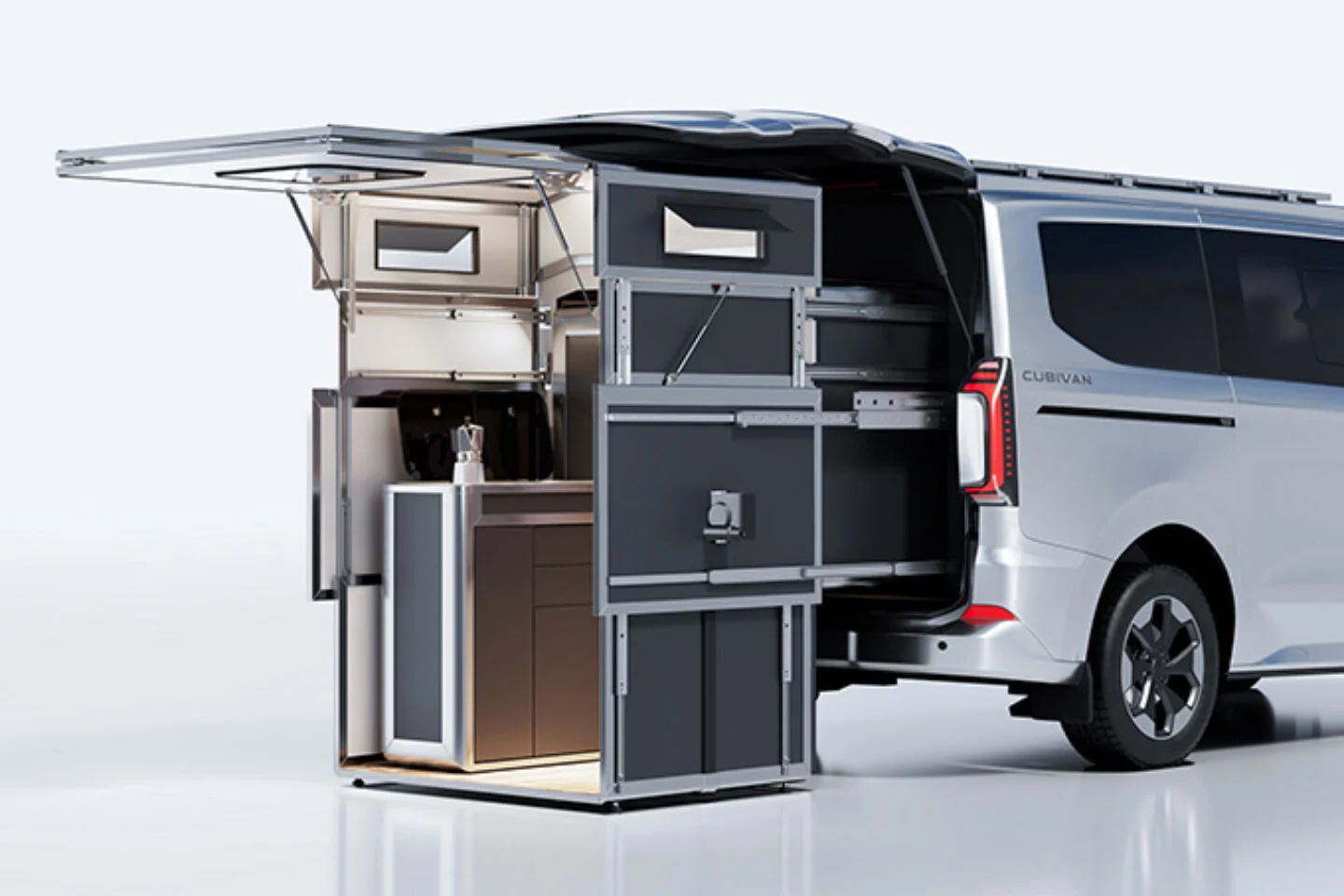
Packed, the rear module is a structure behind the third row, not a drawer. You park, open the tailgate, and roll the cube out on rails that stay bolted to the van. Those rails are the only piece that is not fully removable. Conversion partners fit the brackets. After a trip the cube lifts out.
Then the shells move. Upper lifts. Lower drops until the floor sits on the ground. Standing height is 1.9 meters, about 6.2 feet. Walls are fiber-reinforced plastic over polyurethane cores. Counters around 90 centimeters. Deployed, the module reads as a sideways T: part still nested to the van, part standing as an annex.
No motors in the current design. Cranks and gas struts. Haller has said the videos look automated. They are not. One person is the spec. Furniture assembly in a lot is the thing the geometry is trying to avoid.
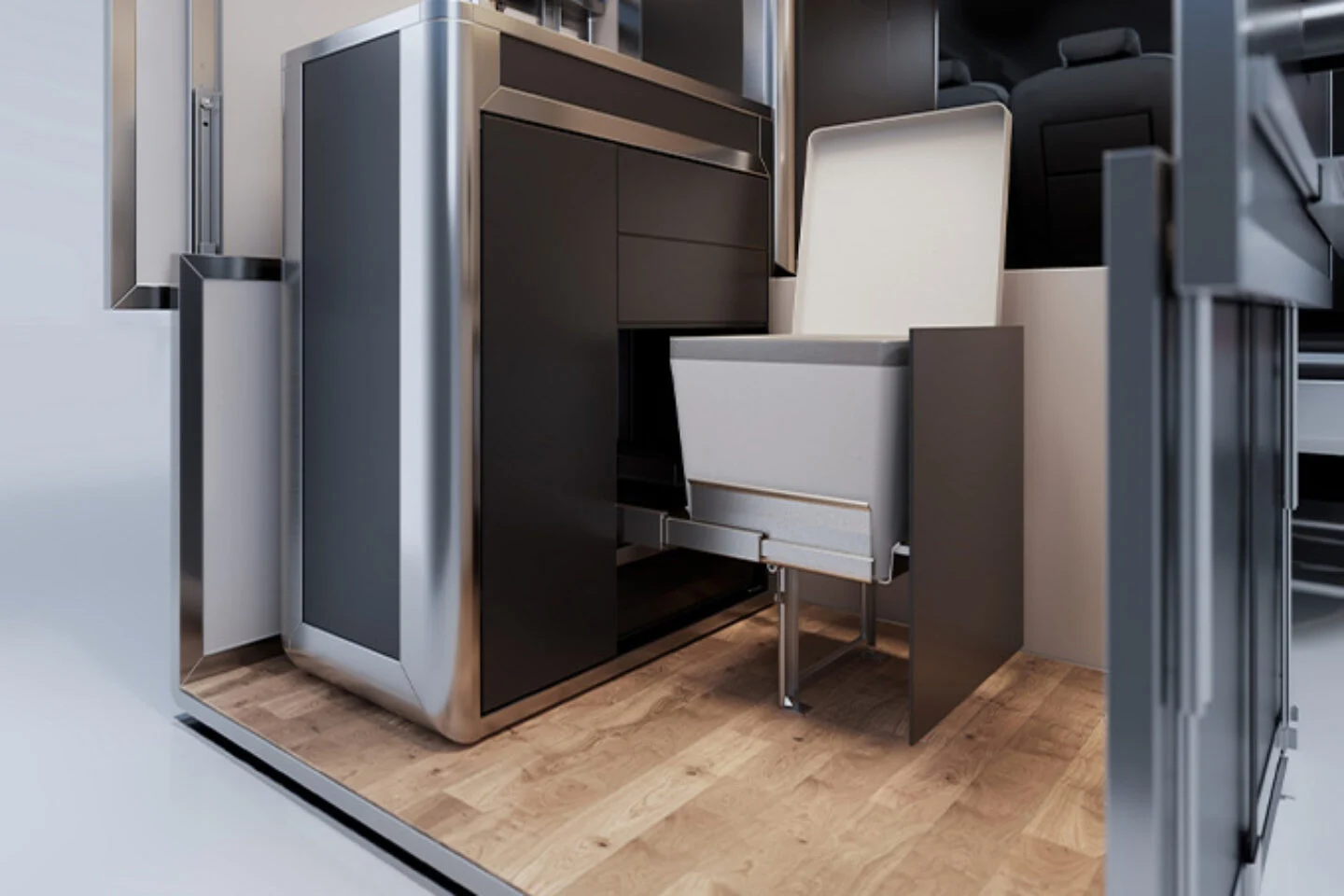
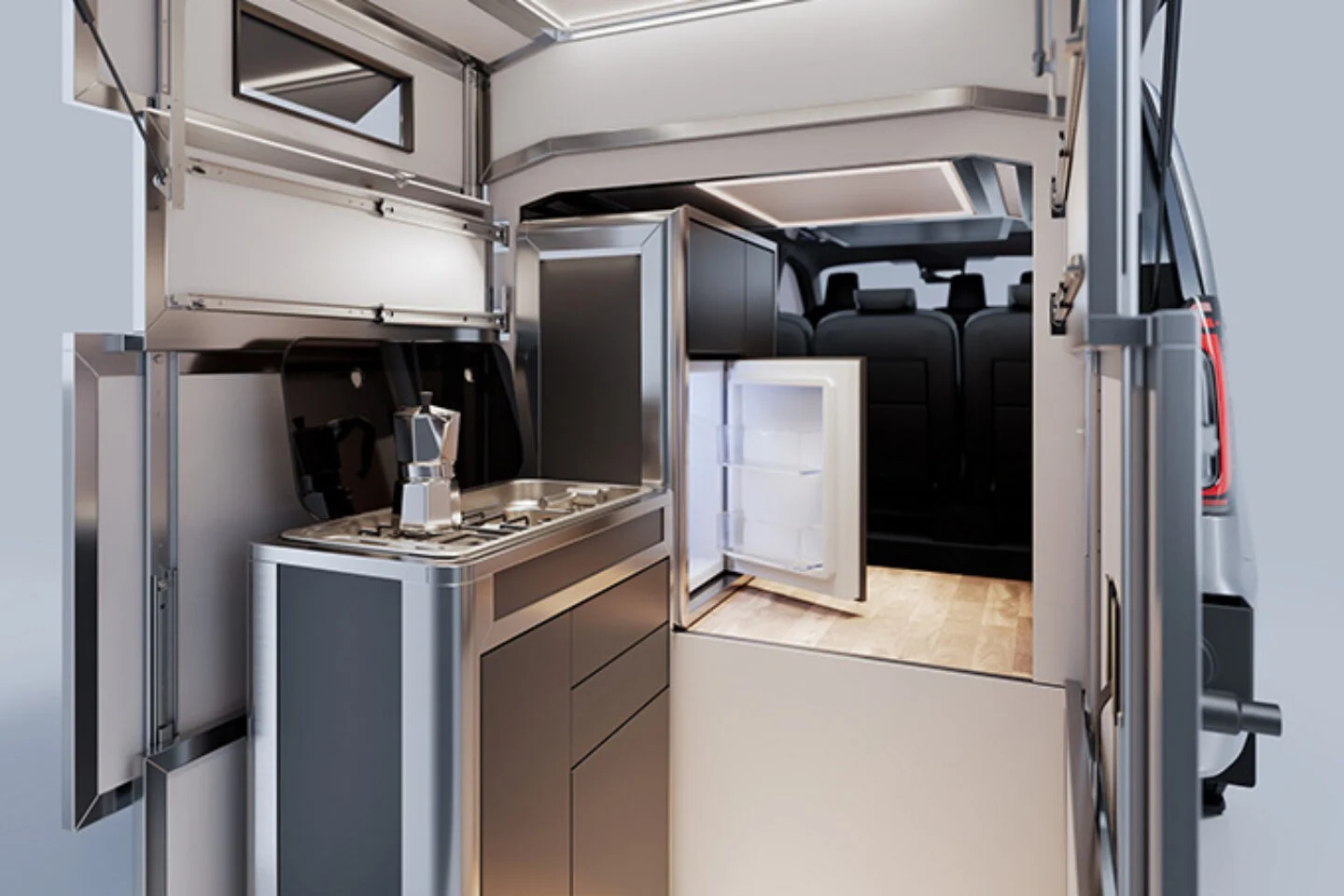
Inside, kitchen is one hinged block: stove, sink, worktop. A compressor fridge stays in the inner section nearer the van, next to a 25-liter freshwater tank. Portable toilet in a lower cabinet. Wet-bath floor 90 by 95 centimeters. Kitchen and bath share that floor. They do not run at once. Swing the kitchen block back beside the fridge and the room is a shower with hard walls. Swing it out and you cook. Nobody rinses over the burners.
Greywater layout is not fully published. Winter condensation at the fold joints is a production question. Payload still has to close with a filled tank. Early talk put the camping box, tank included, inside a family van’s numbers, with the roof targeted around 100 to 130 kilograms. Homologation will care more about those kilograms than the salon video does.
Hard walls are the product difference. Canvas flaps at 2 a.m. Thin plywood drums. Sandwich composite does not. It also weighs. Lightweight is not a slogan here. It is the only way a cube this tall lives behind a third row and still comes out on a Monday.
show
Sleep is not in the annex. Sleep is upstairs.
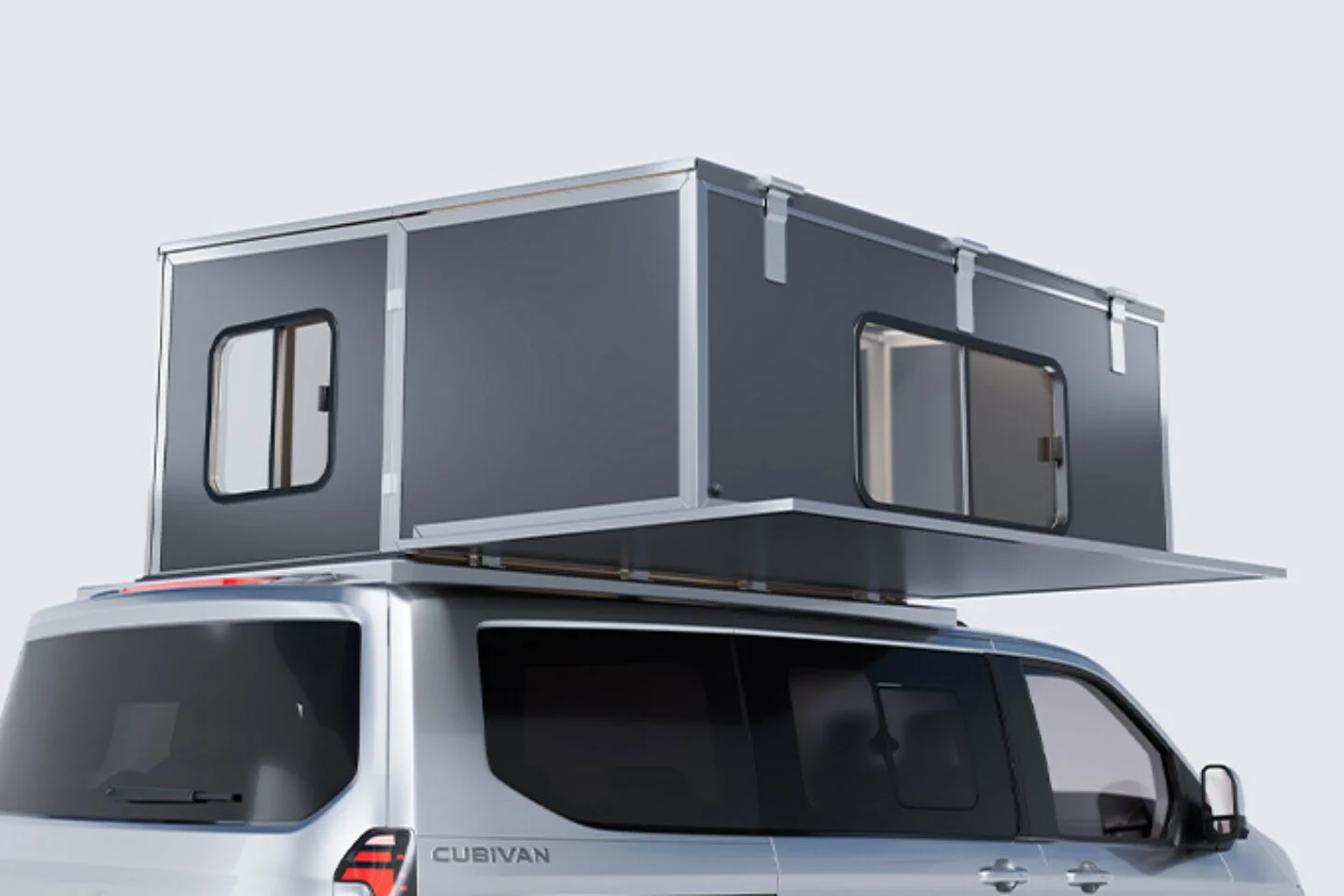
A hard-walled pod replaces the stock roof panel. Closed height is plus 10 centimeters, 3.9 inches. That number is garage doors and ferry tickets. Open, it is four walls around a 200-by-200-centimeter mattress, a square super-king, not a coffin bunk. Windows are part of the unfold.
The roof is the more permanent module. Homologation for an integrated roof with interior access is still moving. Haller’s plan is a pop-top path: standing height in the cabin below and a hatch so you do not climb an exterior ladder in rain. The Düsseldorf unit was not that finished article. Production is supposed to be.
After the weekend the rear cube leaves. Seats return. Cargo floor returns. The roof stays because it is the roof. Daily driving is meant to stay a van with a slightly thicker lid. That split is the thesis: pay once for a kitchen that can leave and a bedroom that barely shows.
Cubivan Camping System
Compatibility is narrow on purpose. Caravelle, Tourneo Custom, Vito. Buzz as show vehicle. Only one of those is a simple American retail van today. Rails must be fitted. Payload must still add up after kids, dogs, and a 25-liter tank. Markets beyond Europe were not locked in the salon copy.
flow
Complete CCS is targeted at €22,000 to €25,000, about $25,550 to $29,050. Rear cube alone about €16,000 to €17,000. Roof about €7,000 to €8,000. Reservations open from €150, climbing toward €600 by December 2026, each deposit credited as a flat €1,000 against purchase. Order books summer 2027. Deliveries aimed at the end of that year.
Those figures sit above a drawer box and next to slide-in campers that already include a bath. You could convert a van forever for similar money. Cubivan is not arguing cheap. It is arguing you should not have to choose between a weekday third row and a weekend door.
The prototype still looked unfinished in places at Düsseldorf. Geometry was clear. Paperwork is not. Folding joints have to seal through seasons. The roof has to stay shh at highway speed. Interior access has to exist if the hatch promise is real. Startups that show origami in September 2026 and sell in late 2027 are asking deposits to fund the gap between a salon floor and a warranty booklet.
extend
Haller’s language is supplier language: cycle counts, vibration, customers who will not be gentle. Fiber-reinforced skins. Polyurethane cores. Gas struts. Rails that survive a washboard road. “Everything that other campers compromise on, you can simply unfold with us.” That sentence is the brief. The CCS is the attempt to make it a room instead of a slogan.
fin
It is not a tent. It is not a full-time tiny house. It is not a California or a built Sprinter for people who live on the road. It is aimed at the larger group that already owns a midsize van, already has a week that is not vanlife, and still wants standing height and a shower that is not a bush. Whether a sliding cube can carry that is a 2027 question. The floor, at least, already drops to the dirt.
Related Articles

Snap, A See-Through Computer For FRAME
SPECS. $2,195. $200 deposit. Fall 2026 ship. US, UK, France. 132 or 136 grams. No […]