DRIFT AUDIO
Listen to this story
Choose a voice, then press play.
Nintendo unveiled Metroid Ravenous last week with a tagline that flips its hero into prey: eat, or be eaten.
Nintendo confirmed Metroid Ravenous during its September 9 Direct, a broadcast covering a wide slate of upcoming Nintendo Switch 2 software. A list had already brief surface on Brazil’s Ministry of Justice and Public Security rating database on July 1, carrying a 2026 production year before it was pulled, so fans had a rough idea something was coming. Nintendo confirmed the rest itself.
Ravenous launches exclusive on Switch 2 on January 28, 2027, the sixth mainline 2D game in the Metroid series and the first built specifically for Nintendo’s new hardware. It picks up an unspecified stretch of time after Metroid Dread, which closed out the five part saga that began on the NES back in 1986. Nintendo’s own listing already shows the game arriving with a full slate of supported languages, including Japanese, English, Spanish, French, Portuguese, German, Italian, Dutch, Korean, and both Simplified and Traditional Chinese, pointing to a genuinely global day one rel rather than a staggered rollout.
The September Direct that carried the reveal ran close to 45 minutes and moved through a wide slate of upcoming Switch 2 software, yet Ravenous still emerged as one of the show’s most discussed reveals within hours, help along by a trailer that made clear this wouldn’t be a straightforward continuation of what Dread established.
The setup, per Nintendo’s own description, drops bounty hunter Samus Aran onto an unfamiliar moon after her ship crash lands there. She’s ambushed almost immediately by a group of assassins, left severely wounded, and forced underground in search of a way back to the surface. The reveal trailer is narrated by Samus herself, describe an attack that leaves her uncertain of her surroundi and doubtful about her odds of getting home. It’s a much more vulnerable opening position than the series usualgives her, closer to how Sortiraparis describe her situation, frame Samus as sudden cast as prey rather than the hunter fans are used to see. That inversion carry through the rest of the game’s market, and it only gets stranger from there.
stir
The detail that’s dominated every reaction since the reveal is what Samus has to do to stay alive. Nintendo’s own copy states it plainly: to survive the hostile environment, Samus must use her latent Metroid powers to regain energy by feeding on her prey, stunning enemies by countering their attacks and then draining their energy before they recover.
That’s a notably specific mechanic for a series that has spent five games put Samus on the other end of that relation. She’s built her career hunting the Metroids, the parasitic organisms capable of draining life force from anything they touch. Metroid Fusion had her infected by the X parasite and forced to fight a version of herself shaped by that same biology, but Ravenous goes further by making the behavior something she actively performs rather than something inflicted on her. Nintendo’s phrase for it, “newly awakened Metroid instincts,” reads less like a new gadget in her arsenal and more like a change happening to her.
Dread built its tension around being hunted (the E.M.M.I. sequences worked precisely because Samus was, for once, the vulnerable party, stalked through corridors by something she couldn’t fight head on). Ravenous looks to flip that dynamic without losing the atmosphere that made it work. Instead of only running from something monstrous, Samus is being asked to become a little monstrous herself, and Nintendo hasn’t said yet how the story treats that by the end.
— MercurySteam (@mercurysteam) December 10, 2021
flow
Nintendo’s marketing uses two overlapping phrases for the ability, calling it both her “latent Metroid powers” and her “newly awakened Metroid instincts.” Neither reads as a tool she’s simply picked up along the way. Both suggest something dormant inside her that the ambush forced to the surface, which is a heavier idea than the series has typically been willing to sit with. It also raises an obvious question Nintendo hasn’t addressed yet: what happens to Samus the longer she keeps rely on it to survive.
The broader Metroidvania genre has leaned into horror framing before, usually through atmosphere and enemy design rather than a mechanic tied this directly to the protagonist’s own body. Dread’s E.M.M.I. units worked as a stalking threat external to Samus. Ravenous is the first mainline entry to put the unsettle part of the equation inside her instead, which is a meaningfully different kind of tension to build a full game around.
scope
Feeding mechanic aside, early coverage from Nintendo Life points to Ravenous being the most melee focused entry the series has produced, layering in traversal options like running across water, warping through the air mid jump, and executing dedicated finishing moves against staggered enemies. Beams and missiles remain part of the kit, and Sortiraparis reports the trailer also shows large, hulking creatures among the bosses Samus will face, alongside the smaller enemies she immobilizes and drains at close range.
Nintendo’s own retail description names the group behind the ambush directly: five assassins the company calls Space Ninjas, who lie in wait throughout the underground world and square off against Samus in dedicated one on one duels built around counters and close quarters weaponry. It’s frame explicit as a revenge arc, with Samus tracking down each of the five in turn through a labyrinthine, interconnected map that early reporting suggests still keeps the series’ usual ability-gated backtrack intact underneath the more aggressive combat layer.
Nothing shown so far suggests Ravenous is walking away from exploration in favor of pure action. If anything, pair an aggression-first combat loop with the standard Metroidvania structure could raise the stakes of explore in the first place, since survive is now tied direct to how effective Samus fights her way through a room rather than how careful she circumvents it.
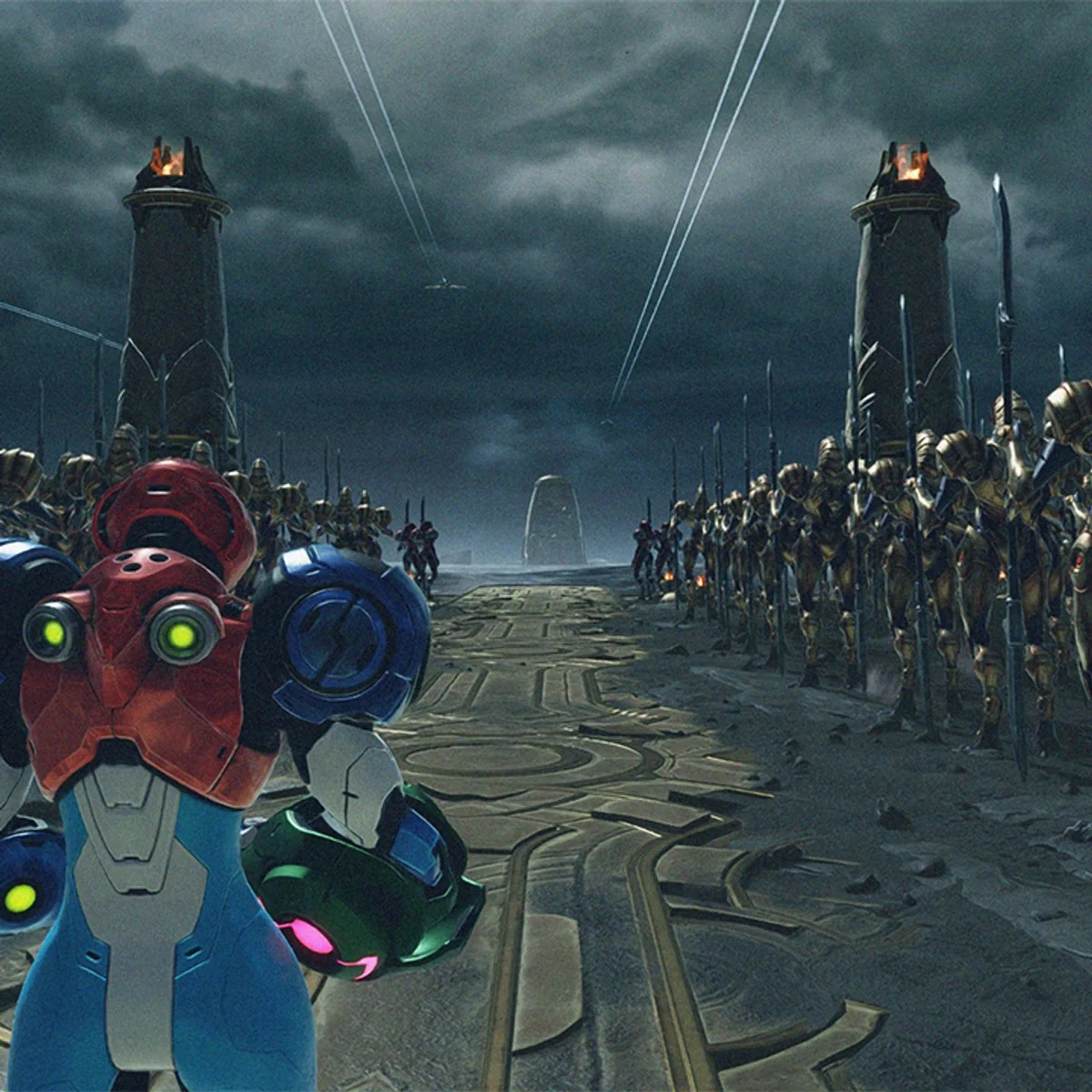
A scene from the video game “Metroid Ravenous” showing Samus Aran in a new red and blue suit, walking toward a distant structure between rows of armored figures in a dark, atmospheric setting.
overall
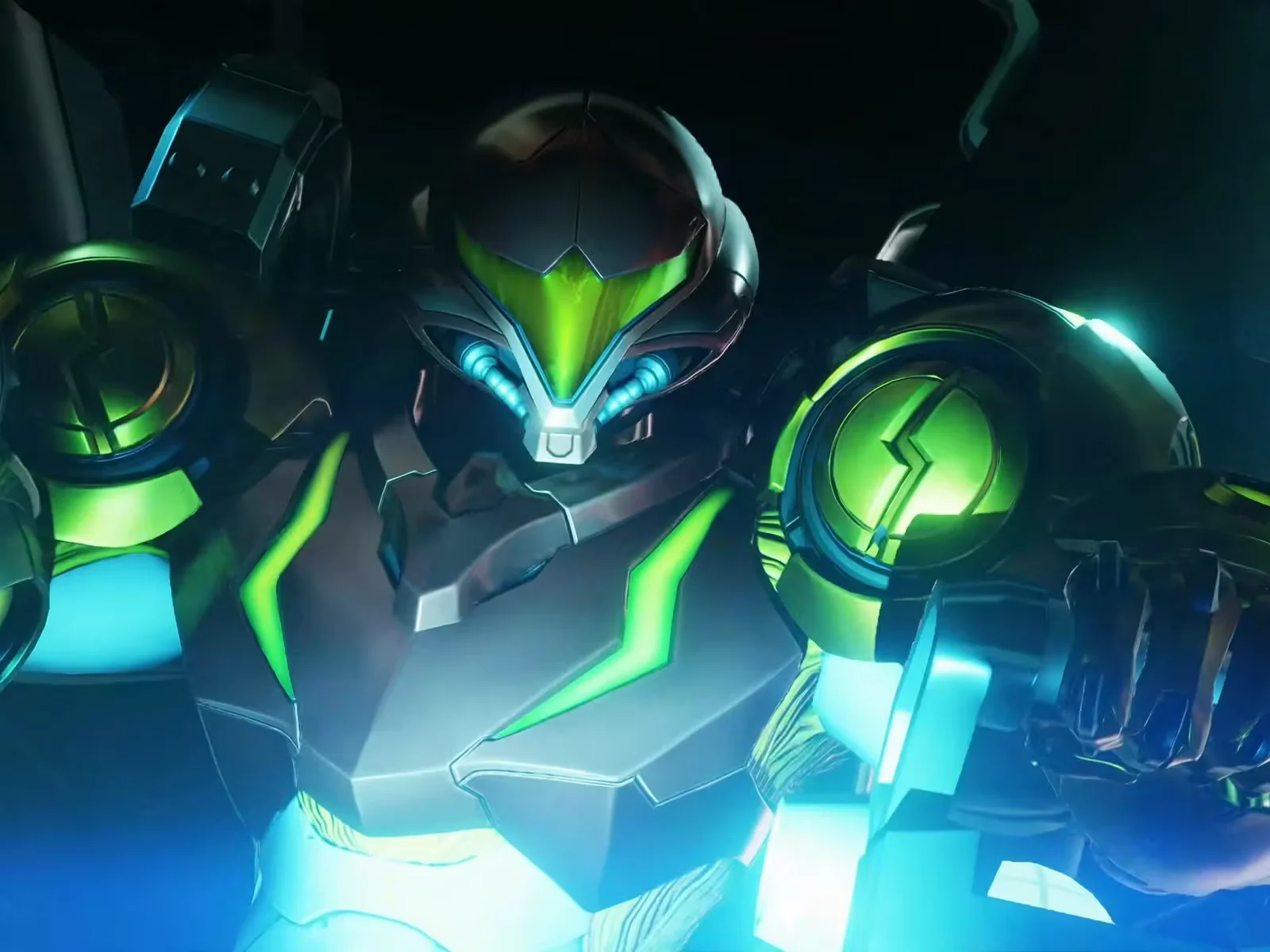
Ravenous keeps Dread’s cin show but pushes the palette somewhere darker and more vivid at once. The Power Suit has been redesigned again, trading some of Dread’s smooth, armored bulk for a leaner silhouette that reads as more predatory than protective, an evolution of the last suit rather than a full reinvention. The moon itself looks suitably hostile too: tight corridors, harsh lighting, and an environment built to make isolation feel like part of the mechanics rather than just the premise.
That environment matters more than usual given the subject matter. A game built around resorting to feeding on enemies to survive needs its setting to make desperation feel real rather than just implied through narration, and the footage shown so far leans into cramped, claustrophobic spaces rather than the more open vistas Metroid has occasionally allowed itself in the past.
extend
True to recent form, Nintendo didn’t name a developer during the Direct itself. That didn’t stop anyone from guess correc. MercurySteam built both Metroid: Samus Returns and Metroid Dread, and the view and structure similar to Dread made the studio’s involvement feel like a formality. MercurySteam more or less confirm it within hours, quote tweeting the reveal with a ninja emoji and a heart before share the trailer on LinkedIn without further comment, accord to My Nintendo News and Nintendo Everything. Sortiraparis add report the game as developed by MercurySteam alongside Nintendo’s internal EPD division, though that specific detail hasn’t been corroborated elsewhere.
The Spanish studio, founded in Madrid in 2002 by Enric Álvarez and a group of former Rebel Act Studios colleagues, built its Metroid pedigree with Metroid: Samus Returns before Dread, and carry a parallel history with Castlevania: Lords of Shadow. Between Dread and Ravenous, MercurySteam also shipped Blades of Fire, an original fantasy action game that rel in 2025 and underperformed commercially, leading the studio to announce a round of layoffs the following year. Ravenous is its first project built for Switch 2 hardware and its first fully original 2D Metroid story rather than a remake or direct continuation of an existing arc, arriving at a moment when the studio has real incentive to make it count.
close
Reaction since the reveal has split fair even between genuine excitement and dark humor. The eat or be eaten tagline turned into a punchline almost as fast as it became a hook, with plenty of fans joking about vegetarian playthroughs in the comments on outlets like Nintendo World Report and My Nintendo News. Underneath the jokes, the response to the view direction and MercurySteam’s confirmed return has been largely positive, especially from fans who’ve waited five years since Dread for a new 2D entry. Commenters on Nintendo World Report specifically singled out the new suit design and the sheer intensity of the trailer’s editing as reasons for optimism, with several noting it felt like Nintendo had given MercurySteam more creative latitude than Dread allowed.