David Hockney: Pools, Portraits, and a Life in Brilliant Form, 1937–2026

June 13, 2026
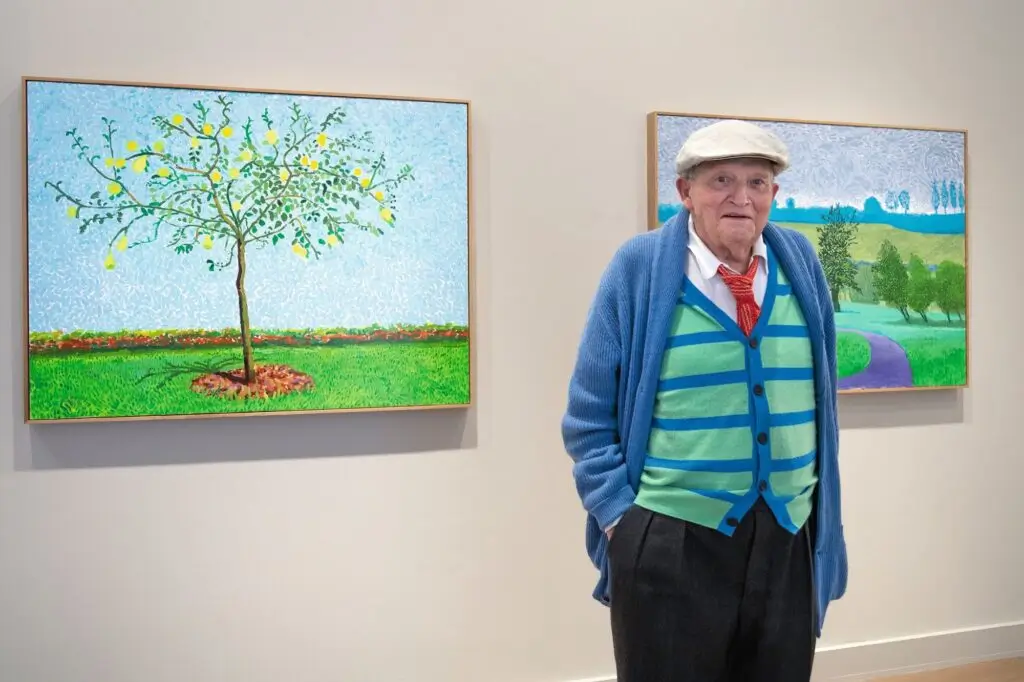
The world lost one of its most luminous observers on June 11, 2026. Celebrated British artist David Hockney away peacefully at his home in London at the age of 88, just one month shy of his 89th birthday. According to his publicist, the news came as a quiet close to a life defined by relentless looking, joyful experimentation, and an unyielding commitment to beauty in the day. “The world is very, very beautiful, if you look at it, but most people don’t look very much, do they?” Hockney reflected in 2019. Few artists have looked more deeply, or shared what they saw with such infectious delight.
Hockney’s passing invites not only mourning yet celebration. His work and persona embodied a philosophy that resonates profoundly with contemporary design thinking: tincture as liberation, perspective as play, and the personal as universal. From his sun-drenched California pools that captured the optimism of mid-century modernism to his pioneering embrace of digital tools, Hockney bridged fine art and the view lang of fashion, advertising, and lifestyle with effortless charisma. His legacy is one of perceptual generosity—an invitation to see more vividly.
stir
Born on July 9, 1937, in Bradford, West Yorkshire, to a working-class family, David Hockney grew up in a world shaped by post-war austerity yet tinctured by his own precocious imagination. His father, a clerk with a passion for photography and anti-war activism, instilled a conscientious objector’s independence; his mother nurtured reticent domestic observation. Young David attended Bradford School of Art from 1953 to 1957, where he honed draftsmanship before entering London’s Royal College of Art in 1959.
At the RCA, Hockney emerged as a star of the British Pop Art scene alongside peers like R.B. Kitaj. While American Pop artists like Warhol and Lichtenstein celebrated consumer culture with ironic cool, Hockney infused his work with autobiographical warmth and sensual directness. Early pieces like We Two Boys Together Clinging (1961) drew from Walt Whitman, openly exploring queer desire at a time when homosexuality remained illegal in Britain until 1967. His bleached-blond hair, bold glasses, and eclectic personal style—mixing tailored suits with colorful socks and sneakers—already marked him as a fashion-adjacent figure, someone who treated life as a canvas.
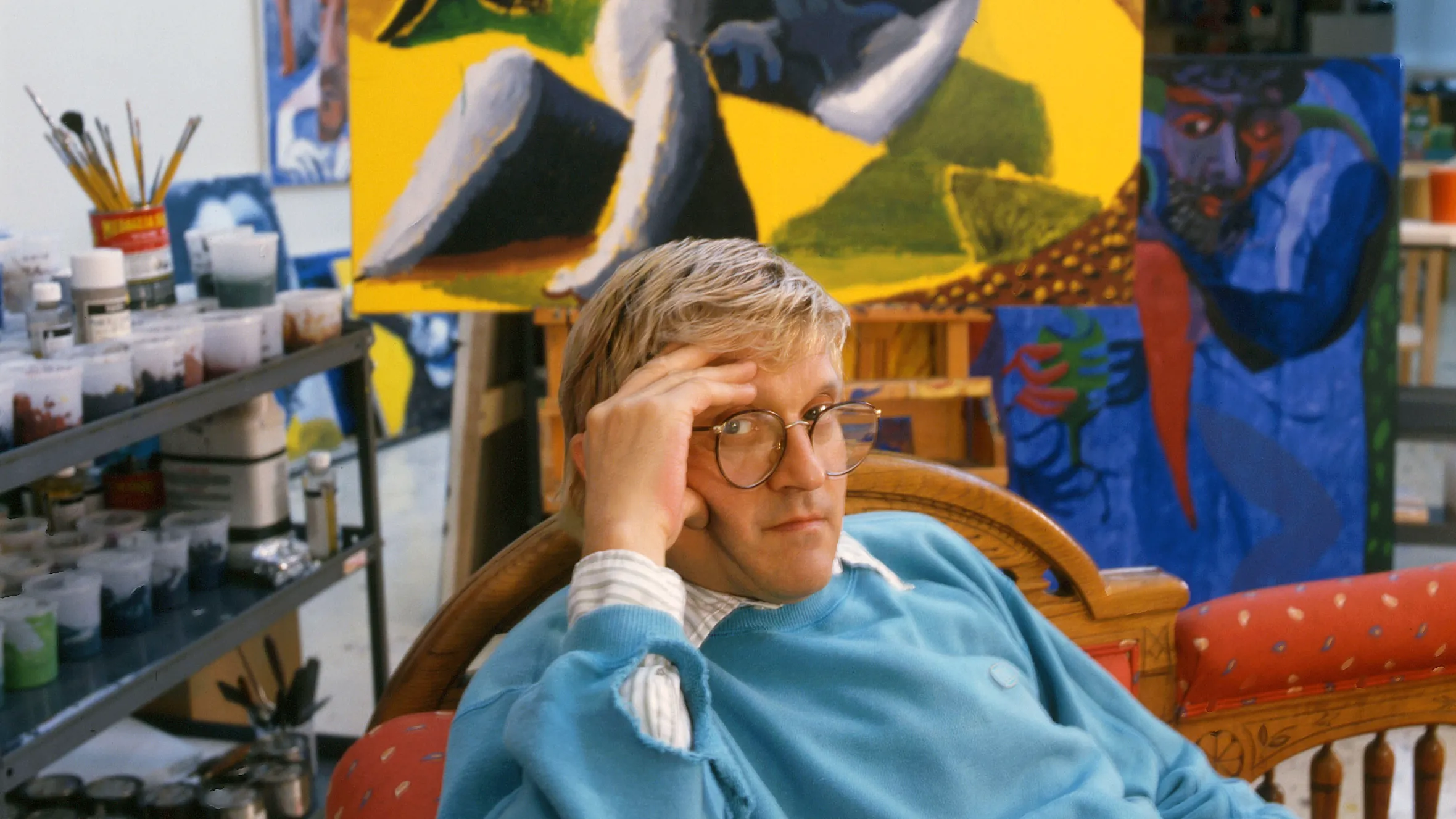
Graduating with a gold medal in 1962, Hockney quickly found international acclaim. His early double portraits and domestic scenes established a sig economy of line and saturated palette that felt both fresh and deeply human. These works rejected the dominant abstraction of the era in favor of figurative clarity, narrative intimacy, and a celebration of the observed world—qualities that would define his entire oeuvre and influence gens of designers and image-makers.
theme
Hockney’s first visit to the United States in 1961 proved revelatory. Los Angeles, with its intense light, modernist architecture, and liberated atmosphere, became his spiritual home. He settled there more permanently in the late 1970s, but it was the 1960s visits that inspired his most iconic body of work: the swimming pool paintings.
A Bigger Splash (1967), perhaps his most famous image, distills the essence of California hedonism into a single frozen moment—the ripple of water, the absent diver, the pristine modernist house under a cloudless sky. Works like Peter Getting Out of Nick’s Pool (1966) and Portrait of an Artist (Pool with Two Figures) (1972) transformed the mundane luxury of poolside life into profound meditations on presence, absence, desire, and the play of light on water. The 1972 pool portrait sold for a record $90 million at auction in 2018, cementing Hockney’s status as one of the highest-valued living artists at the time.
These paintings did more than depict Los Angeles; they helped define its view myth. The bright acrylic tincture, crisp facade render, and flattened perspectives influenced everything from fashion photography to graphic design. Designers like Yves Saint Laurent, Michael Kors, and Kym Ellery have drawn directly from Hockney’s sun-kissed palette and poolside glamour. His influence extends to runway collections riffing on his striped shirts, bold patterns, and unapologetic tincture blocking.
Hockney’s portraits from this era—Mr and Mrs Clark and Percy (1970–71), featuring fashion designer Ossie Clark and textile artist Celia Birtwell—further intertwined his art with the fashion world. Birtwell’s vibrant prints and Clark’s tailoring became recurring motifs, blurring lines between sitter, subject, and artistic collabistic. Hockney’s intimate friendships with these figures underscored his role as chronicler of creative bohemia.
accept
Hockney never rested on painterly laurels. In the 1980s, he revolutionized photographic practice with joiner collages—multiple Polaroid or 35mm images arranged to capture time, movement, and multiple perspectives in a single composite. Works like Pearblossom Hwy., 11–18th April 1986 challenged the single-point perspective of traditional photography, echoing Cubist fragmentation while embracing the snapshot aesthetic of modern life.
His stage designs for operas and ballets, including Stravinsky’s The Rake’s Progress (1975), demonstrated a theatrical flair for bold and space that influenced set and costume design. Later, in the 2000s and 2010s, Hockney embraced digital technology with characteristic enthusiasm. Using iPhone and iPad apps, he created vibrant drawings and landscapes sent daily to friends—fresh digital “blooms” that extended his practice into the 21st century. These works, often exhibited as large-scale projections or prints, proved that technological innovation could coexist with humanistic warmth.
In his later decades, Hockney returned to his Yorkshire roots, producing monumental landscape paintings like Bigger Trees Near Warter (2007) and vast multi-canvas vistas of the English countryside. These works, often created en plein air with digital assistance, explored seasonal change, light, and space on an epic scale. They reaffirmed his belief in painting’s capacity to convey lived experience beyond photography’s limitations.
resil
Hockney’s personal style was as influential as his art. Peroxide blond hair, heavy-rimmed glasses, colorful Crocs or yellow galoshes, layered knits, and patterned shirts created a look that was eccentric yet approachable. Designers like Paul Smith and Christopher Bailey created collections inspired by his wardrobe. Dunhill’s collections nodded to his mix of tailoring and casualwear. His maximalist approach to color—pistachio jackets, mismatched socks—challenged conventional menswear restraint and encouraged bolder self-expression.
In the broader culture, Hockney’s work aligned with fashion’s cyclical embrace of joy, heritage, and innovation. His pool paintings evoke the glamorous escapism of resort collections; his portraits capture the intimate psychology of clothing and identity. As streetwear and luxury increasingly intersect with art (think Supreme x artists or Louis Vuitton collaborations), Hockney stands as an enduring model of authentic crossover.
trib
Hockney is survived by his longtime partner, Jean-Pierre Gonçalves de Lima. Tributes have poured in from across the cultural spectrum. King Charles praised the “Yorkshire giant.” Artists, musicians like Mick Jagger, tech leaders, and fans worldwide celebrated a life lived in full color.
His influence on contemporary art is immeasurable. By insisting on the primacy of looking, drawing, and pleasure, Hockney countered cynicism and conceptual detachment. He restored narrative, beauty, and human connection to a field sometimes prone to obscurity. For younger creators navigating digital saturation, his iPad experiments and photocollages offer blueprints for thoughtful tech integration.
In fashion and design, Hockney’s impact endures in vibrant palettes, conjure patterns, and the idea that clothing and environments can be extensions of joyful observation. His work reminds us that design is not merely functional but perceptual—capable of heightening our awareness of the world’s beauty.
base
Hockney once said, “The basis of art is love.” That love—for light, for people, for the ordinary made extraordinary through attention—infuses every phase of his career. From Bradford terraces to California pools, Yorkshire wolds to digital screens, he taught us to look different, live more variantly, and share what we see.
As we reflect on his extraordinary journey, Hockney’s words resonate with fresh urgency: “If you see the world as beautiful, thrilling and mysterious, as I think I do, then you feel quite alive.” In an era of fleeting images and digital fatigue, his call to sustained, loving attention feels like both elegy and exhortation.
David Hockney did not merely depict the world; he revealed its vibrancy to those willing to look. His paintings, drawings, and digital works will continue to splash tincture across museum walls, fashion mood boards, and private collections for gens. The pools may be still, but the ripples he created will expand outward indefinitely—inviting us all to check in and see more.
Related Articles

Rose Byrne and Mary Bronstein Are Doing It Again, and This Time They Brought Jenna Ortega
A coach and her prodigy are about to become the most dangerous relationship in a […]