DRIFT AUDIO
Listen to this story
Choose a voice, then press play.
Marc Chagall’s fiddler stands on two rooftops at once, one foot in memory and one in a Paris he was still learning to call home.
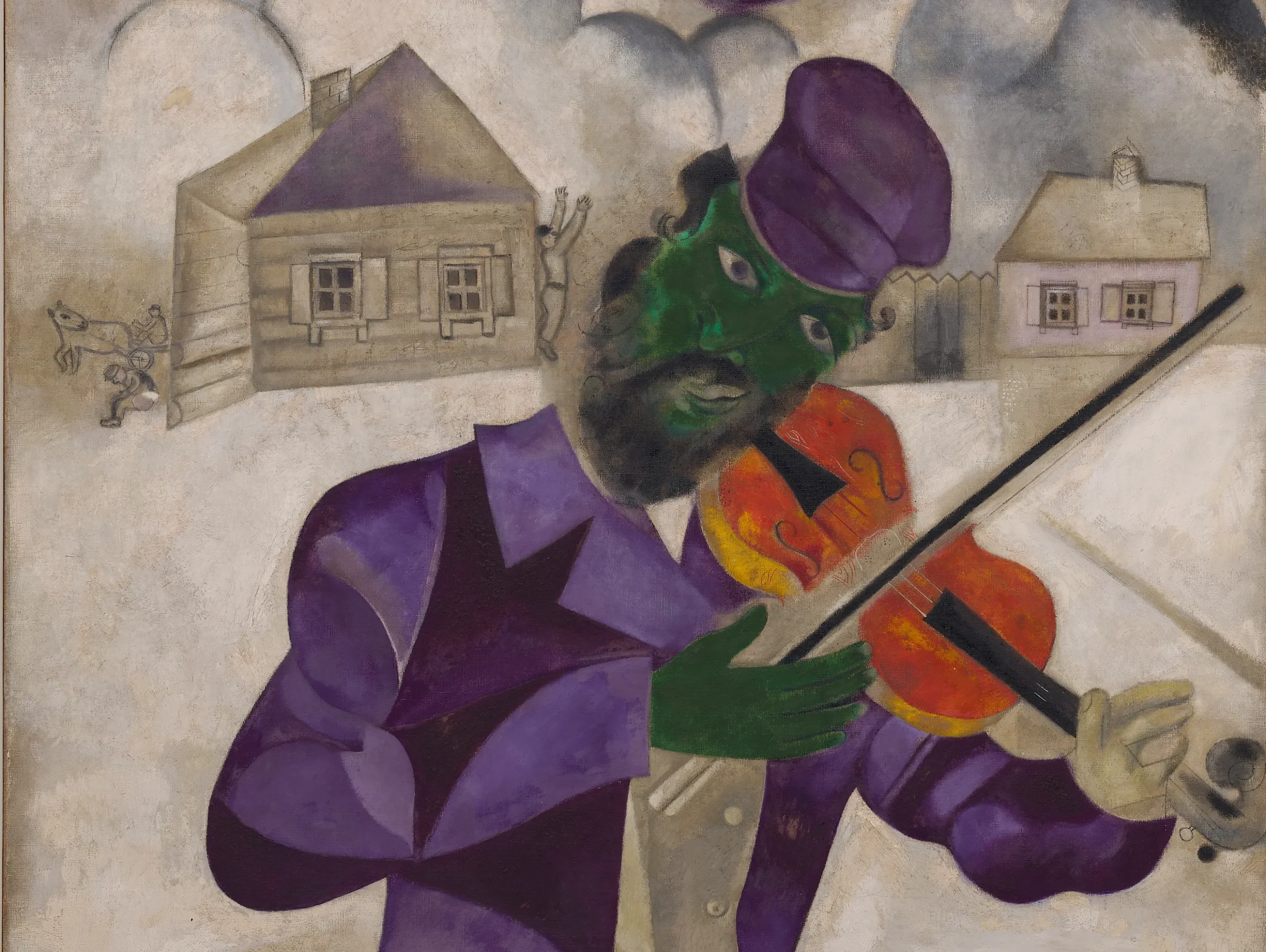
The Green Violinist hangs today in the Solomon R. Guggenheim Museum in New York, one of the largest and most reproduced paintings Marc Chagall ever made. Before going further, one correction is worth making plainly: the painting is consistent dated 1923 to 1924 by the Guggenheim and by every major reference source, completed in Paris shortly after Chagall’s return there following a long stay in his Russian homeland, not 1926 as sometimes circulated. That two year window matters, because it places the painting at a specific, unstable hinge point in Chagall’s life, caught between the town he’d left behind and the city he was still working out how to belong to.
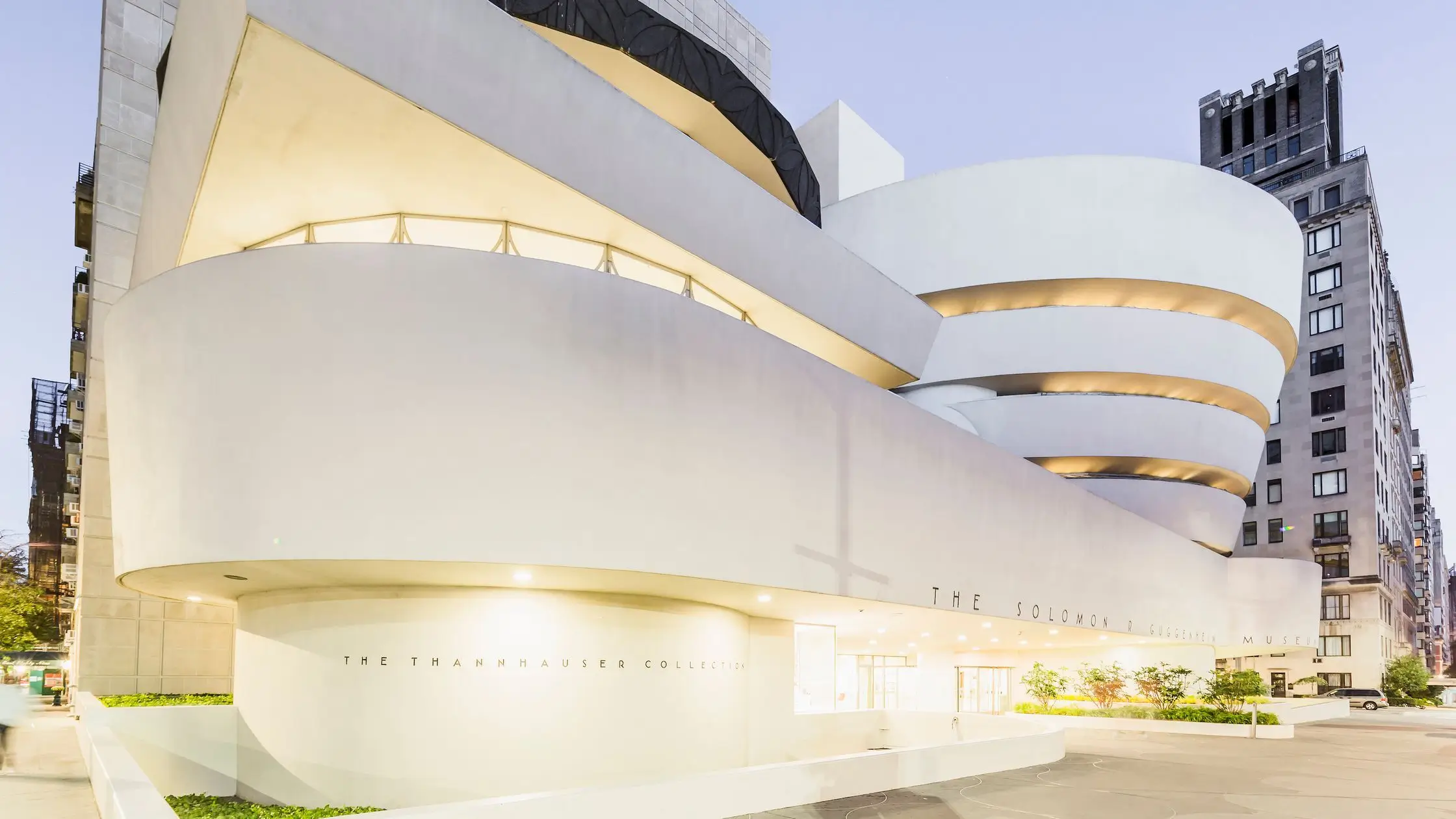
The Solomon R. Guggenheim Museum’s Curved White Exterior Architecture In New York City.
frame
At nearly two meters tall and just under 109 centimeters wide, the canvas is built to be looked up at, which suits its subject. A fiddler in a bright purple coat patterned with small triangles stands, or perhaps floats, across the rooftops of a small gray village, one gloved hand steadying the neck of his violin while the other bows across the strings bare skinned. His face and hands are rendered entirely green, a color choice with no literal explanation in the scene itself, more mood than anatomy. Beneath him the village unfolds in muted grays, browns, and blacks: modest houses, a dog, a bare tree with a single bird in its branches, a ladder propped against nothing in particular, one end grounded and the other reaching into open air. In the upper corners, smaller figures drift further still, a horse and cart pulling away at one edge, a man seemingly falling or flying off the top of the frame at the other.
The palette does the emotional work. Chagall sets the fiddler’s saturated purple, green, and orange against a backdrop scrubbed down to near monochrome, so the human figure reads as the only truly alive thing in the composition, a spark of color moving through a place that has otherwise gone still. The forms throughout carry the geometric fracturing Chagall picked up from Cubism during his years in Paris, angular shoulders, faceted rooftops, a village rendered in planes rather than curves, but the effect never tips into pure abstraction. Every element stays legible as itself even while bending toward dream logic, which is close to Chagall’s signature move across his whole career: borrowing the vocab of the Parisian avant garde without ever fully surrendering to it.
The violinist’s pose rewards a second look. He isn’t simply standing on the rooftops so much as caught mid stride, one leg extended forward as if walking straight off the edge of the building beneath him, weightless in a way none of the smaller figures below share. His stance recalls a folk dance step more than a concert posture, hips and shoulders angled in opposite directions, the kind of movement a village fiddler would actually make while playing for a room full of dancing guests rather than performing shh from a chair. That detail reinforces the reading of the figure as tied specifically to celebration and communal ritual rather than formal music making, a distinction that matters given how central both were to the Hasidic culture Chagall grew up inside.
stir
The green violinist was not a new idea for Chagall by 1923. He had painted a fiddler on a rooftop once before, in 1912 to 1913, in a smaller canvas now held by Amsterdam’s Stedelijk Museum and known simply as The Fiddler. The 1920s version now at the Guggenheim is a larger, more ambitious reworking of the same core image rather than a fresh subject, evidence of how central the motif was to how Chagall thought about his own childhood. In Hasidic communities like the one Chagall grew up in around Vitebsk, the fiddler held a specific, almost ceremonial role, providing the music for weddings, festivals, and the ecstatic communal dancing that marked religious celebration. Painting him hovering above the rooftops rather than standing in the street pushes the figure from tradesman into something closer to a spirit presiding over the town, tethered to the ground by tradition even as everything else in the composition seems to be drifting away from it.
That image would go on to have a life well beyond the canvas itself. The fiddler motif, and this painting in particular, is widely credited as the visual and conceptual seed for the title of the 1964 musical Fiddler on the Roof, whose original set and costume designer, Boris Aronson, drew directly on Chagall’s paintings and his broader visual language of shtetl life when building the show’s world. It’s a rare case of a single canvas seeding an entirely separate, hugely popular piece of American theater decades after it was painted, most of its audience never having stood in front of the actual painting that started it. The musical’s own title imagery, a fiddler balanced precariously on a rooftop, translates Chagall’s specific visual metaphor almost literally into stagecraft: a tradition kept alive through skill and balance, one wrong step from disaster, played out against a backdrop of political upheaval that mirrors the revolution and displacement running underneath Chagall’s own biography.
flow
Chagall was born Moishe Shagal in 1887 in Vitebsk, then part of the Russian Empire and now in Belarus, the eldest of nine children in a poor Jewish family whose father worked as a herring merchant. He studied briefly under a local painter, then spent several years training in Saint Petersburg before an allowance from a Russian patron let him make his first trip to Paris around 1910. That first Paris stretch reshaped him almost completely. He moved into La Ruche, the artist residence in Montparnasse, and fell in with a circle that included Robert and Sonia Delaunay, Fernand Léger, Amedeo Modigliani, and the poet Guillaume Apollinaire, absorbing Cubism and Fauvism and brightening his palette dramatically in the process, while never fully adopting either movement’s rules.
He returned to Vitebsk in 1914, intending a short visit, and the outbreak of the First World War trapped him there far longer than planned. He married Bella Rosenfeld in 1915, the daughter of a family of modest jewelers whom Chagall had courted for years and later described in his own writing as someone whose eyes seemed to understand his past, present, and future all at once. Their daughter Ida was born the following year, and Bella herself became one of the most consistent presences in Chagall’s paintings for the rest of his career, appearing across dozens of canvases well beyond this period. The years that followed the marriage were turbulent well beyond his own household: Vitebsk passed from Tsarist rule into revolution, and Chagall found himself, for a period, appointed a local arts commissar and helping run an art school in the town alongside avant garde contemporaries including Kazimir Malevich, an alliance that eventually fractured over conflicting visions for what the school should become, with Chagall eventually leaving the position he himself had built.
By the time Chagall made it back to Paris in the early 1920s, both the city and the artist arriving in it had changed considerably. He was returning not as a hopeful newcomer but as someone who had already lived through revolution, civil war, and the collapse of the world he’d grown up in, carrying a wife and young daughter along with him. The Green Violinist belongs to that reentry period, and it reads like a document of it: a Cubist fracturing of form learned in Paris, applied to a subject and a hue logic pulled straight from Vitebsk’s Hasidic culture and the town’s own visual memory. The floating figures at the painting’s edges, the cart pulling away, the man away off the top corner of the canvas, read less like literal depiction and more like an artist working out, in paint, what it means to carry a place with you after you’ve left it for good, particularly when that place was actively being remade by forces entirely outside his control while he was gone.
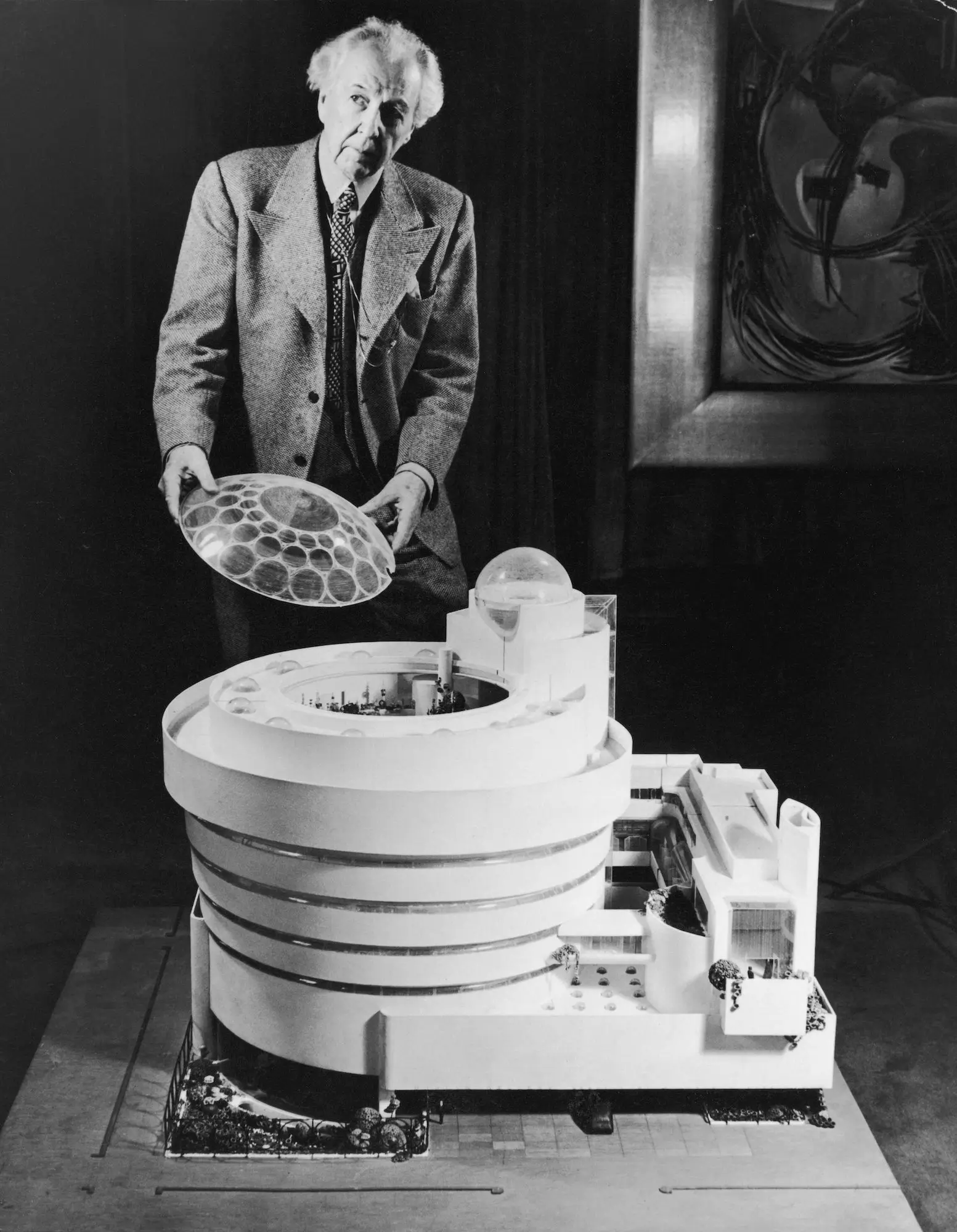
Frank Lloyd Wright Stands Behind An Architectural Model Of The Solomon R. Guggenheim Museum.
how
The painting’s presence at the Guggenheim is itself a small historical accident worth unpacking. Solomon R. Guggenheim built the bulk of his collection under the guidance of Hilla Rebay, a German artist and curator he met in 1929 who steered him firmly toward what she called non objective art, meaning fully abstract painting stripped of recognizable subject matter, above nearly everything else. Rebay’s taste ran toward Vasily Kandinsky and the Bauhaus circle, and the museum she eventually built for Guggenheim opened in 1939 under the name the Museum of Non Objective Painting, well before it became the Guggenheim as it’s known today.
Chagall did not fit that mandate especially neatly, since his work, however fractured and dreamlike, never abandoned the human figure. Rebay brought Guggenheim to Paris to meet Chagall in person in 1930, and the relationship that followed went beyond a single transaction. Rebay separately secured Chagall’s 1913 painting Paris Through the Window for the collection, a work she reportedly regretted not buying for her own holdings once she saw how well it fit alongside the Guggenheim’s other acquisitions. The connection deepened considerably a decade later: when the Second World War made Europe unsafe for Chagall as a Jewish artist, Guggenheim played a direct role in helping arrange his relocation to the United States in 1941, and Chagall and his wife stayed with Rebay at her own home for a period after they arrived, a personal debt layered on top of a curatorial one.
Against that backdrop, The Green Violinist stands as one of the collection’s more figurative outliers, a painting that made it into a museum built to champion abstraction largely on the strength of the relationships and conviction of the people building that collection, rather than any strict fit with the founding philosophy. It shares wall space today with a collection whose early identity was built almost entirely around Kandinsky and the Bauhaus circle, which makes its presence a useful reminder that even the most tightly defined museum collections tend to bend for the artists their founders simply couldn’t say no to. Chagall’s reputation by the time the Guggenheim finally opened to the public in 1959, in Frank Lloyd Wright’s spiraled building on Fifth Avenue, had also grown well past anything Rebay’s original non objective mandate could have accounted for, making the fiddler’s place in the collection look less like an exception in hindsight and more like an early sign of where the museum’s ambitions were always headed.
A century on, it remains one of the most recognized pieces the Guggenheim holds, a purple coated fiddler still hovering, green faced, over a town that has long since disappeared from any actual map.
Related Articles
Where the Face Should Be, Rafael Silveira Paints Open Sky
A pink shirt, shoulder-length hair, then no face at all: in “Surprise,” Rafael Silveira lets flowers and a clear blue sky stand in for the person.