DRIFT AUDIO
Listen to this story
Choose a voice, then press play.
Jon Favreau is putting Disney’s forgotten first star back on screen, hand drawn, live action, and set inside the studio’s own history.
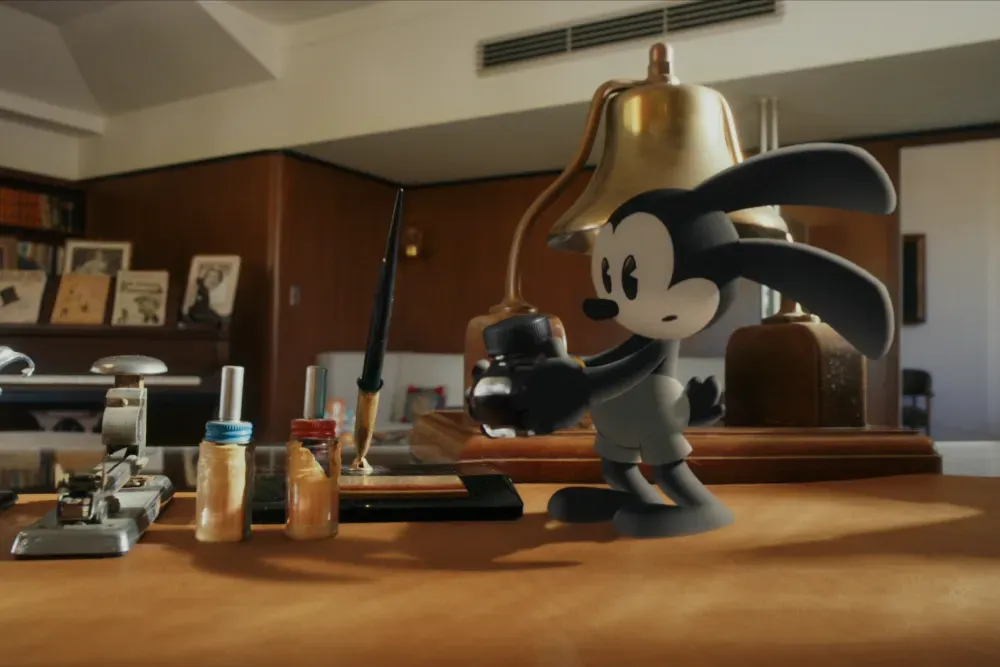
At D23’s Entertainment Showcase in Anaheim on August 14, Jon Favreau walked onstage and screened footage of a hand drawn cartoon rabbit standing on a desk. That desk belongs to Walt Disney. Or it did, decades ago, inside an office on the Burbank lot that Favreau’s crew filmed inside for real. The rabbit is Oswald, and he predates Mickey Mouse by a full year. The Walt Disney Company confirmed what fans had pieced together from casting notices and location permits over the past year: Oswald the Lucky Rabbit is getting a three part miniseries, premiering on Disney+ on February 17, 2027.
The announcement landed the same night as a first look at Pixar’s Ghost Market, but Oswald’s reveal carried a different kind of weight. This isn’t a new IP or a spinoff of something recent. It’s Disney reaching back to the character whose loss, nearly a century ago, accidentally created the mouse the entire company is named after.
stir
Oswald first appeared in 1927, a joint creation of Walt Disney and animator Ub Iwerks, produced for distribution through Universal Pictures. He starred in 26 shorts over roughly two years and became, by most accounts, Disney’s first genuine recurring cartoon star, a character with actual audience recognition before the studio had anything else to point to. He went by a few names along the way. Oswald Rabbit. Ozzie. None of that history overlaps with Disney’s more recent character Ozzy Fox, a distinction worth making since the names invite confusion.
The catch, and it is a sig one, is that Disney never owned Oswald outright. The character legally belonged to Universal and to producer Charles Mintz’s Winkler Pictures, the studio handling distribution. Disney was, in effect, working for hire on his own creation, animating and directing shorts for a character he had designed but did not control on paper. That arrangement is easy to gloss over now, but it’s the entire reason the next twelve months of Disney’s history unfolded the way they did.
Iwerks, for his part, is often treated as a footnote to Walt Disney’s name, but the Oswald shorts are as much his design work as anyone’s. He was the animator actually putting pencil to paper on most of the early Oswald cartoons, developing the character’s proportions and movement in a way that would carry directly into how Mickey looked and moved a year later. Watching the earliest surviving Oswald shorts now, the family resemblance to Mickey is obvious once you know to look for it: same round build, same exaggerated rubber hose limbs, same eagerness in the character’s posture.
challenge
In 1928, a contract dispute with Mintz spiraled into something closer to a heist. Mintz used his control of the distribution deal to poach most of Disney’s animation staff and took Oswald with him, in house at Universal. Walt Disney left that meeting with almost nothing. What he did have was Iwerks, who stayed loyal, and the two of them responded by creating a new character from scratch. That character was Mickey Mouse.
Oswald kept going without Disney for a long stretch, appearing in more than 150 additional cartoons through various hands at Universal before fading out of production in the early 1940s. He didn’t vanish from the world so much as get quietly parked there, a footnote owned by a company that had moved on to other things.
It took nearly 80 years for Disney to get him back. In 2006, under then CEO Bob Iger, the studio negotiated a deal with NBCUniversal that returned the Oswald rights to Disney. The trade itself became one of the stranger footnotes in entertainment history: Disney gave up sportscaster Al Michaels, then under contract to ABC/ESPN, clearing his path to join NBC’s Sunday Night Football booth, in exchange for Oswald and a library of related shorts.
Even with the rights back home, Disney used Oswald sparingly. He turned up as a major character in the 2010 video game Epic Mickey, which paired him on screen with Mickey for the first time in the characters’ shared history and built an entire narrative around the two rabbits, one abandoned and one adopted, reconciling. He resurfaced in the 2013 animated short “Get a Horse!”, his first theatrical appearance in 85 years, a short that itself leaned on old hand drawn animation techniques mixed with modern 3D effects. A hand drawn Oswald short arrived in 2022 as part of Disney’s 100th anniversary celebrations, his first traditionally animated appearance in 95 years and, at the time, treated by fans mostly as a one off birthday gesture rather than the start of anything bigger.
Between those flashes of attention, Oswald mostly lived at the theme parks, showing up on pins, plush toys, and the occasional parade float aimed squarely at collectors who already knew the backstory. Oswald also technically entered the public domain in 2023, meaning Disney no longer holds an exclusive claim on the character’s earliest design even as it now builds a flagship live action and animation series around him. That timing is not lost on longtime Disney historians, who have noted the coincidence of the studio doubling down on Oswald just as the character became legally available to anyone else who wanted to use him too.
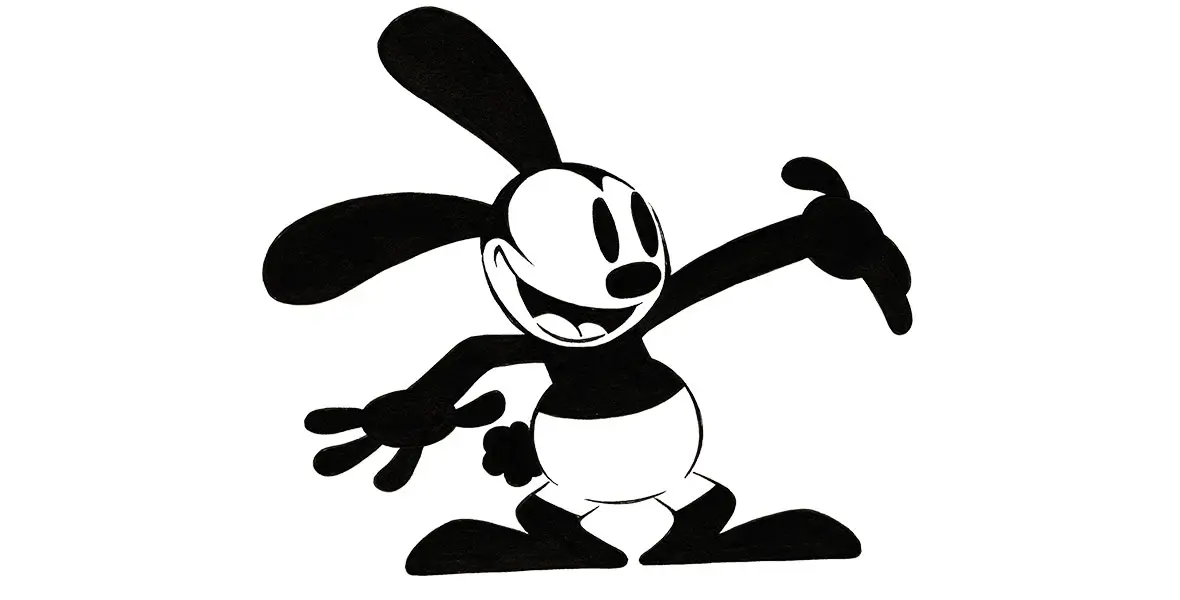
Classic Black-And-White Oswald The Lucky Rabbit Illustration With Arms Outstretched And A Wide Smile.
hx
What Favreau announced at D23 isn’t a straightforward reboot. The premise, according to details shared onstage and in Disney’s own release notes, is that an earthquake dislodges Oswald from wherever he’s been hidden away since the 1920s, and a group of present day middle schoolers end up helping him navigate the modern world. The three young leads are played by Ravi Cabot-Conyers, Mykal-Michelle Harris, and Ryder Allen, with Amy Sedaris and Kathryn Hahn rounding out the cast alongside Al Madrigal and Steve Martin.
Favreau is credited as creator, writer, and executive producer, and he’s directing the series alongside Jude Weng and Andrew R. Jones, with Karen Gilchrist and John Bartnicki also producing. It’s his first major screen return to Disney’s animation history since directing the studio’s live action Jungle Book and Lion King remakes, and it follows his most recent series work on The Mandalorian and Grogu, another project built on blending practical filmmaking with characters that couldn’t exist without heavy visual effects work. Favreau first floated Oswald publicly back in early 2025, and filming took place later that year, with the Disneyland shoot happening roughly a year before the D23 reveal.
The cast leans younger than most Disney legacy projects. Cabot-Conyers previously appeared in the Star Wars series Skeleton Crew, also executive produced by Favreau, and voiced a member of the Madrigal family in Encanto. Harris voiced Blaze in this summer’s Toy Story 5 and previously starred in the sitcom Mixed-ish. Sedaris and Favreau have worked together before, on The Mandalorian and The Book of Boba Fett, so her casting reads less like stunt hiring and more like Favreau pulling from a group of collaborators he trusts. Hahn’s involvement made for an unusually busy night at the Honda Center, since she also appeared earlier in the same D23 presentation to promote Disney’s live action Tangled remake, in which she plays Mother Gothel.
The production leaned hard into authenticity of place. Filming took place at Disneyland and inside the real Walt Disney office suite on the Burbank lot, a space the company has preserved and periodically restored through the D23 fan club. Favreau described the story as unfolding across locations “Disney fans would recognize,” name checking the site of the old Hyperion Studios in Silver Lake, Walt’s actual office, and Office 36 on the current studio lot. It plays, by design, like a series made for people who already know Disney’s own timeline.
The animation itself is being handled entirely by hand, no CG assist standing in for traditional cel style work. Favreau brought back animators who had built careers in 2D animation before the industry pivoted almost entirely to computer generated production, framing it during the D23 panel as an intentional act of restoring craft rather than nostalgia for its own sake. Leading that animation effort is Sergio Pablos, the Spanish animator behind character work on The Hunchback of Notre Dame and Treasure Planet and the director of his own acclaimed feature, Klaus. Pablos’ studio, The SPA Studios, based in Madrid, is handling a significant share of the hand drawn animation, with additional animation work spread across teams in Los Angeles and Canada as well. Composer John Debney, whose Disney credits stretch back through Hocus Pocus, The Emperor’s New Groove, and Favreau’s own Jungle Book, is scoring the series.
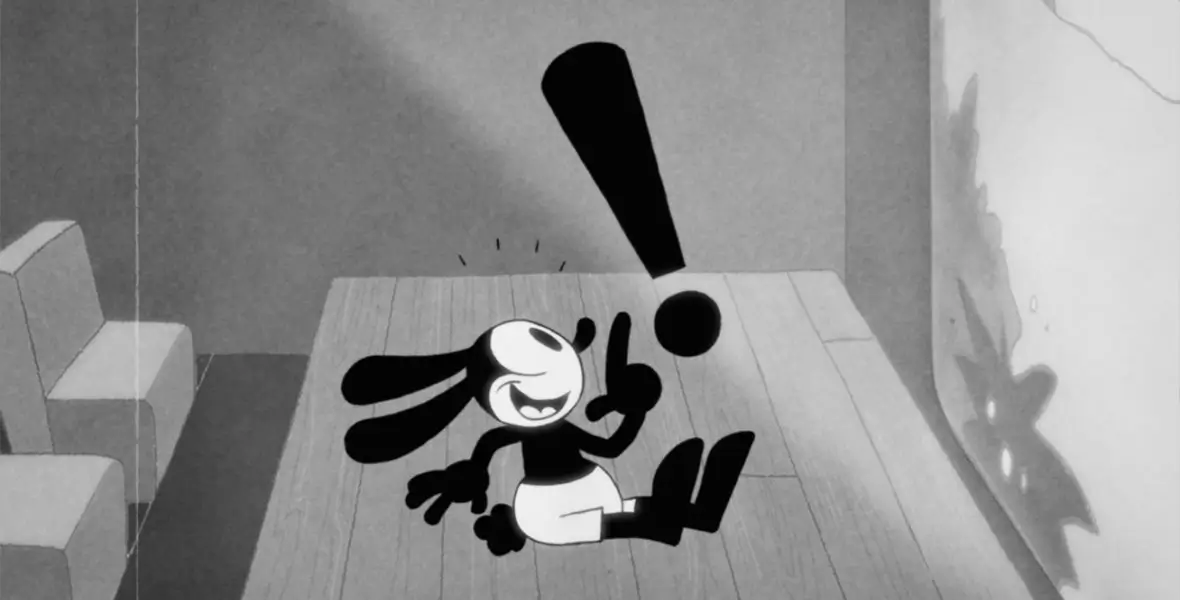
Black-And-White Oswald The Lucky Rabbit Sitting On A Wooden Floor Beneath A Large Exclamation Mark.
actual
The footage shown at D23 placed Oswald, fully hand drawn, inside a photographed real world office, rifling through a desk drawer. It’s a visual approach with an obvious lineage back to Who Framed Roger Rabbit, animated characters interacting believably with live action space and light, and it’s a notably ambitious swing for a three episode miniseries rather than a full theatrical release. Reporters in the room described the sequence as immediately readable even without dialogue, Oswald pulling open drawers and reacting to objects on Walt’s actual desk with the kind of full body physical comedy that traditional animation handles more naturally than most CG work attempts.
Disney has not yet made the D23 footage public, so most of what’s known comes from reporting out of the Honda Center rather than a released trailer. Guests at the panel received a collectible Oswald card on their way out, a small physical nod to a character whose merchandise history at the parks has, until now, mostly consisted of pins and plush figures aimed at collectors already fluent in Disney’s back catalog. Favreau also confirmed the score is coming from John Debney, whose credits at the studio stretch back through Hocus Pocus and The Emperor’s New Groove, giving the project a composer with his own long relationship to Disney’s animated tone.
fin
Disney’s theatrical output has leaned almost entirely on computer animation since the studio’s last fully hand drawn feature, Winnie the Pooh, released back in 2011. In the years since, traditional 2D work at Disney has mostly survived in short bursts: the occasional festival short, archival restorations handled by the Walt Disney Archives, and small anniversary gestures like the 2022 Oswald short. A three part, hand drawn miniseries with a full production team and a composer attached is a different scale of commitment entirely, and it’s arriving at a moment when audiences have spent years asking publicly why the studio moved away from the style that built its early reputation.
Favreau addressed that gap directly onstage, describing Oswald as a dream project and noting that many of Disney’s veteran 2D animators had stray away from hand drawn work simply because the industry stopped commissioning it. Bringing a group of them back, spread across production teams working in Los Angeles, Canada, and Spain, functions as both a creative choice and something closer to a preservation effort, keeping a specific, aging skill set active inside a company large enough to actually employ it at scale. Sergio Pablos, leading the animation through his Madrid based studio, has spent much of his own career making that same argument through independent work like Klaus, an Oscar nominated feature that proved hand drawn animation could still find an audience without a major studio’s marketing machine behind it.
The February 2027 date puts Oswald’s series roughly a year ahead of Mickey Mouse’s own 100th anniversary in 2028, which gives the release an odd, fitting symmetry. The character whose loss created Mickey gets his own moment in the spotlight the year before the mouse’s centennial takes over the conversation entirely, and Disney has not said whether Oswald’s series is meant to set a tone for how it marks that bigger anniversary or simply stands on its own.
For a studio that has leaned overwhelmingly on computer animation for two decades, bringing back a slate of traditional animators for a project this specific, tied this directly to Walt Disney’s own office and the character that indirectly created the entire company, reads as more than a one off. Whether it becomes a template for future hand drawn work at Disney or stays a standalone tribute to where the studio started is something only the show itself, and whatever Disney greenlights after it, will answer.
From the DRIFT archive: Tactical Elegance: Inside Bramford London Aqua Blue Three-Pocket Watch Roll
Related Articles
Messi and the Giants Trades the Biopic for Orbs, Giants and a Realm Called Iko
Lionel Messi’s Disney+ cartoon finally showed its face in Málaga, and it skips Rosario, Barcelona […]