DRIFT AUDIO
Listen to this story
Choose a voice, then press play.
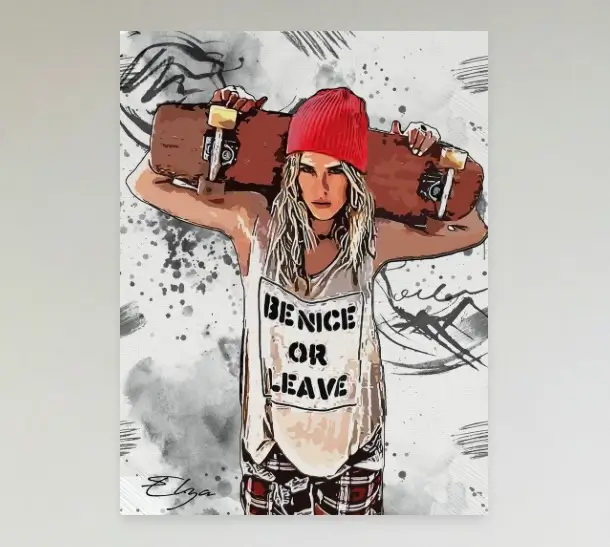
The first encounter with Gazelle Painting is not passive—it’s a confrontation. A young woman stares back, unflinching, her arms raised, a skateboard gripped behind her head like a weapon or a crown. There is no softness in the composition, no invitation to linger gently. This is a declaration: I see you, and I am not here to perform.
Elena Zaharia doesn’t paint animals to depict the wild. Instead, she channels the gazelle’s essence—its alertness, its speed, its poised tension—into a human form rooted in street culture. The animal becomes metaphor; the canvas, a mirror. What we are looking at is not a portrait of a skater. It is a portrait of instinct, modernized.
stir
Elena Zaharia’s work has long moved between representation and abstraction, but Gazelle Painting marks a distinct pivot—not in style, but in strategy. She steps away from depicting the animal itself and instead asks: what does the gazelle mean in a world where survival is no longer about open plains, but about navigating sidewalks, stares, and systems?
The shift is not subtle. It is intentional—almost urgent. Zaharia has often circled the idea of “embodied instinct”: how animals move without hesitation, how they respond to threat with precision rather than panic. In Gazelle Painting, that instinct is transplanted into a young woman who stands not in a savanna, but in a city’s breathless in-between—a parking lot, an alley, a skate spot at dusk.
The environment is indistinct, but the energy is exact. This is urban terrain, where awareness becomes armor.
show
The gazelle is not simply fast—it is hyper-aware. One flick, one shift, and it is gone. Zaharia captures this not through motion, but through stillness charged with potential.
The figure in Gazelle Painting is not running, but she is ready. Her body is coiled, her gaze sharpened, her grip firm. She is the urban gazelle: survival not through flight, but through presence.
That equivalence carries weight. In nature, speed is defense. In the city, speed becomes style—skateboarding, cutting through space, moving fast to remain untouchable. But Zaharia resists glorifying motion. She holds the pause instead—the moment before action, where choice still exists.
The skateboard, held behind the head, is not in use. It is on display: tool, symbol, shield.
dekko
The figure’s posture is both defensive and defiant. Arms raised, elbows bent, the skateboard held high—it could be mistaken for surrender, but it isn’t. There is no collapse in the body, no avoidance in the stance. This is control.
Raised hands, in many contexts, signal submission. Zaharia reverses the meaning. Here, they claim space.
The skateboard—rigid, horizontal—cuts across the composition like a set of horns. Not decorative, but structural. It extends the figure outward, sharpening her silhouette. Like the gazelle’s horns, it is not ornamental. It is functional. It is survival.
tincture
Imbue in Gazelle Painting is not decorative—it is directional. The grayscale environment dissolves into abstraction: splatters, washes, marks that refuse to define space. Ground, wall, sky—they blur into instability.
But the red beanie holds.
It burns as the first point of contact. A pulse. A signal.
Red carries contradiction—danger and defiance, warmth and warning. Here, it holds all of it at once. The beanie is not styling. It is statement. In a culture where view can be risk, red becomes refusal.
The skateboard, rendered in worn browns, grounds the figure in something tactile, something lived. But the red? The red is psychological. It is the interior made view.
signal
The phrase cuts cleanly through the composition:
BE NICE OR LEAVE
There is no metaphor here. No abstraction. It lands with the directness of a sign—functional, immediate, absolute.
But within the painting, it becomes more than language. It becomes structure. A boundary drawn across the body, through the space, toward the viewer.
This is not decoration. It is instruction.
Zaharia does not soften it. She centers it. The figure is not offered for interpretation; she sets the terms. In a view culture that often demands performance—especially from women in public or street-aligned spaces—this refusal is exacting.
It does not ask. It states.
flow
Zaharia’s acrylic handling is controlled without being restrained. The figure is defined through clean, ink-like outlines—decisive, deliberate, almost illustrative in their clarity.
But the background breaks.
Splatters, smudges, and gestural marks scatter outward, introducing instability into the field. It is not chaos, but it resists resolution. The space breathes, but it does not settle.
This duality mirrors the subject herself: composed at the surface, kinetic underneath.
There is a graffiti-adjacent sensibility—not in imitation, but in energy. Marks feel placed in real time, without over-correction. The painting carries immediacy, not hesitation.
Nothing is ornamental. Every surface decision holds weight.
position
The composition thrives on imbalance. The figure is centered, contained, resolved—while the environment dissolves around her.
This contrast generates tension.
The skateboard, cutting horizontally across the upper frame, stabilizes the image. It acts as a viewed bar, preventing stray. Behind it, gestural lines—quick, directional—suggest motion either just passed or about to occur.
This is not action depicted. It is action suspended.
Zaharia understands that the gazelle does not run endlessly. It pauses. It listens. Then it moves.
This painting exists in that pause.
scope
Gazelle Painting does not simply reference skate culture—it understands it.
Skateboarding has never been neutral. It is an assertion of space, a refusal of restriction, a rewriting of public terrain. Zaharia taps into this lineage without dramatizing it.
The subject is not mid-trick. She is not airborne. She is standing—present, grounded, unmovable.
That stillness is the statement.
In a culture where women are often edged out of street-centered environments, this presence reads differently. She is not asking for access. She is not negotiating space.
She occupies it.
The skateboard shifts meaning here. It is no longer just equipment. It becomes extension—of identity, of autonomy, of stance.
fin
Gazelle Painting is not a return to nature. It is a relocation of it.
Zaharia does not look outward for wilderness—she locates it in the city, in the body, in the act of standing firm within unstable space.
The gazelle remains—but transformed.
It lives in the tension before movement. In the clarity of a gaze that does not waver. In the precision of a body that understands its environment without needing to explain itself.
This is not a painting about escape.
It is a painting about position.
And in a culture that demands constant motion, constant output, constant adaptation—there is something radical in refusal. In stillness. In looking back and drawing a line.
From the DRIFT archive: Francesco Clemente’s Portrait Commission: The Human Gaze, Reimagined for The Coral Collective
Related Articles
Modigliani’s Limestone ‘Tête’
Carved from a single block of limestone in Montparnasse more than a century ago, one of Modigliani's rare stone heads goes to auction for the first time…