Exploring Jessica Fuentes’ Watercolor Interpretation of Robert Irwin’s “Untitled (Dawn to Dusk)”

December 8, 2024
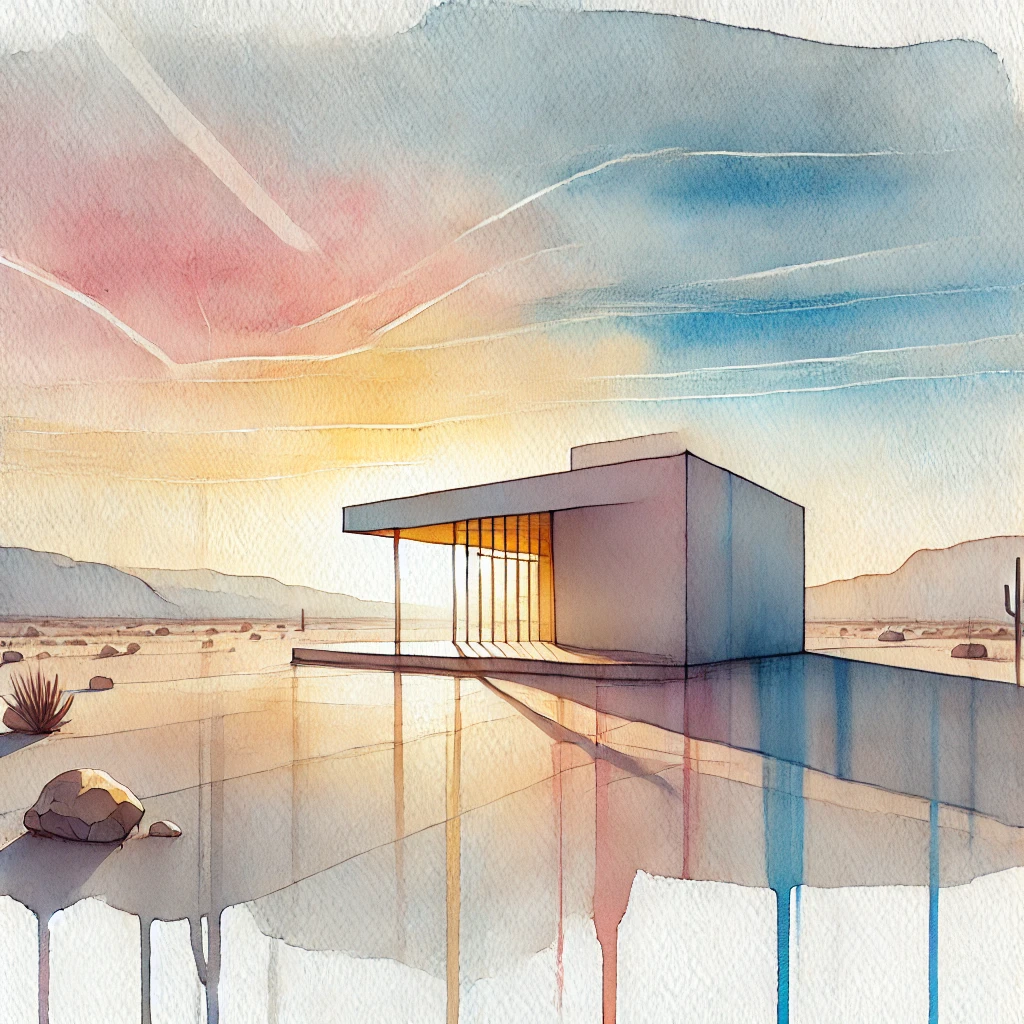
Jessica Fuentes’ watercolor sketch of Robert Irwin’s “Untitled (Dawn to Dusk)” is a masterful reinterpretation of one of the most iconic minimalist installations of the modern art era. Through her unique artistic lens, Fuentes translates Irwin’s meditative exploration of light, space, and time into a vibrant watercolor study. This article delves into Fuentes’ approach, her stylistic choices, and the broader significance of adapting Irwin’s work in such a poetic medium.
Robert Irwin’s Original Masterpiece
Robert Irwin’s “Untitled (Dawn to Dusk)” is a permanent installation located in the desert near Marfa, Texas. The structure, a monolithic pavilion, is defined by its geometric simplicity and sensitivity to the surrounding environment. It embodies Irwin’s dedication to minimalism and his fascination with the interplay of light and shadow. The installation captures the subtle transitions of natural light throughout the day, making the passing hours the centerpiece of the experience.
Irwin’s work is profoundly experiential, requiring the viewer to immerse themselves in the shifting qualities of light. Its minimalist design—a rectangular building with long apertures along the walls—creates a space where the boundary between indoors and outdoors dissolves, emphasizing the infinite horizon of the desert landscape.
Jessica Fuentes’ Artistic Approach
In her watercolor reinterpretation, Jessica Fuentes captures the essence of Irwin’s installation while imbuing it with her own artistic identity. Where Irwin’s work is characterized by architectural precision and minimalist restraint, Fuentes brings a fluid, emotive quality to her representation. Her choice of watercolor as a medium allows her to depict the ephemeral nature of light and space with softness and spontaneity.
The Use of Color
Fuentes’ color palette draws directly from the name and theme of Irwin’s work. Gradients of pale yellows, soft pinks, and cool blues evoke the dawn, while deeper shades of orange, violet, and navy represent the dusk. This choice mirrors the transitions Irwin explored in his pavilion, but Fuentes’ application of color is more emotive and painterly. The flowing watercolor technique mimics the natural blending of hues in the sky, creating a dreamlike atmosphere.
Abstract Architectural Lines
While Fuentes’ sketch leans into abstraction, it retains structural elements that hint at Irwin’s geometric design. Soft, linear forms subtly suggest the pavilion’s long apertures and rectangular framework. By doing so, Fuentes acknowledges the architectural precision of the original while prioritizing an artistic interpretation that focuses on mood and impression.
Watercolor as a Medium for Minimalism
Watercolor might seem an unconventional choice for reinterpreting a work steeped in the traditions of architectural minimalism, but it is precisely this contrast that makes Fuentes’ piece so compelling. Minimalism often emphasizes clean lines, uniformity, and materiality, while watercolor is fluid, unpredictable, and emotive. Fuentes bridges these two worlds by using watercolor to capture the intangible qualities of Irwin’s installation: light, time, and atmosphere.
Watercolor’s inherent transparency allows Fuentes to layer colors delicately, mimicking the way sunlight filters through the desert landscape. The medium’s unpredictability also mirrors the organic transitions of light and shadow that define Irwin’s work. This makes watercolor an ideal choice for translating a static architectural piece into a dynamic visual experience.
Both Irwin’s installation and Fuentes’ watercolor are deeply influenced by the desert environment. The vast, open spaces and unobstructed horizons of Marfa, Texas, create an unparalleled stage for exploring light and color. In Irwin’s work, the desert acts as both the subject and the canvas. Similarly, Fuentes’ sketch captures the essence of this arid landscape through its muted tones and expansive composition.
The desert’s minimalism—its sparse vegetation, endless skies, and stark lighting—resonates with both artists’ approaches. For Irwin, the desert’s simplicity amplifies the interplay of light and shadow, while for Fuentes, it provides the perfect backdrop for her fluid, atmospheric washes of color.
Jessica Fuentes’ watercolor sketch does more than reinterpret Irwin’s work; it opens a dialogue about how art evolves and interacts with different mediums. By translating “Untitled (Dawn to Dusk)” into watercolor, Fuentes invites viewers to see the piece in a new light—both literally and metaphorically. Her work emphasizes the emotional and ephemeral qualities of Irwin’s installation, highlighting aspects that might go unnoticed in the original.
Fuentes’ adaptation underscores the idea that art is not static. Every interpretation, whether through a different medium or a fresh perspective, adds to the richness of the original work. Her watercolor sketch is not a mere replication; it is a reinterpretation that brings Irwin’s ideas into the realm of fine art illustration.
By presenting “Untitled (Dawn to Dusk)” through watercolor, Fuentes makes the work accessible to audiences who may never visit the remote desert installation. Her sketch distills the essence of Irwin’s piece into a portable, shareable format, allowing it to reach a broader audience and inspire new conversations about light, space, and art.
Jessica Fuentes’ watercolor sketch of “Untitled (Dawn to Dusk)” is a testament to the enduring impact of Robert Irwin’s work. Through her fluid, emotive interpretation, Fuentes captures the core of Irwin’s exploration while offering a fresh perspective. Her choice of watercolor as a medium highlights the intangible qualities of light and time, bridging the gap between architectural minimalism and fine art.
Both Irwin and Fuentes share a fascination with the ephemeral, making this adaptation a fitting tribute. Fuentes’ sketch not only celebrates Irwin’s vision but also contributes to the ongoing dialogue about how art can transcend boundaries and mediums, inspiring new ways of seeing the world.
Related Articles
Jason Limon Rips Open Vintage Packaging to Find a Skeleton Waiting Underneath
San Antonio painter Jason Limon’s latest trompe l’oeil work turns torn matchbooks, tins and biological […]