DRIFT AUDIO
Listen to this story
Choose a voice, then press play.
San Antonio painter Jason Limon’s latest trompe l’oeil work turns torn matchbooks, tins and biological charts into windows onto a hidden skeletal world.
Look closely enough at one of Jason Limon’s recent paintings and the illusion falls apart in the best possible way. A corner of what looks like faded packaging or an old biological chart appears to peel back, ripped at the edge, and underneath it sits a small skeletal figure going about its business, entirely unbothered by the fact that its paper covering has just come apart. Except nothing has actually torn. The whole thing, tear and all, is paint.
That technique, trompe l’oeil, literally means to deceive the eye, and it has existed in Western painting for centuries as a way of making a flat surface pretend to be something with real depth and texture. Limon’s version of the trick is narrower and stranger than the genre’s classical roots in still life fruit bowls and painted architecture. He is not trying to convince a viewer that a bowl of grapes is real. He is trying to convince them that a piece of vintage advertising has been damaged just enough to expose an entire invisible universe living behind it, one populated exclusively by bones.
View this post on Instagram
The device works because it gives the skeleton figures something they rarely get in Limon’s other work: a reason for being hidden in the first place. A torn label is not just a stylistic flourish, it is a narrative device, implying that this bony world has been there all along, quietly tucked behind the surface of ordinary printed material, waiting for someone to accidentally rip the wrapper. It also changes how a viewer’s eye moves across the canvas. Instead of taking in a single scene all at once, the painting asks to be read in two layers, the intact printed surface first, then the torn opening, then whatever strange, quiet moment is happening in the gap between them. That layered reading is part of what makes the work feel more like a discovery than a straightforward composition.
There is a long tradition of painters using illusion to hide something inside plain sight, from trompe l’oeil letter racks stuffed with painted correspondence to still lifes built around a curtain that appears to be pulled halfway across the canvas. Limon’s take updates that tradition for an audience raised on collectible ephemera and vintage packaging design rather than aristocratic portraiture, swapping painted velvet curtains for the kind of matchbooks, tins and printed animal charts that read as instantly familiar rather than formal.
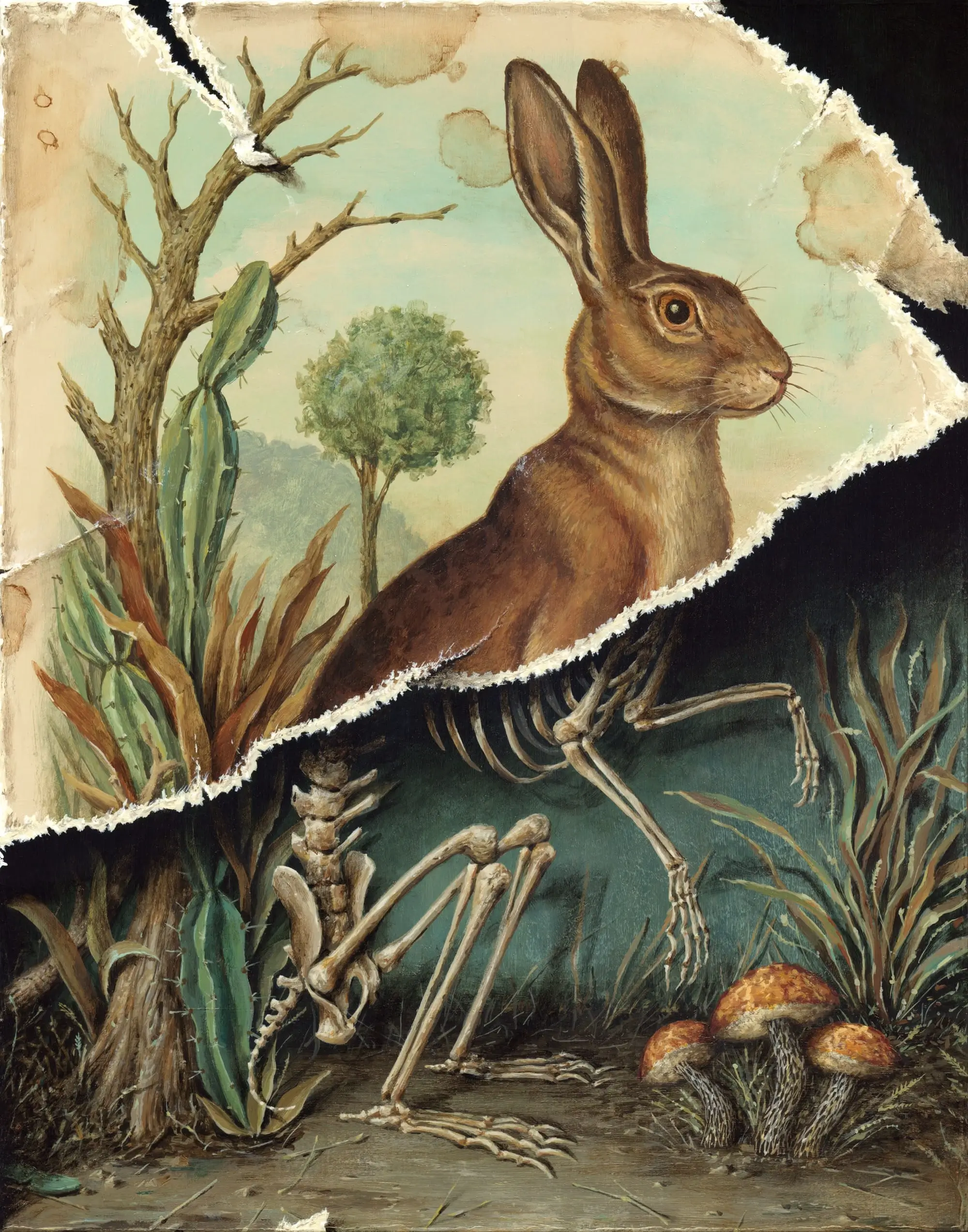
Hyperrealist trompe l’oeil painting of a rabbit transitioning from living form to exposed skeleton through a convincingly torn paper illusion set within a desert landscape.
length
Limon has been painting some version of this world for a long time. Born and raised in San Antonio, Texas, where he still lives with his wife and daughters, he came up as a graphic designer before shifting into painting full time, a background that shows up clearly in his interest in printed ephemera, packaging design and the view lang of old advertisements. He has been exhibiting steadily since 2007, moving through solo and group shows in cities including New York, Albuquerque and Chicago, along with stops across parts of Europe, and has picked up recognition over the years from Communication Arts, American Illustration and the Society of Illustrators of Los Angeles.
The skeleton itself has functioned as Limon’s primary character for most of that run, appearing across an ongoing body of work he calls Fragments. The appeal of the figure, by Limon’s own account, comes down to anonymity. A skeleton carries no face, no expression, no identifying features, which frees it to stand in for a feeling or a memory without the specificity of an actual human likeness getting in the way. That neutrality lets Limon load his scenes with real emotional weight, whether the figure is bursting out of a paint tube, hiding inside a paper construction shaped like an antique dress, or, in the newest works, standing quietly behind a torn illustration of a cat or a rabbit.
Despite the subject matter, very little about Limon’s paintings reads as grim. The muted, jewel toned palette he favors leans closer to old biscuit tins and weathered postage than to anything associated with horror, and the skeletons themselves tend to be caught mid gesture, doing something oddly domestic or play rather than anything sinister. It is a tone that has followed his work consistently for close to two decades: strange without being frightening, morbid without being heavy handed.
show
What sets this newest run of paintings apart is less the subject matter than the pace behind it. Limon has said that shifting toward the trompe l’oeil technique required him to deliberately slow down his own process, a departure from the faster rhythm of his earlier Fragments pieces, while still trying to hold onto the same sense of playfulness that has always defined his work. He has described the two approaches, the quicker graphic style and the newer, more illusionistic one, as identities that will likely merge into a single visual language somewhere down the line, rather than staying permanently split.
That slower pace also lines up with a shift in materials. Limon has started blending oil paint into work that was previously built almost entirely on acrylic, a combination that allows for more gradual layering and the kind of soft, worn edges that make a painted tear look convincingly torn rather than simply drawn on. Getting a fake rip to read as believable depends on exactly that kind of patience, since a trompe l’oeil illusion falls apart the moment a viewer can see brushwork doing the heavy lifting instead of light and shadow.
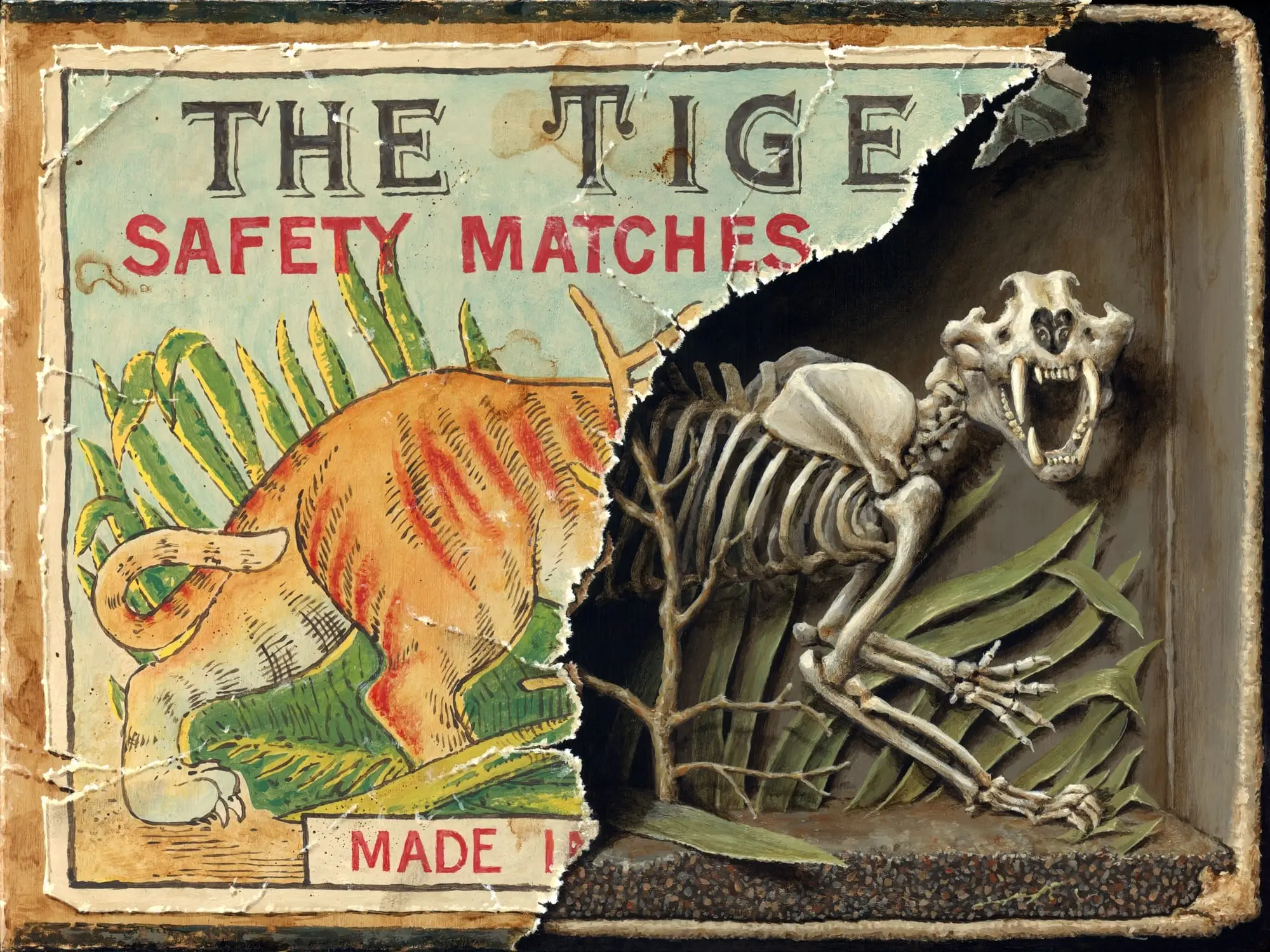
Trompe l’oeil painting transforming a vintage Tiger Safety Matches box into a convincing illusion, with a torn label revealing a meticulously rendered tiger skeleton concealed inside.
new
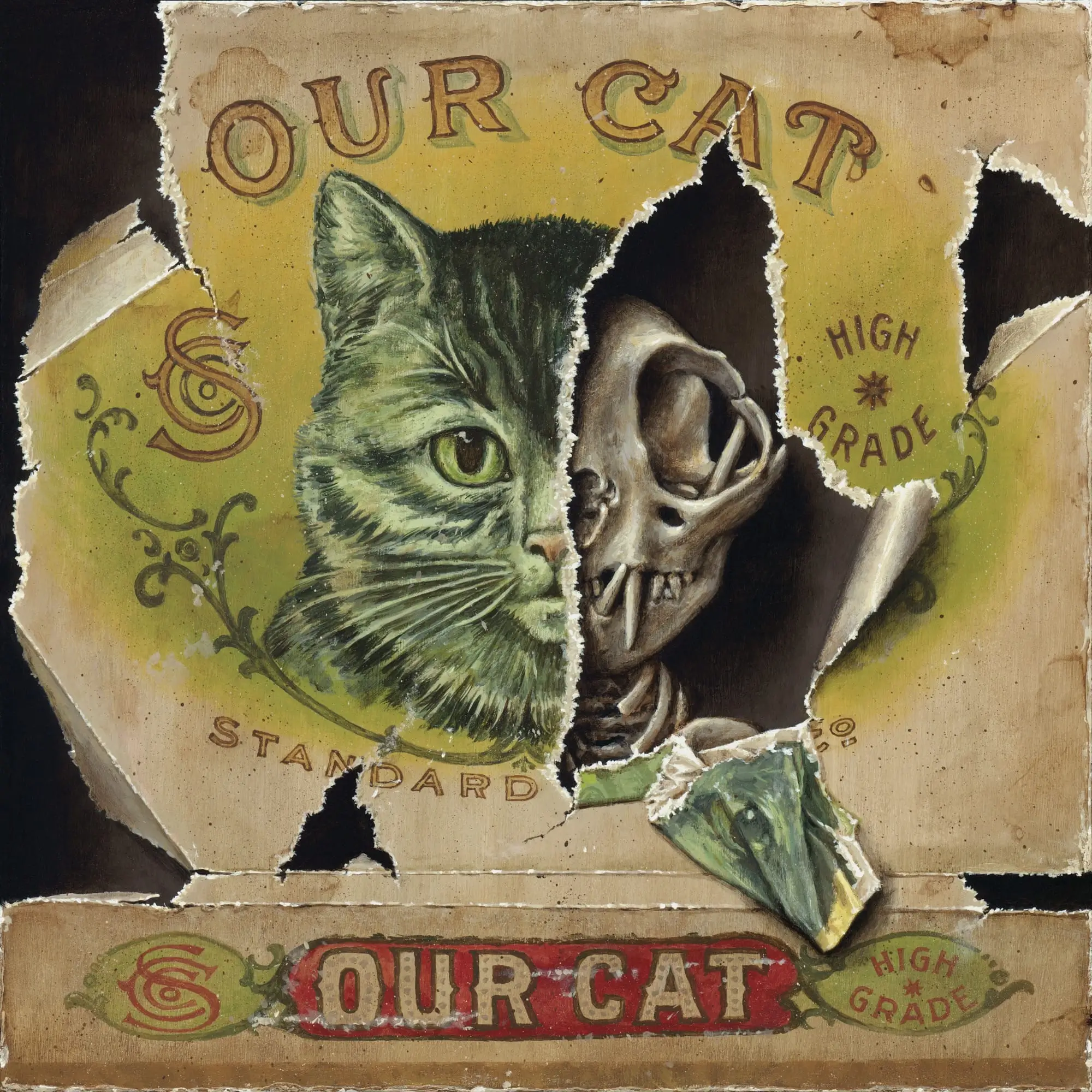
The pieces themselves stay small and intimate, most falling somewhere between eight and fourteen inches on their longest edge, a scale that suits work meant to be examined up close rather than viewed from across a gallery. “Our Cat,” a twelve by twelve inch painting of a torn memorial revealing a cat skeleton underneath, anchors the group and sets the tone for the rest of it: tender, a little wry, and built entirely around the gap between what a viewer expects to see and what is actually hiding underneath.
Elsewhere in the collection, “Matchbook Tiger” imagines a torn matchbook cover giving way to a tiger’s skeleton rather than the printed animal illustration a viewer would expect, while a pair of works titled “Torn Rabbit I” and “Torn Rabbit II” apply the same logic to a rabbit illustration ripped open at the edge. “Fading Feline” and “The Inseparables” continue the theme with a cat and a bird respectively, both caught behind torn paper in the same quiet, matter of fact way. Other pieces push the illusion in different directions entirely. “Perle des Indes” renders a full mastodon skeleton rather than one of Limon’s usual human sized figures, while “Circus Clown” and “Brunette” bring people, or at least skeletal stand ins for people, into more theatrical settings. Smaller works like “Seen” and “Hush” scale the idea down further, with tiny skeletal figures perched on or decorating an oversized skull, and “Matchbox Cyclist” tucks its bony subject into the corner of a torn matchbox rather than a larger printed surface.
Taken together, the group reads less like a single unified series and more like variations on one very specific idea, applied across as many kinds of vintage printed material as Limon can find a reason to tear open. That range, tigers, rabbits, cats, birds, a mastodon, a circus performer, a woman, a cyclist, suggests an artist testing how far a single technical trick can stretch before it needs a new one, and so far it does not appear to be running out of room.
view
Limon sells both original paintings and prints through his own online shop, and continues to post new work and process shots to his Instagram account for anyone following the day to day evolution of the technique. His larger exhibition history includes past solo and group shows with Arch Enemy Arts, where he debuted his first solo feature with the gallery in 2021 after several years showing in its group exhibitions, along with stops at Haven Gallery in Long Island and Copro Gallery in Santa Monica in previous years. No specific upcoming show dates were included alongside this newest body of work, though Limon’s pattern over the past several years has been to keep a fairly steady exhibition calendar running alongside whatever he is currently developing in the studio.
The work was first reported by Colossal, whose ongoing coverage of Limon’s practice stretches back several years and has tracked his shift from the more graphic Fragments pieces toward this newer, slower illusionistic style in real time.
Related Articles
Winter Ran Down A Plywood Panel In Gaeta
Cy Twombly, Untitled (Winter Picture), 2004. Acrylic on plywood in the artist’s frame. Gagosian, Madison […]