DRIFT AUDIO
Listen to this story
Choose a voice, then press play.
Foot Locker just spent fifty years of shelf space on a two-minute film, and the bet is that memory sells better than a markdown.
New York City, August 7, 2026. Foot Locker told the shoe world something it already suspected about itself: the mall stalwart with the black and white awning has decided its best marketing asset isn’t a new drop, it’s its own memory. The retailer unveiled “It Always Will Be Foot Locker,” a brand platform built around a two-minute anthem film that treats five decades of shoe retail as a story worth telling on its own terms, rather than as a backdrop for whatever colorway is on the wall this week.
The announcement landed with the kind of lexicon companies reach for when they want a moment to feel bigger than a product push. Brett O’Brien, senior vice president and chief marketing officer at Foot Locker, frames it plainly in the company’s own release: for more than fifty years, Foot Locker has given shoe culture a true home, helping define its iconic moments and milestones. He called the new platform a love letter to that leg and to the gen of customers who shaped it alongside the company. It is a claim retailers make often and rarely earn. What makes this one worth a second look is who Foot Locker hired to make the case, and how specific the case actually is.
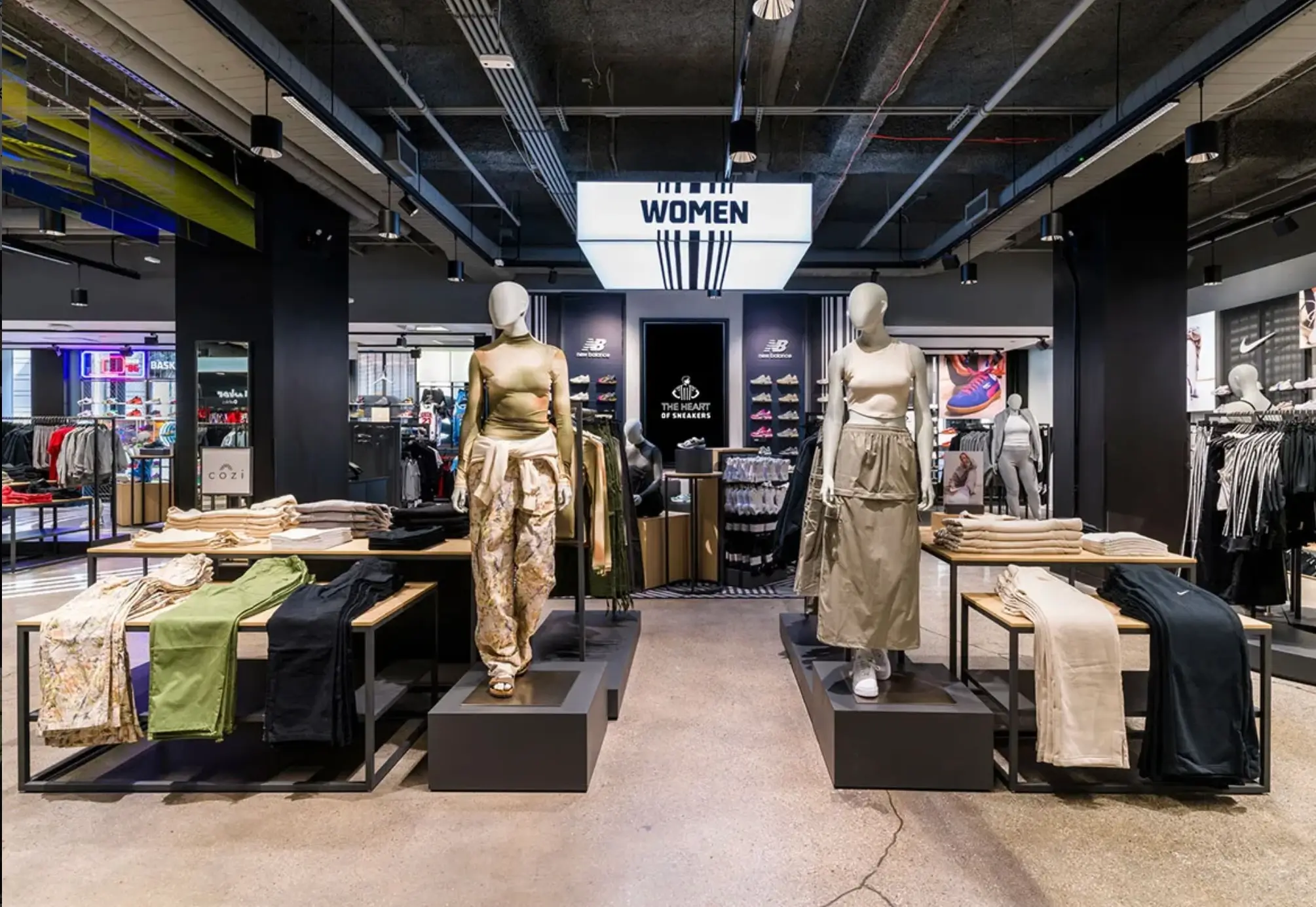
Foot Locker women’s retail section featuring mannequins, apparel and footwear displays.
The timing is not incidental. Dick’s Sporting Goods closed its 2.4 billion dollar acquisition of Foot Locker in September 2025, and O’Brien joined the company shortly after that deal shut. A new marketing chief inheriting a newly owned chain does not typically start with nostalgia. He usually starts with a reset. O’Brien chose the opposite move, and told WWD that establishing the history first was deliberate, a foundation to build from before the campaign pivots toward what “always will be” actually means going forward. The past, in other words, is the opening chapter, not the whole book.
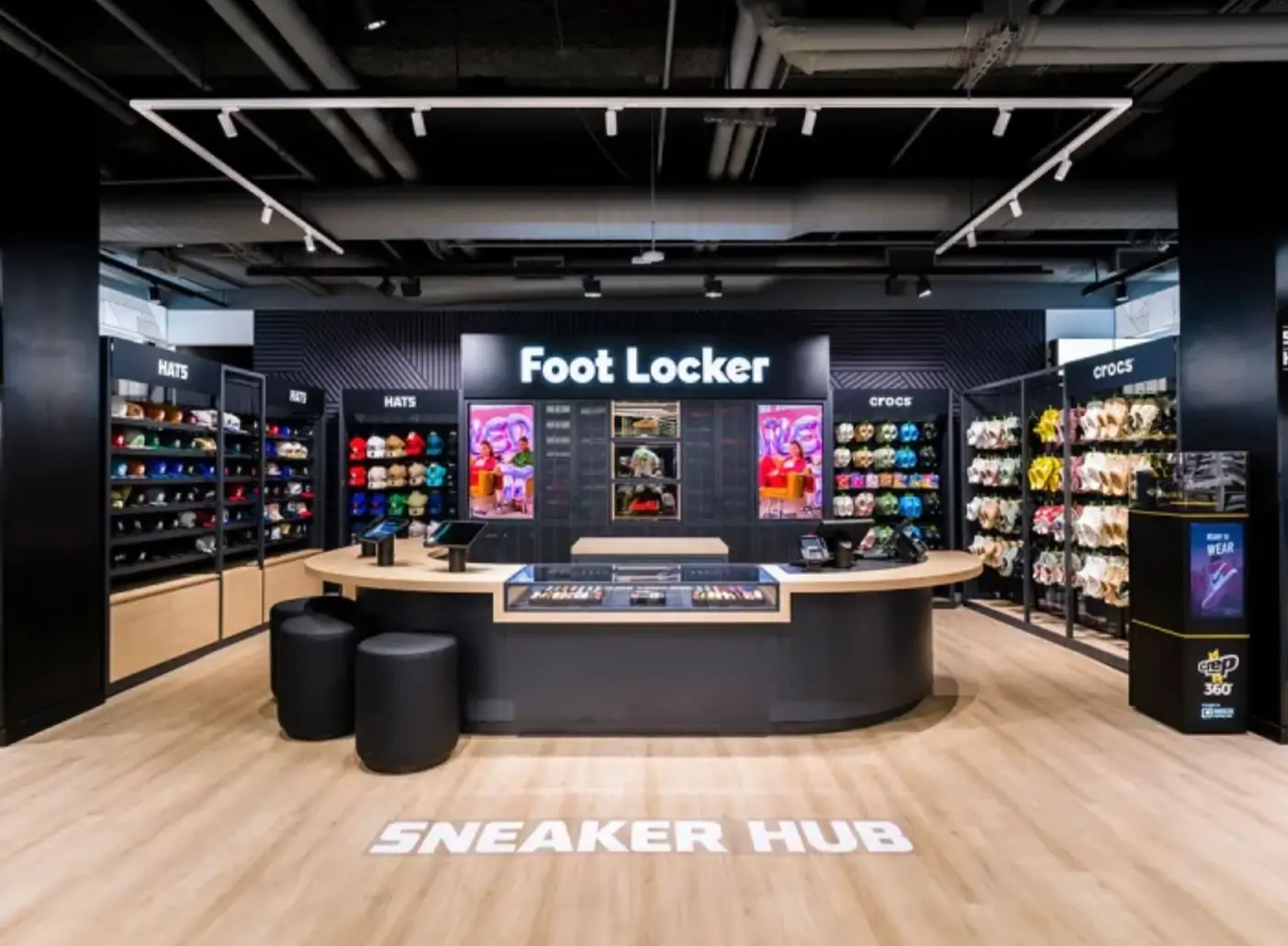
Foot Locker today operates with a footprint that stretches across North America, Europe, Asia, Australia, and New Zealand, plus a licensed store presence spread across Europe, the Middle East, and Asia, a scale that took decades to build store by store, mostly in the same enclosed malls that have been declared dead by retail commentators more than once. That geographic spread is part of why a single unifying platform matters to a company this size. A chain operating under different regional identity, promotion, and store format which could benefit from one narrative thread that reads the same either it’s conjure in a flagship on a major American avenue or a licensed location overseas. “It Always Will Be Foot Locker” is being built to serve that exact function, a single phrase flexible enough to sit under wildly different local execution.
flow
The anthem itself runs two minutes and was narrated by Method Man, the Staten Island rapper and Wu-Tang Clan member whose voice has become shorthand in advertising for lived-in authority rather than polished sales pitch. The film was created with Someplace, the Los Angeles creative and media shop founded by Ryan O’Rourke, Alberto Ponte, and Daniel Sheniak after a collective run of more than twenty years managing the Nike business at Wieden and Kennedy. That pedigree shows in the choice of device: rather than narrate history through dates or box scores, the film uses shifting colorways as its structural spine, letting hue itself carry the story forward from one sneaker era into the next.
The specific shoes chosen were not arbitrary. The film moves through the original red and black Air Jordan 1, the white and green adidas Stan Smith, the Converse Weapon, New Balance’s grey running silhouettes, and the perennial Nike Air Force 1. Each one represents a different decade and a different reason people bought sneakers in the first place, whether that was basketball show, tennis-court crossover style, skate culture, or plain streetwear versatility. Stacking them together in one film is Foot Locker arguing, without saying so outright, that it was the connective tissue between all of those separate sneaker movements rather than a passive shelf for any single one of them.
Method Man called the project personal in the company’s release, saying that as someone who has been part of sneaker culture for decades, the work felt different from a typical ad read. Sneakers, he said, have always been bigger than footwear, representing where you’re from, what inspires you, and the moments that shape you, which is what made the campaign feel authentic to him. It’s the kind of quote that could read as boilerplate from almost anyone else. Coming from a rapper whose own sneaker rotation has been publicly dissected for thirty years, it carries a little more weight.
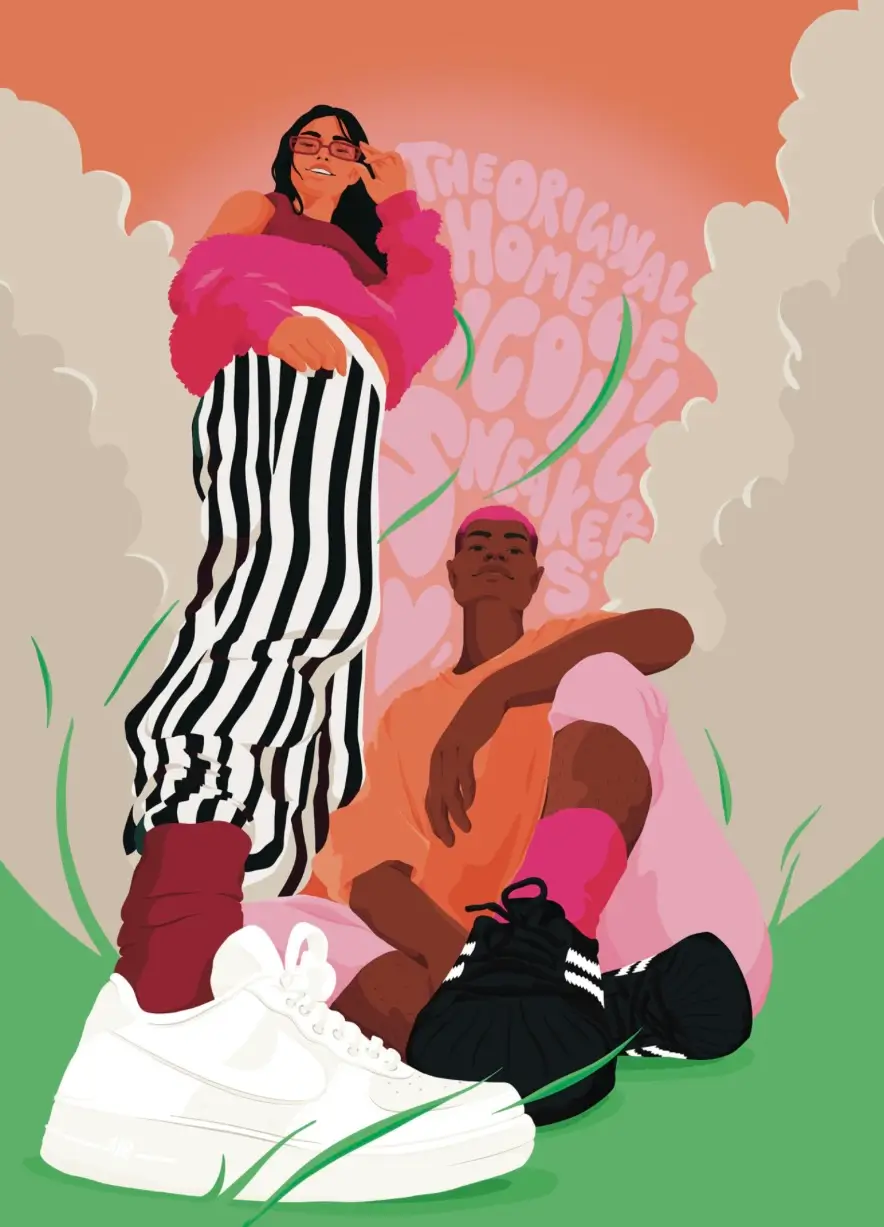
Hue Sensible streetwear show featuring two figures in bold clothing and oversized footwear.
stir
If the shoe rotate every few pages of the film, one image does not: the Foot Locker Striper, the referee-style attendant whose black and white stripes have marked Foot Locker stores and staff uniforms since the chain’s earliest days. The campaign uses the Striper as its view throughline, the one element that stays put while everything around it, the shoes, the decades, the culture, keeps moving. It’s a smart piece of brand math. Sneaker silhouettes go in and out of relevance constantly. A retailer’s own identity mark does not have to, if the retailer keeps showing up.
That distinction matters more now than it might have five years ago. Shoe retail has spent the last decade getting squeezed from two directions at once, by brands selling direct to consumers through their own apps and stores, and by resale platforms that turned scarcity into a marketplace of its own. A chain built on being the place where those brands showed up now has to make the case that the showing up itself has value, separate from any single pair on the wall. “It Always Will Be Foot Locker” is that argument compressed into a tagline, betting that the retailer’s continuity across eras is worth more than any individual product cycle.
It also isn’t the company’s first attempt this year at building a platform rather than a single push. Foot Locker’s own release points back to “Hoops Lives Here,” a year-round basketball platform the retailer stood up to reinforce its position at the center of the sport, separate from any single sneaker release tied to a specific player or season. Read together, the two platforms suggest a company trying to build a small stable of recurring properties it can return to season after season, rather than starting from zero with every new marketing cycle. That’s a meaningfully different posture than the drop-driven, always-chasing-the-next-release marketing that has defined most sneaker retail messaging for the last several years.
The campaign is rolling out across broadcast, social, digital, out of home, and in-store placements, which is Foot Locker’s way of saying this is not a limited social push but a full seasonal buy, the kind of spend that signals a company trying to reset how it’s perceived rather than just move units for a quarter. It’s worth noting how unusual that spend pattern is for a specialty retailer rather than a shoe brand itself. Brands like Nike or adidas fund anthem-scale films regularly. A retailer committing the same scale of production and media buy to its own identity, rather than to a specific product it’s carrying, is a comparatively rare move, and one that puts real budget behind the idea that Foot Locker itself, not just what’s on its shelves, is worth advertising.
narr
The anthem film is the anchor, but it is not the whole platform. Foot Locker is extending “It Always Will Be Foot Locker” through Sole Stories, a 36-episode short-form documentary series produced with Hartbeat, the media company built by Kevin Hart. Where the anthem tells Foot Locker’s own history, Sole Stories hands the microphone to creators, tastemakers, and sneaker enthusiasts, letting them describe the personal meaning behind specific pairs rather than having the brand narrate that meaning for them. The series is set to roll out through the fall across social, digital, influencer, and in-store channels.
It’s a familiar strategy in category marketing right now, pairing a single polished hero film with a longer tail of user-adjacent, creator-driven content that can live comfortably on shorter attention spans. The hero film sets the emotional register. The docuseries lets that register get repeated in dozens of individual voices, each one more specific and less produced than the last, which tends to travel further on platforms where polish reads as inauthentic.
stance
It’s worth sitting for a moment on what Foot Locker is actually protecting here. The chain traces its identity back more than fifty years, long before the current wave of shoe culture discourse existed at all, and it built that identity as a specialty retailer inside American malls at a time when that model was the only real way to buy show footwear. Decades of consolidation, the rise of online-first shoe retail, and now a change of ownership under Dick’s Sporting Goods have all put pressure on that original identity from different directions. A brand platform this deliberate historic is, in part, a defense of continue at a moment when continue is exactly what’s under threat.
O’Brien’s comments to WWD suggest Foot Locker knows the anthem film can’t do that defense alone. He described the history-first approach as step one, with the campaign’s next phase, arriving over the coming months and into 2027, meant to answer the harder question embedded in the tagline itself: what does “always will be” actually mean when the retail landscape keeps changing underneath the company. That’s a bigger ask than a nostalgia reel, and it’s the part of this platform that hasn’t been made public yet.
There’s also a shh signal buried in how deliberate the rel credit its convincers. Naming Someplace’s founders’ Wieden and Kennedy pedigree, credit Hartbeat by name for Sole Stories, and structure the whole announcement around a formal PRNewswire rel rather than a social-first drop all point to a company treating this launch with the weight of an investor-facing moment as much as a consumer-facing one. That reading fits the broader context: a newly acquired retailer under a new marketing chief has two audiences to convince at once, shoppers who need a reason to walk back into a mall store, and a parent company that needs to see the acquisition paying off in brand equity as well as revenue.
fin
For now, what’s public is a film, a tagline, and a documentary series, released on the same day as a company statement that leans hard into the lang of leg and love letters. Whether that frame holds up depends on what Foot Locker does with the next phase O’Brien has already signaled is coming. A brand platform can open with the past. It has to eventual say something about the present, especially one belonging to a retailer now operating under new ownership and trying to prove its shelf space still matters in a market that has more ways than ever to buy a pair of shoe without ever walking into a mall.
The film itself is available through Foot Locker’s own channels and via Someplace’s and Foot Locker’s social pages, alongside the hashtag the two companies are using to track the campaign’s rollout.