DRIFT AUDIO
Listen to this story
Choose a voice, then press play.
Cologne designer Pablo Octavio rips one block of polyurethane foam into a chair that looks like rock and yields like upholstery, and Adorno lists it at €3,100.
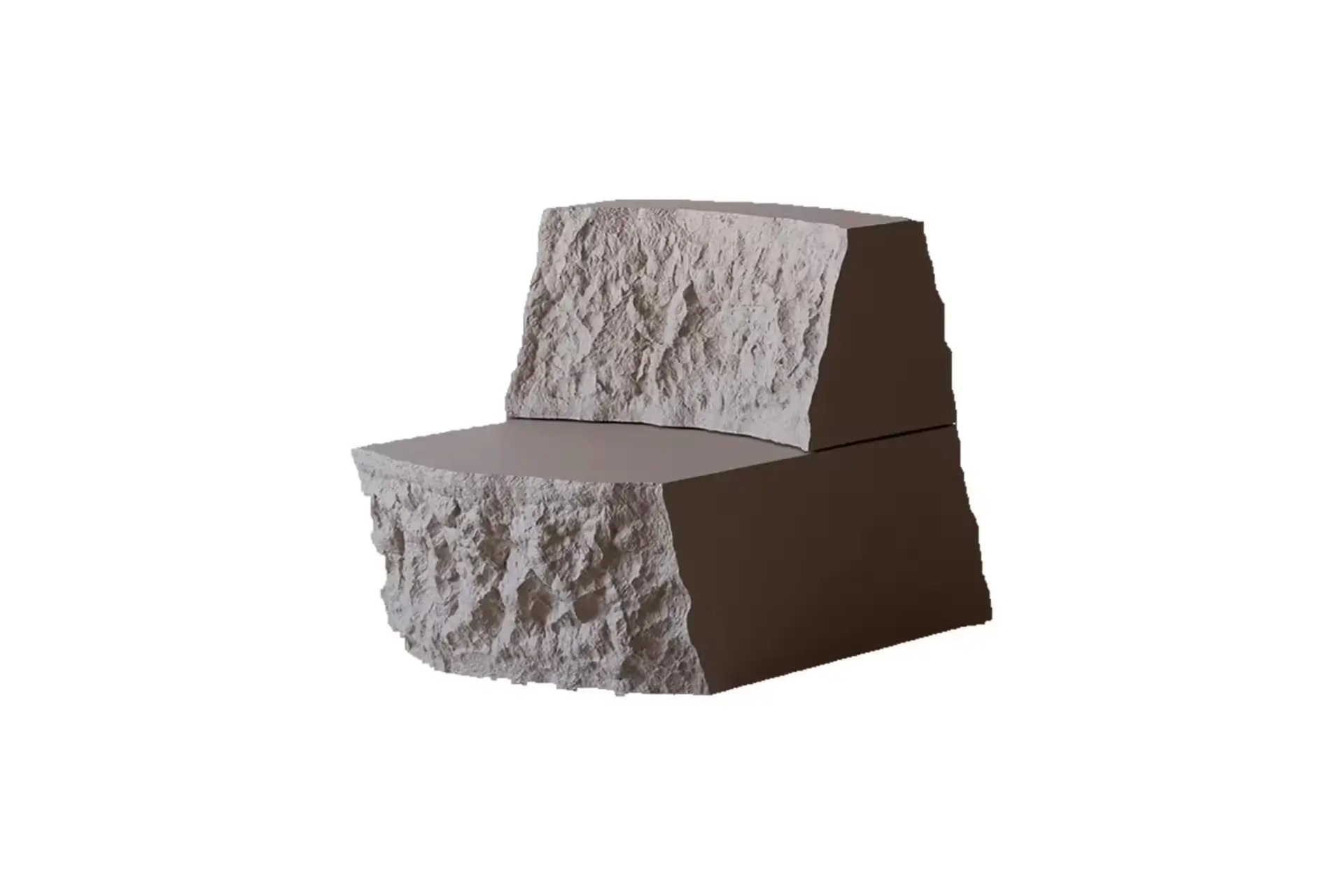
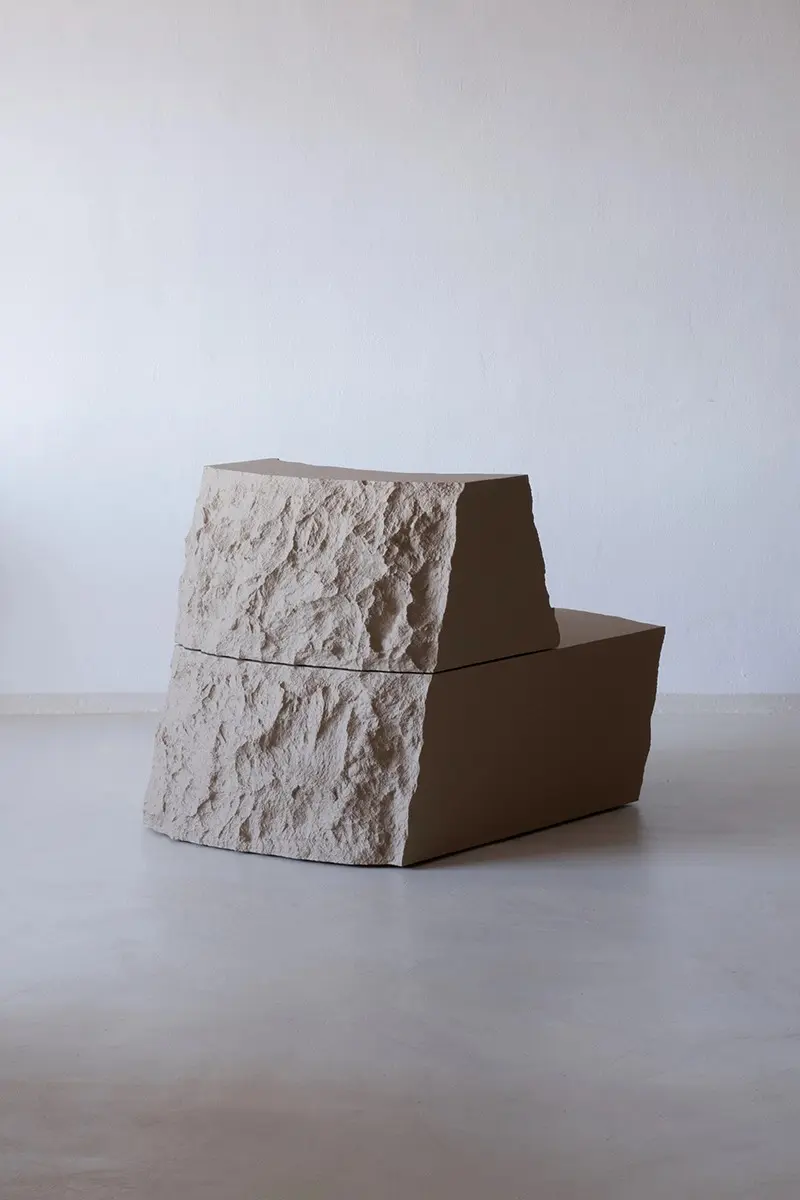
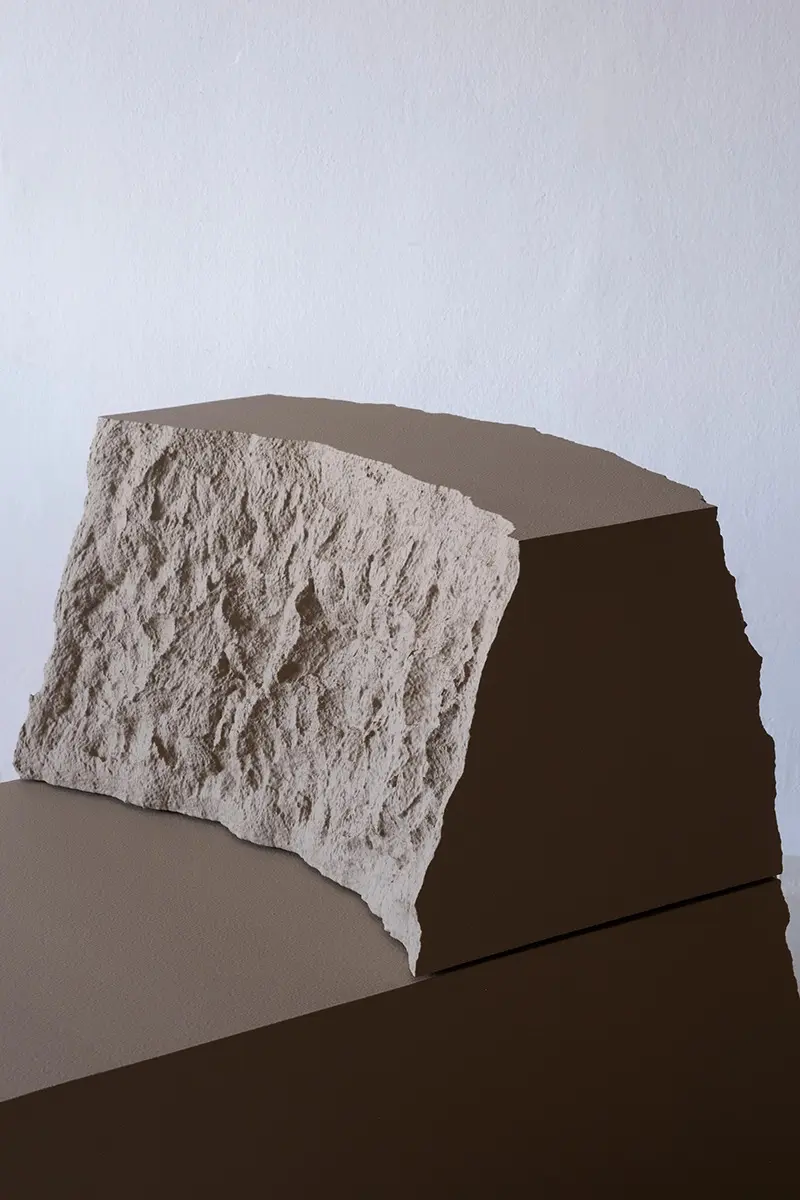
The Lapis Lounge Chair rests on a deliberate misreading. From a few steps away it looks like a boulder split along a seam; up close it is polyurethane foam, and the studio lists the whole chair at 15 kilograms. It comes from Pablo Octavio, the Cologne designer whose Lapis collection is built on tearing rather than carving.
View this post on Instagram
The basics fit in one place.
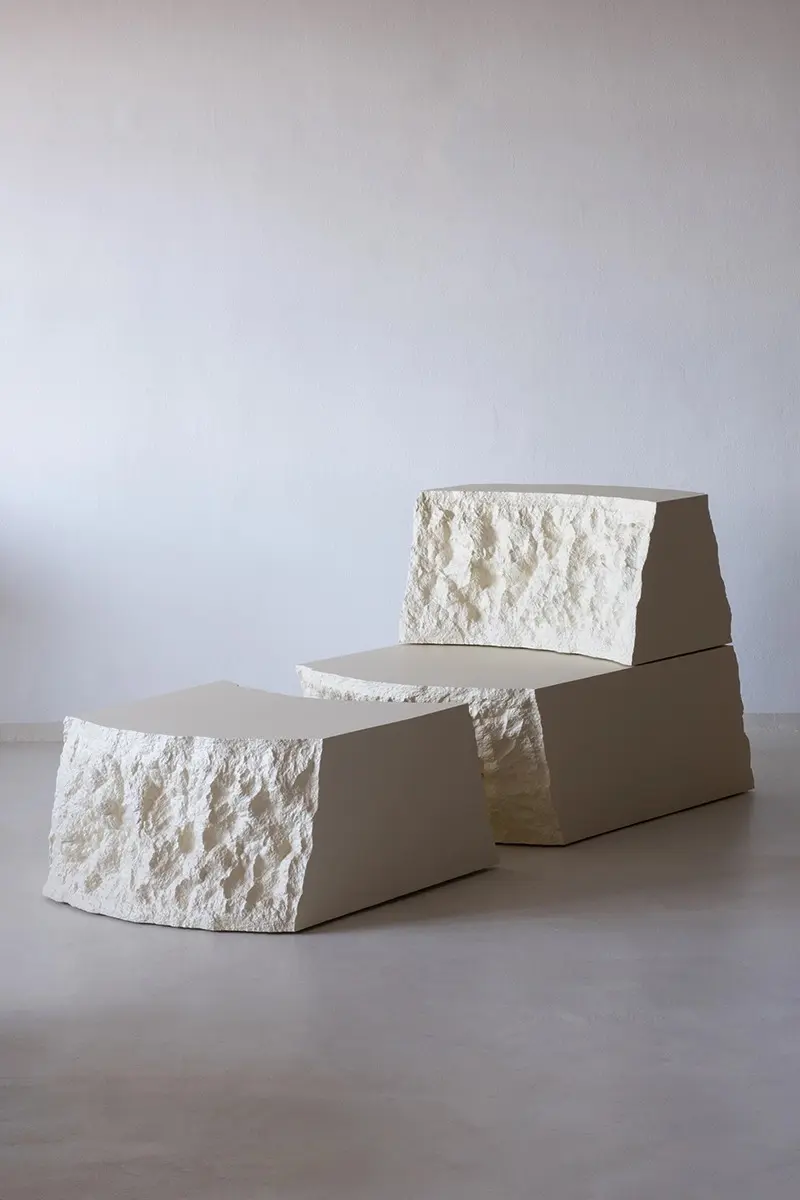
Signal. What happened: Pablo Octavio’s Lapis Lounge Chair studio’s related foam daybed at Collectible Brussels. Exact object: the Lapis Lounge Chair, polyurethane foam torn by hand from a single block and coated with a flexible, UV-resistant, waterproof finish, 66 x 110 x 70 cm, 15 kg, in Light Ivory or Sand. When and where: available from the studio on request, through Adorno at €3,100 with an eight-week lead time, and through Movimento Gallery, which quotes 8 to 10 weeks, while The Oblist sells a chair-and-ottoman set at $4,857. Source: the studio’s own project page, cross-checked against Adorno, Movimento, Dezeen and Leibal. Why it matters: the chair’s surface comes from a tearing process the maker only partly controls, so no two chairs match, and the same method now runs through daybeds, benches and brand commissions.
stir
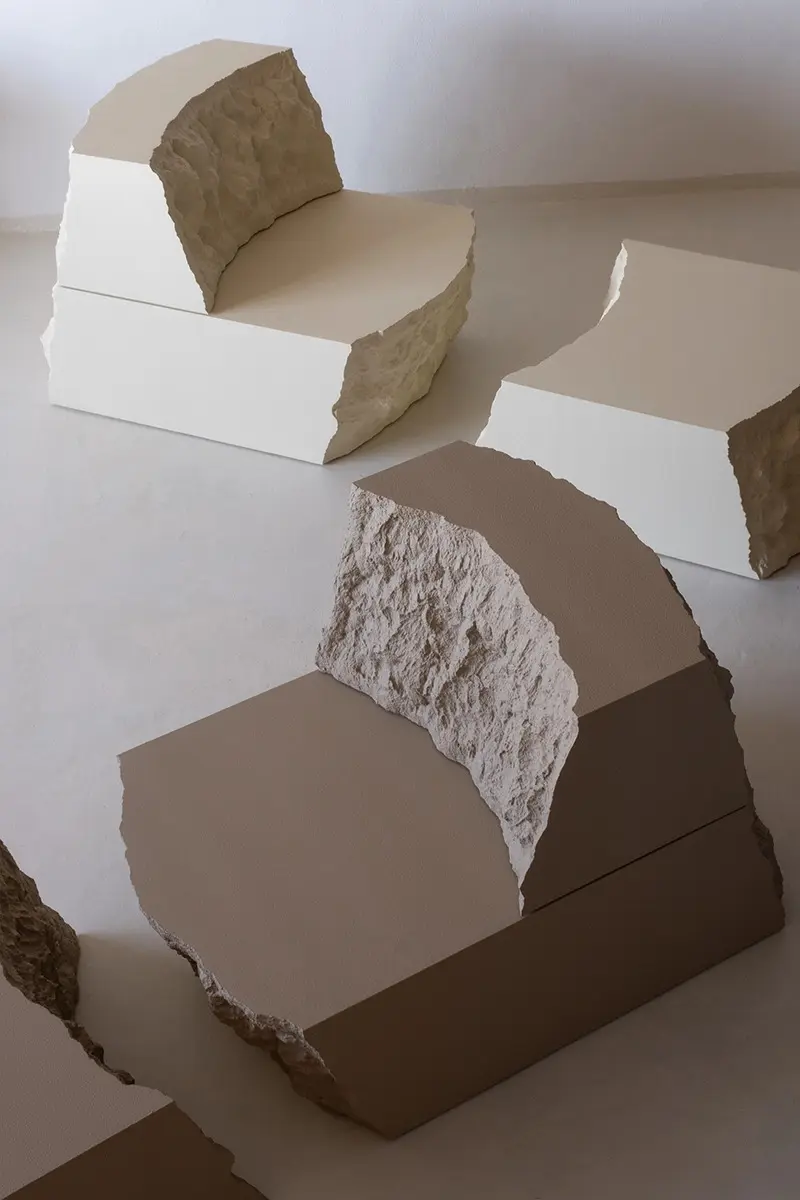
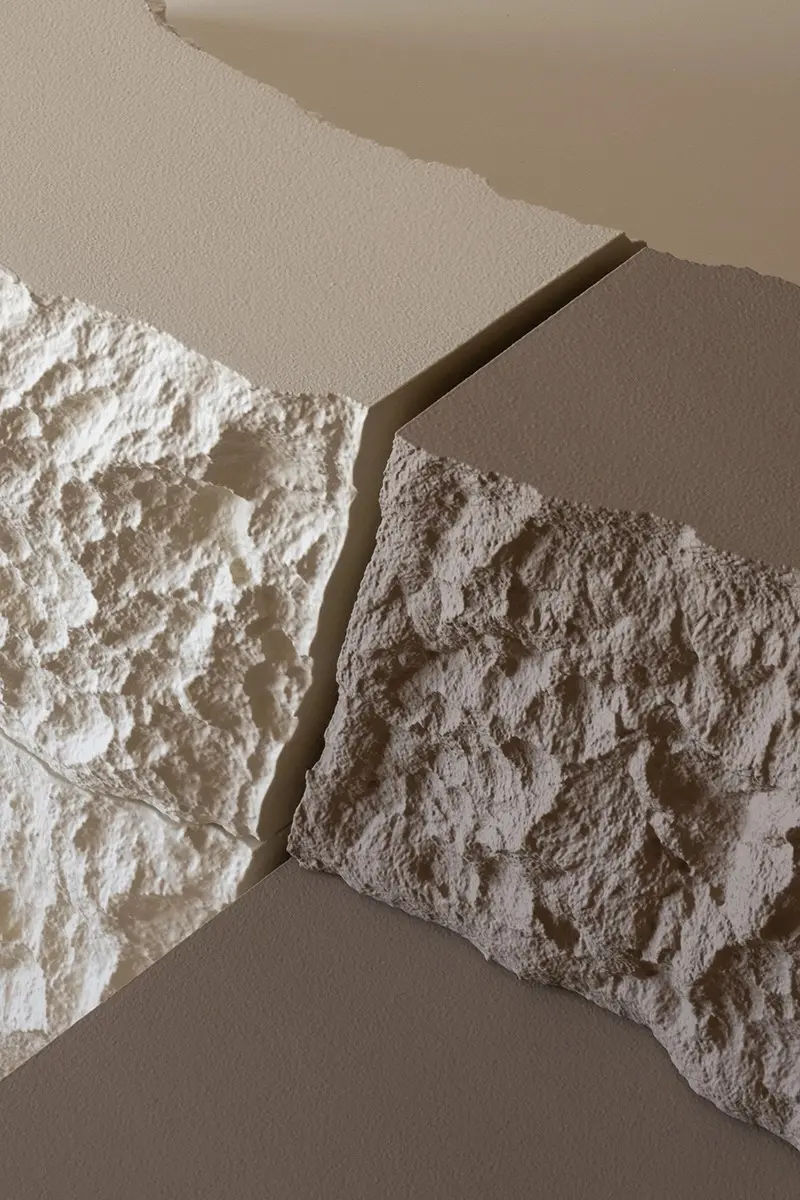
The process starts with one large block of soft foam that Octavio pulls apart by hand instead of cutting. Movimento Gallery, which shows the piece under the longer name Lapis Lazuli, describes the lounge chair’s version: a single block ripped into two pieces, the base and the backrest, which are then rejoined to form the sil and wrapped in one flexible coating, according to its 1stDibs listing. Leibal, writing in March about the collection’s daybed, calls the tearing partly controlled and partly left to the material’s own structure, and notes that no two pieces break the same way. Its write-up locates the appeal in the moment of contact, when a surface that reads as geological gives way with the softness of upholstery, a gap it says is the design itself, and it places the practice in a wider strand of collectible design that treats material unpredictability as a starting condition rather than a flaw to be designed out.
The studio says the interplay of chance and intention in that tearing produces the stone-like surface each piece takes its character from. Because a fracture is not repeated, the ridges and hollows of one chair are never quite those of the next. The studio files the chair as a self-initiated project rather than a commission.
flow
Foam alone would not survive a terrace, so the raw material gets a finish. The studio describes a very flexible coating that is UV-resistant and waterproof, meant to protect the foam outdoors without dulling its feel. Adorno’s listing calls it a highly flexible, UV-proof and water-repellent paint and rates the chair for indoor and outdoor use, and Movimento describes a process that leaves the surface dirt and water repellent. Movimento’s spec sheet lists the foam as grade S T 40/60 with a PU coating and gives Germany as the country of origin.
The sellers all lead with the same contradiction. Movimento’s copy says the chair looks hard, rough and not especially inviting until someone sits, at which point the foam gives. Adorno’s summer roundup of outdoor lounge chairs argues that setting it beside a pool or against real stone turns it into a small act of misdirection, the fake geology sitting next to the genuine article. It adds that the chair’s mineral surface reads differently in midday light than in evening shade, and that a piece like this is seen from inside the house as often as it is sat in. Interest has reached beyond furniture. In April the fashion label Nicole Zizi Studio devoted a blog post to the chair, singling out the gap between its rough first impression and the softness of sitting in it.
The Oblist’s product FAQ answers the practical questions. The seat is described as firm and supportive and able to keep its shape, the piece can get wet and take moderate sun, and it should be covered and kept dry in extreme weather. Cleaning is warm water, a mild detergent and a cotton cloth, and the page warns that dirt left on the surface for a long time can settle into the finish and leave marks.
Color is a smaller variable than texture. Light Ivory and Sand are the standard finishes, The Oblist adds anthracite, and Movimento lists most RAL Classic and NCS colors as options. Adorno and The Oblist both say color and size customizations are possible on request, and The Oblist notes that cost and lead time vary with what is asked for. The name itself points at stone, since lapis is Latin for it, and the longer Lapis Lazuli used by Movimento and Dezeen borrows the blue mineral even though the standard palette is pale.
one
The studio describes the Lapis pieces as a collection of versatile seating objects that share a material and a method. Its stools and benches page lists a bench measuring 45 by 200 by 45 centimeters and weighing 13 kilograms, in the same open edition and the same finishes, and The Oblist sells a set of two stools and a two-seater bench. Its chair listing includes a matching ottoman, 80 by 66 by 35 centimeters, in the price and lists the pair at 170 by 66 by 70 centimeters overall. Minimalissimo frames the way the components can be arranged as a natural modularity, a set that adds up to a landscape rather than a single chair.
View this post on Instagram
The most visible extension is the Radius Daybed, shown with Full Circle at Collectible in Brussels in March. It lifts a torn-foam cushion onto a base of curved aluminium panels, and the studio lists it at 85 by 213 by 45 centimeters, 50 kilograms and a limited edition of nine. Dezeen’s Cajsa Carlson called the daybed brutalist, noting its visibly uneven edges and the flexible waterproof paint sprayed over the foam. Octavio told Dezeen he wanted to lift the foam off the ground and “make it more like furniture” instead of keeping the monolithic look of the chair. The Oblist also lists the daybed as a limited edition of nine. Leibal, which calls the piece the Lapis Daybed in a March 25 post, reads it as the chair’s logic at a more architectural scale.
The fair ran from 12 to 15 March at the Vanderborght building, and Dezeen’s roundup of five unusual seats shows the company the daybed kept. Naked Space made an eight-metre inflatable sofa for Vasto Gallery, AB+AC Architectsupholstered a daybed in cylinders of solid beeswax, and Alan Prekop built a sofa around a latex cushion. Octavio’s entry was the one that borrowed the look of stone.
View this post on Instagram
extend
Pablo Octavio Schneider Motjér was born in Cologne in 1992 and studied product design at FH Aachen before returning to his hometown to open a studio, according to the studio’s shop page. Movimento, a design gallery founded in 2020 with bases in London and Milan, lists him among its artists, and its biography adds that he has worked on projects ranging from residential interiors to stage design, that furniture and objects are his main interest, and that his production runs from one-off pieces to small series. The studio’s about text describes a multidisciplinary practice established in 2023 by the German-Spanish designer, working at the meeting point of design and sculpture. It frames furniture not merely as utilitarian form but as a spatial protagonist, an object with its own narrative, a biomorphic sil and a deliberately raw surface.
The same text centers on impressions from nature: textures, growth patterns, erosion and organic irregularities, translated through experimental fabrication in which unpredictable material behavior is a tool rather than an obstacle. Work is handcrafted mostly in the Cologne workshop, and most pieces are unique or limited editions. In the Lapis chair the designer chooses the block and starts the tear, while, in Leibal’s account, the exact fracture is partly left to the material.
The studio’s list of shows runs through design weeks in Milan, Eindhoven, Vienna, Barcelona and Cologne, a Madrid festival and the Collectible fair in Brussels, and Octavio co-curated the Vienna and Cologne editions of a show called Specular. In Milan the list includes Movimento’s Masterpieces & Tulips presentation. A May 2024 profile at Nave Shop says he had exhibited several times with Movimento during Milan’s design festival and credits the Lapis Lazuli chair with much of his success there.
Commissions have followed. For the Paris flagship of 7 For All Mankind, the studio made a custom Lapis lounge chair and sofa in 2024, listed as unique commissioned pieces in PU foam. In 2025 it produced benches for Nike ACG that pair stainless steel with torn-foam padding and refer to the alpine landscape around Chamonix. The studio’s project page ties them to the know of Nike ACG, short for All Conditions Gear, which it describes as performance in the natural environment. A private commission the same year, a Lisbon rooftop lounge, sets sky-blue padding inspired by the Lapis collection on a solid concrete base. Not everything is foam: in 2026 the studio also designed a hand-brushed aluminium version of the Nolastar room divider and curtain system, a company that dates to 1999, priced at €330 per square meter, and a limited-edition coffee table that pairs its aluminium base with a cast-glass top by Studio Maximilian Beck.
fin
Three retailers handle the chair besides the studio itself. Adorno describes itself as a curated online gallery for contemporary collectible design, The Oblist as a curation of contemporary and vintage objects, and Movimento as a gallery, so the buying experience differs by channel. Pricing does too. The studio lists the chair as price on request. Adorno sells it at €3,100 in Light Ivory or Sand, says it usually ships in eight weeks, and includes a maker-signed certificate of authenticity, while its June roundup describes the price as including tax. The Oblist sells the chair with its ottoman at $4,857 as a made-to-order, final-sale piece shipped from Germany. Movimento lists an 8 to 10 week lead time, and its 1stDibs listing says a wooden box is included in the price. The Oblist notes that buyers in a different economic zone from Germany may owe customs duties. Return terms differ too: Adorno advertises a 14-day return policy that excludes made-to-order items, while The Oblist treats its made-to-order Lapis set as final sale.
The specifications do not agree across sellers. The studio dates the lounge chair to 2023 and calls it an open edition, as do Movimento and The Oblist. Adorno lists production year 2024 and describes a limited edition of 99, and its fact sheet lists the material as foam and the discipline as stone sculpting. The open-edition label sits against the studio’s own statement that most of its works are unique pieces or limited editions, which makes the lounge chair and benches among the exceptions in its catalog.
The name is also not unique. Amura makes a separate Lapis lounge chair, designed by Emanuel Gargano and Anton Cristell as a modular system, and DesignLush described it in 2020 with Italian leather or fabric upholstery paired with marble or natural wood tables. Amura’s version pads its modular elements with memory foam.
Related Articles

Stormind Walked Around Etna And Put The Villa In The Last Remothered
Red Nun’s Legacy. Trilogy close. Acireale studio. Abandoned house on the volcano. Unreal Engine 5. […]