DRIFT AUDIO
Listen to this story
Choose a voice, then press play.
As his twelfth NBA season approaches, Jokić’s explain of leadership starts with winning, watching and helping the players beside him.
Nikola Jokić is being asked about the minutes when he is not playing. In the NBA’s posted interview, the question concerns his engagement with teammates from the bench, right through the end of a game. His answer is direct: “I love to win the game. I love basketball.” The second phrase gives the first one a little more room. Winning matters, but so does remaining involved in how the team gets there.
The league is using that exchange to introduce his twelfth season, with Denver visiting Oklahoma City on Thursday, October 22, at 9:30 p.m. Eastern on ESPN. The promotional framing is familiar, a decorated player returning for another campaign. The detail inside the interview is more revealing. Jokić is explaining why his attention stays with the players still on the floor, rather than describing what he expects to achieve for himself.
Signal. What happened: The NBA shared Jokić’s expound of stay engaged with teammates from the bench. Exact object: An interview excerpt linking his love of basketball with winning and helping younger players. When and where: The promotion points to Denver at Oklahoma City on October 22, 2026, at 9:30 p.m. Eastern on ESPN. Source: The league’s published interview and separately checked season records. Why it matters: His answer connects leadership to attention and participation, not simply status.
View this post on Instagram
It is a useful place to begin a season preview because the bench changes the question of influence. A player sitting there cannot make the next pass or contest the next shot. What remains is observation, communication and an investment in somebody else executing the play. Leadership, understood this way, is less a title than a decision not to withdraw from the game when personal participation pauses.
That does not make every gesture from the sideline meaningful or every shouted instruction correct. The point is narrower: responsibility need not end at substitution. The action may belong to five other players, yet the outcome remains shared. The interview puts that ordinary team relationship ahead of the usual catalogue of individual ambitions.
stir
Jokić’s most recent regular season supplies a measurable counterpart. He averaged 27.7 points, 12.9 rebounds and 10.7 assists in 2025 to 2026, earning another unanimous All-NBA First Team selection. Those numbers show production distributed across several tasks. They are not a leadership score, but they make it difficult to describe his contribution only through the shots he takes.
He also became the first player to lead the NBA in both rebounds and assists per game in one season. Read beside the interview, the distinction suggests a useful connection between securing an opportunity and helping somebody else finish it. The two actions are different, but both extend a player’s value beyond the final image of a ball going through the basket.
The partnership with Jamal Murray supplied a particularly clear example in Game 3 of the 2023 Finals. Jokić finished with 32 points, 21 rebounds and 10 assists; Murray added 34 points, 10 rebounds and 10 assists in Denver’s victory. The final score was 109 to 94. Their simultaneous triple-doubles describe two substantial performances sharing one game, not a star’s production leaving everybody else with the leftovers. Both players scored, found teammates and recovered possession. It is a useful counterpoint to the idea that making room for another player necessarily reduces a leading scorer’s impact. The box score records activity passing between roles rather than one person performing a single task while the other waits for permission to become involved.
A pass is collide in a way that a highlight can conceal. The receiver must arrive, recognize the open and complete the play. Timing belongs to both people. An accurate delivery cannot become an assist without a teammate converting it, which makes the statistic a record of a connection rather than a wholly individual event. That is one reason passing offers a practical way to discuss influence without resorting to personality labels.
Consider a hypothetical possession built around timing rather than a spectacular finish. A defender moves toward the ball, a teammate cuts behind him, and the passer releases before the opening closes. The sequence rewards attention to somebody else’s movement. From the bench, that same sequence can become information: where the opening appeared, when it disappeared, and what the next player might recognize sooner.
flow
The rest of Jokić’s response turns toward younger teammates. He talks about details and the pleasure of seeing them learn, care and enjoy playing. LinkedIn That expands the quote beyond a simple declaration of competitiveness. Development is included in what he finds rewarding, even when another player’s improvement produces no addition to his own statistics.
There is an important difference between expecting a young teammate to contribute and expecting that teammate to become a copy of the established star. The first gives learning a purpose; the second would impose an impossible comparison. The useful question is whether a player understands the next responsibility clearly enough to act on it. Good communication makes that responsibility more specific, not more theatrical.
This is also where encouragement and correction can belong together. Treating every mistake as harmless would make standards meaningless. Treating every mistake as a verdict on ability would leave little space to improve. A constructive response identifies what can change on the next possession. The value lies in making the problem understandable, not in demonstrating how easily the veteran recognized it.
None of this requires turning a short answer into a complete coaching know. The clip cannot establish how every teammate experiences Jokić’s feedback. It does establish what he chooses to emphasize when asked about staying involved: the team’s result and the younger players’ relationship with the game. That is a more grounded account than assuming leadership must always sound like a speech.
endure
Denver selected Jokić 41st in the 2014 draft; his NBA playing career began in the 2015 to 2016 season. The gap matters when counting the coming campaign. The twelfth season refers to years playing in the league, not the number of calendar years since his name was called. What once looked like a long-term possibility has become an extended working relationship with one franchise.
His three regular-season MVP awards came in 2021, 2022 and 2024. Those honors establish sustained individual achievement, but they cannot do the daily work of a new season. An award records what happened over a completed campaign. It does not identify an opponent’s next action, organize a defensive possession or make an inexperienced teammate comfortable enough to ask a question.
The 2023 championship run supplied the collective achievement behind that reputation. Denver beat Miami in five games for its first NBA title, and Jokić received Finals MVP after averaging 30.2 points, 14 rebounds and 7.2 assists in the series. The numbers are substantial, but the outcome gives them another context. They belong to a team that completed the last round, not simply to an impressive performance in isolation.
The championship run also provides an example of correction rather than celebration. During the 2023 title clincher, Jokić challenged Denver’s choice of a three-pointer during a four-on-three opportunity. The issue was a decision made with an advantage already available, not a general demand for greater enthusiasm. That specificity matters. A teammate can reconsider where the extra player stood and which route to the basket remained open. An instruction to care more would not supply the same information. Read alongside his comments about young players, the episode suggests how enjoyment and exacting expectations can coexist. There is room to appreciate the game while objecting to a choice within it, without turning the disagreement into a judgment on somebody’s commitment.
That distinction keeps the current quotation from becoming sentimental. Loving the game does not mean being indifferent to its result. Nor does wanting to win require treating the people around a star as interchangeable support. The championship provides evidence that individual excellence and shared execution can occupy the same account. The new season asks for that relationship to be built again, possession by possession.
retro
There is a concrete example beyond the promotional interview. After Denver’s January 11, 2026 win over Milwaukee, Jalen Pickett described Jokić identifying opposing actions while sidelined. In Jeremy Lambert’s report, Pickett said the center offered information in the locker room and huddles, sometimes anticipating a play before the opposition ran it. Roundtable.io Network This is a teammate’s account of practical help, rather than an observer inferring leadership from an animated expression.
Denver won that game 108 to 104 without Jokić or Jamal Murray playing. Roundtable.io Network The result does not prove that a particular piece of advice caused the victory. It does show the circumstances in which Pickett offered his description: other players had to perform the work on court, while an absent star remained involved in understanding it.
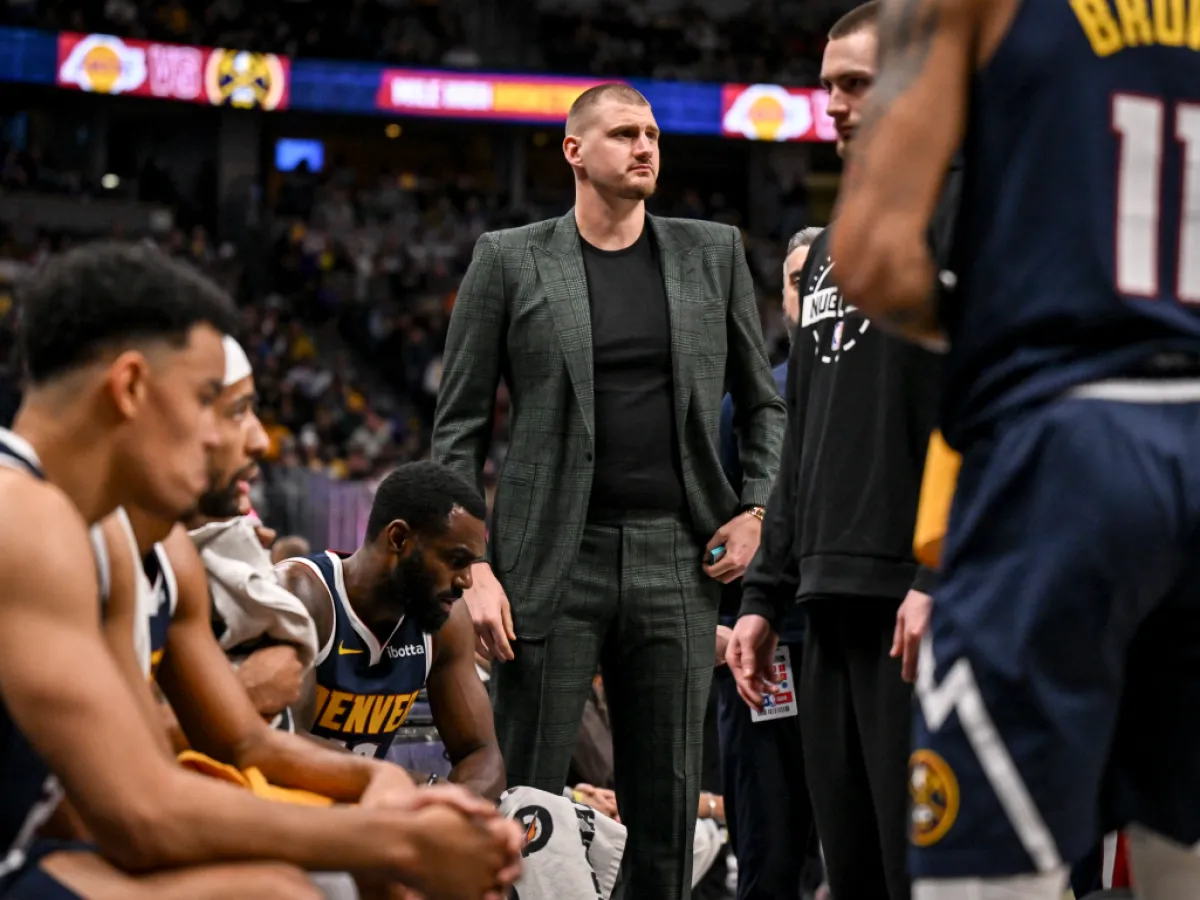
That is a different form of usefulness from taking over. Recognizing an action can save somebody else a moment of uncertainty, but the person receiving the information still has to respond. The contribution is valuable precisely because it does not erase the teammate’s role. Advice supplies a possible advantage; it does not move another player’s feet or make the shot for him.
The example also separates leadership from avail. An injury can prevent physical participation without eliminating everything a player knows. That does not diminish recovery or make constant visible engagement an obligation for every injured athlete. It simply identifies one documented way Jokić remained connected. Pickett’s description concerns basketball information, not a demand that the team perform concern for a camera.
extend
The upcoming opponent has already been part of a more visibly animated version of that leadership. During Game 1 of Denver’s 2025 playoff series against Oklahoma City, cameras caught Jokić addressing the group during a timeout. Sports Illustrated’s contemporary account describes Denver trailing by seven with roughly five minutes left in the first half. SIThe scene puts an important limit on describing him as exclusively quiet: different situations can produce different expressions of involvement.
Denver ultimately won the opener, but the series ended with Oklahoma City’s 125 to 93 victory in Game 7. That outcome is a reminder that leadership is not a guarantee of winning. An encouraging huddle and a good tactical observation still meet the ability, preparation and decisions of another team. The opponent is not scenery in a story about one player’s character.
Shai Gilgeous-Alexander enters the new campaign after winning his second consecutive MVP award in 2026. The matchup therefore offers an obvious meeting of individual distinction. Yet presenting it only as a contest between two decorated names would miss the feature of Jokić’s interview that makes it worth revisiting: his answer keeps returning to what happens around him.
For this preview, the meaningful questions are practical rather than predictive. Can a group recover quickly after a mistake? Does information reach the player who needs it? What happens when the first action is stopped? Those questions do not require declaring an October game a referendum on an entire season. They identify the work through which a broad statement about wanting to win becomes something visible.
fin
There is a temptation to separate enjoyment from serious ambition, as though caring deeply about an outcome must make the activity itself less pleasurable. His brief answer refuses that division. Jokić names winning and basketball together. One concerns the result; the other includes the experience of playing, watching and remaining interested while somebody else has the next opportunity.
That distinction gives the season milestone more substance than a count. Experience matters when it becomes usable knowledge rather than a credential that ends discussion. A veteran can recognize something sooner, explain it more clearly or keep a disappointing possession from becoming the only thing a younger player remembers. None of those actions needs to resemble the performance of a captain delivering a formal address.
The useful viewing perspective is therefore wider than Jokić’s individual line. His decisions with the ball belong in it, as do the decisions made after he gives it up. The bench belongs in it too, without every reaction becoming a psychological diagnosis. A team is carrying out shared work in changing combinations. His brief answer draws attention to staying part of that work rather than making attention itself the achievement.
The NBA’s official promotional post places Denver’s visit to Oklahoma City on Thursday, October 22, 2026, at 9:30 p.m. Eastern on ESPN. For Denver viewers, that is 7:30 p.m. Mountain. The twelfth season starts with another game to win, and with the same responsibility continuing when somebody else checks in.
Related Articles
Bob Pettit, Who Set the NBA’s First Benchmark, Passed Away
Fifty points on an April night in St. Louis gave the Hawks their only title. […]