DRIFT AUDIO
Listen to this story
Choose a voice, then press play.
On May 1, 2026, a single report from The Wall Street Journal altered the way an entire sector could be read: GameStop is preparing a formal bid to acquire eBay. Not a partnership, not a strategic alignment, but a full acquisition—an attempt by a company long associated with mall-era retail to absorb one of the foundational infrastructures of global e-commerce. The proposition feels disproportionate at first glance, almost deliberately so. GameStop, valued in the range of $11–12 billion, moving toward a target exceeding $40 billion, is not an equation designed to balance cleanly. Yet within that imbalance sits the logic of the move itself: this is not about incremental growth but about redefinition, about whether scale can be acquired rather than built, and whether a narrative once dismissed as volatility can be translated into structure.
stir
The reported acquisition attempt is not an isolated escalation but the continuation of a trajectory shaped over several years under the leadership of Ryan Cohen. His earlier statements in 2026, referencing a search for “transformational” opportunities, positioned GameStop not as a company seeking stabilization but as one actively pursuing expansion beyond its original category.
That framing becomes more coherent when traced back to his foundational work with Chewy, where the focus was never simply retail but the creation of a system capable of sustaining customer behavior at scale. When Cohen entered GameStop in 2020, his critique centered on misalignment rather than decline; the company’s issue was not demand erosion but its failure to follow the migration of transactions into digital ecosystems.
What followed was not a dramatic reinvention but a series of disciplined structural shifts—cost reductions, operational tightening, and most critically, the accumulation of capital. By early 2026, GameStop had built a liquidity position of approximately $9 billion, a figure that transformed its strategic posture from defensive to opportunistic and made a move of this magnitude conceivable rather than theoretical.
Need some green? Trade your Xbox or PS5 for $420.69 cash from 4/20 to 4/22. pic.twitter.com/LbOVzyvZtC
— GameStop (@gamestop) April 21, 2026
why
Within that context, eBay emerges not as a surprising target but as a precise one. It represents a fully realized marketplace system with decades of behavioral data embedded in its operation. Its scale is not limited to valuation; it includes over 130 million active buyers, a quarterly gross merchandise volume exceeding $20 billion, and a deep integration into categories that align directly with GameStop’s existing footprint—collectibles, electronics, resale, and enthusiast-driven goods. The relevance lies in this overlap. GameStop has historically operated within these categories through a physical lens, while eBay has refined their digital expression. The acquisition thesis is built on the convergence of these two modes, suggesting that the combination could produce a continuous system rather than parallel ones.
frame
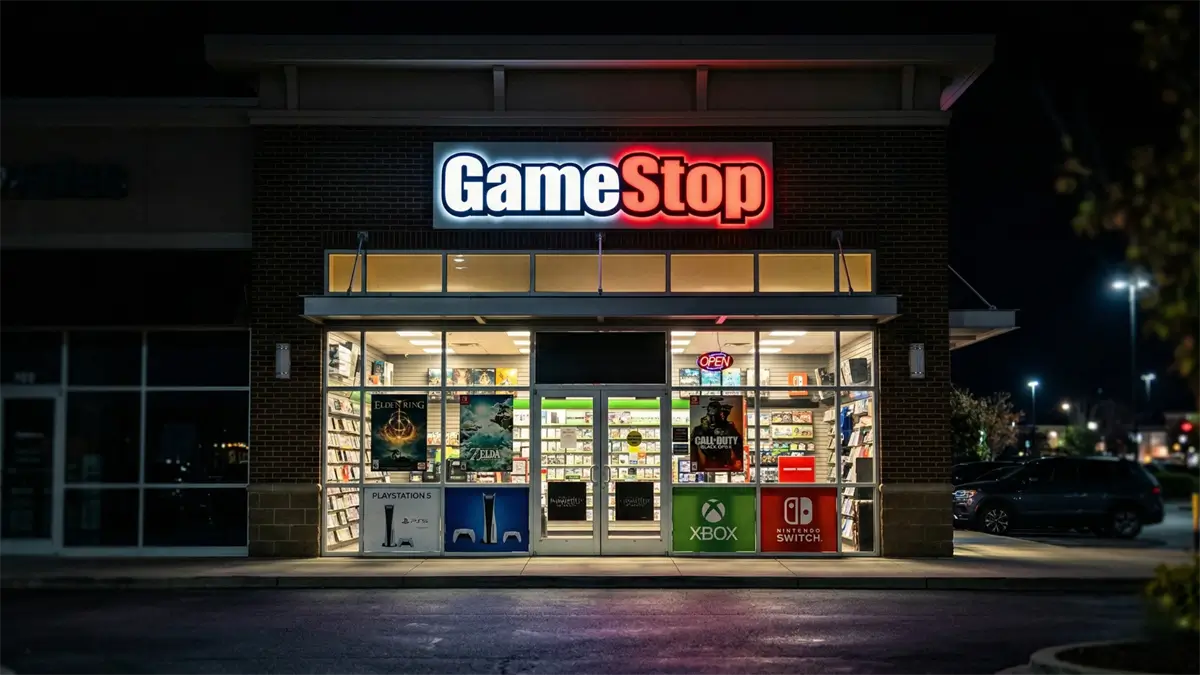
The most compelling aspect of the proposed integration is not financial but structural, particularly in how it redefines the role of physical retail. GameStop’s stores, often viewed as legacy liabilities, can be repositioned as intake points within a broader marketplace ecosystem. In this model, physical locations function as nodes where goods enter the system—games, hardware, collectibles, and adjacent cultural products are received, authenticated, and immediately translated into digital listings accessible through a platform resembling eBay’s existing infrastructure.
This creates a feedback loop in which physical presence generates supply, supply feeds the marketplace, and marketplace activity drives further engagement. eBay, in turn, contributes the other half of this equation: an established base of buyers, a trusted transaction framework, and the technological systems required to sustain global liquidity. The result is not simply the addition of one company to another but the formation of a hybrid structure that integrates physical and digital commerce into a unified flow.
idea
The feasibility of such a deal rests on complex financial engineering. A transaction of this scale would likely involve a combination of GameStop’s existing cash reserves, equity issuance, and leveraged financing supported by eBay’s steady cash flows. While the mechanics are demanding, they are not unprecedented; the challenge lies less in structuring the deal than in sustaining confidence through its execution. Initial market reactions illustrate this tension. eBay’s share price rose sharply following the report, reflecting expectations of a premium offer, while GameStop experienced more moderate gains, signaling both interest and caution.
Beyond traditional markets, the response within online communities—particularly those historically aligned with GameStop—has been immediate and expansive, producing speculative models that range from grounded strategic interpretations to highly imaginative projections of future ecosystems. This dual reception underscores the unique position GameStop occupies as both a financial entity and a cultural signal.
challenge
Despite the conceptual clarity of the integration thesis, the risks remain substantial and multidimensional. Merging two organizations with distinct operational cultures and technological frameworks presents inherent complexity, particularly when one represents stability and the other ongoing transformation. Regulatory scrutiny is likely, given the scale of the combined entity within the e-commerce landscape. Valuation pressure could emerge if acquisition costs exceed the pace at which synergies are realized. Additionally, the competitive environment remains active and unforgiving. Amazon continues to expand its ecosystem across logistics and digital services, while Etsy reinforces its specialization within niche segments. These pressures exist alongside broader Macroeconomic uncertainties, including fluctuating consumer spending in discretionary categories such as collectibles and electronics, which are central to both GameStop’s and eBay’s business models.
clue
GameStop’s progression from near insolvency in 2020 to a position capable of pursuing a multi-billion-dollar acquisition reflects a trajectory that challenges conventional models of corporate recovery. The potential acquisition of eBay extends that trajectory into a new phase, one defined not by survival but by structural ambition.
eBay, as a stable and established platform, provides a counterbalance that could anchor this ambition within an operationally proven system. The combined entity, if realized, would represent a hybrid model in which physical retail functions as a gateway to digital marketplaces, and digital marketplaces amplify the reach and efficiency of physical networks.
For now, the situation remains unresolved but highly active. Markets continue to adjust, analysts refine their interpretations, and industry participants observe closely. The next steps will determine either this proposal becomes a defining case study in strategic transformation or a cautionary example of overextension. Either outcome will leave a lasting imprint on how scale, ambition, and integration are understood within the evolving landscape of global retail.