DRIFT AUDIO
Listen to this story
Choose a voice, then press play.
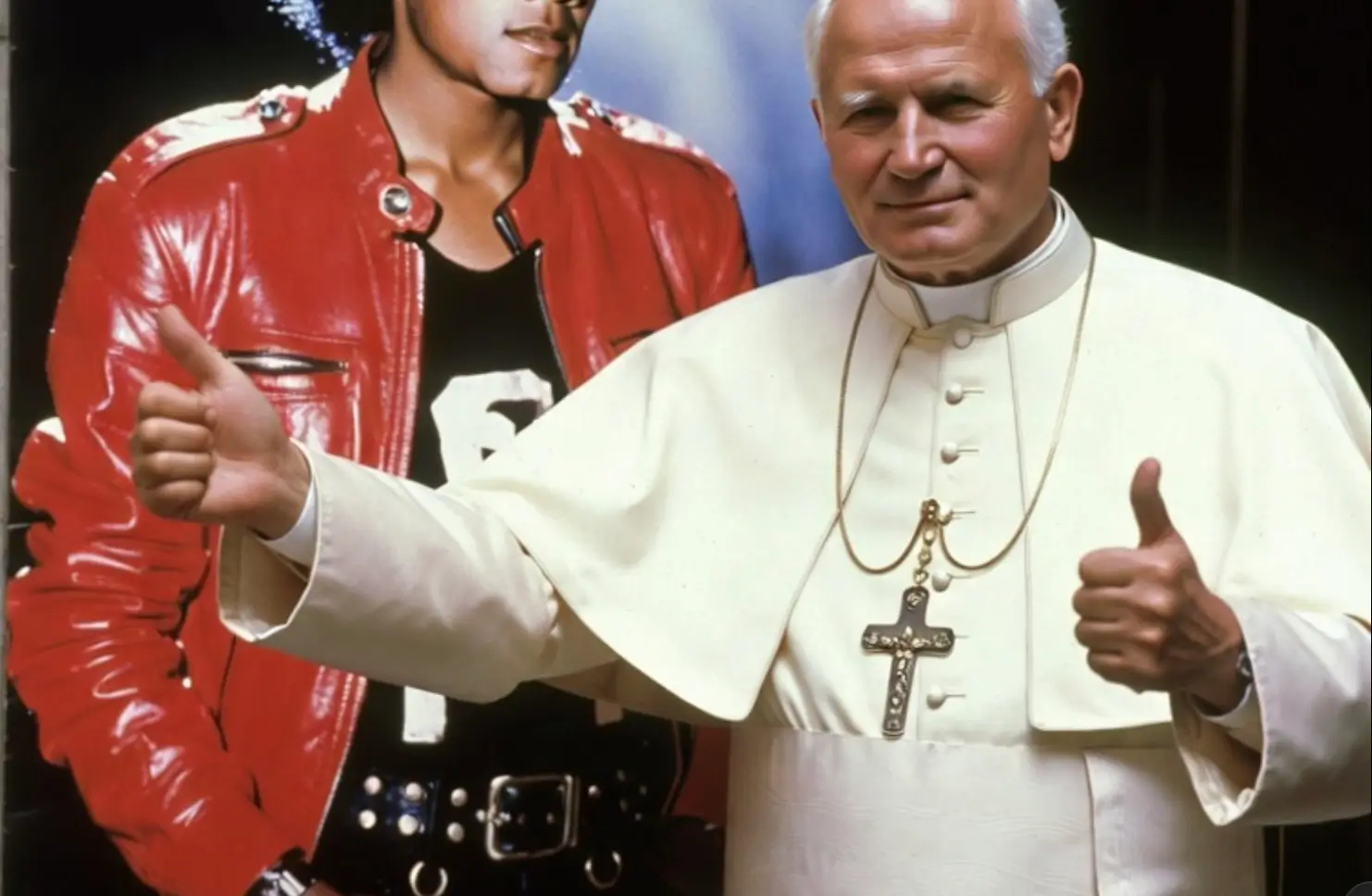
In the fall of 1987, as Michael Jackson’s Bad album dominated charts worldwide with hits like “Bad,” “Smooth Criminal,” and “The Way You Make Me Feel,” a photograph surfaced that seemed too perfect to be real: a man who looked exactly like Pope John Paul II, dressed in full papal regalia, playfully posing beside a towering promotional poster of the King of Pop. The image has resurfaced periodically, most recently going viral on platforms like Instagram, X, and Facebook in 2025, with thousands sharing it under captions like “Even the Pope couldn’t resist the Bad era.”
But here’s the twist that makes it even better: it isn’t the actual Karol Wojtyła, the Polish pontiff who led the Catholic Church from 1978 to 2005. The man in the photo is Gene Greytak, a professional Pope impersonator, devout Catholic, and character actor who made a career out of looking remarkably like John Paul II. Greytak appeared in films such as The Naked Gun (1988) and Hot Shots! (1991), often playing the Pope in comedic bits. He passed away in 2010, but his 1987 photo with the Michael Jackson poster lives on as a perfect emblem of pop culture absurdity.
Pope John Paul II posing next to a promotional poster for Michael Jackson’s “Bad” album in 1987 pic.twitter.com/SV6u5WAyKq
— 𝖓ϊყ𝖆ℏ ☆ (@saranghoe06) May 22, 2025
stir
1987 was peak 1980s excess and global pop phenomenon. Michael Jackson, fresh off Thriller (1982), released Bad on August 31, 1987. The album sold over 35 million copies, and Jackson’s world tour began that September, featuring his signature moonwalk, anti-gravity lean, and elaborate stage shows. Meanwhile, Pope John Paul II was in the midst of his energetic global ministry, traveling to countries, advocating against communism (especially in his native Poland), and engaging with youth culture in ways previous popes hadn’t.
The real John Paul II was no stranger to popular culture. He met with artists, musicians, and celebrities, and the Vatican under his leadership opened dialogues with the modern world. But a casual pose with an MJ poster? That was pure Greytak flair.
Imagine the photo shoot: Greytak, with his striking resemblance—tall stature, kind eyes, slight smile, and that unmistakable white cassock—standing beside a massive Bad poster. Michael Jackson stares out intensely in his red jacket, single glove, and fedora. Greytak might be striking a skittish pose: one hand on his hip, the other giving a papal blessing or thumbs-up, as if saying, “This guy’s music? Bad… in the best way.”
flow
Gene Greytak wasn’t just any impersonator. Born in 1929, he discovered his resemblance to the newly elected Pope in 1978 and leaned into it. He became a fixture at events, fundraisers, and film sets. As a devout Catholic, he approached the role with respect, never mocking the faith but bringing joy and humor. His credits include:
- Conjuring the Pope in multiple comedies.
- Appearances that blurred lines between celebrity and clergy.
- A later connection to Jackson himself: both appeared (in wildly different capacities) in the 2004 comedy Miss Cast Away and the Island Girls, where Jackson has a cameo and Greytak reprises his papal role. The Vatican supposedly “hires” MJ in the plot—another layer of meta absurdity.
Greytak’s 1987 photo was likely a promotional stunt or lighthearted moment during the height of Bad mania. Promotional posters for the album were everywhere—record stores, billboards, magazines. Someone (perhaps a photographer or event organizer) had the brilliant idea to juxtapose the spiritual leader lookalike with the pop superstar.
secular
This image captures the 1980s tension and harmony between faith and fame. John Paul II’s papacy was defined by:
- Charismatic media presence (he was called “the people’s Pope”).
- Engagement with young people through World Youth Days.
- Opposition to materialism while appreciating art and music.
Michael Jackson represented the pinnacle of global entertainment, breaking racial barriers on MTV, innovating music videos as short films, and amassing a fanbase that rivaled religious devotion in intensity. The photo—real or impersonated—symbolizes how pop culture could humanize even the highest religious figures, or at least their doppelgangers.
In a decade of Reagan, Gorbachev, Live Aid, and the rise of cable TV, boundaries blurred. Celebrities became icons; icons became celebrities. The Pope (or his stand-in) jamming with MJ’s image feels like a visual punchline to the era’s “anything goes” spirit.
fin
This image invites us to consider how visual culture merges high and low. Papal vestments evoke 2,000 years of tradition; Jackson’s Bad aesthetic distilled 1980s futurism, street style, and showmanship. Together, they remind us that joy and reverence aren’t opposites. Faith can dance. Pop can inspire.
If the real John Paul II had posed with it? Unlikely, but one can dream of a world where popes and pop stars share stages more often, bridging divides with beat and blessing alike.
The photo endures because it humanizes. It shows a man (Greytak) having fun in borrowed robes beside a superstar’s image. In 1987, as the Cold War thawed and MTV reshaped youth, it was a small sign that even the Vatican could groove to the beat—if only vicariously.
n
From the DRIFT archive: Nike & Chipotle: How a Young Cancer Patient’s Burrito Ritual Became a Once-in-a-Lifetime Sneaker · Wizdom 2025 at Cipriani Wall Street: An Experiential Moment in Cloud Culture
Related Articles

Master Chief Reports to Call of Duty Now: Inside Xbox’s Second Reset Wave
Twenty-five years after Halo launched the original Xbox, the next mainline game belongs to Activision. […]