DRIFT

idea

There is a rare moment in fashion when documentation folds back into the object it once merely observed. The collaboration between photographer Gavin Watson and Baracuta exists precisely in that space—a convergence where image, memory, and garment collapse into a single cultural artifact.

For over four decades, Watson has chronicled the evolving landscapes of British youth culture with an intimacy that resists spectacle. His lens has always been embedded, never external. From the skinhead communities of the early 1980s to the hazy euphoria of 1990s rave scenes, his archive does not simply depict subculture—it constitutes it.

At the center of this visual continuum sits an unlikely constant: the Baracuta G9 Harrington jacket. A garment that has transcended class, era, and ideology, the G9 becomes the connective tissue across Watson’s photographic universe. Now, through this collaboration, the jacket transforms from background detail into primary medium.

sil

The Baracuta G9 is not merely a jacket—it is a cultural instrument. Designed in 1937 in Manchester, it was initially conceived as a functional golf jacket. Yet its trajectory quickly diverged from sport into the realm of identity.

Its defining elements are deceptively simple: a waist-length cut, ribbed cuffs, a stand collar fastened by two buttons, and the unmistakable Fraser tartan lining. But it is the jacket’s adaptability that has allowed it to move seamlessly across generations.

In Britain, the G9 became synonymous with subculture. Mods adopted it for its clean lines. Skinheads wore it with a sense of uniformed precision. Later, it appeared in punk scenes, Britpop, and terrace culture. The jacket never belonged exclusively to any one group; instead, it absorbed meaning through use.

Watson’s photographs consistently return to this silhouette—not as a styled object, but as lived clothing. Creased, worn, inhabited. The G9 in his work is not pristine; it is real, carrying the residue of nights out, friendships, tensions, and fleeting moments of youth.


View this post on Instagram


A post shared by Baracuta (@baracuta)

archive

Gavin Watson’s significance lies not only in what he captured, but in how he captured it. His early work, later compiled into the seminal book Skins, documented the everyday lives of a multi-racial skinhead community in High Wycombe. The images were intimate, unguarded, and often tender—countering media narratives that flattened the subculture into caricature.

This body of work would later inspire This Is England, a film that similarly sought to reclaim nuance within a misunderstood cultural movement.

Watson’s practice evolved alongside the scenes he documented. As the 1980s gave way to the 1990s, his lens shifted toward rave culture—illegal parties, warehouse gatherings, and transient spaces defined by sound systems and collective escape. These images carry a different energy: blurred motion, saturated light, and an atmosphere of dissolution.

Yet across both eras, there is continuity. The same faces reappear, older but recognizably connected. The same garments surface, recontextualized. The G9 Harrington becomes one such thread—appearing again and again, anchoring the visual narrative.

stir

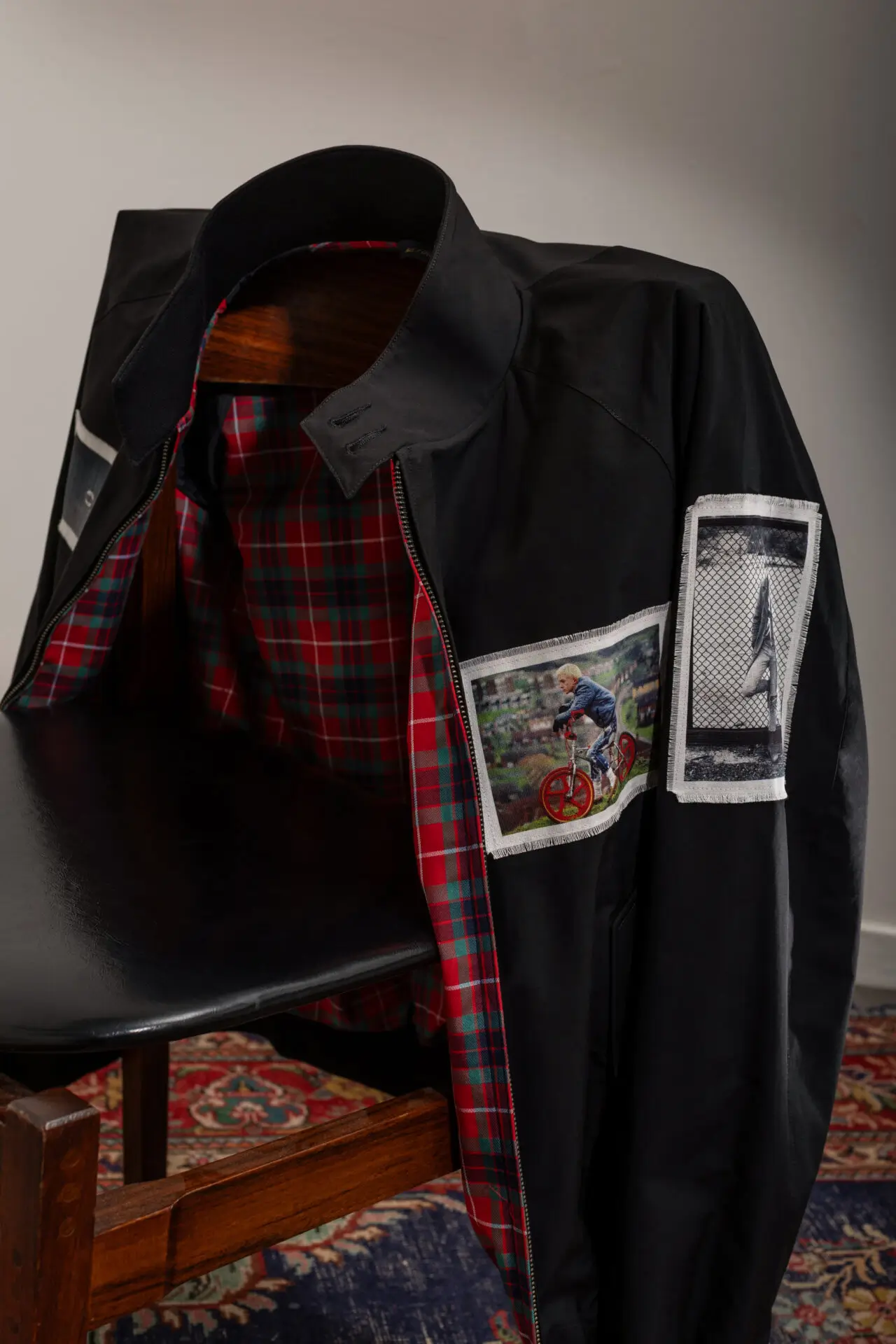
What distinguishes this collaboration is its refusal to treat imagery as surface decoration. Instead, Watson’s photographs are integrated into the garments in ways that alter their very structure.

Archival images appear as internal linings—hidden, intimate, visible only to the wearer. Others are translated into patches, stitched onto the exterior like fragments of memory made permanent. Graphic tees extend the visual language outward, allowing the imagery to exist beyond the confines of the jacket.

Pins and smaller accessories function as modular elements, echoing the DIY ethos that defined many of the subcultures Watson documented. They invite customization, rearrangement, and personal interpretation.

The result is not a simple collaboration, but a reconfiguration of the relationship between clothing and archive. The garments do not merely reference history; they contain it.


View this post on Instagram


A post shared by URBANSTAR®️ (@urbanstaroma)

flow

There is a tendency within fashion to treat subculture as a finite resource—something to be mined, aestheticized, and eventually exhausted. This connection resists that impulse by emphasizing continuity over nostalgia.

Watson’s archive is not presented as a closed chapter, but as an ongoing conversation. The images retain their immediacy because they were never staged to begin with. They are fragments of lived experience, reactivated through the act of wearing.

Baracuta’s role in this dynamic is equally significant. As a heritage brand, it could easily lean into preservation. Instead, it allows its most iconic silhouette to be disrupted—subtly, but meaningfully. The G9 remains recognizable, yet it is transformed by the presence of Watson’s imagery.

This balance between stability and change mirrors the nature of subculture itself. Styles evolve, scenes dissolve, but certain symbols persist. The Harrington jacket is one such symbol—not because it resists change, but because it accommodates it.

mat

One of the most compelling aspects of the capsule lies in its spatial logic. The placement of imagery—whether internal or external—creates a dialogue between private and public identity.

Internal linings suggest intimacy. They are seen by the wearer, perhaps by those allowed into close proximity. These images function almost like personal memories, carried but not broadcast.

External patches and prints, by contrast, operate in the realm of visibility. They signal affiliation, taste, and awareness. Yet even here, the imagery resists overt branding. It is not logo-driven; it is narrative-driven.

This duality reflects the way subculture operates in real life. There are always layers—what is shown, what is hidden, what is understood only by those within the scene.

style

Watson’s work has always carried an implicit political dimension, not through overt messaging, but through representation itself. By documenting communities from within, he challenged dominant narratives that often misrepresented or ignored them.

In translating this archive into clothing, the collaboration extends that politics into a new medium. The garments become vehicles for alternative histories—stories that exist outside mainstream fashion discourse.

Importantly, this is not appropriation. Watson is not an external observer lending credibility to a brand. He is an active participant whose work shaped the very scenes being referenced. The collaboration maintains that authenticity, allowing the imagery to retain its original context even as it enters a commercial framework.

the harrington

Across decades of British style, few garments have maintained the relevance of the Harrington jacket. Its adaptability lies in its neutrality—it can be adopted, modified, and reinterpreted without losing its core identity.

In Watson’s archive, the jacket appears across different moments, worn by different individuals, each time acquiring new meaning. This multiplicity is what makes it such a powerful canvas for collaboration.

By embedding Watson’s images into the G9, Baracuta effectively completes a loop. The jacket that once appeared within the photographs now contains them. The observer becomes the medium.

fwd

The broader implication of this collaboration lies in its approach to time. Rather than presenting the past as something to be revisited, it positions it as something to be worn forward.

This shift has resonance within contemporary fashion, where archival references are increasingly central. Yet too often, these references are stripped of context. What Watson and Baracuta achieve is the opposite: a deepening of context through material integration.

The garments become portable archives—not static, but dynamic. Each wearer adds a new layer of meaning, extending the life of the images beyond their original moment.

fin

The Gavin Watson x Baracuta collaboration is not defined by novelty, but by depth. It does not attempt to reinvent the Harrington jacket; instead, it reveals what was always embedded within it.

Through Watson’s imagery, the G9 becomes more than a garment. It becomes a repository of experience—a surface onto which decades of British youth culture have been inscribed.

In an era where fashion often moves at the speed of trend cycles, this collaboration offers a different proposition: that clothing can carry memory, that design can honor lived experience, and that the most enduring styles are those that remain open to reinterpretation.

The Harrington jacket has always been a witness. Now, it speaks.

Related Articles

Modern data center facility with a solar-panel-clad exterior, bright green administrative offices, and secure perimeter fencing, showcasing sustainable digital infrastructure and renewable energy integration

Lombardy’s Data Center Boom: Balancing Digital Ambition with Environmental Responsible

Lombardy has emerged as Italy’s primary hub for new digital infrastructures, particularly data centers—vast complexes […]

In a highly anticipated reunion after 24 years, Adidas Originals and Coca-Cola have joined forces once again to celebrate the FIFA World Cup 2026™. The collaboration revives their iconic 2002 partnership from the Japan-South Korea tournament, now reimagined for the biggest global sporting event of 2026, co-hosted by the United States, Canada, and Mexico. Set to launch on June 6, 2026, this collection masterfully blends Adidas' streetwear heritage with Coca-Cola's timeless branding, creating a vibrant fusion of football culture, nostalgia, and modern style. The drop arrives at a perfect moment. With the World Cup kicking off on June 11, 2026, fans worldwide are gearing up for a summer of football excitement. This collaboration isn't just merch—it's a cultural statement that merges two legendary brands under the banner of "Originals are the Real Thing," a clever twist on Coca-Cola's famous slogan. Historical Context: A Reunion 24 Years in the Making Adidas and Coca-Cola first collaborated during the 2002 FIFA World Cup, producing limited-edition pieces that captured the era's energy. That partnership helped define early 2000s football-streetwear crossover culture. Fast-forward to 2026, and the brands are back with fresh energy, leveraging Adidas' deep FIFA ties (as an official partner) and Coca-Cola's long-standing sponsorship of the tournament. The 2026 edition promises to be historic as the first 48-team World Cup, spanning three countries and generating unprecedented global hype. This collab taps into that momentum, offering fans wearable pieces that celebrate both brands' legacies while looking forward to the future of football fashion. Collection Overview and Design Philosophy The Adidas Originals x Coca-Cola collection fuses 2000s street style with classic sporting aesthetics. Expect bold reds, creams, whites, and silver accents inspired by Coca-Cola's iconic packaging—think classic script logos, droplet detailing, and can-inspired motifs. The lineup spans footwear, apparel, and accessories, divided into two visual directions: one logo-heavy and graphic-forward, the other drawing from vintage advertising aesthetics. Designs pay homage to Coca-Cola's visual language while staying true to Adidas Originals' archival roots. High-quality materials, attention to detail, and versatile silhouettes make these pieces suitable for both match-day wear and everyday street style. The campaign, featuring young football star Lamine Yamal and a diverse cast in everyday scenes building anticipation for the tournament, reinforces themes of originality and shared cultural moments. Footwear Highlights Footwear takes center stage in this collaboration, with reimagined takes on iconic 2000s Adidas silhouettes: Samba and Superstar Models: These classics get Coca-Cola treatment with white/cream/red colorways and prominent script branding. The Samba blends street heritage with football roots, while the Superstar II features weathered bases and bold side panels. Expected pricing around $110–$130. Adistar Control 5: A standout with droplet detailing mimicking condensation on a cold Coke can. This model brings performance-inspired design into lifestyle territory. Predator Sala: Indoor/hybrid style with silver-and-red accents, nodding to predatory precision on the pitch and Coca-Cola's bold energy. Climacool 1: Revived with breathable tech and Coke-inspired graphics, perfect for warm summer days. Megaride F50: A highlight paying tribute to the iconic Coca-Cola glass bottle, with unique contours and refreshing design cues. Each pair incorporates thoughtful details like embroidered logos, custom insoles, and packaging that mimics vintage Coke crates or cans. These shoes are built for durability and comfort, appealing to sneakerheads, football fans, and casual wearers alike. Apparel and Accessories Beyond kicks, the collection offers a full lifestyle range: Track Tops and Jerseys: Standout jerseys fuse retro Coca-Cola advertising from different eras into cohesive football designs. Track jackets feature signature three stripes alongside Coke branding, in vibrant reds and classic whites. Shorts and T-Shirts: Relaxed fits with graphic prints, ideal for casual wear or layering. Expect motivational football motifs blended with refreshing beverage references. Accessories: A bright red airliner bag stands out as a functional statement piece. Additional items may include caps, socks, and tote bags carrying the collaborative spirit. The apparel emphasizes comfort with premium cotton blends, mesh panels for breathability, and oversized silhouettes popular in contemporary streetwear. Unisex sizing and inclusive fits make the collection accessible to a broad audience. Cultural Impact and Fan Appeal This collaboration resonates on multiple levels. For football fans, it represents national pride and global unity ahead of the 2026 tournament. Sneaker enthusiasts will appreciate the nostalgic 2000s revival mixed with modern execution. Streetwear collectors see it as a prime example of how heritage brands can innovate through partnerships. In an era where sports and fashion increasingly intersect, Adidas and Coca-Cola deliver pieces that transcend the pitch. Wear them to watch matches at home, attend watch parties, or hit the streets in any host city—New York, Los Angeles, Toronto, or beyond. The designs are versatile enough for gym sessions, festivals, or daily commutes. The timing aligns perfectly with rising interest in football in North America, boosted by the co-hosting nations. Young talents like Lamine Yamal in the campaign help bridge generational gaps, attracting newer fans while satisfying longtime supporters. Where to Buy and Release Details The collection launches globally on June 6, 2026, via: Adidas CONFIRMED app (for early access and raffles) Adidas.com Select retailers and flagship stores worldwide Some regions may see staggered drops, with Japan and other markets getting early access. Prices are expected to range from $50–$150 depending on the item, making it relatively accessible compared to ultra-limited drops. Pro Tips for Copping: Enable notifications on the CONFIRMED app. Check local stock at Adidas stores in major cities. Monitor resale platforms post-drop for exclusive colorways, but be wary of markups. Size up slightly for oversized apparel fits. Given the World Cup hype, popular items like the Sambas and jerseys are likely to sell out quickly. International shipping is available, but factor in potential customs delays. Styling Suggestions Match Day Look: Pair a collaborative jersey with classic black shorts and Samba sneakers for effortless fan style. Streetwear Rotation: Layer a track top over a graphic tee with wide-leg pants and the Megaride F50 for a bold urban ensemble. Casual Summer: White Superstar with denim shorts and the airliner bag for a refreshing, vacation-ready vibe. These pieces mix seamlessly with existing Adidas or neutral wardrobes, maximizing versatility. Broader Context in 2026 Fashion and Sports The Adidas x Coca-Cola drop is part of a larger wave of high-profile collaborations tied to the World Cup. Adidas continues its dominance in football kit design, while Coca-Cola leverages its sponsorship with collectibles, bottles, and experiential activations like the Trophy Tour. In the sneaker industry, this collab exemplifies the ongoing trend of lifestyle reinterpretations of performance silhouettes. It also highlights how global brands use major events to drive cultural conversations around unity, originality, and joy—core values for both companies. Sustainability notes (based on Adidas' broader initiatives) suggest some pieces may incorporate recycled materials, aligning with modern consumer expectations. Looking Forward: Legacy and Excitement As the countdown to kickoff continues, this collection serves as the perfect prelude to an unforgettable summer of football. Whether you're a die-hard supporter, a fashion-forward collector, or someone seeking motivation through style, the Adidas Originals x Coca-Cola FIFA World Cup 2026 lineup delivers. Expect potential restocks, special event exclusives in host cities, and continued campaign content featuring more athletes. This isn't just clothing—it's a ticket to participate in the global celebration of the beautiful game. Mark your calendars for June 6, 2026. Refresh your wardrobe, lace up those Sambas, and get ready to cheer on your team in style. The "Real Thing" meets the Originals in what promises to be one of the most talked-about releases of the year. This collaboration captures the essence of football's universal appeal: bringing people together through shared passion, iconic brands, and unforgettable moments. As the world prepares for 2026's expanded tournament, Adidas and Coca-Cola remind us that some partnerships are truly timeless.

Adidas Originals x Coca-Cola Collection: FIFA World Cup 2026

In a highly anticipated reunion after 24 years, Adidas Originals and Coca-Cola have joined forces […]

Loewe shoulder bag crafted in brown and black leather with minimalist lion face detailing and a matching fur tail charm

180 Years Unfolded: The Full Story Behind Loewe’s New Campaign

The year was 1846. Queen Victoria was on the British throne and the telephone, the […]