DRIFT AUDIO
Listen to this story
Choose a voice, then press play.
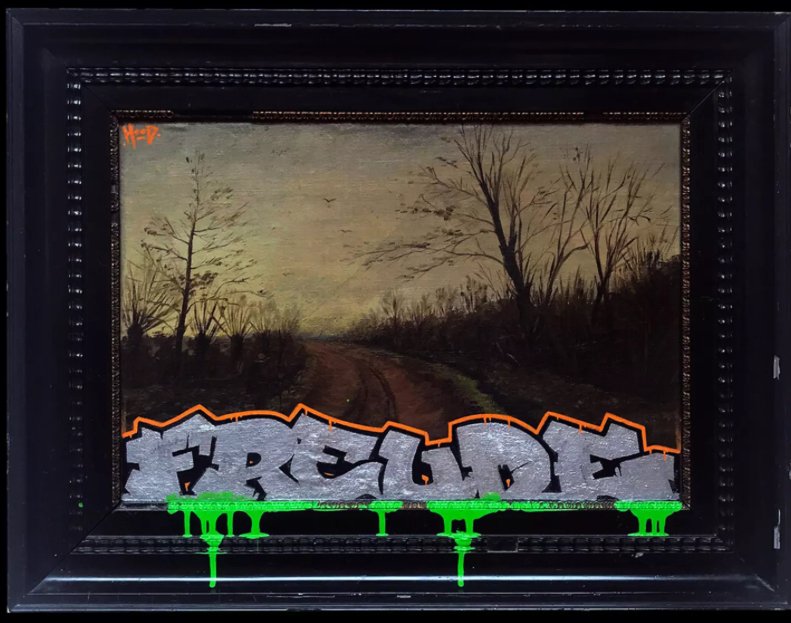
Hoodkitsch, the mysterious street artist known for transforming discarded artworks, has unveiled their latest creation, “Freude, 2025.” Using a reclaimed oil painting as their canvas, Hoodkitsch masterfully blends acrylic paint pen and spray paint to give the piece a new life, intertwining urban expressionism and contemporary themes.
A Visionary Connect of Styles and Mediums
Hoodkitsch’s work is characterized by the seamless integration of street art elements and traditional mediums, creating a truly distinctive and innovative artistic style. In “Freude, 2025,” the artist uses spray paint to juxtapose bold colors and stark lines against the original painting’s softer hues, highlighting the contrast between urban grit and timeless artistry.
Repurposing Art and Reclaiming Spaces
By using reclaimed oil paintings as their base, Hoodkitsch challenges conventional notions of art and redefines the concept of creative expression. Their work is not only visually striking but also thought-provoking, prompting viewers to question the boundaries of what constitutes art and what it means to repurpose and reimagine found objects.
Freude, 2025: An Ode to Urban Expressionism
“Freude, 2025” serves as a testament to Hoodkitsch’s ability to blend various artistic styles into a captivating visual narrative. Through their unique lens, the artist reinvigorates traditional mediums, breathing new life into discarded artworks and transforming them into stunning contemporary pieces.
By combining elements of urban street art with classic oil painting, Hoodkitsch continues to push the boundaries of creative expression. Their work is a celebration of diversity, innovation, and the power of art to transcend genres and eras.
Impression
Hoodkitsch’s “Freude, 2025” stands as a testament to the artist’s unparalleled ability to merge urban expressionism with traditional mediums. Through their distinctive style and dedication to repurposing found objects, Hoodkitsch not only creates visually stunning pieces but also prompts viewers to reconsider the very nature of art and creative expression.
Related Articles
Modigliani’s Limestone ‘Tête’
Carved from a single block of limestone in Montparnasse more than a century ago, one of Modigliani's rare stone heads goes to auction for the first time…