DRIFT AUDIO
Listen to this story
Choose a voice, then press play.
In This Story
- A Painter Between Two Traditions
- Inside When the Sun Shines Again
- Reading the Paintings: Light, Solitude, and Return
- From Seoul to the Royal College of Art
- A Fast-Rising Presence in Global Contemporary Art
- Where to See the Work
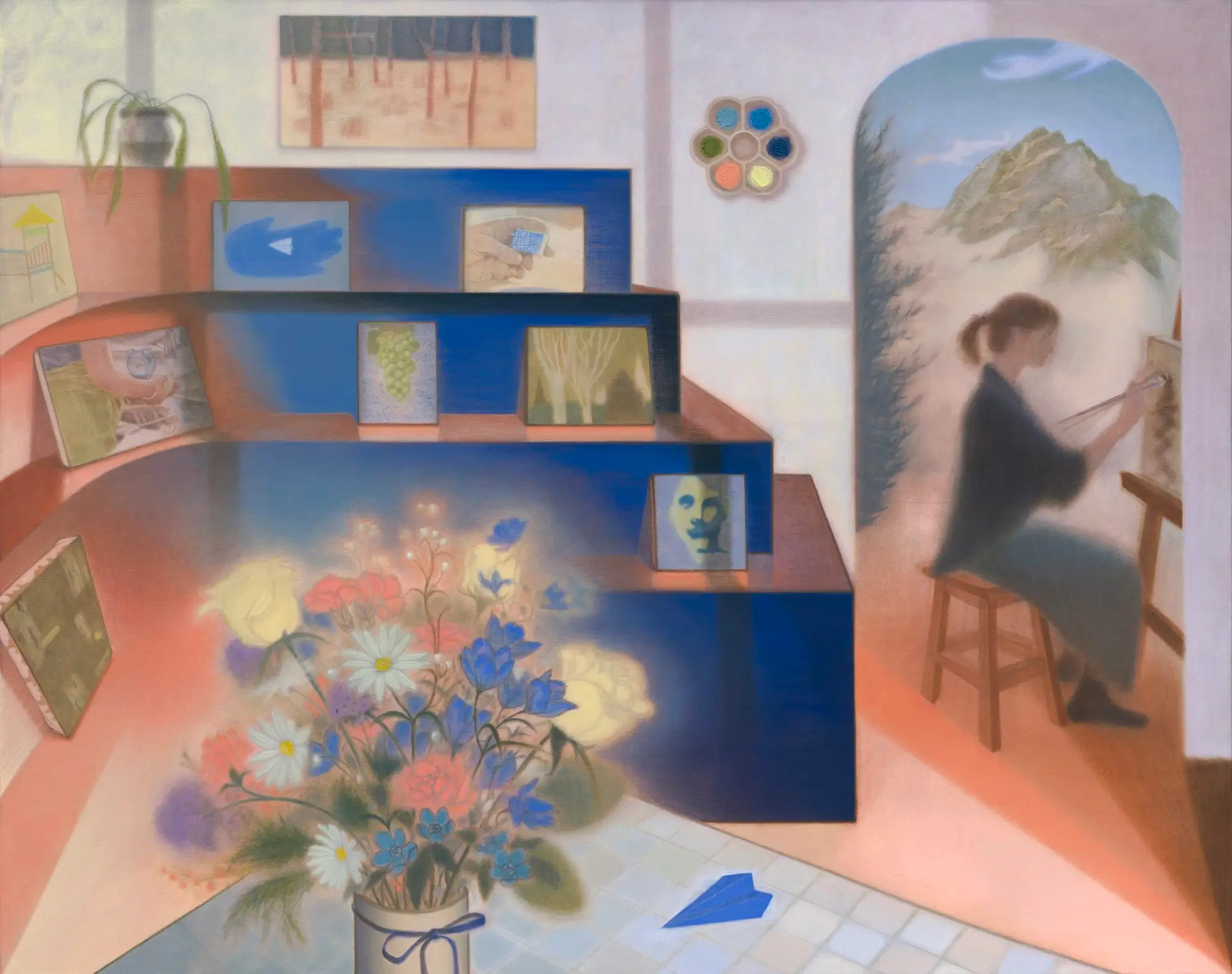
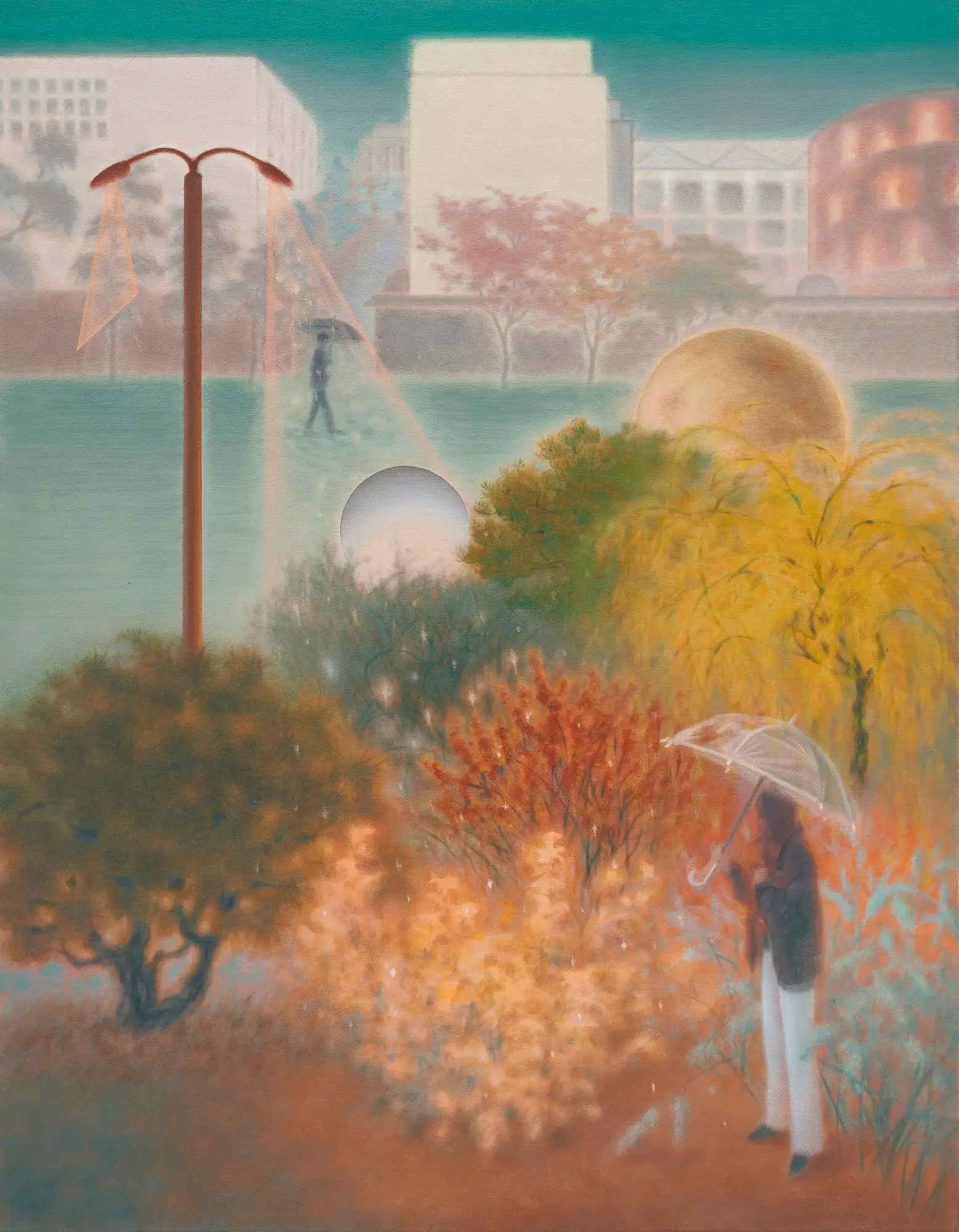
There’s a particular kind of haze that runs through Guimi You‘s paintings, the sort that could belong equally to weather, memory, or a half-remembered dream. The Seoul-based artist builds her oil compositions around that ambiguity, using atmosphere as both a formal device and a subject in its own right. Her canvases return again and again to gardens, interiors, and quiet outdoor scenes populated by anonymous figures who read less as individuals than as traces of presence: a woman bent over a pottery wheel, a solitary walker beneath an umbrella, a painter seated at an easel in an open doorway.
That approach has its roots in a genuinely bicultural training. You holds a BFA and MFA in Korean Traditional Painting, known as san-su hwa, from Seoul National University, completed in 2008 and 2011, before earning an MA in painting from the Royal College of Art in London in 2014. The traditional Korean landscape practice she trained in treats painting less as an act of depiction than of evocation, an approach rooted in ink-wash traditions where form and atmosphere are inseparable and mist can carry as much meaning as line. Her years abroad in the UK and US layered a second vocabulary on top of that foundation, introducing her to the material of oil paint and the compositional lineages of Western modernism, Romanticism, and Surrealism. The result, as Lehmann Maupin has described it, is a practice that “synthesizes East Asian pictorial traditions of evocation and atmospheric transparency with Western lineages,” using landscape not as an escape from the world but as a way of thinking through memory, subjective, and one’s place within it.
View this post on Instagram
Critics and gallerists writing about You’s work have repeatedly drawn a comparison to Caspar David Friedrich’s Rückenfigur, the figure seen from behind that pulls a viewer into a scene without ever fully explaining it. You’s protagonists work in much the same register: turned away, shadowed, or absorbed in a task, they resist becoming fixed characters and instead function as points of entry into the atmosphere surrounding them. It’s a technique that keeps her paintings from settling into either pure narrative or pure abstraction, holding them instead in a deliberately unresolved middle register.
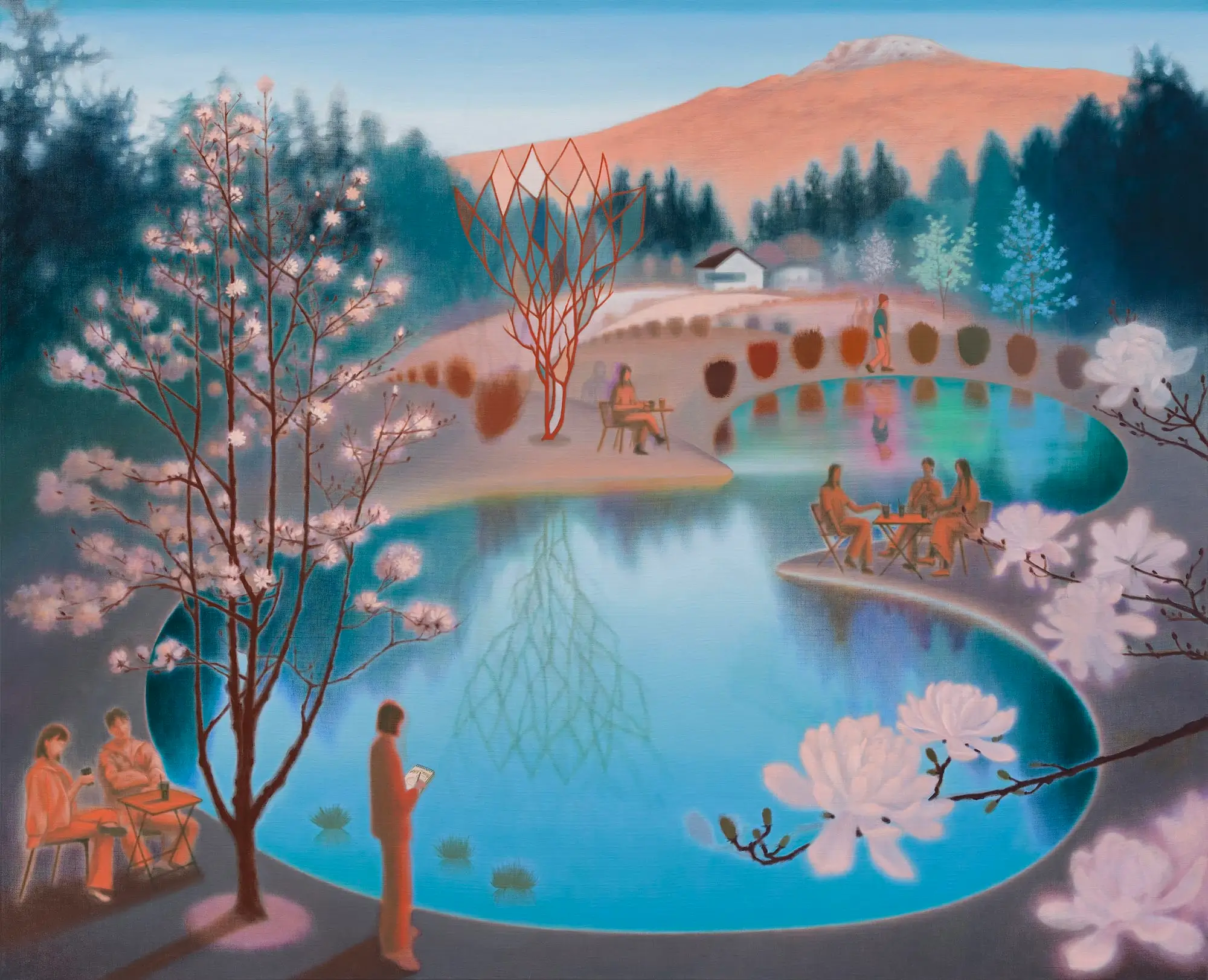
That unresolved quality extends to how You handles setting more broadly. Rather than depicting specific, identifiable locations, her paintings tend to conjure composite spaces built from memory and invention together, so that a garden or interior reads as emotionally precise without being tied to any single real place. This has the effect of universalizing scenes that originate in genuinely personal experience: a painting drawn from a specific walk through a specific neighborhood becomes, in the finished work, a space that a viewer with no knowledge of the original circumstance can still recognize as familiar. That slippage between the deeply personal and the broadly resonant is, by most accounts of her practice, entirely intentional, and it’s part of what has made her paintings legible to audiences across the different cultural contexts in which she’s exhibited.
in
You’s current solo exhibition, When the Sun Shines Again, is on view at Lehmann Maupin in New York through August 14, 2026. Conceived, according to the gallery, as a tribute to those who have returned to creating after time away, the show is built around a recurring motif of sunlight as a symbol of clarity, renewal, and hope. It marks You’s continued relationship with the gallery, which she joined in 2025 after a first major solo exhibition, Breath, Island, drew on a solitary two-week retreat to Korea’s Jeju Island and the volcanic terrain and quiet guesthouses she encountered there.
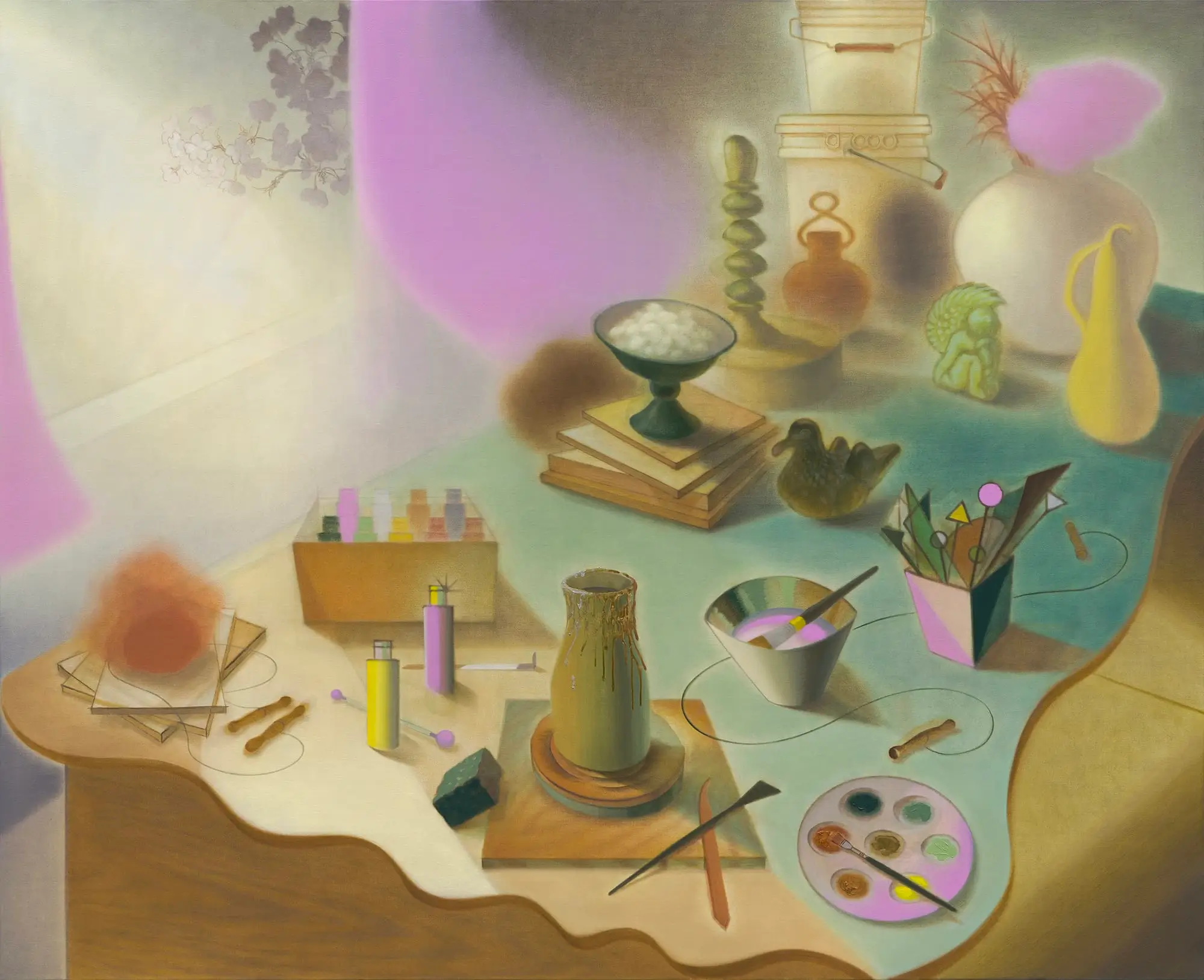
Where Breath, Island used a specific place, a physical retreat to Jeju, as its organizing frame, When the Sun Shines Againworks through a more abstract idea of return: the particular courage it takes to begin creating again after a period of absence, whatever caused it. Several works place figures mid-task, throwing pottery on a wheel or bringing a brush to canvas, framing creative labor itself as the subject rather than the backdrop. Others strip the human figure out almost entirely, letting still-life arrangements of objects and shifting light carry the emotional register instead. Across the show, faces are often obscured, silhouette, or turned away entirely, a consistent choice that keeps the paintings anchored in interiority rather than portraiture.
The gallery frames the exhibition’s tone as “a somberness tinged with hope,” and that description holds up across the works themselves: nothing in the show resolves into pure celebration, but nothing collapses into melancholy either. Instead, the paintings sit in the space between the two, treating the act of starting over as something that can hold grief and possibility simultaneously.
The exhibition’s title itself functions as a kind of promise rather than a description of any single painting’s content: the sun in question doesn’t need to be literally shining in every canvas for the phrase to apply, since the show is less about depicting sunlight than about depicting the specific, difficult stretch of time before it returns. That distinction matters for how the show reads as a whole. Rather than presenting a triumphant return to form, You’s paintings linger in the ambiguous middle of the process, giving as much weight to hesitation and doubt as to eventual clarity.
explain
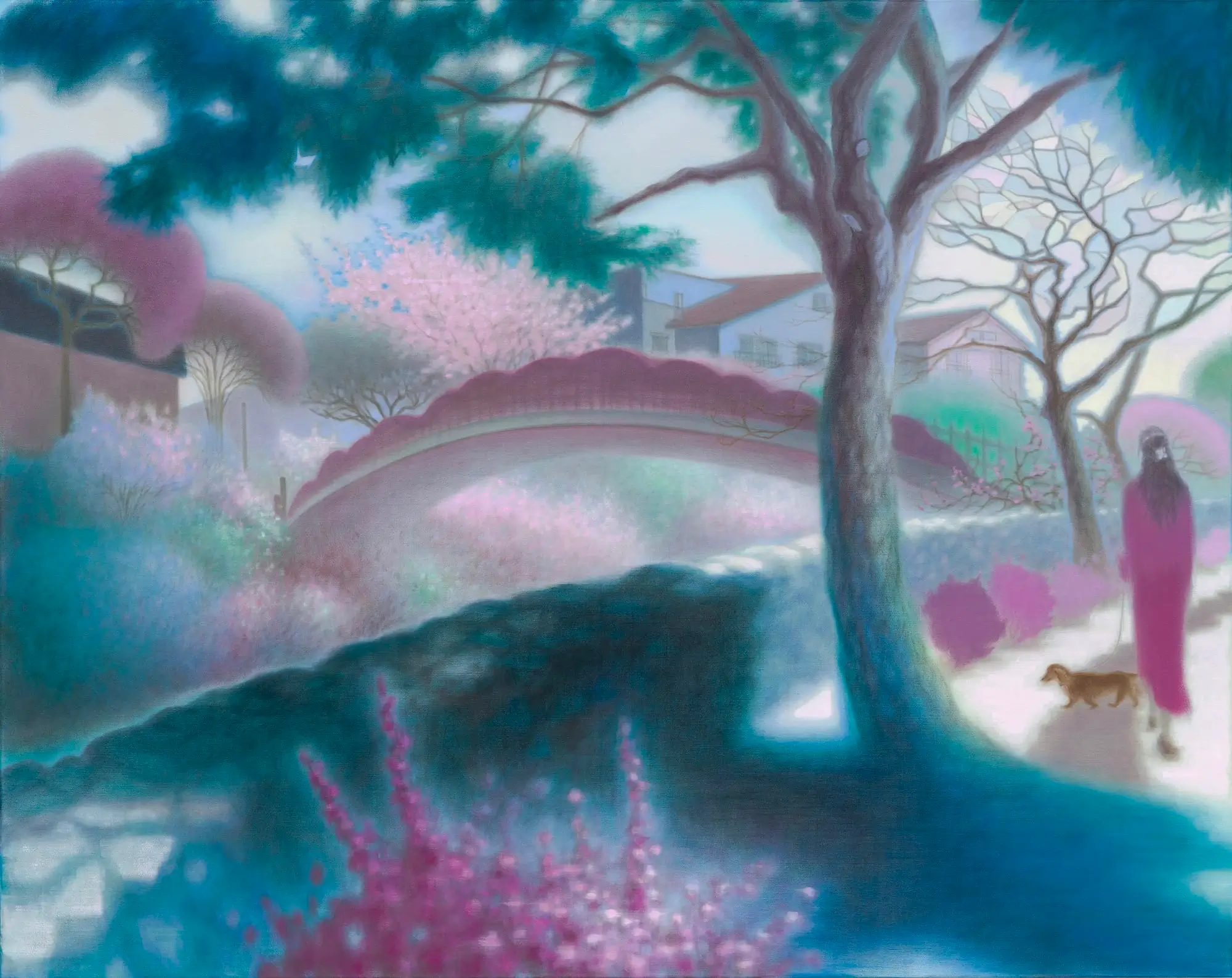
Several works from the exhibition and its surrounding body of paintings illustrate how consistently You returns to particular formal ideas even as her settings shift. Painting, Again (2026), rendered in oil on linen at just over 65 by 82 inches, places a woman at an easel in an open doorway, her domestic space filled with shelves, flowers, and half-view objects that crowd the composition without overwhelming its central figure. Spring Walk (2026), close in scale to Painting, Again, follows a figure strolling with a dog along a stream, its cerulean background set against a single note of magenta in the walker’s jacket, a spring scene built from a narrow, carefully balanced palette rather than a naturalistic range of color.
View this post on Instagram
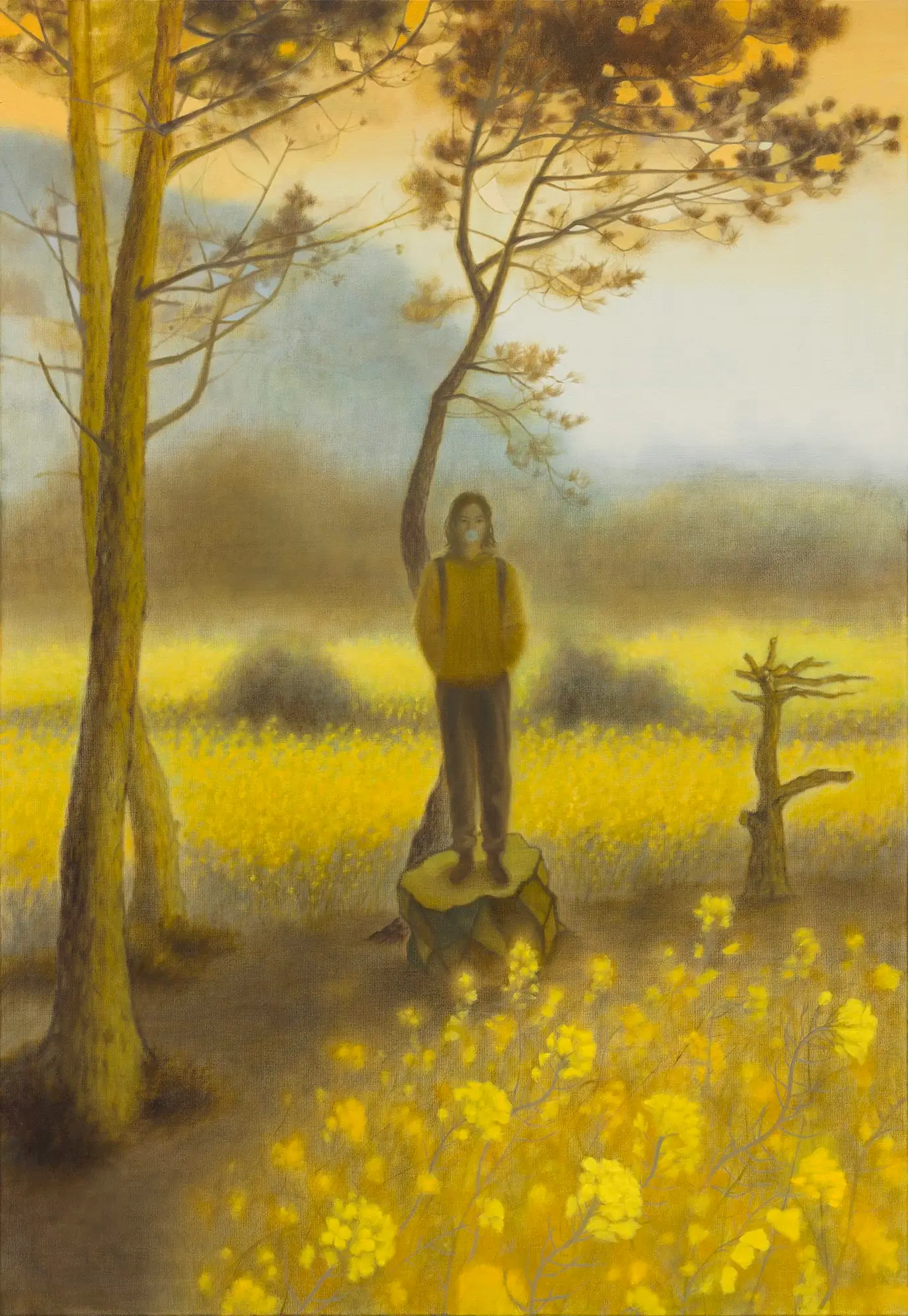
Other works push further into abstraction of setting. The Shape of Silence (2026) returns to the pottery-wheel motif, framing a woman at work beside a shelf crowded with variously shaped vessels, while Let the Sunlight In (2026) abandons the human figure for a still-life arrangement of food and decorative objects on a table, lit from a source outside the frame. Golden (2026) places a seated figure on a lawn in front of a church at what reads as the exact moment of golden hour, rendered with a deliberately fuzzy, dreamlike quality that blurs the edge between observed scene and remembered one. Earlier works in the same vein, including Rest (2025), Pause (2025), and Deep in the Yellow (2025), establish the same vocabulary of gardens, ponds, and half-obscured figures that recur throughout the newer paintings, suggesting a sustained inquiry rather than a single exhibition’s worth of ideas.
Taken together, the works suggest an artist working through a fairly narrow, deliberately repeated set of formal concerns — light, obscured faces, domestic or garden settings, a muted but not desaturated palette — rather than chasing variety for its own sake. That repetition is part of what gives the body of work its coherence: each painting reads as another attempt at the same underlying question about memory and presence, rather than a stylistic departure from the last.
from
You’s biography tracks a path that has become increasingly common among mid-career Korean artists working internationally, but her specific route through it, San-su hwa training followed by an oil-painting practice developed abroad, has shaped her work in ways that are easy to spot even without knowing the details. Before her formal training in Seoul, she absorbed a painting tradition where landscape carries a know and emotional weight beyond its literal subject matter, an inheritance view in the way her later oil paintings treat setting as inseparable from mood. Her subsequent years in the UK and US, where she began working in oil and engaging directly with Western painting history, gave her access to a different set of tools, but the underlying instinct toward evocation over depiction appears to have stayed constant across the shift in medium.
That dual formation has made You a natural fit for galleries positioning themselves at the intersection of Asian and Western contemporary art markets. Beyond her relationship with Lehmann Maupin, which maintains locations in New York, Seoul, and London, You has shown with Jessica Silverman in San Francisco, where her 2024 exhibition Neighborhood drew on her time living in the Bay Area, and with Almine Rech in London, where her 2024 show Unwindfocused on scenes of domestic solitude and California gardens rendered from memory after her return to Korea. Her earlier solo debut, Winter Blossom, was staged at Make Room in Los Angeles in 2023.
tred
You’s work now sits in the public collections of several major institutions, including the Hammer Museum in Los Angeles, the Institute of Contemporary Art in Miami, the Museum of Contemporary Art San Diego, the Columbus Museum of Art in Ohio, and Seoul National University’s own Museum of Art. She has also appeared in group exhibitions at the National Gallery of Victoria’s Triennial in Melbourne and at X Museum in Beijing, giving her a footprint across North American, European, and Asian institutional programming within a relatively short span of time since her 2021 debut.
Her move to Lehmann Maupin’s roster in 2025 was framed by the gallery’s Seoul-based partner Emma Son as recognition of “a rare sensitivity to atmosphere, memory, and the act of seeing,” rooted in Korean pictorial traditions while remaining, in the gallery’s words, fully conversant with contemporary painting more broadly. That framing captures much of what distinguishes You’s work within a crowded field of painters currently working through figuration, memory, and domestic space: rather than treating her Korean training as a decorative reference point layered onto a Western painting practice, she uses it as the actual mechanism by which her paintings gen their sense of atmosphere, making the synthesis structural rather than stylistic.
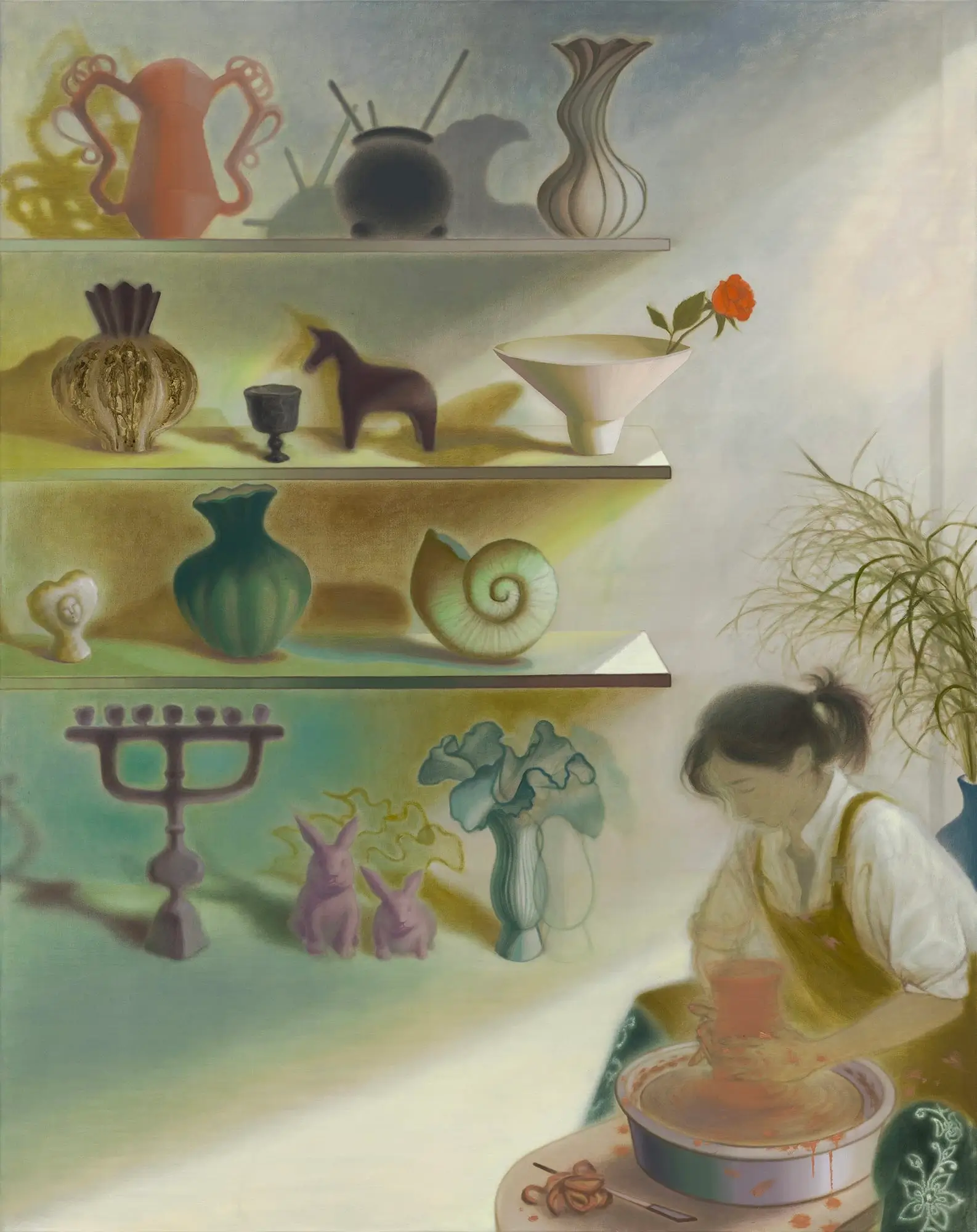
A ceramic artist quietly works at a pottery wheel as whimsical vessels, sculptures, and handcrafted objects line softly lit shelves, capturing the contemplative beauty of creativity and craftsmanship.
The pace of that institutional uptake is worth noting on its own terms. Moving from a 2021 debut to inclusion in the permanent collections of five separate North American museums, plus institutional group shows on three continents, within roughly four years places You among a relatively small cohort of painters to have made that transition this quickly. Part of that speed likely owes to a broader market and curatorial appetite for figurative painting rooted in specific, non-Western pictorial traditions, a trend that has lifted a number of Korean and Korean-diaspora painters over the same stretch of time. But the consistency of the language used to describe You’s work across galleries as different in program and geography as Lehmann Maupin, Jessica Silverman, Almine Rech, and Make Room, all converging independently on words like atmosphere, memory, and evocation, suggests the appeal isn’t simply a matter of timing.
hint
When the Sun Shines Again remains on view at Lehmann Maupin’s New York location through August 14, 2026. Readers in New York through the summer have a direct opportunity to see the paintings’ handling of light and atmosphere at full scale, something reproductions tend to flatten given how much of the work’s effect depends on the layered transparent of You’s brushwork. For those unable to visit in person, Lehmann Maupin’s own exhibition material and the gallery’s Seoul and London locations offer additional points of access to You’s broader body of work as her international profile continues to expand.
Related Articles
Where the Face Should Be, Rafael Silveira Paints Open Sky
A pink shirt, shoulder-length hair, then no face at all: in “Surprise,” Rafael Silveira lets flowers and a clear blue sky stand in for the person.