DRIFT AUDIO
Listen to this story
Choose a voice, then press play.
Zhou Guanyu spent over a decade fighting to become China’s first Formula 1 driver. Now Tommy Hilfiger wants him for something he never had to fight for at all: his sense of style.
In This Story
- Tommy Hilfiger Welcomes Zhou Guanyu
- Leaving Shanghai to Chase Formula 1
- A Career Defined by Patience and Persistence
- From Ferrari Reserve to Cadillac’s New Chapter
- Fashion Was Always Part of the Journey
- Why Tommy Hilfiger Chose Zhou Guanyu Now
Tommy Hilfiger named Zhou Guanyu its newest global brand ambassador this week, and on paper it reads like a routine sponsorship update — another athlete added to a roster that already includes Lewis Hamilton, Sergio Pérez, Rafael Nadal, and Thierry Henry. What makes it worth sitting with is who Zhou is beneath that headline: the only driver from mainland China to ever race a full Formula 1 season, a man who spent from age twelve onward relocating across continents chasing a seat that, statistically, almost never gets handed to someone from outside Formula 1’s usual feeder countries. Fashion is the easy part of this story. Getting to the point where fashion brands wanted him at all was not.
View this post on Instagram
“Zhou Guanyu represents a new gen of talent with influence that reaches far beyond the racetrack,” Hilfiger said of the signing, tying the pick to the brand’s “Prep Made Current” positioning and to what he described as Zhou’s “confidence, individuality and authenticity.” Zhou’s own response leaned into the same idea from the other direction: “Fashion is part of my DNA; I’ve grown up understanding that clothes are not just practical — they are an entire lang. Style is an opportunity to tell your story without words.” It’s a tidy quote, but it’s also, if you know where Zhou came from, a genuinely earned one.
stir
Zhou Guanyu was born in Shanghai on May 30, 1999, and started karting at eight years old — a relatively late start by the standards of a sport where future champions are frequently strapped into go-karts before they can read. He attended his home city’s Grand Prix in 2004 at age five, watching Fernando Alonso from the stands, years before either man could have guessed they’d eventually share a paddock. What separated Zhou from most kids who fall in love with racing at a Grand Prix wasn’t talent alone — it was that his family was willing to relocate an ocean away to give that love somewhere to go. China simply didn’t have the racing infrastructure to develop an F1-caliber driver in the early 2010s, so at twelve years old, Zhou moved with his family to Sheffield, England, enrolling at Westbourne School and rebuilding his entire competitive and social life around a sport his home country had never produced a professional in.
That bet started paying off almost immediately. Zhou won the Rotax Max British Kart Championship and the Rotax Max Euro Challenge in 2013, becoming the first Chinese driver to claim a European karting title. By fifteen, he’d joined the Ferrari Driver Academy and finished runner-up in the 2015 Italian F4 Championship, good enough for Rookie of the Year honors. Three seasons in FIA Formula 3 followed, then a stint as a Formula E development driver for Techeetah, then three years in Formula 2 with UNI-Virtuosi Racing, where he finished third overall in his final season in 2021 — a result that also earned him the Anthoine Hubert Award, given to the series’ top rookie in a season shadowed by the death of Hubert himself at Spa-Francorchamps. Along the way, Zhou also spent time as a test driver for both Renault and Alpine, quietly accumulating exactly the kind of paddock credibility that eventually convinces a team principal to take a chance on a rookie.
That chance came on November 16, 2021, when Alfa Romeo announced Zhou as Valtteri Bottas’s new teammate for the 2022 season — officially making him the first driver from mainland China to compete full-time in Formula One, in a sport that had run for over seven decades and fielded more than 700 drivers without ever including one. He chose car number 24 in tribute to Kobe Bryant, his childhood sporting hero, and scored a point in his very first race at the 2022 Bahrain Grand Prix, finishing tenth — a genuinely difficult feat for any rookie, let alone one carrying the weight of an entire country’s first appearance in the sport.
tread
Zhou’s three seasons with Alfa Romeo and its successor team, Sauber, were defined less by consistent results than by moments that stuck. Early in his rookie year, at the British Grand Prix, contact with George Russell sent his car flipping upside down at Abbey corner, skidding along the track trailing sparks before it was launched over a tire barrier and wedged between the wall and a wire debris fence. He walked away unhurt and was racing again at the very next event — the kind of detail that tends to get mentioned once and then quietly filed under “things this driver has already survived.” He picked up further points finishes across Australia, Spain, Qatar, and Canada over the following seasons, set the fastest lap of a race on two occasions, and finished with sixteen championship points and 68 Grands Prix starts to his name by the time his Sauber tenure ended.
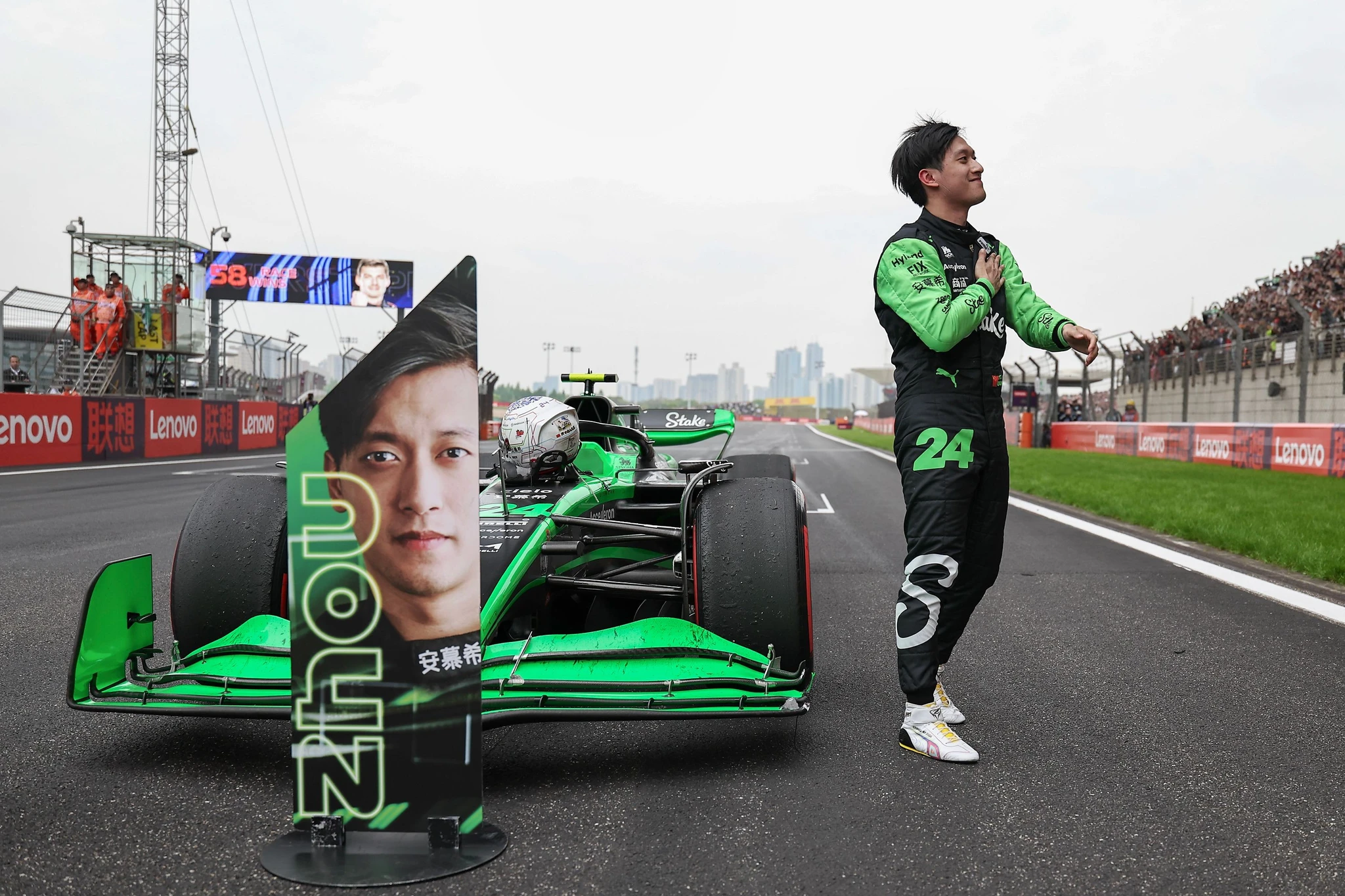
The moment that mattered most personally, though, had nothing to do with points. The Chinese Grand Prix had been suspended from the F1 calendar between 2020 and 2023 because of the pandemic, which meant Zhou spent his entire rookie season and part of his second without ever getting to race in front of a home crowd, despite being the very reason many of those fans had started following the sport at all. When the race finally returned to Shanghai in April 2024, roughly 60,000 fans packed the stands across the weekend to watch him. He finished fourteenth — a result that, by his own account, was almost beside the point on a weekend he called “unforgettable.” “All these achievements, sacrifice, anticipating we’ve done as a family, as a group of people in my team — I’ve just been really grateful to have them there,” he said afterward. “We finally achieved the goal that looked like it was impossible at the beginning.”
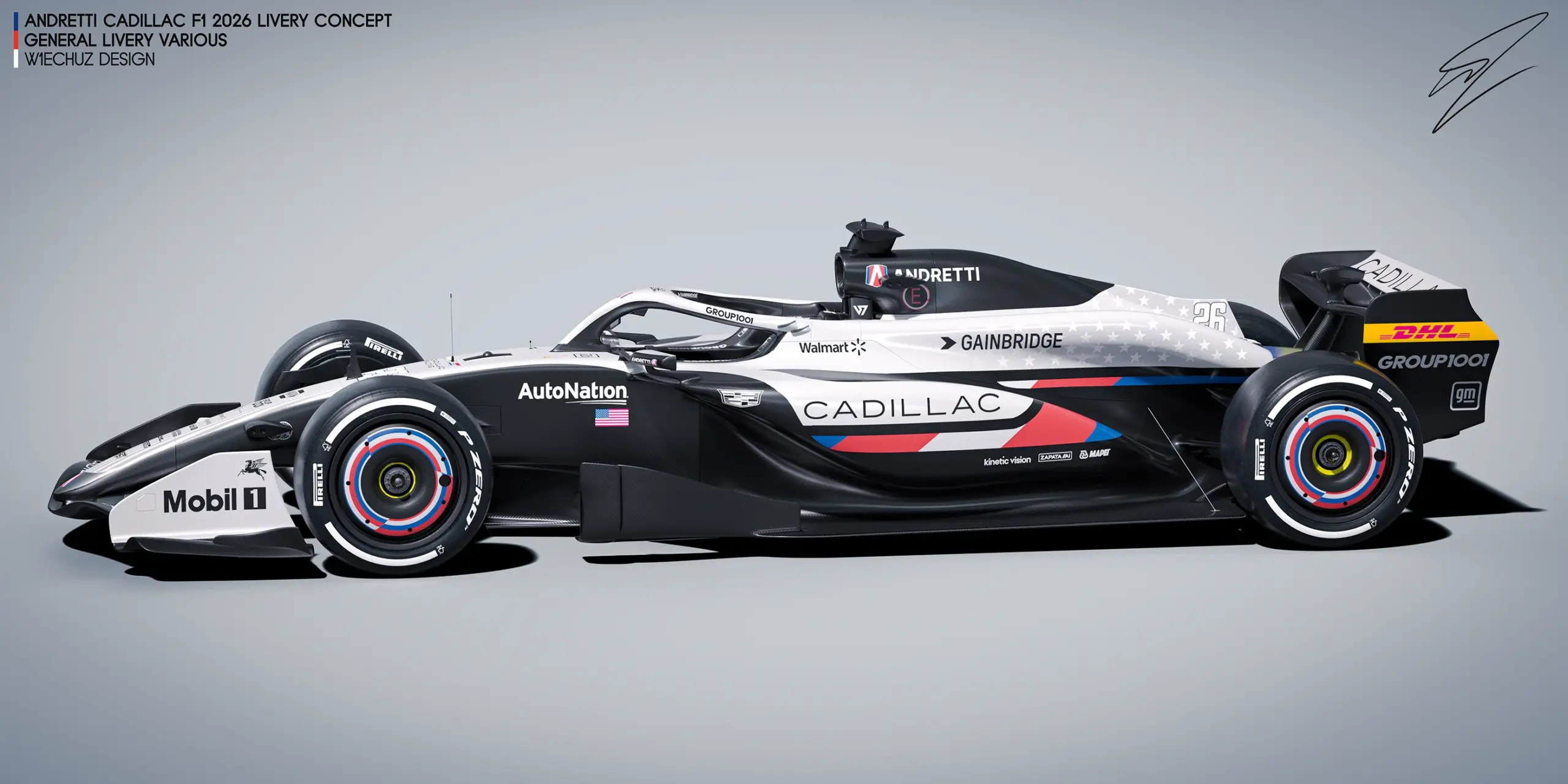
A concept rendering imagines the Andretti Cadillac Formula 1 entry with a patriotic black, white, and silver livery inspired by American motorsport and Cadillac’s performance heritage.
built
Formula 1 doesn’t reward sentiment, and Zhou’s story didn’t get a storybook ending at Sauber. As the team prepared for its 2026 transition to Audi ownership, it opted for an entirely new driver lineup, and both Zhou and Bottas were let go at the end of the 2024 season despite Zhou having delivered the team’s only points finish that year, at the Qatar Grand Prix. For a driver who’d spent three seasons proving he belonged on the grid, it was a blunt reminder that belonging and being retained are two different things in this sport.
He didn’t disappear from the paddock, though. Ferrari brought him back into its fold for 2025 as a reserve driver — a return of sorts, given Zhou had originally come up through Ferrari’s own driver academy between 2014 and 2018 before eventually landing his race seat elsewhere. And for 2026, he moved again, this time to the Cadillac Formula 1 Team as a reserve driver, joining the brand-new American entry in its first full season on the grid. It’s a role without a guaranteed race seat, but it keeps him squarely inside the sport he spent his adolescence relocating continents for, and it’s the seat from which this week’s Tommy Hilfiger news actually makes sense: Hilfiger became Cadillac’s official apparel partner last year, ahead of the team’s F1 approval, which means Zhou’s ambassador deal isn’t a brand reaching outward for a random athlete — it’s a brand formalizing a relationship with a driver already wearing its gear on race weekends.
scope
What makes Zhou a genuinely credible signing, rather than just a convenient one, is that his relationship with fashion long predates this week’s announcement. His mother worked as a fashion designer, and by his own account, she’s the reason clothing became something he thought about seriously rather than just functionally, well before Formula 1 gave him a platform to display it. He’s cited Lewis Hamilton directly as the driver who gave the entire grid permission to treat the paddock walk as a genuine style moment rather than an afterthought — comparing it, in one interview, to the tunnel walks NBA players do before tip-off — and he’s been candid that watching Hamilton do that first is part of what encouraged him to start dressing deliberately for race weekends himself. His own paddock style has developed a reputation of its own: heavy on black, built around statement footwear and carefully chosen accessories, distinctive enough that it drew the attention of Dior, which signed him as a brand ambassador in China before this year’s Tommy Hilfiger deal came together.
That’s worth underlining, because it means the Hilfiger signing isn’t introducing Zhou to fashion as a concept, and it isn’t the first luxury house to recognize what he brings to a red carpet or a paddock walk. It’s simply the biggest global platform yet to formalize what’s already been true for years: Zhou approaches getting dressed with the same seriousness he approaches a qualifying lap, and multiple fashion houses have independently arrived at the same conclusion about what that’s worth.
look
Line up Zhou’s career against Hilfiger’s own history with Formula 1 and the timing stops looking like coincidence. Hilfiger has been sponsoring teams since the 1990s — Team Lotus, Ferrari, Mercedes-AMG Petronas — well before fashion brands treated the paddock as a serious marketing channel, and it built out a fanwear line with Cadillac specifically ahead of the team’s debut season. Formula 1’s global audience has grown substantially since Liberty Media took over the sport’s commercial rights, and a meaningful share of that growth has come from exactly the kind of viewer who cares as much about what a driver wears walking into the paddock as what they do once they’re strapped in. Zhou, at this point, has more genuine standing in that specific conversation than almost anyone else on the grid not named Hamilton — a driver whose sense of style was shaped by his mother, sharpened by watching Hamilton break the mold, validated first by Dior, and now formalized on a global stage by Hilfiger.
None of that changes the fact that Zhou is currently without a race seat, watching the 2026 season unfold as Cadillac’s reserve driver rather than one of its two starters. But the Hilfiger deal is a reminder that his relevance to the sport was never going to be measured by championship points alone. He spent over a decade making sure Formula 1 had its first driver from China. What Hilfiger is betting on now is that the same person who did that has just as much to say about what that driver wears while he does it.
Related Articles
WACKO MARIA Brings Its Leopard Lining to the Big Leagues
Black nylon outside, leopard fur inside: WACKO MARIA’s first Major League Baseball collection reached Japan […]