DRIFT AUDIO
Listen to this story
Choose a voice, then press play.
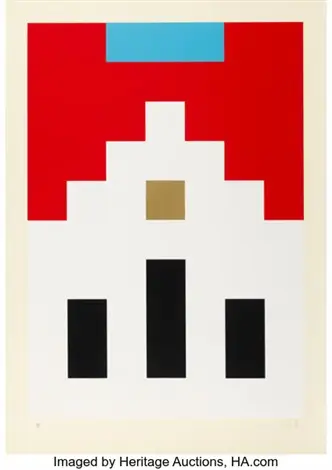
Invader’s Marlboro (2014) is a limited-edition screenprint rag paper — typically measuring 34 × 24 inches (86.4 × 61 cm) in an edition of 200 plus artist proofs — created by the anonymous French street artist Invader (b. 1969). The work exemplifies his signature pixelated visual language applied to consumer iconography. Reproducing the instantly recognizable red Marlboro cigarette pack in chunky, deliberately low-resolution pixels, the image remains unmistakable despite its heavy 8-bit degradation.
grad
Invader, born in France in 1969 and commonly associated with Paris, graduated from the prestigious École des Beaux-Arts. He adopted his pseudonym from the 1978 Taito arcade game Space Invaders. During the late 1990s, his early interventions involved installing ceramic tile mosaics of pixelated video game characters — Space Invaders aliens, Pac-Man ghosts, and other arcade references — onto urban walls around the world, transforming public space into an ongoing global “invasion” project.
By the 2010s, Invader expanded into screenprints, Rubik’s Cube compositions known as “Rubikcubism,” and other collectible formats while carefully maintaining anonymity, often appearing masked or digitally obscured in interviews. His practice consistently bridges street art, pop nostalgia, digital aesthetics, and commentary surrounding consumer culture and image construction. Across decades, he has “invaded” cities globally, documenting these interventions through self-published guides and the FlashInvaders app.
flow
Marlboro translates the glossy, mass-produced familiarity of cigarette packaging into a mosaic-like screenprint. The composition centers the cigarette pack’s iconic red-and-white structure, with the “Marlboro” typography, chevron insignia, and “20 Class A Cigarettes” text all rendered through bold, block-like pixels. The color palette remains faithful to the original packaging — deep reds, whites, and black accents — yet the intentionally degraded resolution evokes early arcade graphics and primitive digital imaging.
The screenprinting process allows for sharp edges and controlled tincture layering, as suited to Invader’s aesthetic vocabulary. Printed on archival 100% cotton rag paper, sometimes with deckled edges, the work carries both street-level accessibility and collectible prestige. Many impressions are signed, dated, and numbered in pencil, frequently bearing the blindstamp of publisher Art Alliance in Chicago as part of the Provocateurs portfolio.
The pixelation itself is conceptual rather than decorative. Each square “pixel” echoes the ceramic tiles used throughout Invader’s public mosaics, emphasizing how digital culture fragments and reconstructs view reality. The Marlboro pack — long associated with the mythology of rugged American masculinity through the Marlboro Man campaign — becomes transformed into something resembling an aging arcade sprite. In doing so, Invader collapses high-production advertising into the nostalgic view limitations of 1970s and 1980s gaming culture.
idea
Invader effectively “invades” the Marlboro logo in the same way his mosaics invade urban architecture. By pixelating the image, he reframes one of the world’s most recognizable commercial symbols, exposing how deeply corporate branding permeates everyday consciousness. The cigarette pack carries associations of addiction, rebellion, glamour, masculinity, and danger, all of which become filtered through a skittish digital distortion.
show
Invader has often described himself as a type of hacker occupying public space through view intervention. Here, that same philosophy manifests through the collision of digital aesthetics and analog advertising. In an era dominated by ultra-high-definition imagery, the deliberately crude resolution recalls the technical limitations of early computing while simultaneously revealing the constructed nature of branding itself. Across his wider oeuvre, pixels become both nostalgic artifacts and symbols of modern fragmentation.
retro
Growing up during the rise of arcade gaming culture in the 1970s and 1980s, Invader continuously mines shared pop memory. Marlboro merges cigarette advertising — once one of the most culturally dominant forms of commercial imagery — with retro gaming aesthetics, drawing parallels between escapism, reward systems, and addiction. Both cigarettes and video games offer immediate gratification while hinting at longer-term consequences beneath the surface.
arena
As a screenprint edition of 200, Marlboro also reflects the transition of street art into collectible contemporary art markets. Invader’s public works are frequently removed, stolen, or destroyed, making prints a more permanent and accessible extension of his practice. Auction demand has steadily reinforced his position alongside figures such as Banksy and Shepard Fairey within the broader evolution of street art’s institutional legitimacy.
emotive
Marlboro fits naturally alongside Invader’s wider body of brand and icon “invasions,” including Rubik’s Cube reinterpretations of historical masterpieces and pixelated celebrity portraits. The work belongs to a period in which he increasingly moved beyond purely public interventions into studio-based editions that simultaneously critique and participate in commercialization. Comparable works such as Hollyweed or his Rubik portraits similarly destabilize familiar cultural symbols through humor, distortion, and digital reinterpretation.
trickle
The work has appeared repeatedly at major auction houses including Phillips, Christie’s, and Tate Ward, often exceeding pre-sale estimates. Its appeal lies in the combination of accessibility, irony, nostalgia, and sharp cultural recognizability. The imagery feels simultaneously retro and contemporary, allowing Marlboro to resonate across collectors interested in street art, consumer culture, and digital-era aesthetics alike.
fin
Invader’s Marlboro arrives within larger conversations surrounding advertising, public space, image saturation, and digital culture. By pixelating the cigarette pack, the artist highlights the extent to which brands invade psychological space as aggressively as physical environments. At the same time, the image functions as a historical artifact: cigarette packaging now carries a distinctly different cultural weight in an era shaped by advertising restrictions, public health awareness, and changing attitudes toward tobacco.
Marlboro (2014) distills the core intelligence of Invader’s practice: taking something hyper-familiar, degrading it just enough to make it visually strange again, and forcing viewers to confront the pixels hidden beneath everyday cultural icons. The work operates simultaneously as playful intervention, digital archaeology, and commentary on branding’s permanence within contemporary life. Whether encountered in a gallery, auction setting, or private collection, it retains the same invasive energy as his street mosaics — a reminder that the visual systems surrounding us are already embedded deep within modern consciousness.
From the DRIFT archive: Scott Listfield: The Astronaut in C.R.E.A.M. — Street Memory, Pop Iconography, and the Architecture of Nostalgia · Between Walls and Silence: Nuno Viegas’s Street Artist (2018)
Related Articles

Where the Face Should Be, Rafael Silveira Paints Open Sky
A pink shirt, shoulder-length hair, then no face at all: in “Surprise,” Rafael Silveira lets flowers and a clear blue sky stand in for the person.