DRIFT AUDIO
Listen to this story
Choose a voice, then press play.
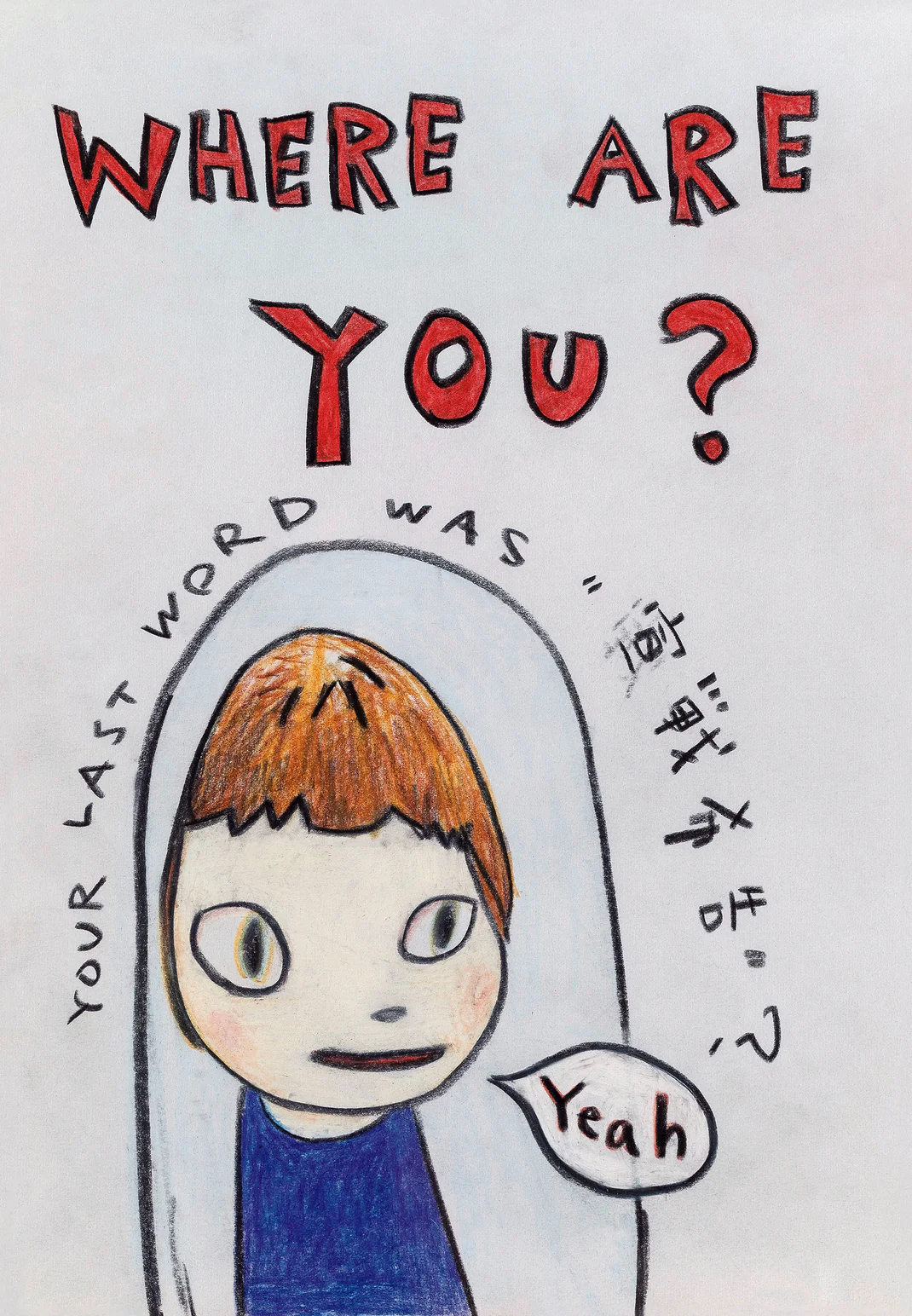
Yoshitomo Nara’s Untitled (Where Are You?) (2003) is a quintessential example of the Japanese artist’s intimate works on paper. Executed in colored pencil and wax crayon on paper board (approximately 33 x 23 cm), this small-scale drawing captures one of Nara’s signature wide-eyed child figures in a moment of introspective solitude. The piece belongs to a prolific period in Nara’s career when he produced numerous delicate drawings on everyday supports like envelopes, notebooks, and cardstock, often during moments of travel or reflection.
The central figure — a young girl with oversized head, piercing eyes, and a neutral-to-melancholic expression — stares directly at the viewer. Her gaze is both confrontational and vulnerable, a hallmark of Nara’s style that blurs the line between innocence and quiet defiance. The title Where Are You? adds a layer of existential inquiry, suggesting themes of isolation, displacement, or a search for connection in an indifferent world.
stir
Born in 1959 in Hirosaki, Aomori Prefecture, in rural northern Japan, Nara grew up as a “latchkey kid” in a post-war landscape marked by American cultural influence. His parents worked long hours, leaving him to entertain himself with music — particularly 1960s folk, rock, and punk — and drawing. This solitary childhood profoundly shaped his artistic vocabulary. He later studied at the Aichi Prefectural University of Fine Arts and Music (BFA 1985, MFA 1987) before moving to Germany in 1988 to attend the Kunstakademie Düsseldorf, where he studied under A.R. Penck until 1993. Living in Cologne until his return to Japan in 2000, Nara absorbed Western influences while maintaining a deep connection to Japanese visual traditions.
Nara emerged alongside the Superflat movement spearheaded by Takashi Murakami, but his work diverged by emphasizing emotional depth over Murakami’s slick consumerism critique. Where Superflat often celebrates surface and spectacle, Nara’s figures inhabit psychological interiors. His children are not cute for cuteness’ sake; they are vessels for complex adult emotions — loneliness, anger, resilience, and quiet rebellion — filtered through the lens of childhood memory. Nara has repeatedly described his characters as self-portraits: “My works are not directed toward others, nor do they depict others… they emerge from dialogues with myself.”
By 2003, Nara had returned to Japan and was gaining international recognition. Exhibitions like Nothing Ever Happens (traveling in the US) and collaborations with designer firm graf highlighted his interest in immersive environments. Untitled (Where Are You?) reflects this transitional phase: technically refined yet emotionally raw, produced with the immediacy of drawing rather than the labored process of large-scale paintings.
view
The work’s modest scale invites intimate viewing, mirroring how Nara often creates on whatever surface is at hand. Colored pencils and wax crayons produce a soft, tactile quality — matte yet vibrant — evoking children’s art supplies. This choice democratizes the work, stripping away the preciousness of oil painting and aligning it with pop culture and everyday creativity.
The figure dominates the composition, typically centered against a minimalist or softly graded background. Nara’s children feature disproportionately large heads and eyes, a stylistic device drawn from manga, anime, and ukiyo-e traditions, as well as Western cartoon influences. The eyes, often rendered with sharp pupils and subtle highlights, act as emotional anchors. In Where Are You?, the gaze feels questioning, as if the child is searching for the viewer or for an absent presence. Subtle facial cues — a slightly downturned mouth, furrowed brows, or neutral expression — convey ambiguity: Is this anger, sadness, boredom, or quiet strength?
Color plays a psychological role. Soft pastels or muted tones contrast with the intensity of the eyes, creating tension between vulnerability and inner power. The title amplifies this: “Where Are You?” could address a lost parent, friend, or even the viewer’s own disconnected self. It echoes Nara’s recurring motifs of isolation in vast, empty spaces or against flat backdrops, symbolizing emotional detachment in modern society.
rebel
Nara’s art resonates because it externalizes feelings many suppress from childhood. As he reflected: “When you are a kid, you are too young to know you are lonely, sad, and upset. Now I know I was.” His figures embody this retrospective awareness — innocent in form but wise (or wounded) in expression.
Untitled (Where Are You?) specifically taps into themes of searching and absence. In a globalized, fast-paced world, it questions belonging. The child’s direct stare implicates the viewer: Where are you emotionally? Are you present? This confrontational intimacy distinguishes Nara from pure kawaii aesthetics. His children often wield weapons (knives, cigarettes, or tools) or display punk attitudes, symbolizing resistance against conformity, authority, or adult hypocrisy. Even without explicit props here, the underlying tension persists.
Music remains a constant undercurrent. Nara’s titles and imagery frequently reference songs (Ramones, Sex Pistols, folk artists). The questioning title evokes lyrical longing, turning the drawing into a visual ballad of disconnection.
oeuvre
2003 sits in Nara’s mature early period. Larger paintings like those with knives or bandanas gained fame, but his drawings — more spontaneous and numerous — reveal his daily practice and emotional core. Many were made on envelopes or scraps, emphasizing transience and accessibility.
The work has appeared in private sales and auctions, reflecting Nara’s strong secondary market. Smaller works on paper like this often fetch significant sums, appealing to collectors drawn to their intimacy. Nara’s auction records (millions for major canvases) underscore his status as one of Japan’s most valuable living artists, yet drawings retain a democratic charm.
endure
Nara’s influence extends far beyond galleries. His imagery appears on merchandise, album covers, and street fashion, bridging high art and pop culture. Exhibitions draw massive crowds, particularly in Asia, where young viewers see their own anxieties reflected.
In Untitled (Where Are You?), viewers find catharsis. The piece invites projection: one might see youthful defiance, immigrant displacement, pandemic-era isolation, or personal grief. This universality explains Nara’s broad appeal across generations and cultures. His children are not nostalgic ideals but mirrors of inner complexity.
fin
In an age of digital connection yet profound loneliness, Where Are You? feels prophetic. It asks us to pause and confront our emotional landscapes. Nara’s deliberate simplicity — bold lines, flat space, direct gaze — cuts through noise, reminding us that profound truths often hide in plain sight, in the eyes of a child who refuses to look away.
Through this unassuming drawing, Yoshitomo Nara achieves something rare: he makes the personal collective, the cute profound, and the silent loudly questioning. Untitled (Where Are You?) stands as a quiet anthem for anyone who has ever felt lost — and dared to ask the universe for an answer.
Read Drift’s related feature, The Enigmatic World of Yoshitomo Nara: A Neo-Pop Visionary.
From the DRIFT archive: Chris P. Bacon: Francis DiFronzo’s Quiet Rebellion Against the Everyday
Related Articles
Joël Andrianomearisoa Finds More Than One Black in a Square of Buttons
In La Guerre des Boutons I, a field of ordinary fasteners turns a modest textile […]