James Prosek’s Untitled (2025) and the Art of Perception

September 23, 2025
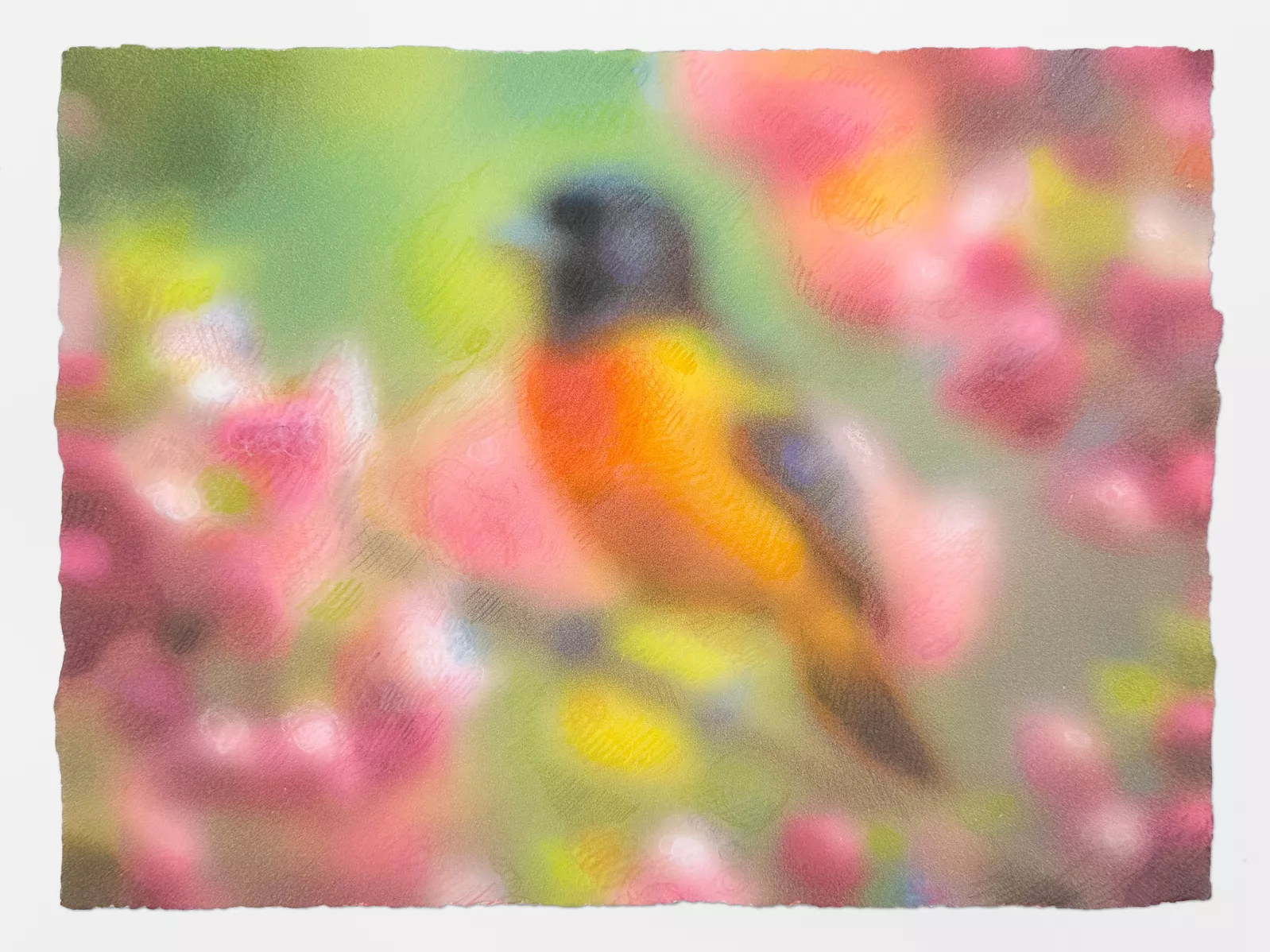
In 2025, James Prosek presented a work that, at first glance, appears deceptively simple: a blurred rendering of a bird perched among blossoms. Yet this Untitled piece stands as a profound continuation of Prosek’s lifelong meditation on nature, perception, and the dialogue between representation and reality.
The artwork depicts a small bird—orange-breasted, dark-headed—set against a wash of flowering pinks, yellows, and greens. The figure is recognizable, but only just; edges dissolve into painterly softness, the body dissolves into color, and the blossoms melt into abstraction. What remains is an atmospheric vision, a record not of the bird itself but of the experience of seeing a bird, fleetingly, in spring light.
The Language of Blur
Where Prosek’s earlier career was dominated by finely detailed renderings of fish, birds, and landscapes—work often praised for its precision—Untitled (2025) leans into a language of blur. This shift is not simply stylistic but conceptual. Blur refuses fixity. It acknowledges that in nature, encounters are rarely still. Birds flit, petals tremble, and eyes cannot hold every detail at once.
By blurring the bird, Prosek destabilizes the scientific impulse to catalogue, measure, and pin down species with absolute clarity. Instead, he offers a vision closer to memory, dream, or the transient perception of a walker glimpsing a flash of color in a tree. In this sense, Untitled becomes less about ornithology and more about phenomenology: how we perceive, remember, and attach meaning to fleeting sights.
Between Painting and Photography
The surface texture of the work suggests a conversation between mediums. The blurred edges recall out-of-focus photography, yet the handling of pigment remains distinctly painterly. This duality invites reflection on how humans record the natural world: through the lens, through the brush, through the written word.
Prosek has long been fascinated with classification systems and the limitations of representation. By echoing the look of a camera’s missed focus, he points to the failures of technology to capture the fullness of lived experience. A camera produces accuracy, but accuracy does not guarantee truth. Painting, in its ability to blur, smear, and exaggerate, might paradoxically bring us closer to what it feels like to encounter wildness.
The Bird as Symbol
The choice of bird is itself symbolic. While the species is not identified in the title, the orange breast and black head evoke an oriole—a bird often associated with joy, renewal, and seasonal change. Orioles are migratory, appearing suddenly in gardens each spring before vanishing again. Their elusiveness makes them apt emblems of ephemerality.
In Untitled, the oriole is both present and dissolving. We recognize its form, yet it resists capture. This tension mirrors our relationship with nature in the 21st century: we are surrounded by abundance, yet always on the edge of disappearance. Climate instability, habitat loss, and extinction shadow even the most ordinary encounters with birdsong or blossom.
Echoes of Art History
Prosek’s work resonates with art historical precedents. The atmospheric softness recalls Impressionism, where artists like Monet sought to capture the shifting conjure of light rather than the rigidity of form. At the same time, the blurriness calls to mind Gerhard Richter’s blurred photo-paintings, where indistinctness becomes a metaphor for memory and the unreliability of vision.
Yet Prosek differs in his insistence on nature as subject. Whereas Richter often blurred images of people or political events, Prosek insists that natural phenomena are equally worthy of such meditations on presence and absence. His Untitled (2025) collapses Impressionist reverie and postmodern skepticism into a single gesture: a bird seen clearly, and not at all.
Paper, Texture, and Materiality
Another layer of interest lies in the materiality of the work. The surface bears the marks of paper—fibrous edges, subtle grain—which interacts with the hazy pigment to produce a tactile blur. Prosek has often worked on paper, valuing its immediacy and connection to field notebooks used by naturalists.
Here, the torn or deckled edge of the sheet resists the polished finish of gallery art, evoking instead the intimacy of a personal record. The image becomes not an authoritative scientific plate but a subjective memory impression. This emphasis on the physical sheet reminds viewers that every encounter with nature is filtered—through eye, through hand, through medium.
Memory, Loss, and Perception
At its center, Untitled (2025) is about perception, but also about loss. Blur suggests both the immediacy of movement and the fading of memory. It mimics the way we recall encounters imperfectly: colors remain, feelings persist, but details dissolve.
This is particularly poignant in the Anthropocene, where many natural encounters are endangered. To see a bird indistinctly is to acknowledge the fragility of such sights. The painting thus becomes elegiac, a reminder that every spring bloom and every birdcall may be more precious than we realize.
A Shift in Prosek’s Oeuvre
For James Prosek, known initially as a wunderkind illustrator of trout species, this work represents a mature and philosophical turn. Over the decades, he has explored taxonomy, environmental storytelling, and the politics of naming. Untitled (2025) suggests a loosening of that scientific grip, a turn toward poetics.
Rather than presenting the bird as specimen, Prosek offers it as apparition. The piece acknowledges that no classification, however rigorous, can fully capture the mystery of living beings. In this sense, his art becomes not documentation but meditation, asking viewers to accept ambiguity as integral to beauty.
Reception and Interpretation
Critics encountering Untitled have described it as simultaneously soothing and unsettling. Its palette is lush—spring greens, rose pinks, fiery orange—but the refusal of clarity produces unease. Viewers find themselves leaning closer, searching for detail that never comes. This act of searching mirrors birdwatching itself, where glimpses are fleeting and patience rarely guarantees reward.
The ambiguity also democratizes interpretation. Without crisp lines or species labels, the image allows projection. For one viewer, the bird might recall childhood mornings. For another, it might symbolize fragility or spiritual visitation. In this openness, Prosek provides not answers but invitations.
Impression
James Prosek’s Untitled (2025) is deceptively titled, for it is far from without meaning. Through blur, the artist opens a space for reflection on perception, memory, and the ineffability of nature. The work resists the authority of science without discarding its reverence for the natural world. It reminds us that to see clearly is not always to see truly.
In a time when humanity craves control over data, categories, and species lists, Prosek’s blurred bird insists on the opposite: that beauty often lies in what cannot be grasped. To stand before this work is to be reminded of the fleeting flash of wings, the shimmer of petals in wind, the humbling reality that nature moves faster than our attempts to pin it down.
Related Articles
Chasing the Sort Sol: Inside Søren Solkær’s Six Year Pursuit of Europe’s Starling Clouds
A Danish portrait photographer spent six years following a bird nobody photographs on purpose, and […]