DRIFT AUDIO
Listen to this story
Choose a voice, then press play.
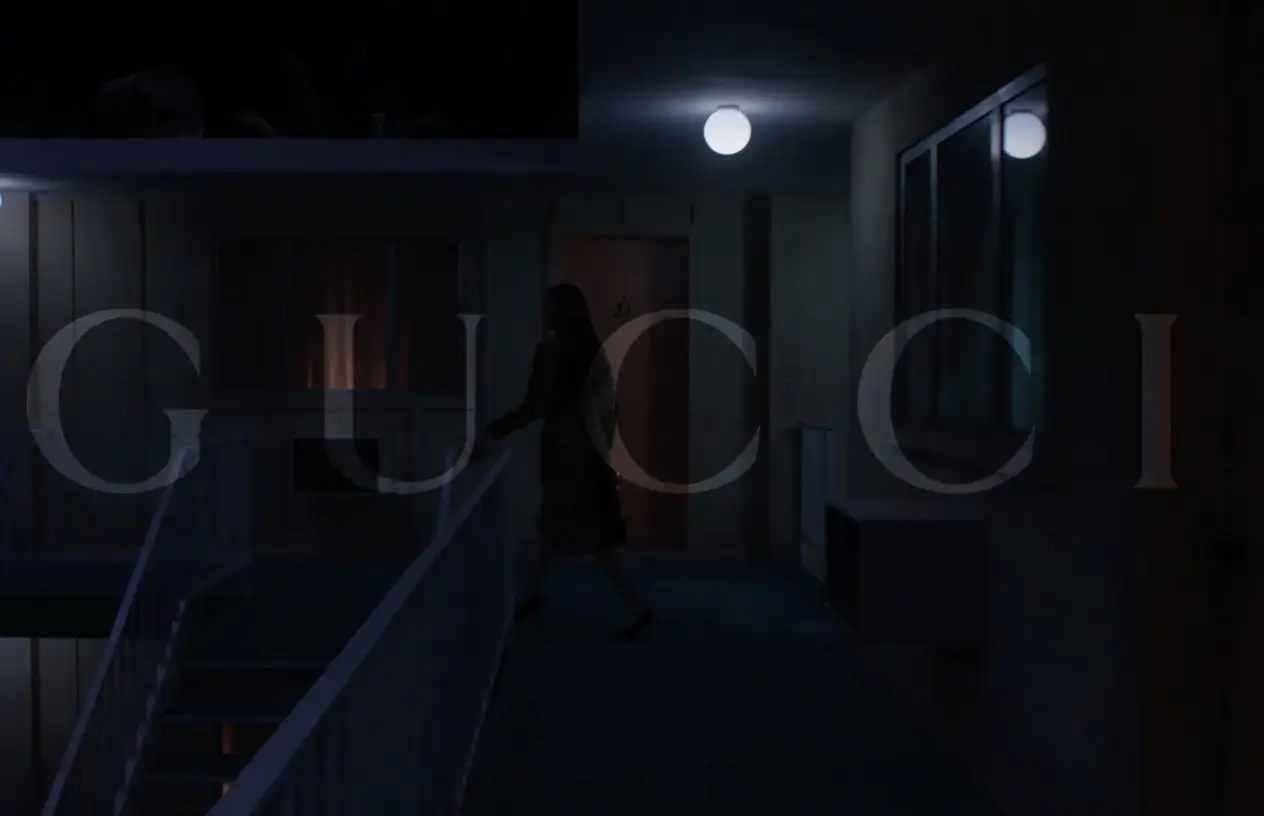
In the pale, bone-white glow of a full moon, a nondescript motel flickers into existence like a half-remembered dream. Neon signs buzz faintly against cracked stucco walls. Cars idle in the parking lot with engines that seem to purr in minor keys. Doors open and close without announcement. People stray about through corridors and across asphalt, their paths intersecting in ways that feel both accidental and ordained. This is the world of Generation Gucci, Jonathan Glazer’s short film for the Italian fashion house, released in late April 2026. Clocking in at under two minutes in its core form yet expanding across campaign stills, loops, and viewer interpretations into something far more expansive, the piece stands as one of the most intriguing intersections of high fashion and auteur cinema in recent memory.
Glazer, the British director celebrated for Under the Skin (2013), The Zone of Interest (2023), and his earlier music videos and commercials, has long specialized in the liminal. His camera lingers on bodies and spaces where identity frays at the edges. Here, under Demna’s creative direction for Gucci’s Pre-Fall 2026, that sensibility finds a perfect vessel: a roadside waystation suspended between the mundane and the mythic. The official logline captures it succinctly: “Set in a motel under a full moon, a short film by Jonathan Glazer strays between the real and the surreal, as people cross paths and gather into a new future adventure.” But to reduce it to plot summary is to miss the point. This is less narrative than invocation—a ritual of convergence.
stir
Motels have always carried a particular American mythology. They are temporary sanctuaries for the displaced: fugitives, lovers, salesmen, runaways. Think of Psycho’s Bates Motel, The Twilight Zone episodes where check-in guarantees transformation, or the neon-drenched purgatories of Lost Highway. Glazer’s motel inherits this DNA but universalizes it. There is no specific geography; the architecture feels mid-century American yet bathed in a European melancholy recalling Antonioni’s alienating modernities or Tarkovsky’s spiritual zones.
The full moon is no mere atmospheric flourish. In folklore and psychology, it governs tides, madness, and revelation. Here, it acts as a celestial spotlight, washing the scene in silver-blue that renders skin luminous and shadows deep. Cinematography plays with this light source relentlessly. A moving spotlight sweeps across faces and garments, picking out individuals as if auditioning them for destiny. Time dilates: a car appears to fly across the sky in one hallucinatory beat, while elsewhere moments stretch like taffy.
This temporal slippage mirrors the film’s thematic core: the dissolution of fixed identity in favor of collective becoming. Gucci’s “Generation” is not a demographic cohort but a process—a gathering of disparate souls into something emergent. Mariacarla Boscono and Alex Consani anchor the ensemble, their presences magnetic yet never dominating. Boscono moves through frames like a wanderer who has seen too many dawns, while Consani brings a sharper, more fluid energy. Around them orbit figures whose names matter less than their collective aura: diverse in age, ethnicity, and bearing, united by the garments they wear and the night that enfolds them.
flow
Demna’s Pre-Fall 2026 collection, photographed by the designer himself for the campaign, integrates seamlessly into Glazer’s view. Oversized tailoring, tactile fabrics that catch moonlight like liquid metal, hoods and layers that obscure and reveal—the clothes are not product placement but extensions of character psychology. A leather jacket becomes armor against the unknown; flowing silks suggest surrender to the surreal. In one sequence, fabric ripples as if responding to an invisible wind, blurring the boundary between textile and flesh.
This merge of fashion and film is hardly new—think David Lynch for Dior or the auteur commercials of the late 1990s and early 2000s—but Glazer elevates it. Where many brand films feel like extended advertisements with cinematic gloss, Generation Gucci prioritizes unease and ambiguity. The garments do not shout haute; they whisper possibility. They clothe bodies in transition, bodies crossing thresholds: literal doors, figurative life stages, metaphysical planes.
Glazer’s history with advertising informs this without constraining it. He has always treated commercials as miniature experiments in form. Recall Radiohead’s “Karma Police” or the hypnotic geometry of Jamiroquai’s “Virtual Insanity.” Here, the constraints of brevity and branding become strengths. Every cut, every lingering close-up on a face half-lit by moonlight, serves dual purposes: selling the collection while probing deeper questions of connection in an atomized world.
muse
The soundtrack is another layer of genius. It opens with Mina’s “Un bacio è troppo poco” (1962), an Italian pop plea for more than a single kiss—romantic, urgent, slightly melancholic. Then, without warning, Slipknot’s “(sic)” erupts: raw, aggressive nu-metal from 1999, all churning riffs and screamed vocals. The juxtaposition is jarring yet perfect. High fashion meets mosh pit; European elegance collides with American rage. The track doesn’t play long—just a blistering snippet—but its intrusion cracks the dreamlike surface, injecting adrenaline into the reverie.
It closes with Charles Aznavour’s “Hier encore,” a wistful reflection on time’s passage. The arc—from desire through disruption to retrospection—mirrors the film’s emotional journey. Music here is not background but co-author. It underscores how generations form not in smooth linearity but through rupture and resonance. Slipknot’s presence, in particular, signals Gucci’s willingness to embrace the abrasive and subcultural, broadening its appeal beyond traditional luxury consumers.
sig
To fully appreciate Generation Gucci, one must situate it within Glazer’s wider oeuvre. His protagonists are often aliens in human skin—literal in Under the Skin, metaphorical elsewhere. They observe humanity from a remove, drawn inexorably into its messiness. Here, the “alien” perspective is distributed across the ensemble. Each traveler carries a private cosmos; their convergence suggests a shared awakening.
As view, Glazer favors long takes, precise framing, and faces pushed to the foreground. Close-ups isolate eyes, lips, hands clutching keys or fabric, rendered hyper-real by moonlight. Sound design amplifies this atmosphere: distant traffic hums like breathing, footsteps echo unnaturally, the moon itself seems to emit a faint tone. Surreal touches—a floating car, time slowing—arrive matter-of-factly, without fanfare. This is Glazer’s trademark: the uncanny as everyday occurrence.
Thematically, the film echoes The Zone of Interest’s exploration of domestic normalcy against horror, though here the undercurrent is hopeful rather than damning. The motel is no villa adjacent to catastrophe but a neutral ground where futures are negotiated. “New future adventure” implies optimism: these strangers are not doomed to repeat history but poised to rewrite it together.
scope
Releasing amid post-pandemic fragmentation, AI-driven isolation, and shifting generational identities, the film taps directly into contemporary anxieties and aspirations. Who belongs to a “generation” anymore when algorithms curate our realities? Glazer and Gucci propose an answer: belonging emerges through accidental crossings, shared nights, and symbolic skins while individuality remains intact.
Critics and viewers alike have noted the campaign’s hypnotic quality. On YouTube and social platforms, responses drift between fashion praise and philosophical reflection. One commenter described it as “a dream I had but can’t remember.” Its brevity invites repetition. Every rewatch reveals another detail—a tattoo catching moonlight, an expression shifting from wariness to wonder.
Fashion campaigns have long borrowed cinema’s prestige, but rarely has the exchange felt this reciprocal. Glazer gains a canvas liberated from feature-length expectation, while Gucci gains emotional and conceptual depth beyond seasonal trends. The result functions simultaneously as advertisement and standalone artwork—brief enough for digital attention spans yet rich enough for cinephile dissection.
frame
Imagine extending this two-minute vignette into a feature-length narrative. The motel becomes a nexus point across time. One guest arrives fleeing a failed marriage, another chasing a half-remembered prophecy. The moon triggers synchronicities: keys opening impossible doors, reflections lagging behind movement. Garments mutate—a coat sprouting feathers, shoes leaving trails of stardust. The Slipknot interlude marks collective rupture, after which language dissolves into gesture alone.
Even without expansion, the existing film rewards close reading. Bodies maintain personal space yet orbit one another gravitationally. Architecture frames characters like stage performers. The moonlight, ever-present, symbolizes illumination without full disclosure—knowledge felt more than understood.
close
Generation Gucci succeeds because it trusts the viewer. It offers no exposition, no tidy resolution, only atmosphere, suggestion, and meticulous craft. In an era of content overload, that restraint feels radical. Glazer reminds us that cinema—whether two minutes or two hours—thrives on mystery and on the spaces between people where meaning quietly coalesces.
As the final notes of Aznavour fade and the screen dissolves into moonlight, what remains is not clarity but exhilaration. The strangers have not merged into uniformity but into possibility. They crossed paths, shared the night, and stepped toward an undefined adventure. In that sense, the film transcends fashion entirely, becoming a quiet manifesto for connection in fractured times.
Related Articles

Master Chief Reports to Call of Duty Now: Inside Xbox’s Second Reset Wave
Twenty-five years after Halo launched the original Xbox, the next mainline game belongs to Activision. […]