DRIFT AUDIO
Listen to this story
Choose a voice, then press play.
Kazuo Shiraga was not simply an artist—he was a rupture in the logic of making. Born in 1924 in Amagasaki, an industrial edge-city near Osaka, his formative years unfolded against the backdrop of war, reconstruction, and ideological collapse. Japan, in the aftermath of World War II, was not just rebuilding infrastructure—it was renegotiating identity. Tradition no longer held the same authority. Systems once considered immovable had proven fragile. And within this instability, a new artistic language began to emerge.
Shiraga’s early training in Nihonga—a classical Japanese painting discipline grounded in mineral pigments, controlled brushwork, and compositional restraint—provided him with technical precision but also imposed a ceiling. The methodology demanded obedience. It prioritized refinement over rupture, continuity over risk. For Shiraga, this became untenable. The problem was not skill—it was distance. The work felt removed from the immediacy of lived experience.
He sought not representation, but confrontation.
stir
In 1955, Shiraga aligned himself with the radical collective Jirō Yoshihara and the Gutai Art Association, a group that would fundamentally alter the trajectory of postwar art. Gutai—translating roughly to “concreteness” or “embodiment”—was not a movement in the stylistic sense. It was a philosophical break.
Their directive was simple but absolute: do what has never been done.
This was not experimentation for novelty’s sake. It was a rejection of mediation. Gutai artists refused to treat materials as passive tools. Instead, they approached them as collaborators—forces with their own resistance, their own behavior, their own agency. Paint was not to be controlled; it was to be engaged. The canvas was not a surface; it was a site.
Shiraga absorbed this completely.
idea
His now-iconic performance Challenging Mud (1955) marked a decisive shift. In it, Shiraga plunged into a mass of wet clay, wrestling it with his entire body. There was no brush. No intermediary. Only direct physical negotiation between human and material.
This was not metaphor. It was literal.
From this, his foot-painting technique emerged—arguably one of the most radical gestures in modern art. Suspended by a rope, Shiraga painted with his feet, dragging his body across the canvas, embedding movement, weight, and gravity into the surface. These works were not compositions in the traditional sense. They were records of action. Residues of encounter.
Control, as a concept, dissolved.
What replaced it was discipline—not of precision, but of surrender.
praxis
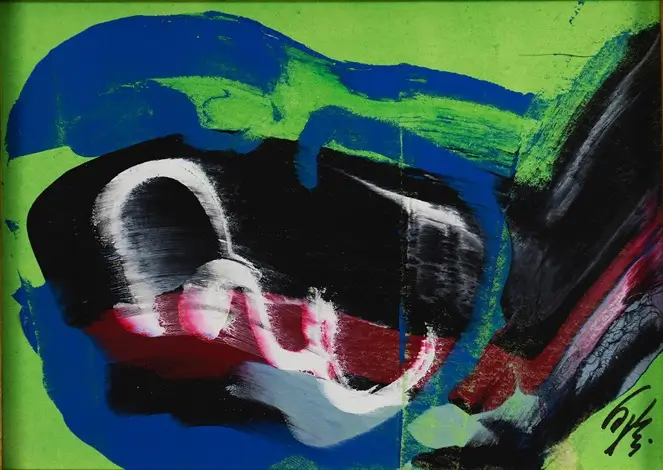
And yet, to understand Shiraga solely through these large-scale, performative works is to misread him. Parallel to this physically intense practice was a quieter, more concentrated body of work: gouache on paper.
These pieces operate differently. They are not events. They do not rely on spectacle. Instead, they compress Shiraga’s philosophy into a more intimate register.
Gouache, by nature, resists hesitation. Its opacity demands decisiveness. Its quick-drying surface eliminates the possibility of prolonged revision. Unlike oil, which allows for layering and correction, gouache fixes the gesture almost immediately. It records intent in real time.
For Shiraga, this was not limitation—it was alignment.
determined
In these works, every line is terminal. Every gesture is final. There is no return, no correction, no softening. The paper absorbs pigment with immediacy, locking in motion as fact.
What emerges is not a “drawing” in the preparatory sense. These are not studies. They are complete, resolved acts.
The compositions often appear deceptively simple—bold strokes, intersecting lines, layered marks—but within this apparent minimalism lies an intense concentration of energy. Each gesture carries weight. Each line is both action and consequence.
Where the foot paintings externalize movement across a large field, the gouache works internalize it. They distill it.
They are not quieter because they are lesser. They are quieter because they are precise.
craft
What defines these works is not aesthetic flourish, but presence. The material is not manipulated into illusion. It is allowed to remain itself—pigment on paper, gesture on surface.
There is no illusion of depth. No attempt to create pictorial space. Instead, the work exists entirely in the plane of action. What you see is what occurred.
This is critical.
Because in Shiraga’s practice, the artwork is not an image of something—it is the evidence that something happened.
sig
This particular gouache work, signed on both the front and reverse, introduces another dimension: authorship as both declaration and archive.
The front signature asserts immediacy—this is mine, this is done. The reverse signature functions differently. It is administrative, almost institutional. It acknowledges the work’s future—its movement through time, through collections, through systems of validation.
This dual-signing is not incidental. It reflects Shiraga’s awareness that while his work is rooted in the moment of action, it will inevitably enter structures of preservation and interpretation.
The piece is also accompanied by certification from the Japan Art Dealers Association. This is not merely a market mechanism—it is a formal recognition of authenticity within a system that values traceability and legitimacy.
In this way, the work exists in two simultaneous conditions: as an immediate act of presence, and as a documented artifact.
loc
Shiraga’s work did not remain confined to Japan. Over time, it entered global discourse, often positioned in dialogue with Abstract Expressionism.
Comparisons to artists like Jackson Pollock are inevitable—but incomplete. While both engaged in action-based painting, Shiraga’s work diverges in its philosophical grounding. Pollock’s gestures are often read through psychology and individual expression. Shiraga’s are rooted in a more physical, almost spiritual confrontation with material.
This distinction matters.
Shiraga is not expressing emotion through gesture. He is testing the limits of embodiment itself.
His work has since been exhibited in institutions such as the Guggenheim Museum and the Centre Pompidou, where it has been recontextualized within broader narratives of postwar abstraction and global modernism.
But even within these institutional frameworks, the work resists full assimilation.
Because it does not behave like conventional painting.
refuse
One of the most enduring qualities of Shiraga’s work—particularly in these gouache pieces—is its resistance to over-interpretation.
There is no symbolic system to decode. No narrative to reconstruct. No hidden meaning waiting to be uncovered.
The work does not ask to be understood.
It asks to be encountered.
This is a difficult proposition in a contemporary art world saturated with explanation, mediation, and context. But Shiraga’s work operates outside of that structure. It insists on a more direct relationship between object and viewer.
You see the mark.
You register the force.
You remain with it.
show
In this sense, Shiraga’s gouache works feel almost subversive today. Not because they are loud or disruptive, but because they are so resolutely present.
They do not perform complexity. They do not signal importance. They simply exist, fully and without apology.
And in that existence, they carry the weight of an entire practice—one that spans performance, painting, philosophy, and material engagement.
The gesture is not decorative. It is declarative.
fin
Kazuo Shiraga’s legacy is often framed through his most dramatic acts—the mud, the rope, the body in motion. But to stop there is to miss the deeper structure of his work.
Because beneath the spectacle lies discipline.
Not discipline as control, but discipline as commitment—to the moment, to the material, to the act itself.
The gouache works reveal this with clarity. They strip away scale and performance, leaving only the essential: a surface, a gesture, a decision.
No revision.
No correction.
No retreat.
Just the mark.
And the willingness to leave it as it is.
In a culture that often demands refinement, optimization, and explanation, Shiraga offers something else entirely:
A practice built on immediacy.
A philosophy grounded in action.
A legacy defined not by what is added—but by what is left.
No commentary.
No apology.
Just presence.
Related Articles
Modigliani’s Limestone ‘Tête’
Carved from a single block of limestone in Montparnasse more than a century ago, one of Modigliani's rare stone heads goes to auction for the first time…