DRIFT AUDIO
Listen to this story
Choose a voice, then press play.
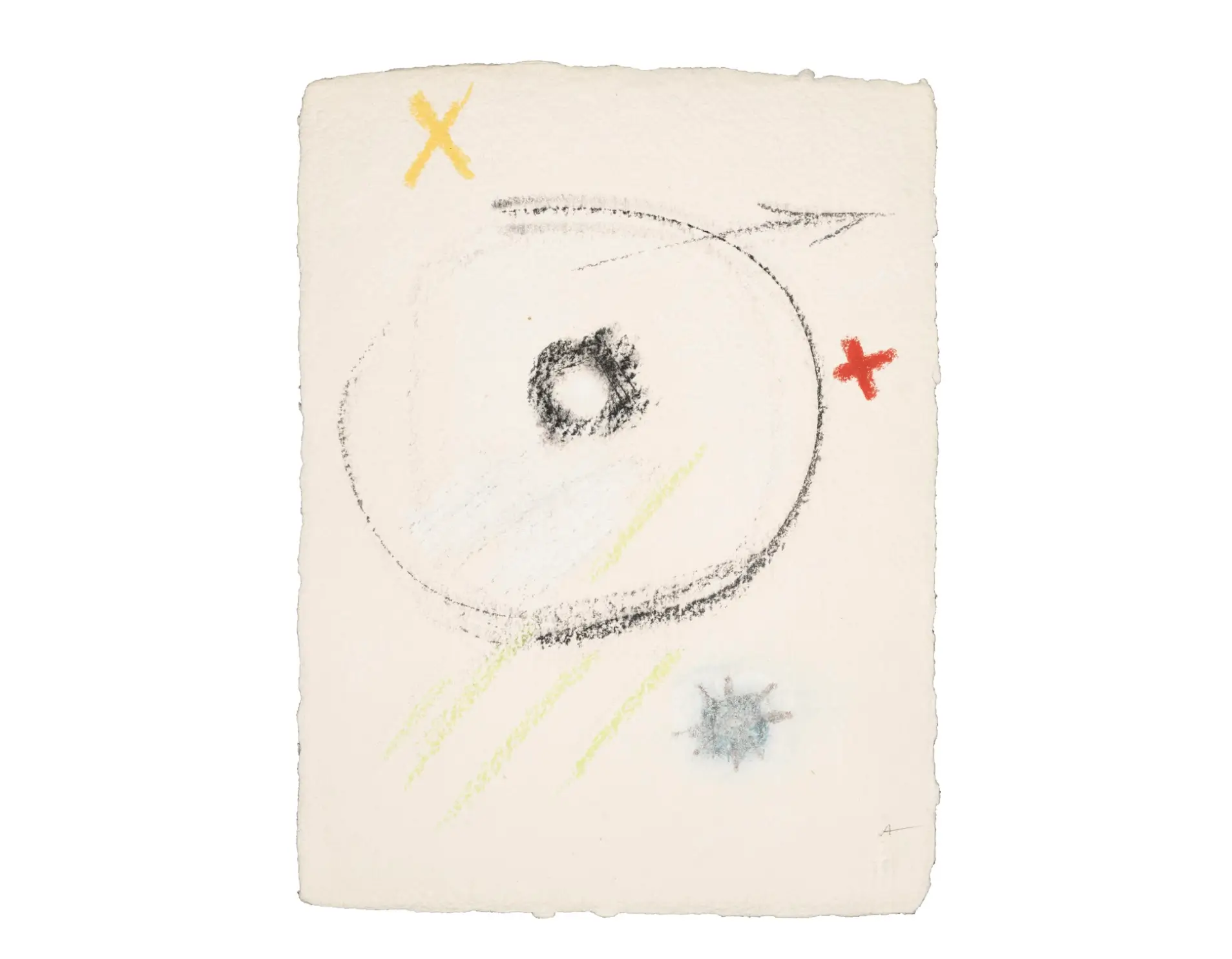
There is a kind of power that doesn’t announce itself. It doesn’t need to. It simply persists — in silence, in color, in the space between breaths. This is the presence of Untitled by Etel Adnan, a work recently surfaced from a private collection in the United Kingdom, not for sale, but for consideration.
The label — Property from a Private Collection, United Kingdom — is discreet, almost bureaucratic. But it carries weight. It suggests a history of reticent stewardship, of a life lived alongside the work, not just above it. This wasn’t a trophy hung for display. It was a companion. And now, as it re-enters the cultural conversation, it does so not with fanfare, but with the kind of stillness that demands attention.
straddle
Etel Adnan (1925–2021) was never a painter who sought the spotlight. A Lebanese-American poet, essayist, and view artist, she moved between languages, geographies, and forms with a rare fluidity. Born in Beirut to a Syrian father and Greek mother, educated in French and English, she spent much of her life in Paris and later in Sausalito, California. Her work — in all its forms — was shaped by displacement, by the Mediterranean light, by the mountains of Lebanon, and by a deep scope engagement with color and form.
She began painting late — in her thirties — and almost by accident. She had no formal training. She didn’t start with canvas. She started with small wooden panels, cutting them herself, applying oil in thick, deliberate strokes. She didn’t believe in representation. She believed in presence.
tincture
Her signature style — stacked horizontal bands of color — emerged not from abstraction as escape, but as compression. Each band was a zone of thought, a layer of memory, a moment in time. Not a landscape, but the feeling of one. Not a sky, but the weight of its light.
The Untitled work in this UK collection is likely from her late period — the 2000s or 2010s — when her palette had deepened, her forms simplified, her touch become more assured. It is not large. Adnan rarely worked at scale. Her power was in intimacy. The canvas — or panel — is modest, meant to be seen up close, not from across a room.
struct
The composition is classic Adnan: horizontal bands, stacked from bottom to top, each a distinct but related hue. The lower registers are earth-toned — umber, ochre, burnt sienna — grounding the piece, anchoring it. Above, the colors rise: terracotta, coral, a soft rose, then sky blue, pale lavender, and finally, at the top, a near-white — not pure, but tinged with warmth, like dawn.
There is no horizon line. No figure. No gesture. Just the architecture of perception. The bands are not gradients. They are zones — each one a decision, a boundary, a breath held. The brushwork is deliberate, tactile, never gestural. Each stroke is a statement of fact, not emotion. And yet, the emotional resonance is undeniable.
show
This is not art that explains itself. It doesn’t need to. It simply is.
Adnan often spoke of color as a form of thinking — not symbolic, not narrative, but sensory. “I don’t paint the sea,” she said. “I paint the effect of the sea on me.” Her work was not about what she saw, but how she felt seeing it. And in that, her Untitled works are not empty. They are full — of listening.
pristine
The UK context matters. British collectors have long favored restraint — Francis Bacon, Lucian Freud, Bridget Riley — artists whose work accumulates rather than declares. The private collection from which this piece emerges is likely one of long-term holding, not speculative acquisition. There is no auction history. No public exhibition trail. It was not bought to flip. It was bought to live with.
That changes how we see it. This isn’t a work that circulated. It stayed. It absorbed time — morning light, evening approach silhouette, daily presence. The collector didn’t just own it. They knew it.
aware
Adnan’s posthumous recognition has grown steadily. Major retrospectives at the San Francisco Museum of Modern Art, the Serpentine Galleries, and the Sharjah Art Foundation have cemented her place in the canon of 20th- and 21st-century art. Her leporellos, tapestries, and poetry have entered institutional circulation. Yet her small oil paintings remain the core of her practice — not the loudest, but the most enduring.
culture
This Untitled piece reflects a broader shift in taste. The art world is moving away from spectacle — from the monumental, the performative, the instantly legible — toward work that unfolds slowly. Adnan’s paintings don’t compete. They coexist.
She never built a studio empire. She didn’t scale production. She painted alone, deliberately, by hand. In that, her work resists the logic of the brand and returns to the act itself.
fin
And so this Untitled painting becomes more than an object. It becomes a condition — of attention, of restraint, of time held in balance.
The private collector’s role is not incidental. By keeping the work out of circulation, they preserved its integrity. By allowing it to surface now, they offer something quieter than ownership: witness.
The Untitled doesn’t need a title. It doesn’t need a price. It doesn’t need to be famous.
It just needs to be seen — not all at once, but over time.
And in that seeing, we might learn to listen.
From the DRIFT archive: American Visionaries: Property from an Important Private Collection — Joan Mitchell, Untitled
Related Articles
Modigliani’s Limestone ‘Tête’
Carved from a single block of limestone in Montparnasse more than a century ago, one of Modigliani's rare stone heads goes to auction for the first time…