DRIFT AUDIO
Listen to this story
Choose a voice, then press play.
In 2025, when news broke that Sony had quietly picked up the screen rights to Labubu—Kasing Lung’s eerie, grinning rabbit-goblin creature turned global collectible sensation—it felt like one of those cultural moments that are both unexpected and entirely predictable. Unexpected because Labubu is not a conventional Hollywood character, not a relic from American childhood nostalgia, and not a toy with any existing storyline, mythology, catchphrase, or era-defining theme song. Predictable because Hollywood’s post-Barbie approach to intellectual property has shifted radically. If a character inspires devotion, virality, resale markets, and an instantly recognizable visual language, it becomes potential cinematic gold.
Labubu’s rise is a symptom of a new kind of global pop culture. The old model of franchising—pulling from comic books, television series, or well-established toy lines—has given way to a world where aesthetic icons matter just as much as narrative icons. Labubu is the perfect example. A creature born from the imagination of a Hong Kong artist, mass-produced through the meteoric growth of POP MART, adored by collectors across Asia and beyond, and silently haunting the feeds of TikTok, Instagram, and XiaoHongShu, has now entered the film industry’s upper atmosphere.
The irony is that Hollywood sees potential where even some collectors see mystery. Labubu is expressive but not expressive. Cute but not cute. Disturbing but also strangely comforting. The character operates on vibes, not on story. And that, paradoxically, is what makes it so appealing as modern IP. Labubu is a blank canvas drenched in personality. A riddle with market potential. A creature that can be anything because it has been nothing yet—at least narratively. Sony is betting that the world is ready to follow Labubu into a universe built from scratch.
At the moment, with no director, no writer, no creative producers, and no revealed format, the announcement marks the beginning of a new phase. It’s speculative, but also symbolic. Labubu represents the type of globally-born, artist-led character Hollywood once overlooked—and now desperately wants.
flow
To understand how this character ended up on a studio slate, it helps to return to its origins. Labubu is the creation of Kasing Lung, a Hong Kong illustrator whose visual language blends childlike innocence with faintly sinister undertones. Lung’s early work often depicted somber, wide-eyed creatures navigating hazy dreamscapes, painterly fog, and surreal forests. His aesthetic has always lived in the borderlands—between sweet and unsettling, playful and haunted.
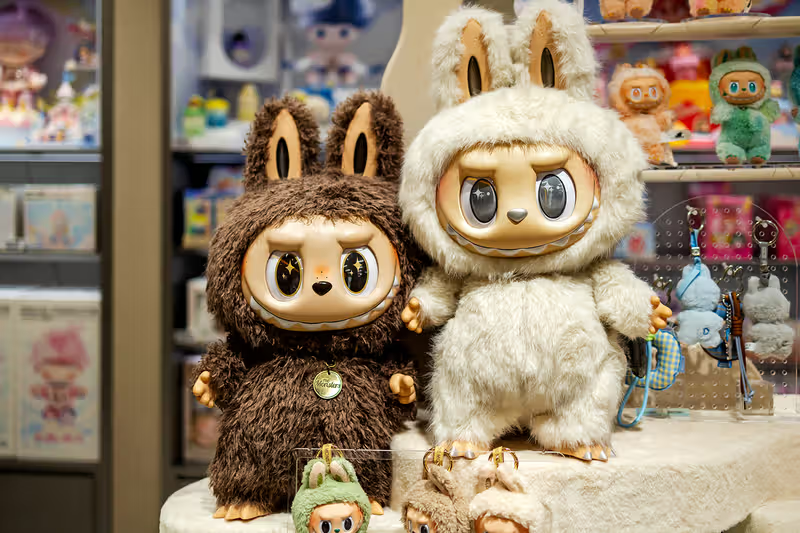
Labubu fit this mood from the start. Its exaggerated smile, enormous ears, elongated limbs, and haunted stare reflect a creature that feels both mischievously alive and strangely hollow. Labubu does not look like a cartoon mascot. It looks like an apparition from a strangely gentle nightmare, the type a child might dream up on a sleepless night and later find comfort in. This emotional ambiguity is the soul of its appeal.
When POP MART collaborated with Kasing Lung to release The Monsters in blind-box format, everything accelerated. The limited nature of drops, the unpredictability of blind-box culture, and the inherent charm of Labubu created a perfect storm. Collectors camped outside malls in China, Thailand, and Singapore. Resale markets soared to luxury handbag prices. Social media transformed unboxings into rituals. Fans built display walls in their bedrooms dedicated solely to the character. In a matter of months, Labubu became more than a toy; it became an aesthetic identity and a cultural signifier.
This rise was not propelled by nostalgia or inherited story canon. It was fueled entirely by design. Labubu succeeded because it sparked emotion before it explained anything. And that makes it a remarkably modern icon.
why
Hollywood’s hunger for new intellectual property has intensified. Traditional franchises have become both saturated and brittle. The superhero bubble feels expanded beyond elasticity. Nostalgia mining can only dig so deep. Studios have begun looking toward new terrain, and collectible culture—once confined to niche art markets—has proven itself fertile ground.
In today’s climate, attention itself is the new fuel. A character that dominates social feeds, commands resale value, inspires fan art, and drives physical queues outside retail locations becomes instantly valuable. Beyond that, Labubu’s fandom is global rather than region-specific. It didn’t begin in American Target aisles. It wasn’t a McDonald’s Happy Meal toy. It emerged from contemporary Asian youth culture, which is increasingly shaping global media trends.
To Hollywood executives, this presents a rare combination. Labubu has the broad recognizability studios crave, but it also has room for interpretation. There is no pre-existing canon to violate, no decades-long fandom to alienate. Sony can shape Labubu into whatever it wants: a whimsical hero, a silent trickster, a mischievous companion, a sentimental spirit, or the center of a surrealist fantasy epic.
This freedom alone is irresistible. It is the freedom Mattel did not have with Barbie, the freedom Hasbro did not have with Transformers, the freedom Nintendo never had with Mario. Labubu is pure potential.
the creative dilemma
For all its potential, Labubu presents one enormous creative puzzle. It does not come with a built-in story. There is no comic series, no animated special, no defining adventure, no clear personality. Everything must be invented.
That challenge becomes an opportunity for the right filmmakers, but a risk for the wrong ones. The central questions are enormous because they force a creative team to define a character whose entire appeal is its lack of definition.
One of the biggest questions concerns identity. Should Labubu be a singular protagonist, or should it be one among many? Every drop of The Monsters includes Labubu in different forms—forest, space, painter, bunny, seasonal versions that reinterpret its persona without explanation. A film needs to choose whether those variations represent a species, alternate realities, disguises, or simply aesthetic choices not tied to narrative logic.
Another question concerns voice. Labubu has never spoken. Its emotional communication is entirely visual. Giving it a voice risks domesticating it, softening what makes it special. But keeping it silent requires sophisticated visual storytelling, a challenging feat in a market dominated by dialogue-driven family films.
Tone is another open question. Should the movie aim for the tender surrealism of Laika, the mischievous charm of Gremlins, the atmospheric whimsy of Studio Ghibli, or something more contemporary and comedic? Labubu could thrive in any of these tones, but each would alter its essence drastically.
Ultimately, the absence of lore means the film must invent mythology from scratch. That’s both liberation and pressure. If the mythology feels too conventional, it will betray the character’s strangeness. If it feels too abstract, it may struggle to find a wide audience.
The future of the project depends on whether Sony finds filmmakers willing to treat ambiguity as a feature rather than a flaw.
format
With no attached creatives, the format is still unspecified. But each possible approach radically shapes the film’s identity.
Animation is the most obvious choice. Sony Animation has proven its willingness to break stylistic norms with the Spider-Verse films, which embrace painterly textures, comic-book abstraction, and experimental motion. A Labubu film rendered with soft pastels, foggy backgrounds, watercolor textures, and gentle distortion could preserve Kasing Lung’s original mood while still feeling mainstream.
Live action is more daring. A physical Labubu puppet or high-end CGI creature moving through real spaces could create an unforgettable cinematic presence. If handled with the earnest charm of Paddington, such a film could become an international hit. But if the design leans too realistic or glossy, the creature may drift into uncanny territory.
A hybrid approach—a stylized live-action world infused with exaggerated color and magical realism—could thread the needle. Films like Detective Pikachu and Sonic the Hedgehog proved that hybrid creature features can succeed if the tone is right and the character design stays true to its essence.
The decision between these formats will determine not only the film’s look, but its entire emotional architecture.
shift
The Labubu announcement symbolizes a deeper shift in entertainment. For decades, Western pop culture exported its characters outward. Now, global culture flows in all directions. Asian designer toys—once dismissed as niche consumer art—are reshaping what character fandom looks like.
POP MART’s designer toys have affected global visual culture more than many traditional entertainment brands. Their drop-based model mirrors sneaker culture and K-pop merch culture, generating scarcity-driven excitement. Their collaborations with world artists—Kasing Lung, Pucky, Kenny Wong, Ayan Deng—have created a new generation of icons.
Labubu is the first of these icons to cross the Hollywood threshold. But it likely won’t be the last. Designer toys have established that you don’t need nostalgia to create devotion. You need visual identity, emotional resonance, and a design that feels instantly emblematic of something—even if that something is only half definable.
Hollywood wants characters that can expand into animation, apparel, games, theme-park experiences, and pop-up installations. Labubu already lives comfortably in all these environments. Bringing it into cinema is the next logical step.
fan
What makes the Labubu fandom particularly unique is its demographic range. It includes toy collectors, K-pop fans, sneakerheads, streetwear enthusiasts, anime viewers, art students, and design-focused adults. It is not built on childhood nostalgia, but on aesthetics, identity expression, and online culture.
This is both a blessing and a delicate responsibility for the studio. Fans expect authenticity not to a story—but to a feeling. Labubu must remain slightly strange, slightly unsettling, slightly beautiful. If the film sandpapers away too much of that edge, the brand risks losing what made it magic.
The fandom’s global nature also means the film must navigate cultural sensitivities. Labubu’s roots are undeniably East Asian. Westernizing it too aggressively would be a mistake. Treating it as an exotic import would be an equal mistake. The key lies in honoring its artistic origin while building a story that resonates universally.
If executed thoughtfully, the film could become a cultural milestone. If mishandled, it could fracture the very fandom that made it valuable.
fin
Labubu’s ascension to the big screen is not simply a studio chasing a trend. It represents a turning point in what constitutes modern intellectual property. Characters no longer need decades of lore, Saturday morning cartoons, or sprawling comic archives to become cinema-ready. They need emotional resonance, instantly recognizable design, and global cultural traction.
Labubu has all these ingredients in abundance.
That Sony saw the potential first signals a shift in industrial imagination. Hollywood is finally willing to see that global characters born from art, design, and collector culture are not fringe—they are the future. Labubu is not the end point of this shift. It is the beginning.
What comes next depends entirely on the creative team Sony assembles. A visionary director could turn Labubu into a new kind of cinematic icon, one rooted not in nostalgia but in dreamlike originality. A cautious, formulaic approach could flatten the creature beyond repair.
But one thing is certain: after years of living in blind boxes, collector shelves, and viral loops, Labubu is ready for a larger stage. And Hollywood, hungry for its next phenomenon, is ready to see what happens when a monster made of charm, strangeness, and possibility steps into the spotlight.
Labubu has always existed in a world between nightmare and fairytale. Now, that world is about to get much bigger.
Related Articles
Pocket-sized Xbox Ctrl
Xbox Nano Controller. Announced 14 October 2026 by James Hunter. $49.99. Rechargeable battery. Programmable Action Button. Xbox Wireless and Bluetooth.