DRIFT AUDIO
Listen to this story
Choose a voice, then press play.
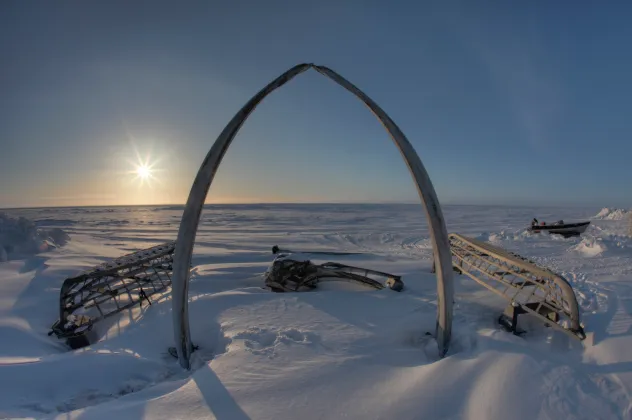
There are places on Earth where winter feels like a suggestion. And then there is Utqiaġvik, Alaska — the northernmost town in North America, a community perched so close to the top of the world that the planet’s tilt becomes less an astronomical fact and more a lived, daily force. This week, Utqiaġvik will watch the sun slip below the horizon for the last time in 2025. It will not rise again until January 22, 2026.
For 65 days, there will be no sun. No golden light brushing roofs. No sunrise, no sunset. Only gradients of blue, violet, and black — a long twilight framing the daily rhythm of a town that has learned to thrive in darkness.
The annual arrival of polar night is often described in dramatic terms: the great descent, the long dark, the deep winter. But for the roughly 4,600 residents of Utqiaġvik, this period is not a crisis. It’s a season — a lived cycle that shapes tradition, community, mental health, economics, culture, and identity. It is a time when the line between human life and the natural world sharpens, deepens, and sometimes blurs.
What happens to a town that says goodbye to the sun? What does life become when day and night are no longer opposites but shades of the same continuum? And what can the rest of the world learn from a community that not only adapts to darkness, but finds meaning in it?
the descent into darkness
When Utqiaġvik enters polar night, the moment is deceptively gentle. There is no sudden blackout or dramatic curtain fall. Instead, the days preceding the final sunset grow shorter by minutes at a time, the sun skimming just above the horizon before dipping lower with each passing day.
On the final afternoon, residents gather outside homes, schools, and workplaces — not in ritualized ceremony, but in a shared hush. Children are picked up early. Adults pause between tasks. People look west, toward an amber line that fades more quickly than one expects. And then, with the quiet certainty that belongs only to nature, the sun disappears.
Not everyone watches, of course. Life carries on. But even those indoors feel the shift. Utqiaġvik becomes a place led not by daylight but by clocks, by instinct, and by the soft illumination of streetlamps on packed snow.
For scientists, the explanation is simple: the Earth’s axial tilt shifts the Arctic away from the sun for weeks at a time. For residents, the explanation is simpler still: it’s winter.
And winter has its rules.
a palette of darkness
The world often imagines polar night as complete blackness, but that’s not true. Darkness here has gradients — subtle, atmospheric, and often stunning.
Midday in Utqiaġvik during polar night feels like standing inside a blue hour that never ends. Light gently leaks over the horizon, creating what locals call “civil twilight,” a window where the sky is slate-blue, lilac, or even soft pink. Snow reflects what little light exists, glowing faintly. The ice on the ocean takes on a matte sheen.
Around 1 p.m., the sky can look like late dusk. By 4 p.m., it deepens into indigo. Midnight is often black velvet, star-draped, crystalline.
But the most mesmerizing phenomenon emerges when the Northern Lights sweep across the sky. With no sunlight to compete, the aurora appears brighter, larger, more fluid. Green ribbons. Red flares. Violet arcs bending across the dome of the atmosphere. For many families, watching the aurora becomes a nightly ritual — one of the great privileges of living at 71 degrees north.
The truth is: Utqiaġvik in darkness is not empty. It is full of texture. Full of color. Full of quiet magic.
commune
Polar night does not freeze life. It rearranges it.
Routines shift indoors. Children go to school in the dark and return home in the dark. Workdays operate on the same schedules as always, but people rely more on interior cues: warm lights, heated air, meals served at consistent times.
Gathering becomes essential. Community centers host events, elders share stories, and families spend long nights cooking, playing games, or working on crafts. The dark encourages closeness, not isolation.
Traditional practices take center stage. The Iñupiat — the Indigenous people whose culture shapes Utqiaġvik — have lived through polar night for thousands of years. Winter is historically a time of storytelling, teaching, music, and community bonding. In modern times, these traditions coexist with contemporary life, giving younger generations a sense of continuity through the darkest months.
Technology makes survival smoother. High-efficiency heating, modern insulation, and bright full-spectrum bulbs transform homes into warm, vibrant refuges. Snowmachines, trucks with studded tires, and digital weather forecasts let residents navigate conditions safely.
And yet, people adapt emotionally as well as physically. Many locals describe polar night as peaceful — a time when the world narrows and quiets, forcing a slower, more intentional pace.
“It’s the only season when time feels soft,” one resident has said. “You don’t race the sun. You learn to take your days as they come.”
psych
Life without sunlight for 65 days is an intense psychological experience, particularly for newcomers. Seasonal Affective Disorder (SAD) is a very real concern, and doctors in Utqiaġvik are proactive about addressing it. Light-therapy lamps are common household items. Schools and clinics emphasize sleep hygiene, vitamin D intake, and mental health check-ins.
But long-term residents often push back against the assumption that darkness must be depressing.
Some describe polar night as calming — a time of deep focus. Others say it heightens creativity. Many explain that community keeps spirits strong; the sense of shared experience lightens emotional burdens.
And there is a paradoxical comfort in the predictability of the season. Unlike in temperate regions, where winter arrives gradually and inconsistently, Utqiaġvik’s darkness is precise, cyclical, ancestral. People know what to expect. They prepare. They adjust.
There is, too, the knowledge that light will return. It always does.
polar
Utqiaġvik’s economy remains active through polar night. Oil and gas operations in the North Slope continue at full capacity. Local businesses remain open, often extending hours to accommodate winter routines. Research stations — including the Barrow Arctic Research Center — stay busy, collecting valuable climate data during the coldest months of the year.
Winter is also prime hunting season for many Iñupiat families. Caribou, seals, and fish remain essential sources of food and tradition. Hunters navigate by moonlight, starlight, or headlamps, relying on knowledge passed down for generations.
While tourism slows dramatically, a small but dedicated stream of adventurous travelers still visits Utqiaġvik specifically to experience polar night, aurora viewing, and Arctic culture.
Local guides emphasize caution but welcome the opportunity to educate visitors about the realities — not the myths — of Arctic living.
climate change in the dark
Polar night offers a unique vantage point for observing the effects of climate change. Sea ice formation, once reliable and thick by November, has become increasingly unpredictable. Hunters speak of thinner ice, rougher storms, and wildlife migration patterns shifting in ways that complicate traditional practices.
Scientists stationed in Utqiaġvik use the extended dark to study atmospheric changes, ice growth, permafrost stability, and carbon release. Winter offers a pure dataset — one untouched by summer’s melt or sunlight variability.
In this sense, polar night is not just a season. It is a laboratory.
But it is also a warning: a reminder that even the darkest months are changing.
stir
The first sunrise after 65 days does not blaze across the sky. It peeks.
On January 22, 2026, the sun will hover just above the horizon for less than an hour. Children will be brought outside to witness it. Adults will interrupt work to stand in the cold. Cameras will point upward. People will cheer, laugh, or simply stare.
The light, after its long absence, feels impossibly soft — almost fragile. It reflects off the snow in warm gold, turning the town into a glowing frozen mirror.
Some residents admit to crying.
The return of the sun is not just a celestial event. It is a communal affirmation: We made it. Again.
The day after sunrise, the light lingers a little longer. Then longer still. By early February, daylight once again feels familiar. Life expands outward. The world grows. But the memory of the long dark stays — grounding, humbling, and strangely beautiful.
impression
Utqiaġvik is not an anomaly. It is a masterclass in human adaptability.
In a world that equates darkness with danger, depression, or stagnation, Utqiaġvik offers a different narrative: darkness as community, as reflection, as a season with its own rituals and rhythms.
From the outside, people often ask, How do you live without sunlight?
The residents answer: Together.
Polar night reminds us that humans are not fragile. We organize. We adapt. We build warmth in cold spaces. We create meaning where others might see emptiness. And we learn to trust cycles — even the ones that take us deep into the dark.
As the sun sets this week for the last time in 2025, Utqiaġvik enters a season known everywhere else only in metaphor. But here, it is lived with clarity:
Darkness is not the absence of life. It is another form of it.
And when the sun returns in January, the celebration is not simply about light. It is about surviving, together, through the long arc of the Earth’s own turning.
Related Articles
Le Labo Writes Memory Into Wax With PAPYRUS 20
Cypriol, the root oil kin to the reed that carried ancient writing, anchors Le Labo's first new classic candle in two years.